
Courier regulatory compliance is the set of legal obligations a courier business must meet to operate lawfully in the UK, covering customs declarations, vehicle and driver licensing, dangerous goods handling, insurance, and data protection. If you move goods across UK borders, carry anything above 3.5 tonnes, transport medical specimens, or handle personal data through tracking systems, specific rules apply to you right now.
Quick compliance triage:
- Customs/SDD: Do you import or export goods between the UK and EU? You need Safety & Security Declarations and an EORI number.
- Licences: Does your vehicle exceed 3.5 tonnes GVW? An Operator's Licence is required.
- Dangerous goods: Do you carry chemicals, medical specimens, or temperature-sensitive cargo? ADR and cold-chain rules apply.
- Insurance: Do you carry third-party goods? Goods in transit and public liability cover are non-negotiable.
- Data protection: Do you process recipient names, addresses, or medical data? You must comply with UK GDPR and may need to register with the ICO.
First steps: Identify whether you operate cross-border routes. Check your heaviest vehicle's GVW against the 3.5-tonne threshold. Review your insurance schedule against the cargo you actually carry. Appoint one named person as your compliance lead before the end of this quarter.
Key takeaways
UK courier regulatory compliance requires documented processes across customs, licensing, insurance, dangerous goods, and data protection, with automation of records being the single most effective way to reduce operational risk.
| Point | Details |
|---|---|
| SDD is mandatory from January 2025 | Pre-arrival Safety & Security Declarations are required for all EU imports; register with HMRC's CDS and obtain an EORI number. |
| O-licence triggers at 3.5 tonnes GVW | Any vehicle over 3.5 tonnes used for hire or reward requires an Operator's Licence and a CPC-qualified Transport Manager. |
| Insurance must match the cargo | Goods in transit, commercial motor, public liability, and employers' liability are each required for different aspects of courier operations. |
| Medical and dangerous goods carry extra layers | ADR training, UN 3373 packaging, cold-chain validation, and data processing agreements with healthcare clients are all mandatory for specialist cargo. |
| Automate records to survive audits | Digital chain-of-custody logs, driver licence alerts, and CDS API integration reduce manual error and produce the audit trail regulators and clients require. |
Table of Contents
- 1. Which UK regulators oversee courier activity?
- 2. What are Safety & Security Declarations and what do couriers need to submit?
- 3. What licences and vehicle standards apply to UK couriers?
- 4. What rules apply to dangerous goods, medical cargo, and temperature-sensitive shipments?
- 5. What insurance do couriers need and how does consumer law affect liability?
- 6. How do GDPR and ICO rules affect courier data handling?
- 7. How do you build an auditable compliance process?
- 8. What are the consequences of getting courier compliance wrong?
- 9. How do you make your courier business compliant from day one?
- The compliance gap most UK couriers underestimate
- Sources
1. Which UK regulators oversee courier activity?
Courier regulatory compliance in the UK is not governed by a single body. Six regulators divide responsibility across different risk areas, and a courier operating at scale will encounter most of them.
| Regulator | Primary duties | When they apply |
|---|---|---|
| HMRC | Customs declarations, EORI registration, import/export duties | Any cross-border consignment |
| Border Force | Physical border checks, pre-arrival data enforcement, shipment holds | Imports and exports at UK ports and airports |
| DVSA | Vehicle roadworthiness, Operator's Licence compliance, driver CPC | Vehicles over 3.5 tonnes GVW; all HGV operations |
| HSE | Dangerous goods (ADR), workplace safety, COSHH | Carriage of hazardous materials; driver health and safety |
| ICO | UK GDPR enforcement, data breach investigation, ICO registration | Any processing of personal data (names, addresses, tracking data) |
| MHRA | Medicinal products, clinical specimens, cold-chain standards | Medical and pharmaceutical courier operations |
Border Force and HMRC work in tandem at the frontier. Border Force handles physical inspections and can hold or seize shipments; HMRC administers the declaration systems and penalties for incorrect or missing data. The Border Target Operating Model sets out how pre-arrival data flows between carriers, agents, and both bodies.
The European Parliament's Regulation (EU) 2018/644 on cross-border parcel tariff transparency was retained in UK law post-Brexit. It requires parcel delivery providers to submit annual turnover and workforce data to national regulators and sets transparency obligations for cross-border tariffs. Operators offering cross-border parcel services should confirm whether they meet the reporting thresholds.
Two key dates shape current obligations. Safety & Security Declarations for EU imports became mandatory from January 2025, closing the post-Brexit grace period. Operators who had not yet integrated with HMRC's electronic systems by that date faced immediate exposure to Border Force holds.
2. What are Safety & Security Declarations and what do couriers need to submit?
Safety & Security Declarations (SDDs) are pre-arrival data submissions that tell Border Force what is on a vehicle or aircraft before it arrives at a UK port. They replaced the EU's Entry Summary Declaration (ENS) for UK imports and are now a hard legal requirement for goods arriving from the EU.
Gov.uk guidance on SDD requirements sets out the preparatory steps carriers and agents must take, including registering with HMRC's Customs Declaration Service (CDS) and obtaining an EORI number if you do not already hold one.
Documents couriers typically need to collect or handle:
- Commercial invoice — confirms the value, description, and origin of goods; required for every commercial consignment.
- Export declaration — submitted by the exporter in the country of origin; the courier may need to confirm receipt.
- Commodity codes (CN/HS codes) — eight-digit codes identifying the goods category; incorrect codes are one of the most common causes of Border Force queries.
- EORI number — the Economic Operator Registration and Identification number; both shipper and courier may need one.
- CMR consignment note — the standard road transport contract document for international carriage; legally required under the CMR Convention for cross-border road freight.
- Air waybill (AWB) — the equivalent document for air freight consignments.
- Packing list — itemises contents, weights, and dimensions; supports the commercial invoice.
- Any licences or permits — for controlled goods (pharmaceuticals, dual-use items, CITES-listed species).
Who is responsible for submitting declarations? The legal obligation sits with the carrier or their appointed customs agent. In practice, many couriers contract this to a freight forwarder or customs broker. The key point is that the contractual allocation of responsibility must be documented. A well-drafted service level agreement should specify whether the courier or the shipper is responsible for declaration accuracy and what happens if data is missing at pick-up.
Practical submission timeline:
- At booking: Capture commodity codes, declared value, and shipper EORI.
- Before pick-up: Confirm the commercial invoice matches the booking data.
- Before departure: Submit the SDD via HMRC's Customs Declaration Service or an approved third-party API integration.
- At the port: Carry the CMR or AWB and be ready to present it to Border Force on request.
For consignments moving between Great Britain and Northern Ireland, separate rules apply under the Windsor Framework. Gov.uk's Northern Ireland parcel guidance and Manufacturing NI's Windsor Framework parcels guidance both set out the current practical steps.
To avoid Border Force holds:
- Never leave commodity codes blank or use catch-all descriptions such as "general goods."
- Confirm the shipper's EORI is valid before accepting the consignment.
- Submit declarations before the vehicle departs, not on arrival.
- Keep copies of all submitted declarations for a minimum of four years.
3. What licences and vehicle standards apply to UK couriers?
The threshold that triggers the most significant licensing obligation is a vehicle gross vehicle weight (GVW) of 3.5 tonnes. Below that, a standard driving licence and business insurance are the primary requirements. Above it, a structured set of DVSA-administered obligations applies.
Operator's Licence (O-licence): Any operator using vehicles over 3.5 tonnes GVW to carry goods for hire or reward on public roads in the UK must hold a Standard National or Standard International Operator's Licence. The licence is issued by the Traffic Commissioner and requires a nominated Transport Manager who holds a Certificate of Professional Competence (CPC). Operating without an O-licence is a criminal offence.
Driver obligations by vehicle class:
- Up to 3.5 tonnes GVW: Category B licence; no CPC required for couriers.
- 3.5–7.5 tonnes GVW: Category C1 licence; Driver CPC required for commercial carriage.
- Over 7.5 tonnes GVW: Category C licence; full Driver CPC with periodic training (35 hours every five years).
- Working time rules: Drivers subject to EU-derived working time regulations must not exceed an average of 48 hours per week, with mandatory rest periods enforced under the Road Transport (Working Time) Regulations 2005.
| Vehicle GVW | Licence required | O-licence needed? | Driver CPC required? |
|---|---|---|---|
| Under 3.5t | Category B | No | No |
| 3.5t–7.5t | Category C1 | Yes | Yes |
| Over 7.5t | Category C | Yes | Yes |
Operators running 7.5 tonne vehicles sit right at the threshold where O-licence and CPC obligations begin. Getting the vehicle classification wrong at this weight class is a common and costly error.
Pro Tip: Set up a driver licence expiry calendar with automated alerts at 90, 30, and 7 days before renewal. Cross-reference with DVLA checks at least annually for all drivers, and maintain a maintenance schedule that ensures every vehicle has a current MOT and a planned inspection interval. DVSA roadside checks can happen at any time; an up-to-date maintenance log is your first line of defence.
For guidance on matching vehicle type to cargo weight and regulatory class, courier vehicle selection covers GVW thresholds and practical fleet decisions in detail.
4. What rules apply to dangerous goods, medical cargo, and temperature-sensitive shipments?
Standard parcel rules are not sufficient for hazardous materials, medical specimens, or temperature-controlled goods. Each category carries its own regulatory layer, and the consequences of getting it wrong range from Border Force seizure to patient harm.

ADR dangerous goods (road transport):
The European Agreement concerning the International Carriage of Dangerous Goods by Road (ADR), as adopted into UK law, governs the road transport of hazardous materials. Obligations include:
- Classifying goods by UN number and hazard class before acceptance.
- Ensuring the vehicle carries the correct placards and orange plates.
- Providing the driver with written instructions (Tremcard) for each dangerous goods class carried.
- Completing ADR training for drivers carrying goods above the exemption thresholds.
- Maintaining a Dangerous Goods Safety Adviser (DGSA) if your operations exceed the ADR exemption limits.
Medical courier obligations:
Medical couriers transporting clinical specimens, pharmaceuticals, or patient samples operate under NHS data protection standards and MHRA expectations. The Cargo identifies triple packaging for UN 3373 biological substances (Category B) as a baseline requirement, alongside chain-of-custody logging and annual bloodborne pathogen training for drivers.
UK medical couriers should also hold data processing agreements with healthcare clients, equivalent to the Business Associate Agreements (BAAs) used in US HIPAA compliance. AccountableHQ's guidance on medical courier safeguards covers the training and contractual controls that translate directly to NHS and MHRA expectations. For live goods and perishable consignments, how emergency couriers handle live goods safely provides practical handling protocols.
Cold-chain responsibilities:
Temperature-controlled shipments require validated packaging, continuous temperature monitoring, and documented excursion procedures. A PubMed-indexed study on medical transport found that digital recordkeeping and validated temperature monitoring reduce chain-of-custody errors and specimen degradation in medical logistics. For a full breakdown of cold-chain controls, courier temperature control for UK businesses covers validated packaging, monitoring equipment, and documentation requirements.
Chain-of-custody checklist:
- Assign a unique consignment identifier at pick-up.
- Apply tamper-evident seals and photograph the package before departure.
- Record timestamps at pick-up, each transfer point, and delivery.
- Obtain a signature or biometric confirmation at delivery.
- Retain all records for the period required by the client contract or regulator (minimum two years for medical specimens; four years for customs records).
Pro Tip: Digital audit trails are not just good practice; they are increasingly expected by healthcare and pharmaceutical clients as a contract condition. A GPS-timestamped log combined with temperature sensor data creates an auditable record that protects you in the event of a disputed delivery or a specimen integrity complaint.
5. What insurance do couriers need and how does consumer law affect liability?
Insurance for courier operations covers several distinct risks, and carrying only one type leaves significant gaps. The main categories are:
- Goods in transit insurance: Covers loss or damage to third-party goods while in your care. Most commercial clients will require a minimum declared value per consignment; check your policy's per-item and per-vehicle limits against the highest-value loads you carry.
- Commercial motor insurance: Mandatory for all vehicles used for hire or reward; a standard private motor policy is void the moment you carry goods commercially.
- Public liability insurance: Covers injury or property damage to third parties during a delivery. Most contracts with commercial clients specify a minimum of £1 million; many require £2 million or more.
- Employers' liability insurance: Legally required if you employ any staff, including part-time drivers. The statutory minimum is £5 million.
- Professional indemnity insurance: Relevant if you provide logistics consultancy or manage third-party supply chains, covering advice-related claims.
Under UK consumer protection law, when a retailer uses a courier to deliver goods to a consumer, the retailer remains liable to the consumer for non-delivery or damage. The courier's liability to the retailer is governed by the terms of carriage. This distinction matters: a consumer can pursue the retailer regardless of whether the courier caused the problem, and the retailer will then seek recovery from the courier under the carriage contract.
Reducing your exposure:
- State your liability limits clearly in your terms of carriage and require shippers to declare the value of high-value consignments at booking.
- Capture photographic proof of condition at pick-up and delivery, with GPS timestamps.
- Use signature capture or electronic proof of delivery (ePOD) for every consignment.
- Require shippers to confirm packaging adequacy for fragile or high-value goods in writing.
- Review your terms against licensed mover contract best practices to confirm your carriage conditions are enforceable and clearly communicated to clients.
For claims handling, courier service communication best practices covers the documentation and client communication steps that reduce disputes and support successful claims resolution.
6. How do GDPR and ICO rules affect courier data handling?
Every courier that processes recipient names, delivery addresses, phone numbers, or tracking data is a data controller under UK GDPR. The gov.uk data protection guidance summarises the core obligations: lawful basis for processing, purpose limitation, data minimisation, accuracy, storage limitation, and security.
Practical do's and don'ts for couriers:
- Do identify your lawful basis before processing (typically "legitimate interests" for delivery data or "contract performance" for the delivery itself).
- Do minimise what appears on external labels. A recipient's full name, address, and phone number on a visible label is more data than most deliveries require; consider using a reference code with a lookup system instead.
- Do encrypt data in transit between driver apps and your central system.
- Do not retain delivery data longer than necessary. A 12-month retention period for standard delivery records is a common and defensible position; medical or regulated cargo records may require longer retention under sector-specific rules.
- Do not allow drivers to store recipient data on personal devices without mobile device management (MDM) controls.
- Do not share tracking links that expose recipient addresses to third parties without consent.
ICO registration: Most courier businesses that process personal data must register with the ICO and pay the data protection fee (currently £40–£60 per year for most small businesses). Failure to register is a civil offence with a fixed penalty of £400.
Medical couriers handling patient data or NHS specimen information are processing special-category data under UK GDPR Article 9. This requires an explicit lawful basis, a Data Protection Impact Assessment (DPIA), and a data processing agreement with the healthcare client. The contractual safeguards described in AccountableHQ's medical courier guidance map closely to what the ICO expects for special-category processing in a UK context.
Pro Tip: Add a standard data processing clause to every contract with a healthcare or pharmaceutical client before the first collection. Retrofitting data agreements after an incident is significantly more difficult and leaves you exposed during the gap. Multi-factor authentication (MFA) on all driver-facing apps and encrypted communications between dispatch and drivers are the two technical controls that most materially reduce your ICO risk.
7. How do you build an auditable compliance process?
Knowing the rules is the first step. Demonstrating that you followed a reasonable, documented process is what protects you during an audit, an enforcement action, or a client dispute. CLDA compliance experts warn that reliance on manual compliance processes is a major operational risk and recommend automated systems for driver certifications, vehicle maintenance tracking, and real-time visibility.
Core elements of an auditable compliance process:
- Named compliance owner: One person is accountable for maintaining records, monitoring regulatory changes, and triggering corrective actions. In small operations, this is often the owner-operator; in larger ones, it is a dedicated operations or compliance manager.
- Documented procedures: Written SOPs for each regulated activity (customs declarations, dangerous goods acceptance, cold-chain handling, driver licence checks). Procedures do not need to be lengthy; they need to be followed and dated.
- Periodic audits: Internal audits at least quarterly; a full compliance review annually. Document findings and corrective actions.
- Staff training records: Date, content, and attendee for every training session. Driver CPC, ADR, bloodborne pathogen, and GDPR awareness training all require evidence of completion.
Technology that materially reduces compliance risk:
- Automated driver licence expiry alerts integrated with DVLA checks.
- Digital pre-arrival declaration submission via CDS API, eliminating manual re-keying of commodity codes.
- GPS-timestamped chain-of-custody logs for medical and high-value consignments.
- Temperature sensor data with automated excursion alerts and tamper logs for cold-chain shipments.
- Technology in courier services covers the specific automation tools and telematics systems that UK operators are deploying to reduce manual risk.
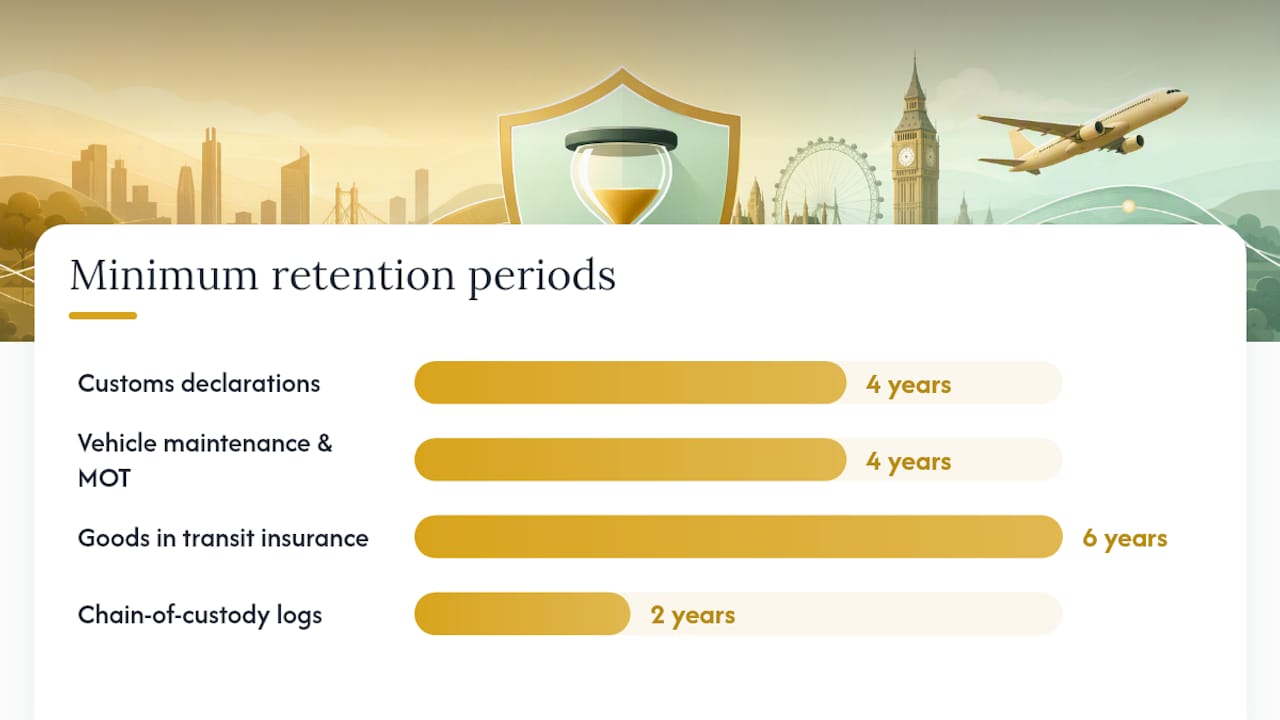
Records to keep and minimum retention periods:
| Record type | Minimum retention | Regulatory basis |
|---|---|---|
| Customs declarations (SDD/CDS) | 4 years | HMRC |
| Driver licence and CPC records | Duration of employment + 2 years | DVSA |
| Vehicle maintenance and MOT records | 4 years (minimum) | DVSA |
| Goods in transit insurance certificates | 6 years | Commercial best practice |
| Medical specimen chain-of-custody logs | 2 years minimum (client contract may require longer) | MHRA / NHS |
| GDPR data processing records | Duration of processing + 1 year | ICO |
For documentation practices and retention frameworks, why courier documentation matters for businesses provides a practical overview of what to keep and how to organise it.
8. What are the consequences of getting courier compliance wrong?
Non-compliance is not an abstract risk. The consequences are operational, financial, and reputational, and they tend to compound quickly once an enforcement action begins.
Regulatory sanctions:
- Border Force: Shipment holds, seizure of goods, and storage or demurrage costs that accrue daily until the consignment is released or destroyed. Persistent non-compliance can result in referral to HMRC for civil penalties.
- HMRC: Civil penalties for incorrect or missing customs declarations; in serious cases, criminal prosecution for deliberate evasion.
- DVSA: Prohibition notices preventing a vehicle from moving until defects are rectified; O-licence revocation or suspension by the Traffic Commissioner; unlimited fines for operating without a licence.
- ICO: Fines for data breaches or failure to register as a data controller. The ICO can issue fines of up to £17.5 million or 4% of annual global turnover (whichever is higher) for serious UK GDPR infringements.
- HSE: Improvement notices, prohibition notices, and prosecution for ADR or workplace safety breaches.
Operational consequences:
- Healthcare and pharmaceutical clients routinely require evidence of compliance as a contract condition. A single DVSA prohibition notice or ICO enforcement action can disqualify you from regulated contracts for months.
- Shipment delays caused by missing SDD data damage client relationships and can trigger service level agreement penalties.
- Reputation damage in the medical and legal sectors, where chain-of-custody integrity is a procurement criterion, can be permanent.
Typical enforcement timeline:
- Inspection or data query (Border Force check, DVSA roadside stop, ICO complaint).
- Formal notice issued, specifying the breach and a remedial window (typically 28 days for minor breaches).
- Remedial window: Operator must demonstrate corrective action with evidence.
- Fine or prosecution if the breach is not remedied or is found to be deliberate.
The cost of a single Border Force hold, including storage, demurrage, and the administrative time to resolve a declaration error, routinely exceeds the cost of implementing a compliant pre-arrival declaration process in the first place.
9. How do you make your courier business compliant from day one?
Compliance is most manageable when it is treated as a structured project with clear ownership and a phased timeline. The following checklist gives operators a practical starting point.
Quick triage questions:
- Do you carry goods across UK borders (including to/from Northern Ireland)? If yes, SDD and EORI registration are immediate priorities.
- Do your vehicles exceed 3.5 tonnes GVW? If yes, O-licence and Driver CPC obligations apply.
- Do you carry medical specimens, pharmaceuticals, or temperature-sensitive goods? If yes, ADR, cold-chain, and MHRA obligations apply.
- Do you process recipient personal data through tracking systems? If yes, ICO registration and UK GDPR compliance are required.
- Do you employ drivers or warehouse staff? If yes, employers' liability insurance is a legal requirement.
30/90/180-day action plan:
- Days 1–30: Register with HMRC for an EORI number if cross-border activity applies. Review your insurance schedule against the cargo you carry. Appoint a named compliance lead. Register with the ICO if you have not already done so.
- Days 31–90: Apply for an Operator's Licence if your fleet includes vehicles over 3.5 tonnes. Implement driver licence expiry alerts. Run a GDPR awareness session for all staff. Draft or update your terms of carriage to include liability limits and declared value procedures.
- Days 91–180: Integrate with HMRC's Customs Declaration Service for pre-arrival submissions. Implement digital chain-of-custody logging for medical or high-value consignments. Conduct your first internal compliance audit. Establish a training calendar for Driver CPC, ADR, and data protection refreshers.
Roles and responsibilities:
| Role | Compliance responsibilities |
|---|---|
| Compliance lead | Maintains records, monitors regulatory changes, triggers audits |
| Operations manager | Enforces SOPs, manages vehicle maintenance schedule, oversees driver checks |
| IT / systems owner | Manages data security, MDM, CDS API integration, temperature monitoring systems |
| Training coordinator | Schedules and records Driver CPC, ADR, GDPR, and bloodborne pathogen training |
Emergency courier reliability factors covers the operational planning considerations that support a compliant, dependable service for time-critical consignments.
The compliance gap most UK couriers underestimate
Most operators focus on the visible compliance tasks: getting the O-licence, buying goods in transit insurance, and ticking the GDPR box. What they underestimate is the documentation layer. Regulators and clients do not just want to know that you comply; they want to see that you have a process, that the process is followed, and that you can prove it on short notice.
The shift from manual to automated compliance records is not a luxury for large operators. A missed driver licence renewal, a single temperature excursion without a logged response, or a customs declaration submitted after departure can each trigger a chain of consequences that far outweighs the cost of the system that would have prevented it. At Sddbyaba, the operational lesson from running same-day dispatch across the UK is straightforward: the couriers who win regulated contracts in healthcare, legal, and manufacturing are the ones who can produce an audit trail on the same day they are asked for it, not the ones who spend a week reconstructing records from memory.
Compliance is not a constraint on speed. A well-documented, automated process is what makes fast, reliable delivery possible at scale, because it removes the friction points that cause delays, holds, and disputes.
Sources
The following primary sources are the authoritative starting points for each compliance area. Bookmark them and check for updates at least quarterly, as regulatory guidance changes.
- EUR-Lex: Regulation (EU) 2018/644 — transparency of cross‑border parcel tariffs
- Courier company compliance best practices — CLDA
- Cargo
This article is general information, not a substitute for advice from a qualified lawyer. Consult a qualified legal professional about your own circumstances before acting on anything here.