
For most UK commercial logistics needs, Sddbyaba (SDD by ABA) is the clearest hire-ready option. The fleet spans motorcycles to artic trucks; same-day dispatch is available nationwide, and dedicated B2B account support means procurement teams get a named contact rather than a call centre queue. If your operation needs urgent parts on site by noon, palletised retail stock moved overnight, or a dedicated vehicle for a construction site delivery, Sddbyaba covers all three without routing you through a broker.
Immediate next steps:
- Request a tailored quote via Sddbyaba's commercial logistics page, including your typical shipment profile and preferred SLA
- Arrange a 4–8 week pilot run across your highest-volume or most time-critical lane
- Confirm SLA terms, coverage for your specific postcodes (including any Highlands or Northern Ireland addresses), and escalation contacts before signing
Contact Sddbyaba now to get a commercial quote and agree a pilot scope.
Table of Contents
- Which service type matches your commercial delivery need?
- How to choose a commercial courier partner
- What does commercial courier pricing actually look like?
- What good commercial account management looks like in practice
- What to verify about insurance, claims and compliance before you sign
- How to set up a commercial courier account: step-by-step
- Why Sddbyaba suits most UK commercial logistics requirements
- Key takeaways
- What most procurement teams get wrong about commercial courier selection
- Get a commercial logistics quote from Sddbyaba
- Useful sources for procurement and compliance teams
Which service type matches your commercial delivery need?
Choosing the wrong service type is one of the most common and costly procurement errors. A business that books a standard next-day parcel service for an urgent medical consignment, or pays for a dedicated vehicle when a pallet network would do, is either risking a missed deadline or overspending on every shipment.
Same-day courier is the right choice when time is the primary constraint: urgent manufacturing parts, legal documents, medical supplies, or any consignment where a missed delivery has a direct operational cost. Sddbyaba's same-day dispatch covers the UK mainland with motorcycles and vans for small urgent loads, scaling to 7.5-tonne trucks for larger same-day requirements.
Express next-day suits planned but time-sensitive shipments: ecommerce orders with a next-day promise, replenishment stock for retail, or engineering components ordered before a cut-off. Transit is typically overnight with morning delivery windows.
Palletised freight (LTL/FTL) is the cost-efficient route for high-volume or heavy consignments that do not need same-day speed. Less-than-truckload (LTL) consolidates your pallet with others; full truckload (FTL) gives you the whole vehicle. Construction materials, bulk retail stock, and manufacturing inputs typically move this way.
Dedicated vehicle hire gives you an exclusive vehicle and driver for the duration of a job. No shared loads, no depot sorting, no intermediate stops. It suits high-value, fragile, or time-critical freight where you need full chain-of-custody visibility. Sddbyaba's fleet runs from cars and small vans through to 26-tonne and artic trucks so the vehicle matches the load rather than the other way around.

White-glove and temperature-controlled services apply to medical goods, pharmaceuticals, and sensitive equipment. Confirm handling protocols and temperature logging capability with any provider before booking these consignments.
Pro Tip: If your SKU mix spans both small urgent parcels and regular pallet movements, consider a multi-carrier model: a same-day specialist for urgent lanes and a pallet network for planned volume. A single provider that genuinely covers both is rare; Sddbyaba is one of the few UK operators with the fleet depth to handle both without subcontracting the urgent work.
How to choose a commercial courier partner
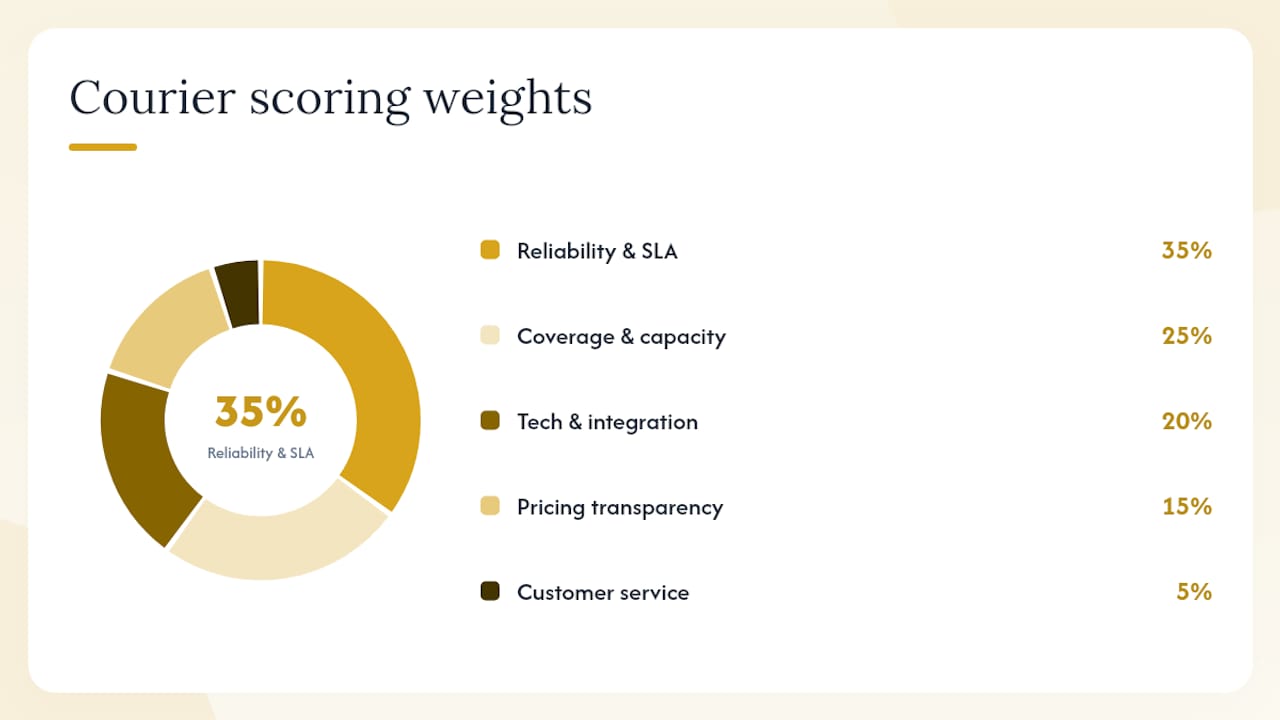
The single most reliable evaluation method is a weighted scoring framework applied consistently across every shortlisted provider. Weight reliability and SLA performance highest (suggested 35%), then coverage and capacity (25%), technology and integration capability (20%), pricing transparency (15%), and customer service quality (5%). Scoring frameworks that prioritise reliability over headline price materially reduce the risk of choosing a carrier that looks cheap but costs more in failed deliveries and customer complaints.
Questions to ask every supplier:
- What percentage of your deliveries are completed on time, and how is that measured?
- Which postcodes fall outside your standard SLA, and what is the uplift or alternative?
- Do you subcontract, and if so, what proportion of jobs and to whom?
- What is your proof-of-delivery standard — electronic, photo, or signature?
- Does your platform offer a REST API or webhook, and which OMS/WMS platforms do you integrate with natively?
- How do you handle surge volumes — for example, peak season or a sudden campaign uplift?
- What is your average time to resolve a claims dispute?
Red flags to watch for:
- Tariff sheets that exclude surcharges until invoice — a full tariff should be provided before you sign
- No API or only a manual portal for booking and tracking
- Vague SLA language ("aim to deliver") with no credit mechanism for failure
- Poor claims history or an unwillingness to share it
- Subcontracting ratios above 50% with no visibility of the subcontractor's standards
Before committing to a full contract, run a structured pilot. A 4–8 week window is generally sufficient to capture representative data: at least one billing cycle, weekend behaviour, and any minor volume peaks. Define success metrics upfront — on-time delivery rate, damage rate, claims ratio, and billing accuracy — and review them weekly. Providers who resist a pilot or refuse to share granular performance data during it are telling you something important.
What does commercial courier pricing actually look like?
Pricing for business delivery services follows four primary models, and the one that applies to your shipment profile has a significant effect on per-consignment cost.
Per-parcel pricing applies to small packages moving through a network. The rate depends on weight, dimensions (dimensional weight often applies — the greater of actual and volumetric weight), destination zone, and service level. Surcharges for remote areas, fuel, and peak season are standard additions.
Per-pallet pricing covers palletised freight moving through a pallet network. Rates vary by pallet size (quarter, half, full, or oversized) and destination. Scottish Highlands, Northern Ireland, and the Channel Islands attract surcharges that can be material — always request a full zonal tariff.
Hourly or mileage-based pricing applies to dedicated vehicle hire. You pay for the vehicle and driver for the duration of the job, regardless of load size. This model suits time-critical or high-value consignments where exclusivity matters more than network efficiency.
Contract rates are negotiated for regular, predictable volumes. They typically offer lower per-unit costs in exchange for volume commitments and longer contract terms.
| Service type | Typical UK transit time | Common cut-off | Highlands/NI caveat |
|---|---|---|---|
| Same-day courier | 1–4 hours (local), same day (national) | morning delivery windows for national | Extended transit; confirm with provider |
| Express next-day | Next business day AM or PM | — | +1 day typical; surcharge applies |
| Pallet LTL | overnight | — | +1–2 days; remote surcharge |
| Dedicated vehicle | Flexible; driver allocated on booking | On-demand | Confirm availability and mileage rate |
Fuel surcharges fluctuate with diesel prices and are typically applied as a percentage of the base rate. Always request the current surcharge schedule alongside the base tariff, and ask how often it is reviewed. Dimensional weight pricing can significantly increase costs for light but bulky goods — measure and weigh your parcels accurately before requesting quotes.
What good commercial account management looks like in practice
A commercial courier account should include three things from day one: a named account manager, regular performance reporting (weekly during onboarding, monthly thereafter), and a documented escalation path with response time commitments. Without these, service issues get lost in general support queues and billing disputes drag on.
Typical onboarding milestones:
- Contract signed; rates and service schedule confirmed in writing
- API keys issued and integration tested in sandbox environment (allow 5–10 business days)
- Packaging, labelling, and collection window requirements confirmed
- Test shipments run across key lanes; performance reviewed against agreed metrics
- Full cutover; weekly reporting begins
Scaling checklist: Before volumes increase, confirm in writing that your provider can guarantee capacity during peak periods, has access to additional vehicles or freight capacity at short notice, and has a named process for surge requests. Seasonal peaks — pre-Christmas, promotional campaigns, end-of-quarter manufacturing runs — should be flagged to your account manager at least four weeks in advance.
On contract terms: negotiate SLA credits (a percentage of the consignment value returned for late or failed deliveries), quarterly service reviews, and a termination clause that does not require six months' notice. Providers with genuine confidence in their performance will accept reasonable SLA credit structures. Compliance document management for commercial fleets, including operator licences and vehicle maintenance records, is worth auditing as part of your due diligence; fleet compliance documentation guidance from Velocerta covers the key requirements.
What to verify about insurance, claims and compliance before you sign
Confirm three things before committing: the declared value limit per consignment, the carrier's liability cap, and the maximum time allowed to file a claim. These three figures determine your actual financial exposure in the event of loss or damage.
Claims checklist:
- Obtain written confirmation of liability limits per consignment and per kilogram
- Understand whether standard liability covers declared value or replacement cost
- Confirm the claims filing window (typically 7–28 days from delivery or expected delivery)
- Know the documentation required: ePOD, photos of damage, original invoice, packaging evidence
- Ask for the average claims resolution time and whether a dedicated claims contact is assigned
For cross-border shipments, UK consumer protection rights guidance covers contractual remedies and delivery obligations. Any business moving goods internationally needs an EORI number; register for an EORI via gov.uk before your first cross-border consignment. For commodity classification and duty rates, the UK trade tariff is the authoritative reference. EORI numbers can be validated using the EU EORI validation tool before a shipment moves.
On subcontracting: ask what proportion of your consignments will be handled by the carrier's own drivers versus third-party subcontractors. A high subcontracting ratio without visibility of those subcontractors' standards is a compliance and quality risk. Verify the carrier's operator licence and company registration via Companies House as a standard due diligence step. Independent review platforms such as Trustpilot are also worth checking for recurring complaint themes before shortlisting a provider.
How to set up a commercial courier account: step-by-step
1. Prepare your shipment profile. Document your typical consignment dimensions, weights, collection postcodes, delivery postcodes, and weekly volume. Include any specialist requirements: fragile goods, temperature sensitivity, or hazardous classifications.
2. Gather required documents. Most providers need: company registration number, VAT number, billing address, and a contact authorised to sign the service agreement.
3. Request a full tariff. Ask for base rates, all surcharges (fuel, remote area, dimensional weight, peak season), and the review schedule for each. Do not accept a quote that excludes surcharges.
4. Confirm labelling and packaging standards. Understand the provider's label format requirements, barcode standards, and any packaging minimums that affect dimensional weight calculations. Incorrect labelling is one of the most common causes of delayed or misrouted consignments.
5. Run a structured pilot (4–8 weeks). Measure on-time delivery rate, damage rate, claims ratio, and billing accuracy weekly. Flag discrepancies to your account manager immediately — how quickly they respond tells you more than any SLA document.
6. Review billing and reconciliation. Confirm invoice format, accessorial charge codes, and the dispute window. Billing errors are common in the first 60 days; reconcile every invoice line against your booking records until the account is stable.
For guidance on documentation requirements that support claims and compliance, courier documentation for businesses covers the key paperwork standards.
Why Sddbyaba suits most UK commercial logistics requirements
When the job is urgent, the load is awkward, or the destination is anywhere on the UK mainland, Sddbyaba is the operator to call first. The fleet runs from motorcycle couriers for small urgent parcels through cars, small and medium vans, Luton vans, and 7.5-tonne trucks, up to 12-tonne, 18-tonne, and 26-tonne freight vehicles and artic trucks. That range means the vehicle is matched to the load, not the other way around.
Service match by sector:
- Retail and ecommerce: replenishment stock and emergency deliveries when a next-day network fails or a promotional campaign creates an unplanned spike
Sddbyaba provides dedicated B2B account support, nationwide UK coverage, and a fleet capable of handling palletised freight alongside urgent same-day dispatch. For a full view of available services and vehicle options, explore the fleet and services page before requesting a quote.
Key takeaways
Sddbyaba is the most practical hire-ready option for UK commercial logistics buyers who need same-day capability, a broad fleet, and dedicated account support without routing work through a broker.
| Point | Details |
|---|---|
| Match service to need | Choose same-day, dedicated vehicle, pallet, or next-day based on urgency and load profile, not price alone. |
| Use a weighted scoring framework | Weight reliability at 35% and coverage at 25% when evaluating providers to avoid choosing on headline rate. |
| Run a 4–8 week pilot | Measure on-time rate, damage rate, claims ratio, and billing accuracy before committing to a full contract. |
| Verify insurance and EORI upfront | Confirm liability limits, claims windows, and EORI registration before the first cross-border consignment moves. |
| Sddbyaba for UK commercial logistics | Fleet from motorcycle to artic, same-day dispatch, and named B2B account support across the UK mainland. |
What most procurement teams get wrong about commercial courier selection
The most persistent mistake is treating courier selection as a price negotiation rather than a capability audit. A logistics manager who opens with "what's your cheapest rate?" signals to every provider that price is the lever, and providers respond accordingly: headline rates drop, surcharges multiply, and SLA language softens. The real cost of a poorly performing carrier shows up in failed deliveries, customer complaints, and the internal time spent chasing exceptions.
The second mistake is skipping the pilot or running it on low-stakes lanes. A pilot on your easiest, most forgiving route tells you nothing useful. Test the lanes that matter: the ones with tight cut-offs, difficult postcodes, or high-value consignments. That is where a carrier's actual capability shows.
One practical tip that most guides omit: during the first two weeks of a pilot, call your account manager with a non-urgent query and time the response. The speed and quality of that response is a better predictor of long-term service quality than any SLA document. Providers who are responsive before they have your full volume committed tend to stay responsive after.
Get a commercial logistics quote from Sddbyaba
Sddbyaba gives UK businesses a direct route to same-day dispatch, dedicated vehicle hire, and palletised freight without the delays and opacity of broker-managed logistics. The fleet covers motorcycles to artic trucks, the account team is reachable and named, and the service range spans urgent one-off consignments through to scheduled commercial contracts.
To request a quote, send the following to Sddbyaba via the commercial logistics enquiry page:
- Your typical consignment profile (dimensions, weight, frequency)
- Collection and delivery postcodes, including any Highlands, Northern Ireland, or Channel Islands addresses
- Required SLA (same-day, next-day, or scheduled pallet)
- Pilot request: confirm you want a 4–8 week trial period with weekly reporting
For heavy haulage requirements, the freight haulage service page covers pallet and FTL options in detail. Contact Sddbyaba today to confirm availability and agree your pilot scope.
Useful sources for procurement and compliance teams
| Source | What it covers | When to use it |
|---|---|---|
| gov.uk consumer protection rights | Contractual remedies, delivery obligations, buyer protections | Reviewing contract terms and claims rights |
| gov.uk EORI registration | How to obtain an EORI number for cross-border trade | Before arranging any international shipment |
| UK trade tariff | Commodity classifications, duty rates, export controls | Classifying goods and checking duty liability |
| EU EORI validation tool | Validates EORI numbers for cross-border movements | Confirming your or a partner's EORI before shipment |
| Companies House | Company registration records and financial filings | Verifying supplier financial standing and registration |
| Statista UK parcel market | Market size, volume trends, and segmentation data | Strategic planning and benchmarking volume forecasts |
| UKFT trade body | Sector-specific export and trade guidance | Fashion, textile, and related sector logistics planning |
For fleet operator compliance and licence verification, Velocerta's fleet compliance resources provide practical guidance on operator standards relevant to commercial carrier due diligence.