
A courier service level agreement (SLA) is a binding contract that sets measurable delivery performance standards and financial penalties between a business and its courier provider. Unlike a pricing contract, which covers rates and general terms, a courier SLA defines exactly what "good service" looks like in operational terms. Standard courier SLAs specify on-time delivery targets of 92–96% and financial remedies such as 5–25% invoice credits for breaches. That specificity is what gives you real leverage when a courier underperforms. Key performance indicators (KPIs) covered typically include first-attempt delivery rates, loss and damage thresholds, return processing times, and pickup window compliance.
What is a courier service level agreement and what does it include?
A courier SLA is the operational backbone of any serious courier relationship. It transforms vague service promises into measurable, enforceable guarantees with defined consequences for failure. Without one, you are relying on goodwill rather than contractual accountability.
The essential components of a well-drafted courier SLA cover five distinct areas:
- Service scope: A precise definition of which delivery types, routes, and value-added services the agreement covers. This prevents disputes about whether a particular consignment falls inside or outside the contract.
- Measurable KPIs: On-time delivery rate, first-attempt delivery rate, and loss or damage rates under 0.2% are standard benchmarks. Each KPI must have a numerical target, not a narrative description.
- Measurement methodology: The SLA must state how each metric is calculated, when the clock starts and stops, what counts as a delay, and how often performance reports are issued.
- Penalty and compensation structures: Financial remedies tied to specific KPI breaches. These typically range from invoice credits to service credits applied against future invoices.
- Contractual safeguards: Exit clauses, liability caps, and force majeure provisions protect both parties when circumstances fall outside normal operations.
Corporate courier contracts with full SLAs also typically include clauses on pickup windows, damage liability caps, return-to-origin terms, and peak-season capacity guarantees. Each clause closes a potential gap that could otherwise cost you money or damage your customer relationships.
Pro Tip: Avoid any SLA language that uses the phrase "best effort." Vague terms like this provide no authority to enforce penalties. Every KPI needs a binary pass or fail definition with an explicit measurement start and end point.

How does a courier SLA differ from a standard pricing contract?
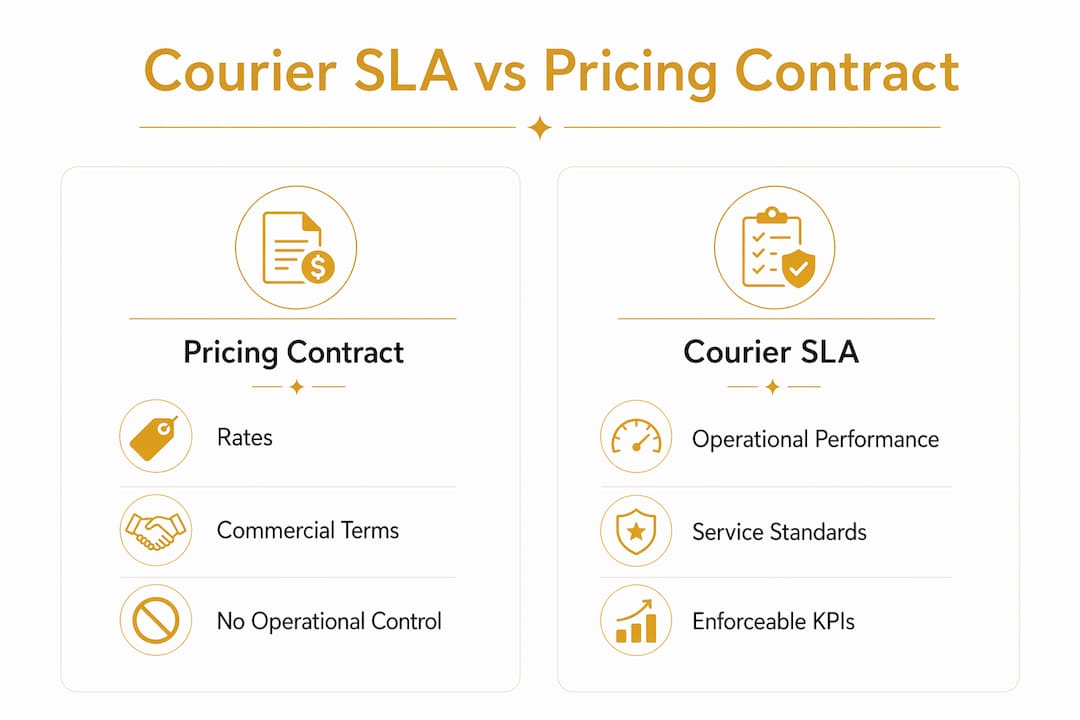
The distinction between a pricing contract and an SLA is one of the most misunderstood points in logistics management. A pricing contract sets your rates, general terms, and commercial conditions. It does not bind the courier to any specific operational standard. An SLA does exactly that.
Without an SLA, an agreement is merely a price list without operational control. That means a courier can miss delivery windows, damage goods, or fail on first-attempt rates without any contractual consequence. Businesses often confuse marketing transit-time claims with SLA-backed guarantees, which creates a serious expectations gap.
The table below shows how the two documents differ in practice:
| Element | Pricing contract | Courier SLA |
|---|---|---|
| Focus | Rates and commercial terms | Operational performance standards |
| KPIs defined | No | Yes, with numerical targets |
| Penalties for failure | Rarely included | Defined invoice credits or service credits |
| Measurement method | Not specified | Explicit calculation rules and reporting frequency |
| Exit provisions | Standard termination clauses | Performance-triggered exit rights |
Relying solely on a pricing contract exposes your business to operational inefficiency and brand reputation damage. When deliveries fail, your customers blame you, not the courier. That is why the SLA sits alongside the commercial contract as a separate, equally important document.
What best practices ensure effective SLA management?
Drafting a strong SLA is only half the work. Active management is what turns a contractual document into genuine operational control. Many businesses sign an SLA and then fail to enforce it, which renders the agreement worthless.
A weekly operational cadence is the standard approach for serious logistics managers. The process follows a clear sequence:
- Pull performance data from your courier's reporting dashboard or your own tracking system every Monday morning. Capture on-time delivery rates, first-attempt rates, and any damage or loss incidents from the previous week.
- Identify outliers by comparing actual performance against the SLA targets. Flag any KPI that has breached its threshold or is trending towards a breach.
- Conduct escalation calls with your courier account manager for any confirmed breach. Document the call, the explanation given, and the agreed remedial action.
- Apply penalty credits as specified in the SLA for confirmed breaches. Do not wait for the courier to raise them. Track credits applied against your invoices monthly.
- Run quarterly business reviews (QBRs) using aggregated SLA scores. QBRs are the right forum for contract renegotiation, capacity planning, and peak-season preparation.
Technology plays a direct role in making this cadence work. Courier dispatch software and real-time tracking platforms give you the data accuracy needed to enforce SLA penalties without relying on the courier's own reporting alone. Good delivery tracking practices also reduce disputes about whether a delivery was attempted within the agreed window.
Pro Tip: Build 1–2 buffer days into your customer-facing delivery promises, especially during peak seasons. Carrier marketing transit times are not SLA guarantees. If your SLA target is next-day delivery, promise customers two days. That buffer protects your brand when the courier hits a capacity issue.
Why are courier SLAs important for brand protection?
Courier SLAs are a brand protection tool, not just an operational one. End customers blame the retailer or business when a delivery arrives late or damaged, regardless of which carrier caused the problem. That reality makes SLA enforcement a direct investment in customer retention.
The brand protection case for strong courier SLAs rests on several interconnected points:
- Customer perception: A courier SLA improves operational transparency across your supply chain, reducing cancellations and improving seller ratings. Customers who receive consistent, on-time deliveries are significantly more likely to reorder.
- First-attempt delivery rates: High first-attempt delivery rates reduce carbon footprint, cut redelivery costs, and improve customer loyalty simultaneously. A failed first attempt costs money and erodes trust.
- Financial remedies: SLA penalty clauses recover a portion of the cost when service failures occur. Without them, you absorb the full cost of the courier's underperformance.
- Carrier selection discipline: Requiring an SLA before awarding a contract forces couriers to commit to standards they can actually meet. It filters out providers who rely on marketing claims rather than operational capability.
Choosing couriers with strong reliability factors and enforceable SLAs is part of a sound brand strategy, not just a procurement decision. The courier you choose represents your business at the point of delivery, which is often the only physical touchpoint your customer experiences.
Key takeaways
A courier service level agreement is the primary tool for operational control in any courier relationship, and without enforceable KPIs and penalty clauses, a contract offers no real accountability.
| Point | Details |
|---|---|
| SLA versus pricing contract | An SLA enforces operational standards; a pricing contract only covers rates and commercial terms. |
| Core KPI benchmarks | Target on-time delivery rates of 92–96% and loss or damage rates under 0.2% as standard thresholds. |
| Penalty structures matter | Invoice credits of 5–25% for KPI breaches are standard; always apply them proactively. |
| Weekly management cadence | Pull data, identify outliers, escalate breaches, and apply credits every week without exception. |
| Brand protection link | High first-attempt delivery rates reduce costs, cut carbon impact, and directly improve customer loyalty. |
SLA contracts versus SLA management: the gap most businesses miss
The most common failure I see in courier SLA management is not a badly drafted contract. It is the complete absence of active enforcement after signing. Businesses invest time negotiating penalty clauses and KPI targets, then file the document and never open it again. That gap between contractual SLA negotiation and operational SLA management is where performance quietly deteriorates.
Vague SLA language is the second major pitfall. Phrases like "best effort delivery" or "subject to operational conditions" sound reasonable in a negotiation but are legally meaningless when you try to enforce a penalty. Every KPI needs a precise definition, including exactly when measurement begins, when it ends, and what counts as a failure. If your current SLA does not pass that test, renegotiate it before the next contract renewal.
The third issue is treating courier marketing transit times as contractual commitments. They are not. A courier's advertised next-day service is a commercial claim, not an SLA guarantee, unless your contract explicitly states otherwise. Always confirm whether your agreement includes a money-back guarantee for missed deliveries, or you are carrying the risk yourself.
The most productive approach is to treat your courier as an operational partner rather than a vendor to be managed at arm's length. Quarterly business reviews, shared performance dashboards, and open escalation channels produce better outcomes than adversarial penalty enforcement alone. The goal is consistent performance, not a credits dispute every month. Good communication practices between your team and your courier account manager are as important as the contract itself.
— Ayomide
Sddbyaba: SLA-backed courier services for UK businesses
Sddbyaba operates as a UK-wide same day courier and logistics provider built around measurable service commitments. Every consignment, from urgent parcels to commercial freight, is handled with clear communication, dedicated vehicles, and a focus on first-attempt delivery performance.

Business owners and logistics managers who need reliable nationwide dispatch can access a full range of vehicles, from motorcycles to artic lorries, with service standards designed to support SLA-backed operations. Sddbyaba also offers dedicated courier services for time-critical consignments where performance guarantees are non-negotiable. Contact Sddbyaba to discuss service terms that match your operational requirements.
FAQ
What is a courier service level agreement?
A courier service level agreement is a binding contract that defines measurable delivery performance standards, such as on-time delivery rates and damage thresholds, along with financial penalties for breaches.
What KPIs should a courier SLA include?
Standard courier SLA KPIs include on-time delivery rate, first-attempt delivery rate, loss or damage rates, return processing time, and pickup window compliance, each with a defined numerical target.
How does a courier SLA differ from a pricing contract?
A pricing contract sets rates and commercial terms but contains no enforceable operational commitments. A courier SLA defines specific performance standards, measurement methods, and financial remedies for failure.
How do I enforce a courier SLA effectively?
Run a weekly cadence of data pulls, outlier analysis, and escalation calls, then apply penalty credits proactively. Use quarterly business reviews to assess aggregated performance and renegotiate terms where needed.
Why are courier SLAs important for brand protection?
End customers blame the business, not the carrier, for late or damaged deliveries. Enforceable SLAs with penalty clauses recover costs from service failures and incentivise couriers to maintain consistent performance.