
Courier documentation is defined as the formal record of every delivery event, from dispatch to final handover, and it is the foundation of accountability in shipping logistics. Understanding why courier documentation is important separates businesses that resolve disputes in hours from those that lose revenue over missing paperwork. Proper shipping documents, including Proof of Delivery (POD) records, digital signatures, and timestamps, create indisputable records that protect revenue and prevent false claims. For any business managing time-sensitive consignments, these records are not optional. They are the difference between a verifiable delivery and an expensive dispute.
Why courier documentation is important: the core case
Courier documentation covers every formal record generated during a shipment's lifecycle. The most critical form is Proof of Delivery, which typically includes a recipient's signature, a timestamped photo of the delivered goods, and a GPS-confirmed location. These three elements together create a record that is difficult to dispute in any legal or commercial context.
Delivery documentation links operational delivery events directly to financial and compliance systems. That connection matters because it gives procurement, finance, and operations teams a shared source of truth. Without it, businesses rely on memory, phone calls, and informal confirmations, all of which fail under pressure.

The importance of courier paperwork extends beyond individual deliveries. Across a fleet or a month of operations, documentation becomes an audit trail. It supports SLA enforcement, identifies patterns in failed deliveries, and provides the evidence base for any insurance or legal claim. Businesses that treat documentation as an afterthought consistently face higher dispute rates and weaker supplier relationships.
What types of courier documentation exist?
Different documents serve distinct purposes in the delivery chain. Understanding each one helps businesses choose the right paperwork requirements for their operations.
| Document type | Primary purpose | Key feature |
|---|---|---|
| Proof of Delivery (POD) | Confirms receipt by the correct party | Digital signature, photo, timestamp |
| Courier manifest | Lists all items in a consignment | Supports SLA enforcement and audit trails |
| Shipment record | Tracks movement from origin to destination | Links dispatch data to financial systems |
| Service confirmation | Verifies courier attendance and completion | Used for billing and compliance reporting |
| Consignment note | Legal transfer of goods responsibility | Required for freight and haulage movements |
Each document type plays a specific role. A courier manifest, for example, reduces the risk of lost or delayed items by providing a verified list of every item in a consignment. A POD protects the sender from false non-delivery claims. A consignment note establishes legal liability at each stage of transit.
The benefits of courier documentation become clearest when something goes wrong. A missing item, a damaged parcel, or a disputed delivery all require documentary evidence to resolve quickly. Businesses without that evidence face prolonged disputes, refund costs, and damaged client relationships.
- Proof of Delivery: protects against false claims and confirms handover
- Courier manifests: provide a verified audit trail for every consignment
- Shipment records: connect delivery events to invoicing and compliance
- Consignment notes: establish legal responsibility at each transit point
How documentation improves operational efficiency and reduces risk
Proper documentation reduces re-delivery costs, support call volumes, and financial leakage across logistics operations. Failed last-mile communication generates hidden costs in re-delivery labour, inbound support, and customer attrition. Those costs are often misattributed to fuel or staffing, when the real cause is a gap in delivery records and recipient notification.
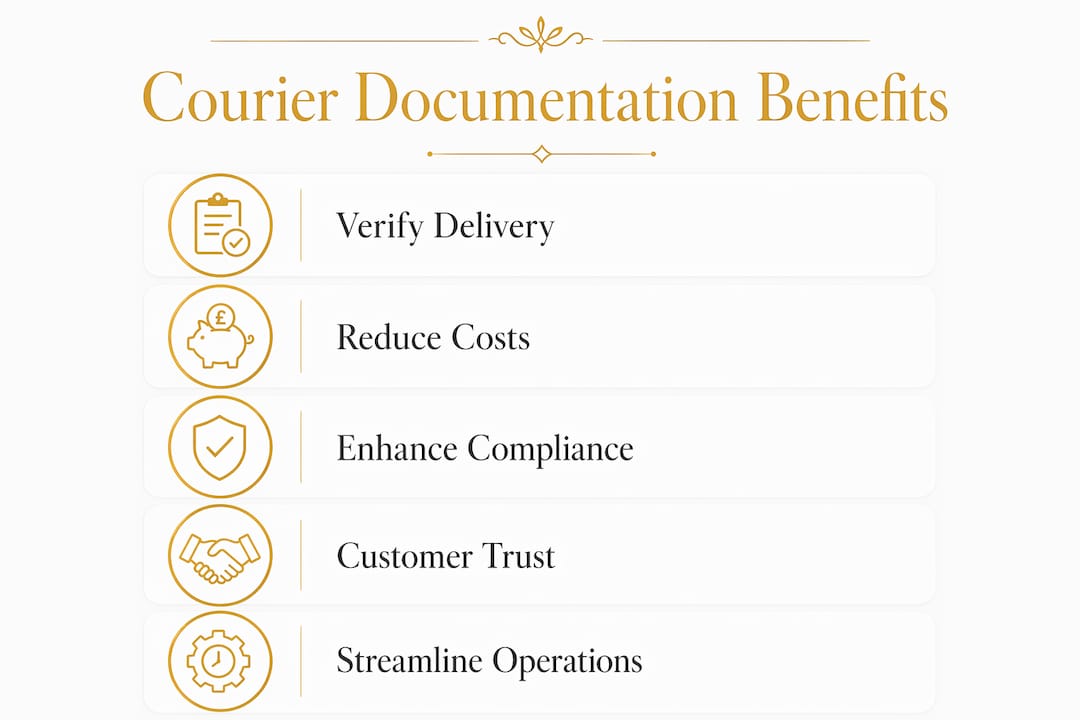
Documentation also improves forecasting accuracy. When delivery events are recorded consistently, operations managers can identify which routes, time slots, or vehicle types generate the most failed attempts. That data feeds directly into planning decisions, reducing wasted capacity and improving on-time performance.
Digital documentation and automated recipient notifications close information gaps and reduce repeated delivery attempts. Integrated digital workflows eliminate the manual update delays that cause recipients to miss deliveries or contact support unnecessarily.
- Fewer re-delivery attempts reduce fuel and labour costs
- Verified records speed up dispute resolution and reduce refund exposure
- Audit trails support SLA enforcement and contract renewals
- Consistent data improves route planning and capacity decisions
Pro Tip: Digitising your delivery documentation removes manual transcription errors and cuts average dispute resolution time significantly. Cloud-based POD capture, where drivers photograph and timestamp deliveries in real time, is the most reliable method currently available to UK logistics operations.
Why courier communication and professionalism matter alongside paperwork
Courier professionalism is inseparable from documentation quality. A courier who arrives on time, handles goods carefully, and completes paperwork accurately represents the sending business at the final touchpoint of every transaction. Couriers act as invisible employees of the brands they deliver for, and their conduct directly shapes customer loyalty and brand perception.
What is courier customer communication in practice? It is every interaction between the courier and the recipient, from the pre-delivery notification to the handover conversation. Polite, timely communication at the door reinforces the professionalism of the sending business. Poor communication, or none at all, leaves recipients frustrated regardless of whether the parcel arrives on time.
"The courier should be treated as the final employee in the sales workflow. Clear, timely documentation and communication reflect directly on the brand's professional standard and customer retention."
Documentation supports this communication by giving couriers the information they need to answer recipient questions confidently. A driver with access to a complete shipment record can confirm what is in the parcel, who sent it, and what the recipient should do if there is a problem. That transparency builds trust at the point of delivery.
- Train couriers to treat every delivery as a brand interaction, not just a task
- Ensure drivers have access to shipment records before arrival
- Use pre-delivery notifications to reduce failed first attempts
- Record delivery outcomes in real time to support follow-up communication
What role does automation play in courier documentation?
Automated systems linked to delivery documentation transform customer experience and reduce operational overhead. Integrating automated communication with delivery documentation improves customer satisfaction scores by 0.8–1.2 points on a 5-point scale. That improvement comes from proactive, data-backed updates that reduce reactive enquiries and build recipient confidence.
Manual client communication is labour-intensive, inconsistent, and a bottleneck that automated workflows can eliminate. When a driver marks a delivery complete on a digital POD system, that event can automatically trigger a recipient notification, update the client's tracking portal, and log the record in the business's compliance system. All three happen without a single manual step.
| Method | Speed | Consistency | Cost per update | Error rate |
|---|---|---|---|---|
| Manual phone or email updates | Slow | Low | High | High |
| Automated documentation-linked notifications | Immediate | High | Low | Very low |
Pro Tip: Link your POD capture system directly to your customer notification platform. When delivery confirmation triggers an automatic message to the recipient, you eliminate the most common source of inbound support calls: recipients who simply do not know whether their parcel has arrived.
Operational leaders prioritise digitising delivery documentation to synchronise updates with client communication. The result is fewer inbound queries, faster resolution of exceptions, and a measurable reduction in information lag across the supply chain. For businesses managing high volumes of time-critical deliveries, this integration is not a luxury. It is a requirement for maintaining service standards at scale.
Key takeaways
Courier documentation is the single most effective tool for protecting revenue, resolving disputes, and building customer trust across every delivery operation.
| Point | Details |
|---|---|
| Documentation prevents disputes | Digital POD records with signatures, photos, and timestamps create indisputable delivery evidence. |
| Audit trails reduce costs | Verified shipment records cut re-delivery attempts, support calls, and financial leakage. |
| Couriers represent your brand | Professionalism and communication at the door directly affect customer loyalty and retention. |
| Automation multiplies documentation value | Linking POD systems to automated notifications improves satisfaction scores and reduces manual overhead. |
| Compliance requires formal records | Consignment notes and manifests establish legal responsibility and support SLA enforcement. |
Documentation is the backbone of professional logistics
I have spent years watching businesses underestimate the cost of poor courier documentation. The losses rarely show up as a single large write-off. They accumulate quietly: a disputed delivery here, a re-delivery cost there, a client who quietly stops reordering because their last three shipments arrived without any confirmation. By the time the pattern is visible, the damage is done.
The most common mistake I see is treating documentation as an administrative burden rather than a commercial asset. Businesses invest in vehicles, drivers, and route planning, then leave the paperwork to chance. That is the wrong order of priorities. Documentation is what makes every other investment defensible. Without it, a perfect delivery can still become a costly dispute.
The second mistake is separating documentation from communication. A POD record that sits in a back-office system and never reaches the recipient does half the job. The full value comes when that record triggers a notification, updates a portal, and gives the recipient confidence that their goods have arrived safely. That is what courier communication actually means in practice.
My advice to any business managing deliveries at scale: treat documentation as a product. Design it, test it, and measure it. The businesses that do this consistently outperform those that do not, on dispute rates, customer retention, and operational cost.
— Ayomide
Professional courier services built around reliable documentation
Businesses that need same day dispatch with full documentation support should not have to choose between speed and accountability.

Sddbyaba provides same day courier services across the UK with professional communication, real-time delivery records, and dedicated vehicle options from motorcycles to artic lorries. Every consignment is supported by verified shipment documentation and proactive recipient updates. For businesses in construction, retail, manufacturing, medical, and commercial logistics, that combination of speed and paperwork accuracy is what keeps operations running without costly interruptions. Whether you need a dedicated courier for a single urgent consignment or a reliable partner for ongoing freight movements, Sddbyaba delivers with the documentation standards your business depends on.
FAQ
What is courier documentation?
Courier documentation is the formal record of a delivery, including Proof of Delivery, shipment records, manifests, and consignment notes. These documents confirm handover, establish legal responsibility, and link delivery events to financial and compliance systems.
Why does Proof of Delivery matter for businesses?
Proof of Delivery provides digital signatures, photos, and timestamps that create an indisputable record of receipt. This protects businesses from false non-delivery claims and supports dispute resolution without relying on informal confirmation.
How does courier documentation reduce operational costs?
Verified delivery records reduce re-delivery attempts, inbound support calls, and financial leakage caused by unresolved disputes. Connecting dispatch data to automated notifications cuts these costs further by closing information gaps before they generate complaints.
Why does courier professionalism affect brand reputation?
Couriers represent the sending business at the final point of every transaction. Polite, timely communication and accurate paperwork at the door reinforce brand trust and directly influence whether customers place repeat orders.
What is the benefit of automating courier communication?
Integrating automated notifications with delivery documentation improves customer satisfaction scores by 0.8–1.2 points on a 5-point scale. Automated workflows also eliminate manual update delays and reduce the inconsistency that comes with phone or email-based communication.