
Technology is the operational backbone of modern courier services, determining whether a shipment is tracked in real time, delivered on time, and confirmed without dispute. In 2026, the role of technology in courier logistics extends far beyond GPS tracking. AI, robotics, IoT, and cloud logistics now drive route optimisation, automated sorting, and end-to-end shipment visibility across the entire supply chain. Companies like UPS, Amazon, FedEx, and DHL have moved from manual processes to sensor-driven networks, and the gap between technology-enabled operators and those without is widening fast. For logistics professionals and businesses that depend on reliable dispatch, understanding these advances is no longer optional.
What key technologies are transforming courier services today?
The impact of technology on delivery operations is most visible in four areas: artificial intelligence, RFID sensing, automation, and electronic proof of delivery (ePOD) systems.
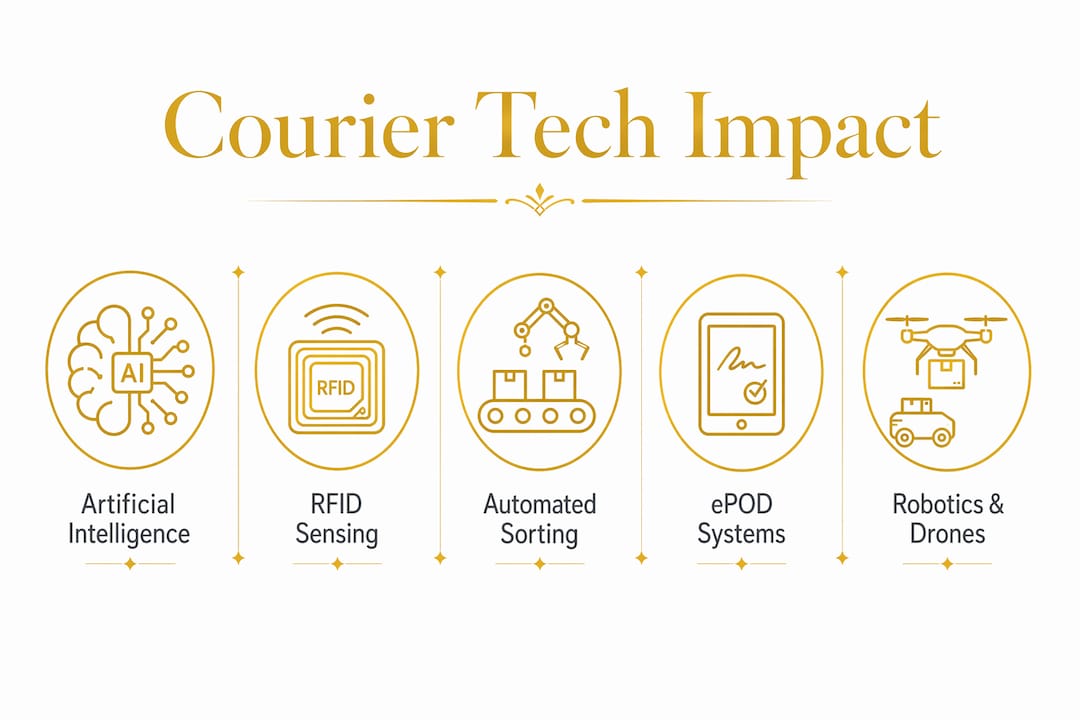
Artificial intelligence and advanced analytics give courier operators the ability to forecast demand, optimise vehicle routing, and manage capacity in real time. AI-powered platforms analyse traffic patterns, weather data, and historical delivery performance to assign the most efficient routes before a driver leaves the depot. This reduces fuel consumption, cuts delivery windows, and lowers the cost per consignment.

RFID sensing is redefining package visibility at scale. UPS has deployed RFID technology across all US vehicles, facilities, and over 5,500 UPS Store locations, eliminating manual scans and providing continuous tracking without human intervention. This means a package is automatically detected the moment it enters a vehicle or loading bay, with no barcode scan required. The practical result is fewer errors, faster processing, and a real-time view of every item in the network.
Robotic sorting and automated parcel hubs handle volume that human teams cannot match. FedEx is expanding robotic automation for loading and unloading across its US hubs, using physical AI and sensors to increase throughput and reduce reliance on manual labour. These systems process thousands of parcels per hour with consistent accuracy.
Internet of Things (IoT) sensors and cloud logistics platforms connect vehicles, warehouses, and delivery points into a single data environment. Operators can monitor temperature-sensitive freight, track vehicle location, and receive automated alerts when a delivery falls outside its scheduled window.
ePOD systems capture timestamped photographs, GPS coordinates, and digital signatures at the point of delivery, providing verified delivery confirmation that is legally defensible and instantly accessible to both sender and recipient.
- AI route optimisation reduces cost per delivery and improves on-time performance
- RFID sensing automates package detection across vehicles, hubs, and retail locations
- Robotic sorting increases hub throughput without proportional increases in staffing
- IoT sensors provide live data on freight condition and vehicle location
- ePOD systems replace paper-based confirmation with digital, timestamped evidence
Pro Tip: When evaluating digital tools for courier services, prioritise platforms that integrate ePOD, GPS tracking, and route optimisation in a single interface. Fragmented systems create data gaps that undermine both efficiency and dispute resolution.
How do tracking and proof of delivery systems build customer trust?
Real-time shipment tracking is now a baseline expectation for business customers, not a premium feature. GPS and IoT sensors feed live location data to customer-facing portals, giving consignees accurate estimated arrival windows and reducing inbound enquiries to courier operations teams.
RFID takes this further by removing the dependency on manual scanning at each checkpoint. System-level sensor coverage across packages, vehicles, and loading bays confirms possession automatically, creating a granular event log without any driver or warehouse operative needing to act. The result is a tracking record that is both more accurate and more complete than traditional barcode-based systems.
ePOD systems add a further layer of assurance at the final delivery point. The process typically works as follows:
- The driver arrives at the delivery address and opens the ePOD application on a mobile device.
- A timestamped photograph of the delivered item is captured, recording the exact location via GPS coordinates.
- The recipient provides a digital signature, or the system records a contactless confirmation where applicable.
- The completed proof of delivery record is uploaded instantly to the operator's platform and made available to the customer.
- Geofencing validation confirms the delivery event occurred within the designated delivery zone, adding a final layer of verification.
Geofencing creates virtual delivery perimeters using GPS coordinates, recording precise delivery events and reducing disputes between shippers and recipients. This matters enormously for high-value commercial consignments where a disputed delivery can trigger contractual penalties.
"No single proof method suffices; redundancy creates robust, legally defensible delivery validation." Combining timestamped photos, GPS, and geofencing into a layered evidence chain is the standard that serious logistics operators now apply.
One challenge worth acknowledging is data continuity. ePOD effectiveness depends entirely on uninterrupted GPS and live tracking data. Gaps in connectivity during critical delivery moments can invalidate secure drop-off workflows, particularly where smart lock integrations are involved. Operators must account for this when designing their technology infrastructure.
How are drones and robotics reshaping last-mile delivery?
Drone delivery and robotic automation represent the most visible frontier of technology advancements in courier operations, though both come with meaningful constraints that logistics professionals should understand clearly.
Amazon launched its first UK drone delivery trial in Darlington, delivering sub-5 lb packages within a 7.5-mile radius using obstacle avoidance technology and remote human monitoring. The service operates at a maximum of ten flights per hour and delivers within two hours of order placement. This is a genuinely significant proof of concept, but it is not yet a scalable national solution. Regulatory approvals, airspace management, and payload limitations mean drone delivery remains a specialist tool for specific use cases rather than a replacement for ground-based courier networks.
| Technology | Current capability | Key constraint |
|---|---|---|
| Drone delivery (Amazon UK) | Sub-5 lb packages, 7.5-mile radius, 2-hour delivery | Flight volume caps, regulatory approvals, payload limits |
| Robotic hub sorting (FedEx, DHL) | Thousands of parcels per hour, automated loading | High upfront capital investment, hub-specific deployment |
| RFID sensing (UPS) | Real-time visibility across all vehicles and facilities | Requires sensor infrastructure at every network touchpoint |
| AI route optimisation | Dynamic rerouting, demand forecasting, capacity management | Dependent on data quality and system integration |
Robotic systems at major hubs deliver more immediate and scalable benefits. FedEx is deploying physical AI including sensors and robotics to improve loading, unloading, and sorting across its network. DHL has similarly invested in automated parcel hubs that process freight around the clock. These systems do not replace drivers, but they dramatically reduce the time freight spends stationary between collection and dispatch.
Pro Tip: For businesses assessing smart delivery solutions, robotic hub automation delivers a faster return on investment than drone programmes in 2026. Focus technology investment on the parts of the network where volume and repetition are highest.
What are the real challenges of adopting courier technology?
Technology adoption in courier services is not simply a matter of purchasing software. The operational and integration requirements are substantial, and underestimating them is a common mistake.
- Sensor infrastructure investment: RFID deployment requires sensors in packages, vehicles, and loading bays. UPS's expansion is expected to eliminate nearly 20 million manual scans daily, but achieving that scale demands significant upfront investment in hardware, label printing equipment, and IT integration. Smaller operators face the same infrastructure requirements without the same volume to justify the cost.
- System-level coverage gaps: Partial sensor deployment creates blind spots. If a vehicle lacks RFID readers or a loading bay is not instrumented, the event granularity that makes real-time tracking valuable disappears. End-to-end visibility requires instrumentation at every touchpoint, not just the most convenient ones.
- Balancing automation with human oversight: Amazon's drone trial operates with real-time human monitoring for safety. Fully autonomous systems are not yet viable for complex urban delivery environments. Human oversight remains a necessary component of any automated courier workflow.
- Data continuity and security: ePOD systems depend on continuous GPS and live tracking data. Connectivity gaps during delivery events can undermine the security model, particularly for contactless or smart lock deliveries. Operators must design for resilience, not just average-case performance.
- Harmonising routing, tracking, and access control: The most effective digital tools for courier services work as an integrated system. Routing platforms, ePOD applications, geofencing tools, and access control systems must share data in real time. Siloed platforms create reconciliation problems and slow dispute resolution.
For businesses considering secure parcel delivery solutions, integrating smart lock technology with ePOD systems addresses the contactless delivery challenge directly, provided the underlying GPS data is reliable.
Key takeaways
Technology defines operational performance in courier services, and operators who integrate AI, RFID, ePOD, and automation across their networks will consistently outperform those relying on manual processes.
| Point | Details |
|---|---|
| RFID removes manual scanning | UPS's network-wide RFID deployment eliminates nearly 20 million manual scans daily, improving accuracy and speed. |
| Layered ePOD is the reliability standard | Combining timestamped photos, GPS, digital signatures, and geofencing creates legally defensible delivery proof. |
| Drone delivery is promising but constrained | Amazon's UK trial shows real potential, but payload limits, flight caps, and regulation restrict current scalability. |
| Data continuity is non-negotiable | GPS and tracking gaps during delivery events undermine ePOD security models and dispute resolution. |
| Integration determines ROI | Technology tools deliver value only when routing, tracking, and proof of delivery systems share data in real time. |
Why technology integration matters more than technology selection
The conversation in logistics circles often focuses on which technology to adopt. Having worked closely with courier operations across the UK, I think that framing misses the point. The operators who extract the most value from technology are not necessarily those with the most advanced tools. They are the ones who have integrated their existing tools most thoroughly.
RFID is a compelling example. UPS's deployment is impressive in scale, but the underlying principle is straightforward: instrument every touchpoint so that possession is confirmed automatically. The technology is not exotic. The discipline required to achieve system-level coverage across every vehicle, hub, and facility is what makes it work. Partial deployment produces partial results.
The same logic applies to ePOD. I have seen operations where drivers use ePOD applications on their phones, but the GPS data is unreliable in certain postcodes, or the photo upload fails on a slow mobile connection. The technology exists, but the infrastructure to support it does not. That gap is where disputes happen and where customer trust erodes.
The future of secure, contactless delivery lies in combining ePOD with smart secure parcel boxes and real-time GPS validation. This is not a distant prospect. The components exist today. What is missing in many operations is the commitment to integrate them properly rather than deploying them in isolation.
For logistics professionals advising their organisations, the priority should be integration architecture before additional technology investment. Map the data flows between your routing platform, your ePOD system, and your customer communication tools. Find the gaps. Close them. The efficiency gains from a well-integrated existing stack will often exceed those from adding a new platform on top of a fragmented one.
— Ayomide
How Sddbyaba uses technology to deliver with confidence
Sddbyaba operates as a technology-supported courier service built for businesses that cannot afford delivery failures. Whether you need same day courier services across the UK, a dedicated vehicle for time-critical freight, or an emergency delivery response for urgent consignments, every dispatch is backed by proof of delivery processes and real-time communication.

From motorcycle couriers to 26-tonne trucks, Sddbyaba matches vehicle capability to consignment requirements and provides the operational transparency that commercial clients expect. If your business depends on reliable, trackable, and professionally confirmed deliveries, explore Sddbyaba's dedicated courier solutions to find the right fit for your logistics requirements.
FAQ
What is the role of technology in courier services?
Technology in courier services covers AI route optimisation, RFID package tracking, robotic sorting, IoT sensors, and ePOD systems. Together, these tools improve delivery speed, accuracy, and customer visibility across the entire shipment journey.
How does RFID improve courier tracking accuracy?
RFID embeds sensors in packages and network infrastructure to detect shipments automatically without manual scanning. UPS's deployment eliminates nearly 20 million manual scans daily, reducing human error and providing continuous real-time visibility.
What is electronic proof of delivery (ePOD)?
ePOD is a digital system that captures timestamped photographs, GPS coordinates, and digital signatures at the point of delivery using a mobile application. It replaces paper-based confirmation and provides instant, verifiable delivery records for both operators and customers.
Are drones a practical solution for UK courier deliveries?
Currently, drone delivery is limited to specific use cases. Amazon's UK trial in Darlington covers sub-5 lb packages within a 7.5-mile radius, with flight volume caps and regulatory constraints restricting wider deployment. Ground-based courier networks remain the primary solution for most commercial deliveries.
What are the biggest challenges in adopting courier technology?
The main challenges are infrastructure investment, system integration, and data continuity. RFID requires sensors at every network touchpoint, ePOD depends on reliable GPS connectivity, and routing platforms must share data with proof of delivery systems to deliver consistent operational results.