
What is courier temperature control?
Courier temperature control is the precise management of thermal conditions throughout the transport of goods, keeping cargo within defined temperature limits from collection through to final delivery. The industry term for this broader discipline is temperature-controlled logistics, which encompasses not just the vehicle but the packaging, monitoring technology, handling protocols, and regulatory compliance that together protect product integrity.
For UK logistics managers, this matters because a single temperature excursion can render an entire pharmaceutical consignment worthless, trigger a food safety recall, or breach regulatory requirements. Temperature-controlled delivery uses refrigerated vehicles and specialised packaging to maintain temperature ranges from frozen to ambient conditions, depending on the cargo.
Key components of a temperature-controlled courier service include:
- Temperature range specification: the precise temperature limits for refrigerated pharmaceuticals and frozen goods defined before shipment begins
- Specialised transport: refrigerated vehicles, temperature-controlled vans, and insulated containers matched to cargo requirements
- Packaging solutions: validated insulated boxes, gel packs, dry ice, and phase-change materials that buffer against external temperature fluctuations
- Real-time monitoring: IoT sensors and data loggers that record and transmit temperature readings throughout transit
- Regulatory compliance: adherence to Good Distribution Practice (GDP), the ATP agreement for road transport, and sector-specific standards
Table of Contents
- What types of temperature control methods are used in courier logistics?
- What regulations and standards govern temperature-controlled couriers in the UK?
- How does the operational process of temperature-controlled courier services work?
- What types of cargo require temperature-sensitive delivery?
- Common misunderstandings about courier temperature control that cost businesses money
- The UK temperature-controlled courier market: who operates in this space?
- Sddbyaba: same-day temperature-sensitive courier services across the UK
- Key takeaways
What types of temperature control methods are used in courier logistics?
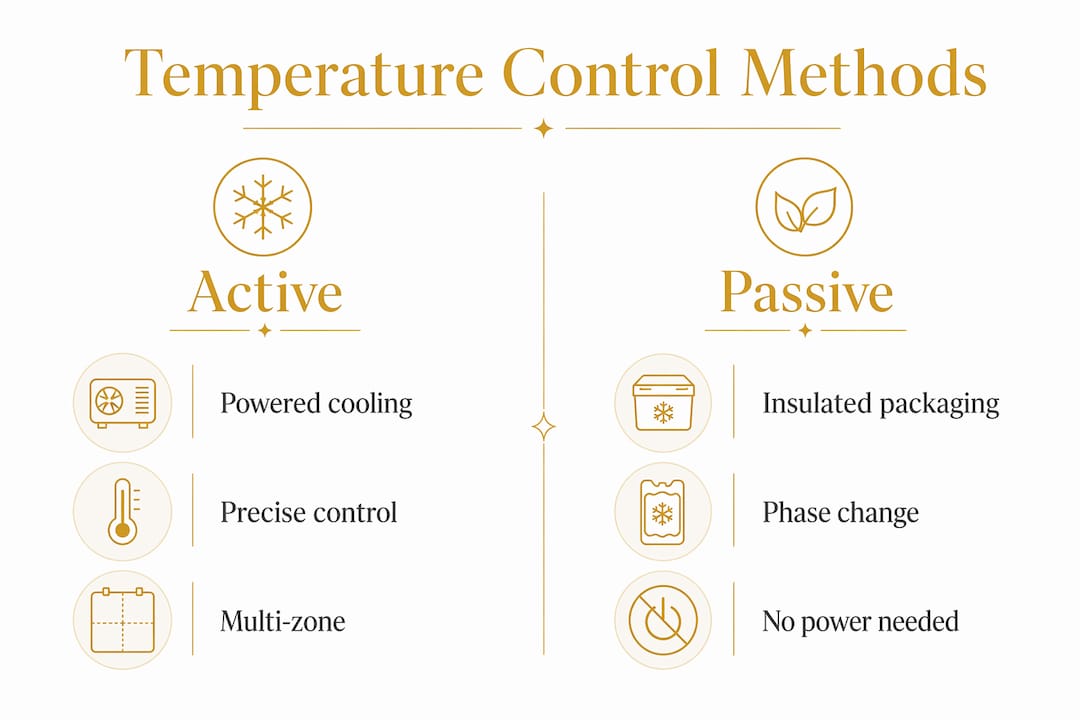
Temperature control methods divide into two fundamental categories: active and passive. Understanding the distinction helps logistics managers specify the right solution rather than defaulting to whichever vehicle is available.

Active and passive temperature control each serve different cargo profiles. Active methods use powered refrigeration or heating units to maintain a set temperature regardless of external conditions. Passive methods rely on insulation, coolant packs, or phase-change materials to slow temperature change without powered intervention.
| Method | How it works | Typical uses |
|---|---|---|
| Active refrigeration | Powered cooling unit maintains set temperature | Pharmaceuticals, dairy, fresh produce |
| Active freezing | Powered unit holds cargo below freezing | Frozen food, biological samples |
| Ambient control | Heating or cooling maintains room temperature | Cosmetics, certain chemicals |
| Passive insulation | Insulated packaging slows temperature drift | Short-haul perishables, samples |
| Dry ice | Sublimates to maintain ultralow temperatures | Biologics, vaccines, frozen cargo |
| Gel packs | Pre-frozen packs buffer temperature for hours | Chilled pharmaceuticals, food |
| Humidity and airflow management | Climate control units regulate moisture and air circulation | Fresh produce, flowers, live goods |
Multi-temperature refrigerated vehicles add another layer of capability, carrying cargo at different temperature zones within a single load. This matters for mixed consignments where, say, chilled dairy and ambient confectionery travel together. Temperature-controlled logistics at this level requires monitoring technology integrated into the vehicle itself, not just the packaging.
What regulations and standards govern temperature-controlled couriers in the UK?
Two frameworks dominate UK temperature-controlled road transport: the ATP agreement (Agreement on the International Carriage of Perishable Foodstuffs) and Good Distribution Practice (GDP), which applies specifically to pharmaceutical supply chains.
Under ATP rules for road vehicles, refrigerated vehicles must carry ATP certificates visibly displayed. Classification codes such as FRC (Freezer Reinforced Class C) indicate the vehicle's tested performance standard. Non-compliance risks border delays and fines, which in a time-critical cold chain can mean spoiled cargo on top of the financial penalty.
Critical regulatory points for UK operators:
- ATP certificates must be visibly displayed in the vehicle at all times during transport
- Vehicle classification codes must match the cargo's temperature requirements
- GDP guidelines require documented temperature monitoring, qualified personnel, and validated transport lanes for pharmaceutical goods
- The Welfare of Animals (Transport) (England) Order 2006 sets additional requirements for vehicles carrying live animals, including warning systems that alert drivers when compartment temperatures breach limits
- Documentation of temperature records must be retained and available for inspection
Compliance is not optional. Border delays caused by missing or incorrect ATP documentation extend farm-to-store times and may require additional cooling intervention to maintain conditions, increasing both cost and spoilage risk.
Best practices go beyond minimum compliance. Operators should conduct regular vehicle qualification tests, train drivers on temperature excursion protocols, maintain calibration records for monitoring equipment, and document every stage of the cold chain. For pharmaceutical clients, this documentation forms part of the GDP audit trail.
How does the operational process of temperature-controlled courier services work?
The cold chain is only as strong as its weakest handover point. Temperature-controlled courier services maintain conditions across five distinct stages, each requiring specific protocols.
Key process points:
- Collection: cargo is pre-conditioned to the required temperature before loading; vehicles are pre-cooled or pre-heated to the target range
- Packaging: validated insulated packaging is selected based on transit duration, external temperature forecasts, and cargo sensitivity
- Transport: refrigeration units run continuously; real-time temperature monitoring systems track conditions and issue alerts if limits are breached
- Storage in transit: where intermediate storage is required (e.g., overnight holds), temperature-controlled warehousing maintains the chain
- Delivery: final handover includes temperature record transfer to the recipient, confirming the chain remained intact
IoT temperature sensors with real-time alerts, GPS tracking, and cloud-based data reporting give logistics managers continuous visibility. When a sensor detects a breach, the system alerts both the driver and the operations team simultaneously, enabling rapid intervention before the cargo is compromised.
Border delays represent a specific operational risk. Longer transit times caused by documentation issues or congestion require the cooling system to work harder and may exhaust passive coolant packs before delivery. Planning contingency cooling for cross-border or long-haul routes is standard practice for experienced operators.

Pro Tip: Pre-cool the vehicle for at least 30 minutes before loading, and never load warm product into a cold vehicle expecting the refrigeration unit to compensate. The unit maintains temperature; it does not recover it efficiently once the load is warm.
What types of cargo require temperature-sensitive delivery?
Temperature-sensitive goods span multiple sectors, and each category carries distinct logistics requirements. Getting the specification wrong is not just a quality issue; for pharmaceuticals and food, it can be a regulatory and public safety matter.
- Pharmaceuticals and vaccines: require validated refrigerated transport within a narrow temperature range; some biologics and mRNA vaccines need ultralow freezer conditions. IoT sensors, GPS tracking, and contingency plans are standard for this category
- Fresh produce: fruit, vegetables, and salad crops typically require chilled transport within a cool temperature range with humidity control to prevent dehydration or condensation damage
- Dairy and seafood: strict chilled requirements, often with short shelf lives that make transit time as critical as temperature
- Frozen food: maintained at temperatures below freezing throughout; any partial thaw and refreeze cycle compromises both safety and quality
- Biologics and clinical samples: may require dry ice or liquid nitrogen shippers; packaging must be validated for the specific transit duration
- Chemicals and industrial materials: some require temperature control to prevent crystallisation, separation, or degradation; humidity control is often equally important
- Cosmetics and personal care products: certain formulations are sensitive to heat or freezing, requiring ambient-controlled transport rather than refrigeration
- Live goods and plants: require airflow management and temperature control within specific ranges; governed by additional welfare regulations in the UK
Packaging and vehicle selection must be matched to each category. A pharmaceutical shipper using dry ice in an unventilated space creates a CO2 hazard; fresh produce in a vehicle without humidity control arrives dehydrated. Specifying requirements precisely at the point of booking is the single most effective way to prevent cargo damage.
Common misunderstandings about courier temperature control that cost businesses money
The term "temperature controlled" is broader than most logistics buyers realise. Assuming any refrigerated van will do the job for any temperature-sensitive cargo is one of the most common and costly errors in UK logistics procurement.
Logistics professionals caution that precise client specifications must state whether refrigeration, freezing, or full climate control including humidity and CO2 management is required. A vehicle certified for chilled transport may not control humidity, which matters enormously for fresh flowers or certain pharmaceutical packaging. Improper classification can cause cargo damage from a climate control method that is technically "temperature controlled" but wrong for the specific product.
Key clarifications for logistics managers:
- Temperature control ≠ climate control: refrigeration manages heat; climate control also manages humidity, airflow, and sometimes CO2 levels
- ATP certification is vehicle-specific: a classification code on one vehicle does not transfer to a substitute vehicle; always verify the certificate matches the actual vehicle used
- Passive packaging has a finite window: gel packs and insulated boxes are validated for specific transit durations; exceeding that window without active refrigeration invalidates the protection
- "Ambient" is not uncontrolled: ambient temperature control means maintaining a specific range (often 15–25°C), not simply leaving cargo at whatever temperature the van reaches
- Monitoring data is a legal document: for GDP-regulated shipments, temperature records are part of the compliance audit trail and must be retained
Pro Tip: When booking temperature-sensitive courier services, provide the courier with the product's temperature specification, not just the category name. "Pharmaceutical" tells the operator very little; "2–8°C refrigerated, GDP-compliant, with continuous data logging and excursion alerts" gives them everything they need to match the right vehicle and protocol.
The UK temperature-controlled courier market: who operates in this space?
The UK temperature-controlled logistics sector serves pharmaceuticals, food manufacturing, retail, healthcare, and agriculture, among others. Demand has grown alongside the expansion of pharmaceutical distribution networks and the rise of direct-to-consumer chilled food delivery.
The market spans a range of operator types. Specialist cold chain carriers focus exclusively on temperature-regulated freight, investing in multi-temperature fleets and GDP-validated processes. General hauliers with temperature-controlled capability offer this as one service line within a broader portfolio. Same-day dedicated courier operators, including those running fleets from motorcycles through to artic lorries, provide urgent temperature-sensitive delivery where scheduled services cannot meet the time requirement.
Fleet diversity is a genuine differentiator in this market. A courier network capable of deploying vehicles from small vans through to 26-tonne freight capacity can handle everything from a single pharmaceutical sample to a full pallet of chilled product, matching vehicle size to load rather than forcing cargo into an oversized or undersized vehicle. Proper courier vehicle selection for temperature-sensitive freight directly affects both cost efficiency and cargo safety.
Maintaining refrigerated vehicle fleets requires consistent mechanical attention. Cooling system integrity is critical; a compressor failure mid-route can compromise an entire consignment. Operators who invest in cooling system maintenance and regular diagnostics reduce the risk of in-transit failures that no monitoring system can prevent once the unit stops working.
Technology integration is increasingly a market differentiator. Operators using cloud-based temperature reporting, integrated dispatch notifications, and GPS-linked sensor data offer clients the audit trail that GDP compliance and food safety regulations require. Those without this infrastructure are progressively excluded from pharmaceutical and regulated food contracts.
Sddbyaba: same-day temperature-sensitive courier services across the UK
When a temperature-sensitive consignment cannot wait for a scheduled service, Sddbyaba provides the dedicated vehicle and the speed that specialist cold chain carriers often cannot match on urgent timescales.

Sddbyaba operates a nationwide fleet spanning motorcycles, vans, and heavy goods vehicles up to artic lorries, giving logistics managers the flexibility to match vehicle capacity precisely to the consignment. For businesses in pharmaceuticals, healthcare, food manufacturing, or any sector where cargo integrity is non-negotiable, Sddbyaba's dedicated courier service provides a single vehicle assigned to one consignment, with no shared loads and no intermediate stops that introduce temperature risk.
Same-day dispatch means the transit window is as short as possible, the most effective way to protect temperature-sensitive goods when time is the variable you can control. Whether the requirement is an urgent pharmaceutical sample, a chilled food delivery, or time-critical commercial freight, Sddbyaba's operations team coordinates the right vehicle with professional communication throughout.
Contact Sddbyaba directly via sddbyaba.com to discuss your temperature-sensitive delivery requirements and get a quote for same-day or urgent dispatch.
Key takeaways
Courier temperature control requires precise specification, validated equipment, regulatory compliance, and real-time monitoring to protect cargo integrity from collection to delivery.
| Point | Details |
|---|---|
| Define requirements precisely | State exact temperature ranges (e.g., 2–8°C), humidity needs, and compliance standards when booking. |
| Active vs passive methods | Active refrigeration maintains set temperatures; passive insulation only slows drift for a finite window. |
| ATP compliance is mandatory | UK road vehicles must display ATP certificates with correct classification codes or face fines and delays. |
| Monitoring is a legal record | For GDP-regulated shipments, continuous temperature data logs form part of the compliance audit trail. |
| Sddbyaba for urgent needs | Sddbyaba's dedicated same-day courier fleet handles temperature-sensitive consignments with a single vehicle and no shared loads. |