
Courier vehicle selection is the process of matching a vehicle's physical and legal capabilities to the specific demands of a delivery operation. Get it right and you control costs, meet compliance requirements, and deliver on time. Get it wrong and you face overloaded vehicles, failed emission zone checks, and insurance gaps that leave your business exposed. The core factors are payload capacity, cubic load volume, route type, fuel efficiency, and UK regulatory requirements. Vehicle types range from motorcycles and compact vans through to 26-tonne artics, and each tier serves a distinct operational purpose.
Key factors to assess before choosing any courier vehicle:
- Payload and gross vehicle weight (GVW): the maximum weight the vehicle can legally carry, including driver, fuel, and cargo
- Cubic capacity: the internal load volume, which determines how much space you have regardless of weight
- Route profile: urban multi-drop, regional mixed, or long-haul freight each demand different vehicle characteristics
- Emissions compliance: Low Emission Zones (LEZ) and Ultra Low Emission Zones (ULEZ) restrict older or higher-emission vehicles in UK cities
- Driving licence category: a standard Category B licence covers vehicles up to 3.5 tonnes GVW; heavier vehicles require Category C entitlements
- Insurance type: courier work requires specialist cover, including goods in transit insurance, not standard van policies
What do payload, cubic capacity, and cargo density mean for your vehicle choice?
Payload capacity and gross vehicle weight rating directly influence the types and volumes of goods a courier can transport, affecting both profitability and vehicle utilisation. Payload is the difference between a vehicle's GVW and its kerb weight. A van with a 3,500 kg GVW and a 1,800 kg kerb weight carries a payload of 1,700 kg. That figure governs what you can legally load, and exceeding it creates insurance, safety, and legal liability.
Cubic capacity is equally important, and the two figures do not always align. A Luton box van might offer 18 m³ of load space but carry only 1,000 kg before hitting its payload limit. Conversely, a compact van might reach its weight limit long before its load bay is full when carrying dense goods such as tiles or medical equipment. Understanding cargo density, calculated as weight divided by volume, tells you which constraint will bind first on a given route.
Key technical points for assessing vehicle suitability:
- GVW vs payload: always calculate payload from the specific variant you are considering, not the model family average
- Cubic capacity by category: small vans offer small cubic capacities; medium vans moderate cubic capacities; long wheelbase vans larger cubic capacities; Luton box vans the largest cubic capacities
- Density calculation: divide total cargo weight (kg) by total cargo volume (m³) to identify whether weight or space is the binding constraint
- Insurance and compliance: accurate payload data must be declared to your insurer; operating overweight invalidates cover and risks prosecution
- Mixed loads: multi-drop parcel routes often fill volume before weight, favouring larger cubic capacity; palletised or construction materials typically hit weight limits first
Pro Tip: When speccing a new vehicle, always request the payload figure for the exact trim and wheelbase you intend to buy. Manufacturers often quote the highest payload available in a range, which may apply only to the base specification without additional fitments such as shelving or a tail-lift.
How do operational factors in the UK affect which vehicle you should use?
Urban delivery in the UK presents constraints that simply do not apply on regional or motorway routes. Low emission zones and parking limitations favour smaller, lower-emission vehicles for efficient city operation, and this shapes vehicle selection as much as payload does. London's ULEZ, for example, applies to most of Greater London and requires petrol vehicles to meet Euro 4 standards and diesel vehicles to meet Euro 6. Operators running older diesel vans in non-compliant areas face daily charges that quickly erode delivery margins.
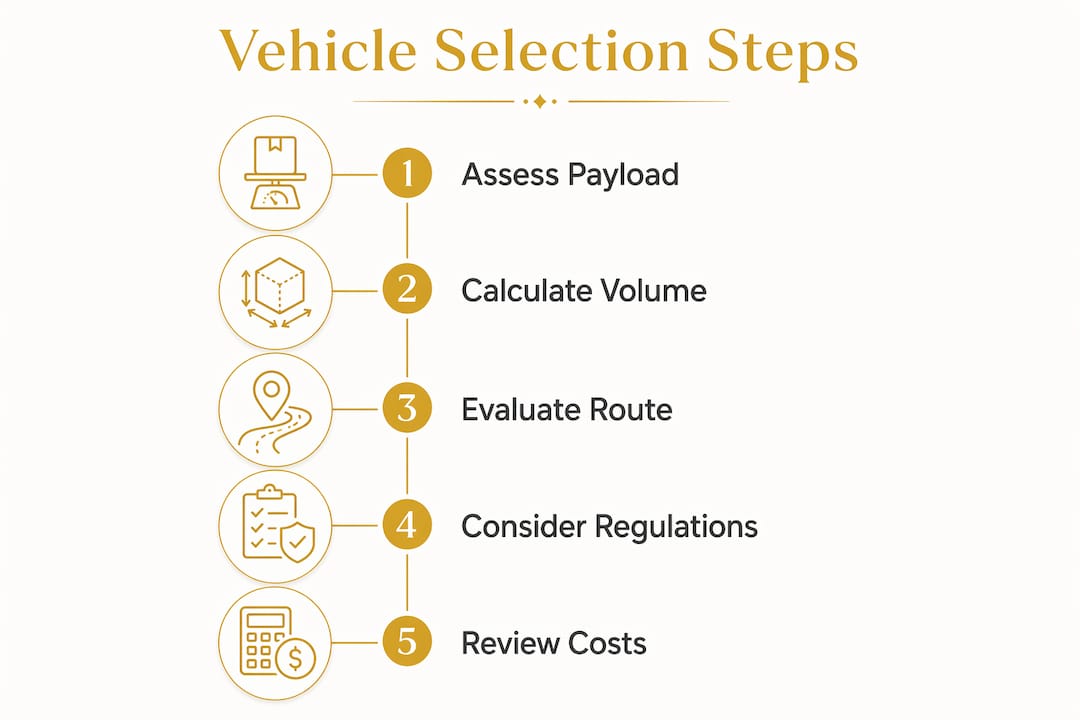
Route type determines almost everything else. A courier running 80 stops a day in Birmingham city centre needs a short wheelbase van with a low loading floor and easy rear access. A regional operator moving furniture or construction materials between depots needs a long wheelbase van or Luton with a tail-lift. These are not interchangeable choices.
Operational factors to evaluate before committing to a vehicle:
- Emission zone compliance: check whether your routes pass through LEZ or ULEZ areas and confirm the vehicle's Euro emission standard before purchase or lease
- Urban manoeuvrability: short wheelbase vans are easier to park and turn in tight city streets; long wheelbase vehicles suit A-road and motorway routes
- Loading and unloading frequency: high-stop multi-drop routes benefit from low loading heights and wide rear doors; palletised loads require tail-lifts or dock-level access
- Parcel size and type: small parcels suit compact vans; oversized or fragile items may need a high-roof configuration or specialist interior fitment
- Driver comfort and safety: adjustable seating, lane-assist technology, and reversing cameras reduce fatigue and incident risk on high-mileage routes
- GPS and route software integration: modern fleet telematics systems such as Samsara or Quartix integrate with most van platforms; confirm compatibility before speccing a vehicle
For motorcycle courier operations, urban access restrictions are largely irrelevant, but lane-filtering rules, cargo limits, and weather exposure become the primary operational considerations.
How do fuel type and running costs shape the right vehicle choice?
Fuel efficiency directly affects delivery profitability, and the gap between diesel, petrol, and electric running costs has widened considerably as fuel prices have remained volatile. Diesel vans still dominate UK courier fleets because they offer the best combination of range, payload, and fuel economy on mixed routes. Petrol variants suit lighter urban work but typically consume more fuel per mile on motorway runs.
Electric and low-emission vans are increasingly viable for urban courier operations, offering zero-emission benefits and lower operating costs, though they may carry lower payload and shorter range than diesel equivalents. For operators whose routes stay within city boundaries and whose loads are light to moderate, an electric van can reduce fuel costs and eliminate ULEZ charges simultaneously.
Running cost factors to weigh when selecting a vehicle:
- Fuel economy: diesel vans typically deliver better economy on longer routes; electric vans suit urban short-to-medium range work
- Maintenance costs: electric drivetrains have fewer moving parts than diesel engines, reducing scheduled servicing costs over time; however, battery replacement represents a significant long-term expense
- Downtime risk: a vehicle off the road costs you revenue, not just repair bills; established models with wide dealer networks, such as the Ford Transit range, reduce parts lead times
- Insurance premiums: larger vehicles and those carrying higher-value goods attract higher premiums; courier insurance must reflect the vehicle type, cargo value, and usage pattern
- Lifetime cost comparison: a small van costs less to purchase, insure, and fuel than a large van, but carries less per trip; the right choice depends on whether your load fills the smaller vehicle consistently
- Residual value: well-maintained, popular models retain value better; this matters if you plan to refresh your fleet every three to five years
What UK regulations govern courier vehicle selection?
Regulatory compliance is not optional, and the rules governing courier vehicles in the UK are more layered than many operators realise. The UK driving licence categories set the foundational limit: a standard Category B licence covers vehicles up to 3.5 tonnes GVW. Operating a vehicle above that threshold without the appropriate Category C entitlement is a criminal offence, not a minor administrative oversight.
Maintaining compliance with UK regulations including driver licence categories and emissions standards is essential to legally operating courier vehicles and avoiding fines. Beyond licensing, the ULEZ and LEZ frameworks are expanding. Transport for London has already extended the ULEZ to the North and South Circular boundaries, and other UK cities including Birmingham, Bristol, and Bath operate their own clean air zones with varying charge structures and vehicle standards.
Compliance requirements to address before selecting any vehicle:
- Licence category: Category B covers up to 3.5 tonnes GVW; Category C1 covers 3.5–7.5 tonnes; Category C covers vehicles above 7.5 tonnes
- ULEZ and LEZ standards: petrol vehicles must meet Euro 4; diesel vehicles must meet Euro 6 to avoid daily charges in most UK clean air zones
- Health and safety obligations: operators must conduct pre-use vehicle checks, maintain service records, and ensure loads are secured in compliance with the Highway Code and Road Vehicles (Construction and Use) Regulations
- Refrigerated transport: temperature-controlled vehicles carrying food or pharmaceutical goods must comply with the ATP Agreement and relevant Food Standards Agency guidance; temperature data loggers are standard practice
- Goods in transit insurance: courier insurance policies require specialist cover that reflects the commercial nature of parcel transport; standard van insurance does not cover goods carried for hire or reward
- Future-proofing for electric adoption: the UK government's zero-emission vehicle mandate requires manufacturers to increase the proportion of electric van sales year on year; operators planning fleet renewals from 2026 onwards should factor EV infrastructure and range into their vehicle strategy
Which vehicle models work best for UK courier operations?
The right model depends on your load profile and route type, but certain vehicles have earned their place in UK courier fleets through a combination of reliability, parts availability, and load practicality.
Choosing the right courier van is not necessarily about the biggest or most expensive option. The best vehicle is the one that fits your load volume needs, offers reliable payload and efficiency, suits your typical routes, and can be insured appropriately.
Small vans for urban and light parcel work
Ford Transit Courier is the benchmark compact van for city-based courier work. It is agile, easy to park, and well-suited to small parcel delivery and short urban runs. The Ford Transit Courier sits at the lighter end of the panel van market, making it straightforward to drive on a standard Category B licence with minimal additional training.
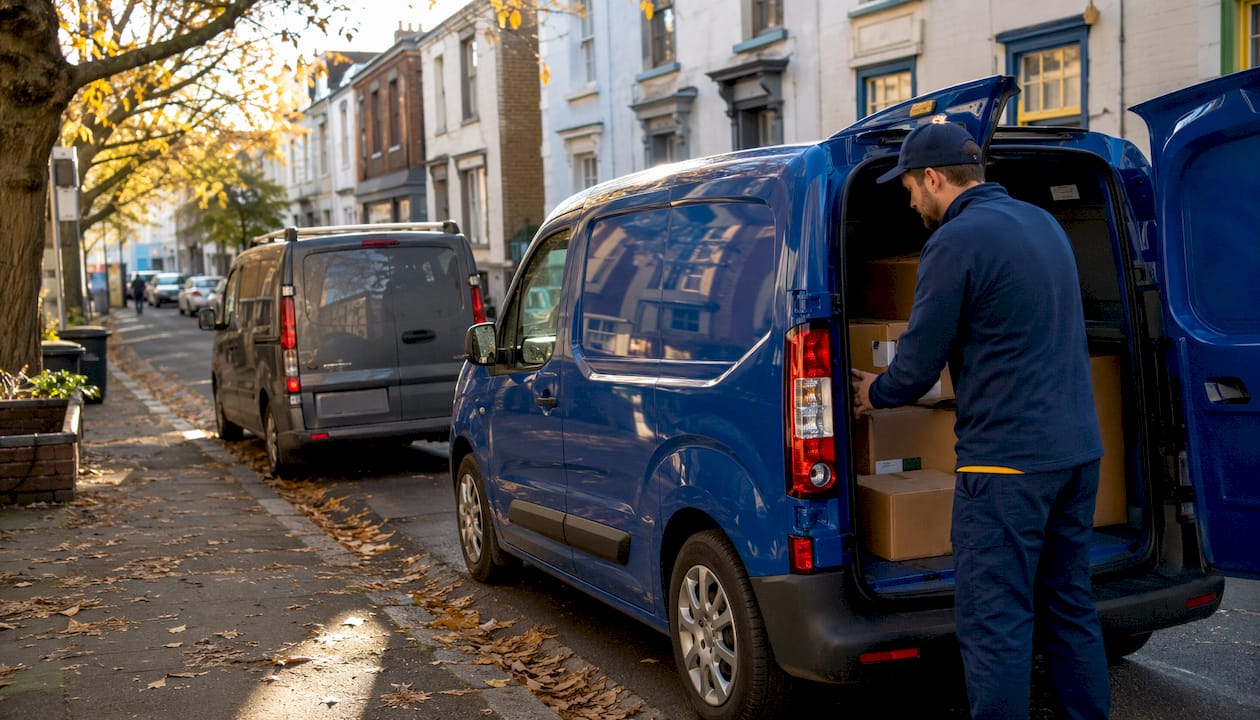
Citroën Berlingo and Peugeot Partner (closely related under the Stellantis platform) offer up to approximately 4.4 m³ of load space and a payload of around 1,000 kg depending on variant. These models fit within the small/compact van tier at approximately 2 m³–4.4 m³ load space, consistent with UK size categories. Their low loading height and wide rear doors make them particularly practical for high-frequency multi-drop parcel routes.
Volkswagen Caddy Cargo suits operators who want a smaller van with a higher-quality interior finish, useful when the vehicle doubles as a client-facing transport for time-sensitive or premium deliveries.
Medium vans for mixed urban and regional routes
Medium vans such as the Ford Transit Custom and Vauxhall Vivaro strike the best balance between load capacity and manoeuvrability for couriers handling moderate volumes across mixed urban and suburban routes. The Transit Custom in particular dominates UK courier fleets because of its payload flexibility, wide dealer network, and strong residual values.
Large vans for high-volume and palletised loads
The Mercedes-Benz Sprinter offers load compartment volume up to approximately 15.5 m³ in its largest configuration, making it the preferred choice for high-volume parcel routes or bulky goods. The Renault Master and the closely related Peugeot Boxer, Citroën Relay, and Vauxhall Movano (all sharing the same platform) offer load volumes up to approximately 17 m³ and high payloads, suited to bulk deliveries or routes with heavy or voluminous loads.
Loading ease, including rear door size and tail-lifts, is an essential consideration for bulky or palletised loads typical of large vans and Luton trucks. A tail-lift adds weight and reduces payload, so operators should calculate the net payload after fitment before committing to a specification.
Electric and low-emission options
Courier operators increasingly use electric vans to meet emissions regulations in UK cities with low emission zones, balancing environmental commitments with operational demand. Electric variants of the Ford Transit, Renault Master (E-Tech), and Citroën Berlingo are now available and viable for urban routes where daily mileage stays within battery range.
Motorcycles and bicycles for last-mile delivery
For rapid urban parcel delivery, motorcycle couriers offer unmatched speed through congested city traffic. Cargo bicycles and e-bikes are increasingly used for last-mile delivery in pedestrianised zones where vans cannot operate.
Customisation options
- Refrigeration units: factory or aftermarket refrigeration maintains temperature ranges required for food, pharmaceutical, or biological specimen transport
- Racking and shelving systems: fixed or adjustable shelving maximises load organisation and reduces damage on multi-drop routes
- Tail-lifts: hydraulic tail-lifts enable ground-level loading of heavy or fragile cargo without manual lifting
- Security partitions and locking systems: essential for high-value goods transport; some insurers require them as a condition of cover
- Tracking and telematics: GPS units and fleet management software integrate with most modern van platforms to support route planning and proof-of-delivery
Pro Tip: Before fitting aftermarket refrigeration or shelving, confirm the net payload impact with your vehicle supplier. A full racking system can reduce usable payload by 150–300 kg, which may push a lightly-specced van below the threshold needed for your typical load.
How should you structure a small courier fleet by vehicle size tier?
The UK vehicle size tiers for courier work are small/compact vans (2–4.4 m³), short wheelbase vans (5–6 m³), long wheelbase vans (7–9 m³), and Luton box vans (12–18 m³). Each tier sits within the Category B licence weight limit, enabling small businesses to operate a mixed fleet without requiring additional driver licence categories.
For a small courier business, fleet composition should reflect your actual load profile rather than aspirational capacity. A single long wheelbase van paired with one compact van covers most urban and regional parcel work without the overhead of a large van that runs half-empty on lighter days. Adding a Luton van opens up pallet delivery and furniture-grade loads, which typically command higher rates per job.
Practical guidance for composing a small fleet:
- Start with your most common load: if 80% of your jobs are small parcel multi-drop, a compact or short wheelbase van is your workhorse; add capacity as volume grows
- Licence planning: all vehicles up to 3.5 tonnes GVW are Category B; plan driver licences before purchasing heavier vehicles to avoid operational gaps
- Mix sizes deliberately: a compact van handles city work efficiently while a long wheelbase van covers regional runs; running both avoids sending an oversized vehicle on a light urban route
- Insurance per vehicle type: each vehicle in your fleet needs its own courier-specific policy; fleet policies become cost-effective once you operate three or more vehicles
- Review load data regularly: track average load weight and volume per route monthly; this tells you when a vehicle tier change is justified by actual demand rather than guesswork
- Compliance per vehicle: each vehicle must meet the emission standard for the zones it operates in; a mixed fleet may require different vehicles for different city routes
For operators whose requirements extend beyond the 3.5-tonne limit, Sddbyaba operates a full fleet from small vans through to artic lorries, covering every load tier from urgent parcels to heavy freight. Whether you need a dedicated courier vehicle for a time-critical consignment or a nationwide courier solution for regular freight movement, the right vehicle match is built into every job. For multi-vehicle coordination across complex routes, a structured multi-leg logistics workflow approach ensures each vehicle tier is deployed where it adds most value.
Pro Tip: When projecting fleet growth, model two scenarios: one based on current volume and one based on a 30% increase. If the larger scenario still fits within the same vehicle tier, hold your current spec and invest the capital difference in maintenance reserves instead.
Key takeaways
Courier vehicle selection requires matching payload, cubic capacity, route type, and regulatory compliance to your specific operational demands before committing to any vehicle purchase or lease.
| Point | Details |
|---|---|
| Payload and cubic capacity | Calculate both figures for the exact variant you intend to use; weight and volume limits bind at different points depending on cargo density. |
| UK size tiers | Small vans (2–4.4 m³) through to Luton box vans (12–18 m³) all sit within the Category B 3.5-tonne licence limit. |
| Emissions compliance | Vehicles operating in ULEZ or LEZ areas must meet Euro 4 (petrol) or Euro 6 (diesel) standards to avoid daily charges. |
| Insurance requirements | Courier work requires specialist goods in transit cover; standard van insurance does not cover goods carried for hire or reward. |
| Fleet composition | Mix vehicle sizes to match actual load profiles; a compact van for urban multi-drop and a long wheelbase van for regional routes covers most small business needs. |
Work with a courier fleet built for every load tier
Sddbyaba operates a full-range fleet across the UK, from motorcycle couriers and compact vans to 26-tonne artics and lorries. Every vehicle is matched to the job, not the other way around. Whether you need a same day courier for an urgent consignment, freight haulage for heavy loads, or 18-tonne haulage for large-scale freight movement, Sddbyaba provides dedicated, compliant, and reliable transport solutions nationwide. Contact us to discuss the right vehicle for your delivery requirements.