
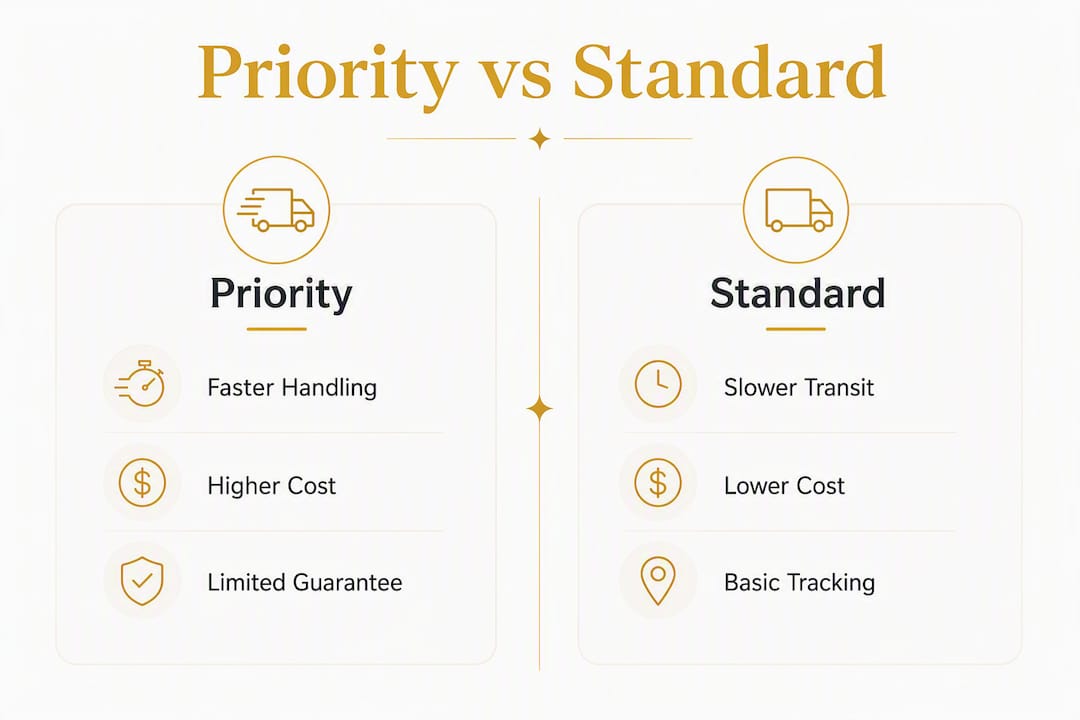
Courier priority service is an expedited handling tier that moves a consignment ahead of standard queue-based shipments, reducing transit time and improving handling reliability throughout the carrier's network. Think of it as a faster lane through the same road system, not a private road. The parcel still travels through the carrier's hub-and-spoke infrastructure, but it jumps the queue at each processing point.
TL;DR
- Priority service gives your consignment front-of-line processing, enhanced tracking, and often signature-on-delivery, but it is typically a target window rather than an absolute guarantee.
- Royal Mail Special Delivery Guaranteed is the most widely recognised UK example of a time-definite postal priority product, offering next-day delivery by 1pm or 9am with compensation cover.
- Dedicated same-day courier (a direct vehicle assigned solely to your job) is the stricter alternative when the deadline is immovable or the cost of delay is high.
- Typical use cases: urgent legal documents, production-critical spare parts, medical consignments, and high-value goods where late delivery carries a measurable financial or operational consequence.
Table of Contents
- How does courier priority service actually work?
- What features and costs come with priority delivery?
- How does priority compare with other UK courier options?
- How do you decide which service to book?
- Common mistakes businesses make with priority delivery
- When should you choose a dedicated same-day vehicle instead?
- Key takeaways
- The gap between 'priority' and 'guaranteed' is wider than most businesses realise
- Sddbyaba: dedicated courier and same-day dispatch across the UK
- Useful sources and further reading
How does courier priority service actually work?
The time savings from a priority booking do not come from a faster vehicle. They come from faster processing at every logistics touchpoint before the vehicle even moves.
When a carrier marks a consignment as priority, it receives a distinct label that triggers front-of-line handling at the depot. Sorters process it before standard parcels, it enters the outbound vehicle earlier, and at any intermediate hub it bypasses the standard queue again. For international shipments, priority status can also accelerate customs documentation queuing, though customs clearance itself remains outside any carrier's control.
There is an important distinction between two types of priority. Network-level priority speeds a parcel through the same hub-and-spoke system every other parcel uses; the vehicle still carries multiple consignments. Vehicle-level priority, or a dedicated direct service, assigns a single vehicle exclusively to one job, bypassing hubs entirely. True priority in UK courier practice can mean consignments skip central sorting hubs altogether when assigned to a dedicated vehicle; network priority only speeds processing through the existing system.
Limits apply regardless of service level. Severe weather, road closures, and final-mile access issues affect every tier. Customs holds on international parcels are outside carrier control. And critically, if your own warehouse or dispatch team is slow to hand over the parcel, the priority label achieves nothing. The priority booking starts the clock from the moment the carrier collects, not from the moment you place the order.
What features and costs come with priority delivery?
Key features you should expect
Priority services typically include a defined set of enhancements over standard delivery:
- Enhanced real-time tracking — with more frequent scan events, so you can monitor progress at each stage rather than waiting for a single "out for delivery" update.
These features suit high-value goods and business-critical consignments where the cost of a lost or delayed parcel exceeds the premium paid for the service tier.
How carriers price priority services
Pricing is driven by several compounding factors: weight and volumetric dimensions, distance and zone, the specific service band (priority versus top-tier express), declared value for insurance purposes, and any time-window commitment such as a guaranteed AM delivery slot. Priority sits between standard and express in both speed and price. It is often more budget-friendly than top-tier express options but offers fewer formal guarantees in return.

The most practical way to evaluate the premium is to calculate your cost of delay. If a missed delivery means a production line stops for four hours, or a legal filing deadline is missed, the financial exposure almost certainly exceeds the difference between a standard and priority booking. Where the cost of delay is high, the priority premium is not a cost; it is risk mitigation.
How does priority compare with other UK courier options?
Priority sits in the middle of the courier service spectrum. Understanding where it sits relative to standard, express, and dedicated same-day options is what allows you to match the right service to the right job.

Priority and expedited/express services overlap but differ in coverage and the formality of their guarantees. Priority is generally more affordable than top-tier express but carries fewer contractual commitments on delivery time.
| Service type | Typical UK window | Guarantee / compensation | Tracking & proof | Cost shape | Best use cases |
|---|---|---|---|---|---|
| Standard network | 2–5 business days | No time guarantee; basic loss cover | Basic scan events | Lowest | Non-urgent, low-value parcels |
| Priority network | a few business days | Target window; improved but variable compensation | Real-time scans, signature option | Moderate premium | Urgent but flexible deadline; high-value goods |
| Express / next-day | Next business day (AM slots available) | Time-definite; stronger compensation | Full tracking, signature | Higher premium | Hard next-day deadlines; business-critical documents |
| Royal Mail Special Delivery | Next day by 9am or 1pm | Guaranteed; statutory compensation bands | Full tracking, signature required | Fixed Royal Mail tariff | Legal documents, valuables, regulated items |
| Dedicated same-day | Same day, point-to-point | Contractual; vehicle assigned solely to job | Real-time, direct driver contact | Highest; priced per job | Immovable deadlines, production-critical parts, medical |
Royal Mail Special Delivery Guaranteed is the clearest UK example of a time-definite postal priority product. It offers a named delivery deadline with compensation cover, making it a reliable reference point for what a genuine guarantee looks like in practice. Network priority services from parcel carriers are faster than standard but rarely offer the same contractual certainty.
A dedicated same-day vehicle removes routing risk entirely. Because the vehicle carries only your consignment, there is no dependency on hub schedules, other customers' parcels, or network capacity. The trade-off is cost: dedicated services are priced per job rather than per parcel weight band.
How do you decide which service to book?
Work through these questions before confirming any booking. They take two minutes and can prevent a costly mismatch between service level and actual need.
- How rigid is the deadline? A target window is acceptable for most business shipments. An immovable deadline (court filing, production line restart, surgical supply) requires a contractual guarantee or a dedicated vehicle.
- What is the cost of delay? Calculate the financial or operational impact of a missed delivery. If it exceeds the premium for a dedicated service, book the dedicated service.
- What is the item's declared value? Check the carrier's compensation limit for the service tier. If the item's value exceeds that limit, add declared-value insurance or choose a service with higher cover.
- Do you need proof of delivery? Signature-on-delivery is standard with most priority and express tiers but not always with standard services. Confirm before booking.
- Is there a customs element? International priority shipments still clear customs. Build in realistic customs time and confirm the carrier's documentation support.
- How fast is your own dispatch process? A priority booking is wasted if the parcel sits in your warehouse for three hours after the order is placed. Align your internal cut-off with the carrier's collection window.
Questions to ask your carrier before confirming:
- What is the exact compensation limit for this service tier and declared value?
- Is the delivery window a target or a contractual guarantee?
- How granular is the tracking, and at what intervals are scan events generated?
- For international shipments: does the carrier handle customs documentation, or does that fall to the shipper?
When the deadline is same-day and the job cannot tolerate routing delays, upgrade to a dedicated courier service rather than relying on network priority. The cost difference is predictable; the cost of a missed deadline often is not.
Common mistakes businesses make with priority delivery
Assuming the time window is a guarantee
The most frequent and costly mistake is treating a priority target window as a contractual guarantee. Most network priority services aim for a few business days but do not compensate for delays within that window the way a guaranteed product does. Read the carrier's terms before booking, not after a missed delivery.
Failing to match internal dispatch speed
A priority label on a parcel that sits in your warehouse until 4pm achieves nothing. The carrier's clock starts at collection. Align your internal cut-off time with the carrier's latest collection window, and communicate that cut-off to whoever is responsible for packing and handing over the consignment.
Pro Tip: Set an internal dispatch cut-off 30 minutes before the carrier's latest collection time. This single operational adjustment preserves the value of a priority booking more reliably than any service upgrade.
Misunderstanding compensation limits
Compensation under most network priority services is capped, often well below the value of business-critical goods. Declared-value insurance is usually available as an add-on but must be selected at booking. Assuming the carrier will cover full replacement value without checking the policy is a common and expensive error.
Poor address validation
An incorrect postcode or missing access instructions can delay final-mile delivery regardless of service tier. Automated address validation at the point of order entry removes this risk at negligible cost. For urgent delivery tracking to function correctly, the destination data must be accurate from the start.
Neglecting recipient coordination
Priority services often carry short delivery windows. If the recipient is unavailable, a redelivery attempt adds a full day. Notify the recipient of the expected window and confirm access arrangements before the vehicle departs.
When should you choose a dedicated same-day vehicle instead?
Network priority is the right call for most urgent shipments where the deadline has some flexibility and the cost of delay is moderate. A dedicated vehicle becomes the correct choice when those conditions no longer hold.
Sddbyaba handles jobs across construction, manufacturing, healthcare, and legal sectors, and the threshold for recommending a dedicated vehicle is consistent across all of them: if the delivery window is tighter than the network's same-day service level agreement, or if the cost of a missed delivery is severe, a direct vehicle is the only reliable option.
Concrete examples where network priority is insufficient:
- Production line stoppage. A manufacturing plant waiting on a single component cannot absorb a hub delay. A dedicated vehicle with a direct route and a named driver removes that variable entirely.
- Time-critical medical consignments. Surgical supplies, temperature-sensitive pharmaceuticals, and diagnostic samples carry deadlines that are clinical, not commercial. Network routing introduces risk that a dedicated vehicle eliminates.
- Sealed legal documents with immutable deadlines. Court filing deadlines do not flex. A dedicated vehicle with chain-of-custody tracking and direct handover to the recipient is the appropriate service.
Sddbyaba operates a fleet from motorcycle couriers and small vans through to 7.5, 12, 18, and 26 tonne trucks and artic lorries. For a single urgent document, a motorcycle or car courier provides the fastest point-to-point transit in urban areas. For palletised production-critical parts, a 7.5 tonne vehicle or larger handles the load without the constraints of a parcel network. The vehicle is matched to the consignment, not the other way around. Guidance on matching fleet choice to job type is covered in detail in Sddbyaba's courier fleet management guide.
For any job where the emergency courier reliability factors point toward a dedicated vehicle, the decision framework is straightforward: calculate the cost of delay, compare it to the dedicated service price, and book accordingly.
Key takeaways
Priority courier service is a risk-mitigation tool for UK businesses: it reduces transit variability and protects critical workflows, but a dedicated same-day vehicle remains the only option when the deadline is immovable and the cost of failure is high.
| Point | Details |
|---|---|
| Priority is a faster lane, not a guarantee | Network priority improves handling speed but is typically a target window, not a contractual commitment. |
| Calculate cost of delay first | If the financial impact of a missed delivery exceeds the dedicated vehicle premium, book the dedicated service. |
| Check compensation limits before booking | Carrier compensation caps often fall below the value of business-critical goods; add declared-value insurance where needed. |
| Internal dispatch speed matters | A priority booking is nullified if the parcel is not ready for collection at the carrier's cut-off time. |
| Sddbyaba for dedicated same-day jobs | Sddbyaba provides dedicated vehicle transport nationwide, from motorcycle couriers to artic lorries, for time-critical consignments. |
The gap between 'priority' and 'guaranteed' is wider than most businesses realise
The courier industry's use of the word "priority" is not standardised. One carrier's priority service is another's standard express, and the compensation terms attached to each vary considerably. What the SERP consensus and most carrier marketing pages understate is how much of the actual delivery outcome depends on the shipper's own process rather than the carrier's service tier.
The businesses that get the most value from priority services are not necessarily the ones booking the most expensive tier. They are the ones who have aligned their internal dispatch process with the carrier's collection window, validated their address data, and taken thirty seconds to check the compensation limit before clicking confirm. The service level is the ceiling; the shipper's preparation is the floor.
Where the deadline is genuinely immovable, the honest answer is that network priority, however well-marketed, introduces variables that a dedicated vehicle removes. The cost difference is real but predictable. The cost of a missed production deadline, a failed legal filing, or a delayed surgical supply is neither predictable nor recoverable. That asymmetry is what makes the dedicated vehicle decision straightforward once the numbers are on the table.
Sddbyaba: dedicated courier and same-day dispatch across the UK
When a priority booking is not enough and the deadline cannot move, Sddbyaba provides a direct alternative: dedicated vehicle transport with same-day dispatch, nationwide UK coverage, and a fleet sized to the consignment rather than the parcel network's constraints.
For urgent documents, a motorcycle or car courier delivers point-to-point without hub delays. For palletised freight, production-critical parts, or medical consignments, Sddbyaba's fleet scales from small vans to 26 tonne trucks and artic lorries. Every job is assigned a dedicated vehicle, which means no shared routing, no hub dependency, and no network capacity constraints on the day you need it most.
Sddbyaba serves construction, manufacturing, healthcare, retail, and legal sectors across the UK. If your consignment has an immovable deadline or a high cost of delay, request a same-day quote or contact the team directly for urgent bookings. For dedicated point-to-point transport, the dedicated courier service page covers vehicle options, coverage, and how to book.
Useful sources and further reading
- What are courier services and how do they work? — LegalClarity
- What is a courier? — Shopify
- Fast vs priority courier services: a comparison — Urgent Express
- Comparing expedited and priority shipping — ShipScience
- How fast is priority shipping really? — GetSelfServe
- Courier — Wikipedia
- Same-day courier and dedicated vehicle services — Sddbyaba
- Why courier tracking improves trust in delivery — Sddbyaba Blog