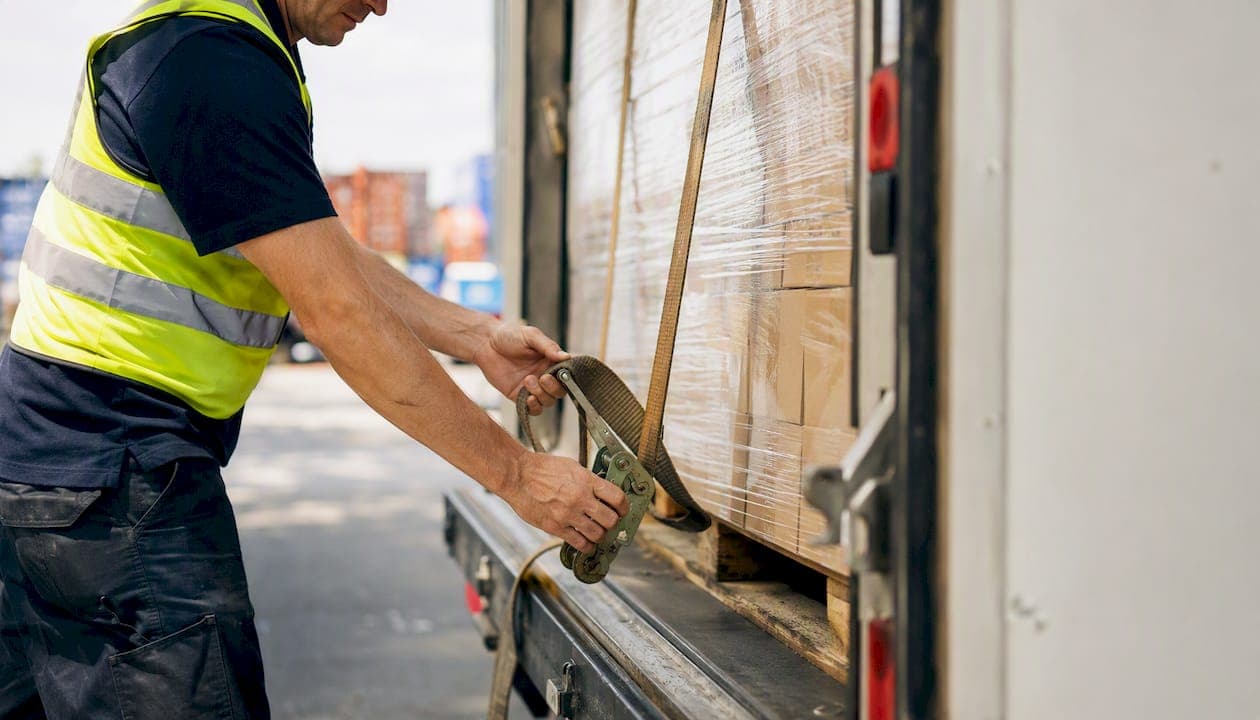
For any imminent line-stop risk, book a dedicated same-day vehicle immediately. That single action protects your production SLA faster than any other option. Sddbyaba provides urgent delivery services for manufacturing operations across the UK, with a mixed fleet from motorcycles to 26-tonne and artic trucks, WMS/TMS integration, real-time tracking, and proof-of-delivery capture as standard.
Before you call, have these ready:
- Pickup address and precise delivery point (dock number, line-side bay, or goods-in contact)
- Part number, serial, or job reference for the consignment
- Required arrival window and any site access restrictions
- Declared value and any special handling flags (fragile, heavy, temperature-sensitive)
Pro Tip: When a line-stop is imminent, escalate directly to a dedicated vehicle and specify driver-to-worksite handover. A shared courier run saves cost but adds dwell time you cannot afford when a line is down.
Key takeaways
Urgent delivery services for manufacturing require a dedicated vehicle, pre-agreed SLAs, and WMS/TMS integration to protect production continuity and minimise line-stop risk.
| Point | Details |
|---|---|
| Book a dedicated vehicle first | For any line-stop risk, a dedicated same-day vehicle with driver-to-worksite handover is the fastest recovery action. |
| Match vehicle to load and urgency | Fleet choice from motorcycle to 26-tonne artic determines both ETA and cost; undersizing causes failure. |
| Negotiate SLAs before you need them | Pre-agreed emergency response agreements with defined remedies outperform ad-hoc booking on cost and reliability. |
| Integrate with WMS/TMS | Courier API or portal connectivity removes manual coordination and feeds ETA data back into production systems. |
| Sddbyaba covers the full range | Nationwide UK fleet from motorcycle to artic, with emergency delivery, pallet freight, and WMS/TMS integration available. |
Table of Contents
- What do urgent delivery services for manufacturing actually cover?
- Which manufacturing scenarios actually need urgent delivery?
- What vehicle and service type should you book for each load?
- How do you choose the right urgent delivery partner for manufacturing?
- How does urgent delivery integrate with your production workflows?
- What happens from booking to on-site handover?
- What drives the cost of an urgent manufacturing delivery?
- Operational checklist to reduce urgent delivery failures
- Why Sddbyaba is procurement-ready for UK manufacturers
- An honest perspective on urgent manufacturing logistics
- Sddbyaba: get a quote for your next urgent manufacturing run
- Further reading and sources
What do urgent delivery services for manufacturing actually cover?
Urgent delivery services for manufacturing sit at the intersection of speed, reliability, and operational precision. They cover same-day courier dispatch, dedicated vehicle runs, pallet and haulage urgent movements, and, for international critical spares, express air or on-board courier options. The defining characteristics are immediacy (pickup within the hour in most cases), single-point contact throughout the run, and documented proof of delivery.
Service models typically fall into three shapes:
- Per-run booking: ad-hoc, on-demand dispatch for unplanned events such as machine breakdowns or quality holds
- Emergency response agreements: pre-negotiated terms with guaranteed response times and pre-approved vehicle classes, activated by a single call or system trigger
- Retainer arrangements: contracted capacity reserved for a site or production line, with agreed SLAs, pricing, and escalation contacts
The types of critical manufacturing deliveries vary considerably by urgency, load, and destination, so matching the service model to the operational scenario is the first decision procurement needs to make.
Which manufacturing scenarios actually need urgent delivery?
Not every supply disruption justifies an emergency run, but several scenarios consistently do. Understanding which situation you are in determines both the vehicle class and the SLA you need to negotiate.
- JIT line feeding and Kanban replenishment: a missed replenishment cycle can halt an entire production cell within minutes; same-day dispatch is the standard recovery mechanism
- Unplanned machine breakdowns: critical spare parts and, in some cases, the technician carrying them need to arrive within a defined window to limit downtime costs
- Quality holds and cross-site sample transfers: a component held pending test results at one site needs to reach the quality lab and return before the production window closes
- Line restart after tooling or mould failure: urgent tooling movements often involve heavy, awkward loads that require a tail-lift or flatbed, not a standard van
- Seasonal and campaign rushes: short-notice component shortages during peak build periods, where the planned supply chain cannot flex fast enough
Pro Tip: For breakdown spare parts specifically, pre-agree a parts-ready protocol with your maintenance team so the consignment is packaged and labelled before the courier arrives. Every minute of dwell time at pickup is a minute added to your line-stop. See the breakdown parts urgent delivery guide for a step-by-step pickup checklist.
Understanding how emergency deliveries prevent downtime is the clearest way to quantify the ROI of a pre-agreed emergency response agreement versus ad-hoc booking.
What vehicle and service type should you book for each load?
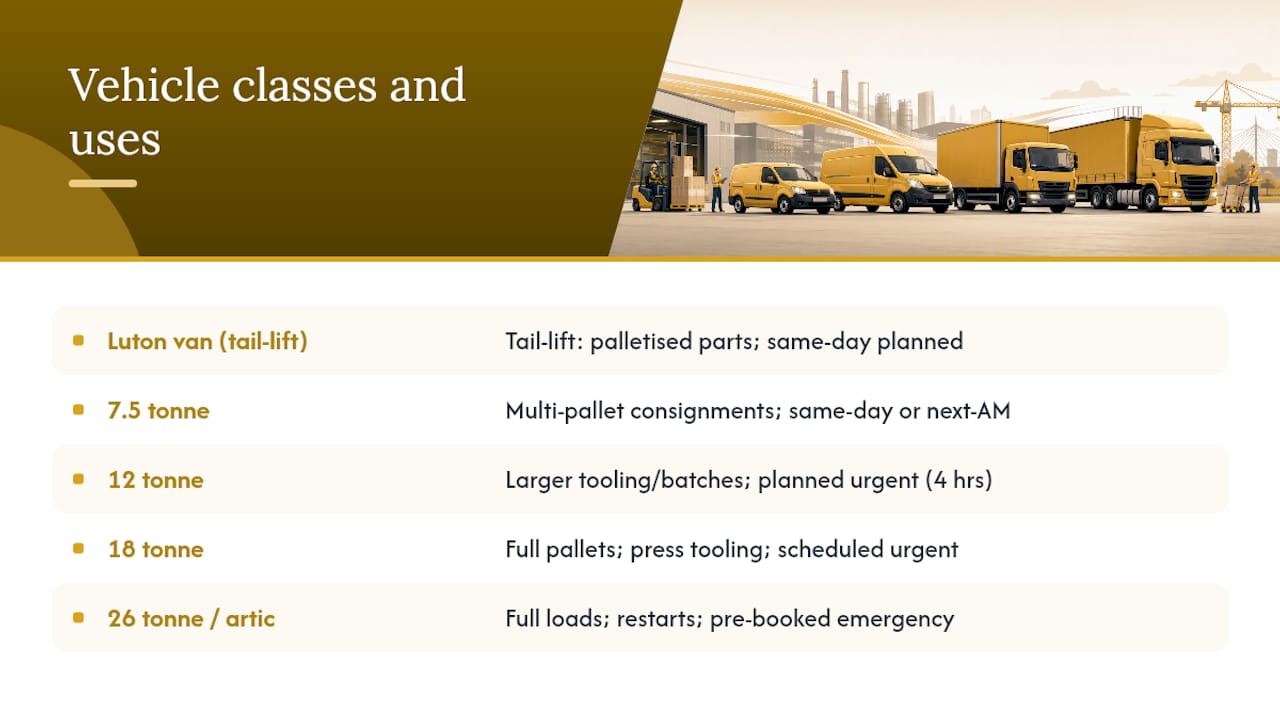
The right vehicle is determined by payload, handling requirements, ETA window, and site access. Booking an undersized vehicle to save cost is one of the most common causes of delivery failure on urgent manufacturing runs.
| Luton vans equipped with tail-lifts suitable for palletised parts and heavier tooling | Planned urgent same-day delivery | 7.5 tonne | — | Multi-pallet consignments | Same-day or next-AM | | 12 tonne | — | Larger tooling, batch components | Planned urgent, 4 hours | | 18 tonne | — | Full pallet runs, press tooling | Scheduled urgent | | 26-tonne or articulated trucks carry full loads for production line restarts, typically arranged as pre-booked emergency shipments |
For international critical spares where domestic options cannot meet a strict time-definite window, on-board courier or charter air options exist, though these sit outside standard same-day industrial shipping and require specialist arrangement.
Commercial logistics and pallet freight using heavier vehicle classes are well-suited to manufacturing sites requiring bulk urgent movements alongside dedicated courier runs.
How do you choose the right urgent delivery partner for manufacturing?
Procurement teams shortlisting providers for fast manufacturing logistics need to assess capability, operational controls, systems integration, and commercial terms together, not in isolation.
Capability checks:
- Mixed fleet covering motorcycle to artic, available 24/7
- Nationwide coverage across your required lanes, including multi-site operations
- Demonstrated experience with heavy, fragile, or temperature-sensitive consignments
- Named escalation contacts, not just a general call centre
Operational checks:
- Published SLA terms with defined remedies for late delivery
- Live tracking with predictive ETAs, not just a static booking reference
- POD capture (photo, signature, timestamp) delivered to your inbox or system
- Documented exception management process
Systems and integration:
- WMS/TMS connectivity via API, EDI, or portal access
- A decision-intelligent TMS centralises dispatch and carrier allocation, reducing manual intervention and improving SLA adherence across high-volume manufacturing distribution networks
- Ask for a reference or proof point on prior WMS/TMS integrations
Commercial checks:
- Pricing model clarity: per-run fixed rate, time-and-mileage, or retainer
- Waiting and detention terms stated explicitly
- Insurance limits and declared value handling confirmed in writing
Pro Tip: Include a short technical questionnaire on WMS/TMS connectivity in your RFQ and add a 48-hour trial clause before committing to a full contract to better assess capabilities.
Shortlisting steps in order:
- Issue a capability questionnaire covering fleet, coverage, SLA terms, and integration
- Request sample run pricing for your two most common urgent scenarios
- Run a 48-hour trial covering at least one live urgent consignment
- Review POD, tracking fidelity, and exception handling from the trial
- Negotiate SLA terms, remedies, and escalation contacts before signing
How does urgent delivery integrate with your production workflows?
WMS features that support JIT, Kanban, sequential, and batch line-feeding strategies directly reduce line shortages and inventory holding costs when paired with reliable emergency fulfilment, according to Logistics Reply's manufacturing logistics documentation.
A typical urgent run triggered by a production system follows this path:
- Breakdown or shortage signal raised in WMS/ERP
- Pickup instruction generated and transmitted to the courier via API or portal
- Carrier allocated and vehicle mobilised, with ETA fed back into the production system
- Live tracking visible to both logistics and production teams
- Driver handover at line-side with POD captured and transmitted
- Stock re-entry confirmed in WMS to close the replenishment loop
Sequencing and kitting for batch deliveries matter as much as speed. A consignment that arrives at the right time but in the wrong sequence, or missing one component from a kit, can still stop a line. Agree line-side delivery procedures and labelling standards with your courier before the first live run, not during an emergency.
What happens from booking to on-site handover?
Booking an urgent run correctly is as important as choosing the right vehicle. Missing information at the booking stage is the leading cause of delays on same-day industrial shipping runs.
Essential booking data:
- Pickup and delivery windows (hard deadlines, not preferences)
- Part IDs, serials, or job references
- Special instructions: tail-lift required, dock booking needed, hazardous goods declaration
- On-site handover contact name and mobile number
Execution stages:
- Booking confirmed, vehicle allocated, and driver briefed
- Pickup completed with condition check and initial POD
- Real-time tracking active, ETA updates sent to nominated contacts
- Arrival at delivery site, driver contacts on-site handover contact
- Final POD captured (photo, signature, timestamp) and transmitted
For exception handling, follow urgent delivery tracking best practices and ensure your provider has a documented re-routing and cross-dock contingency process. Out-of-hours runs require a separate escalation path; the out-of-hours emergency delivery guide covers staff handovers and overnight escalation contacts in detail.
What drives the cost of an urgent manufacturing delivery?
Price on an urgent freight run is determined by distance, vehicle class, urgency premium, and any additional handling requirements. There is no single flat rate, and any provider quoting one without knowing the load and lane should be treated with caution.
Primary cost drivers:
- Distance and route: longer lanes and complex multi-drop routes increase both time and cost
- Vehicle class: a dedicated artic costs materially more than a motorcycle courier for the same urgency level
- On-demand premium: booking within the hour carries a higher rate than a pre-booked emergency run agreed the day before
- Waiting and detention: unplanned dwell time at pickup or delivery is usually charged per 15 or 30 minutes
- Special handling: tail-lift, hazardous goods, or temperature-controlled requirements add to the base rate
- Permits: abnormal load or out-of-hours delivery permits where applicable
Common pricing models are fixed same-day rates (predictable, good for budgeting), time-and-mileage (transparent but variable), and retainer or response-contract pricing (best value for high-frequency urgent users). When presenting scenarios to suppliers for quotation, provide volume-weighted examples: your three most common urgent run types, with typical distance, load, and urgency window, so the supplier can price realistically rather than on a worst-case assumption.
Procurement teams that pre-agree retainer pricing for their two or three most frequent urgent run types consistently achieve better cost control than those who book ad-hoc every time. The SLA terms negotiated at retainer stage also tend to be stronger.
Operational checklist to reduce urgent delivery failures
- Confirm packaging, labelling, and part information are complete before the driver arrives
- Provide accurate site access instructions, including gate codes, dock numbers, and restricted hours
- Assign a named on-site contact with a mobile number for the duration of the run
- Activate live tracking immediately after booking and share the link with production
- Set ETA alerts at 60 minutes and 15 minutes before required arrival
- Verify POD on receipt and reconcile stock in WMS within 30 minutes of delivery
- Capture a brief lessons-learned note after any exception or near-miss
Red flags when evaluating providers: opaque or verbal-only exception handling, insurance limits that do not cover your declared values, tracking that updates only at pickup and delivery with no in-transit visibility, and no named escalation contact above the call centre level. The common emergency delivery mistakes guide covers the most frequent failure points in detail.
Why Sddbyaba is procurement-ready for UK manufacturers
Sddbyaba provides same-day courier, urgent delivery, pallet distribution, and haulage across the UK with a mixed fleet from motorcycles to 26-tonne and artic trucks, covering the full range of manufacturing consignment types from small spares to full production-line restarts.
Core capability proof points:
- Nationwide UK coverage with dedicated vehicle dispatch
- Fleet spanning motorcycle, car, small and medium vans, Luton, 7.5t, 12t, 18t, 26t, and artic
- Emergency delivery capabilities with rapid response for urgent consignments
- WMS/TMS integration, real-time tracking, and POD capture
- Industry experience across manufacturing, engineering, medical, and commercial logistics
- Published blog resources covering manufacturing delivery scenarios and protocols
Procurement fit for manufacturing is not just about having the right vehicles. It is about having the operational discipline to mobilise quickly, communicate clearly throughout the run, and deliver documented proof that the consignment reached the right person at the right time. These three things together protect a production SLA.
Procurement next steps: request a capability pack covering fleet availability, SLA terms, integration options, and escalation contacts; arrange a sample run on a live urgent consignment; and agree draft SLA terms before the first contracted run.
An honest perspective on urgent manufacturing logistics
What most providers get wrong about manufacturing urgency
The standard courier industry frames urgency as a speed problem. Get the van there faster, and the problem is solved. Manufacturing operations know this is incomplete. Speed to pickup matters, but so does sequencing, labelling, line-side handover discipline, and the quality of the exception call when something goes wrong at 2 AM.
The providers who genuinely serve manufacturing well are the ones who understand that a delivery arriving 20 minutes late with a clear ETA update and a named escalation contact is operationally better than one arriving on time with no communication and a missed handover. Production teams can plan around a known delay. They cannot plan around silence.
The other underestimated factor is integration. A courier who can receive a pickup instruction directly from your WMS and feed an ETA back into your production system removes an entire layer of manual coordination during an already stressful event. That capability is not universal, and it is worth asking for explicitly during procurement.
Sddbyaba: get a quote for your next urgent manufacturing run
When a line is at risk and you need a vehicle moving within the hour, Sddbyaba delivers. From a motorcycle courier carrying a critical spare across a city to a 26-tonne freight run restarting a production line, the fleet and operational capability are in place for UK manufacturers who cannot afford to wait.
Request an emergency delivery quote or arrange a sample run today. Prepare your part IDs, required arrival window, and preferred billing terms, and the team will confirm vehicle availability, SLA options, and pricing. For scheduled urgent freight, the commercial logistics service covers pallet distribution and heavier vehicle classes with the same SLA discipline.
Further reading and sources
Internal resources (Sddbyaba):
- Types of critical manufacturing deliveries: 2026 guide — categories and when to use each
- How emergency deliveries prevent downtime in 2026 — response protocols and production continuity examples
- Urgent delivery tracking best practices: 2026 guide — live tracking and POD workflows
- How to resolve urgent delivery failure quickly — exception handling and recovery steps
- Common emergency delivery mistakes businesses make — failure points and how to avoid them
Third-party resources:
- Locus: Manufacturing logistics — TMS dispatch planning, carrier allocation, and predictive ETA capability
- Logistics Reply: Manufacturing logistics solutions — WMS support for JIT, Kanban, sequential, and batch line-feeding strategies