
Handling breakdown parts urgent delivery is the process of sourcing, dispatching, and delivering critical spare parts rapidly to prevent costly operational downtime. In industrial and commercial settings, this practice is also known as emergency parts logistics or hot-shot freight. Unplanned machinery downtime costs between £16,000 and £65,000 per hour. That figure alone explains why getting the right part to the right bay at the right time is not a logistics preference. It is a business-critical requirement. Logistics managers in manufacturing, engineering, and construction who master this process protect both revenue and reputation.
How to handle breakdown parts urgent delivery effectively
Success in emergency parts logistics begins before the courier is ever booked. The quality of information you submit at the point of request determines whether the right part arrives on time or the wrong one arrives too late.
The following details are non-negotiable for any urgent parts request:
- Full collection and delivery addresses, including dock number, bay reference, and site access instructions
- Exact part description, including manufacturer name, model number, and serial number
- Clear photos of the failed component, nameplate, and any visible error codes
- Hard deadline, specifying the latest acceptable arrival time and any shift constraints
- Named contact at both ends, with direct mobile numbers for out-of-hours coordination
Precise bay and dock notes reduce critical handoff times during off-peak and after-hours shifts. This matters because many industrial breakdowns happen overnight or at weekends, when site staff are minimal and delays compound quickly.
High-detail RFQ submissions reduce the risk of incorrect parts and shorten sourcing times significantly. A photo of the component nameplate is worth more than a paragraph of description. Serial numbers, firmware versions, and error LED patterns all help suppliers match parts without back-and-forth queries.
Pro Tip: Coordinate with your onsite receiving team before the courier departs. Confirm who will be present, where the handover point is, and whether any access codes or permits are needed. A courier arriving at a locked gate with no contact number loses time you cannot recover.

How do specialised emergency couriers ensure timely delivery?
Not all courier services are built for emergency parts logistics. The difference between a standard parcel carrier and a specialised emergency courier is the difference between a part arriving at 9am and arriving at 3pm.
| Delivery Method | Typical Transit Time | Best For | Key Risk |
|---|---|---|---|
| Same-day dedicated courier | 1–4 hours (UK) | Urgent local or national parts | Higher cost per shipment |
| Hot-shot freight | 2–8 hours | Heavier or oversized components | Limited to road network |
| Overnight express | Next morning | Non-critical but time-sensitive parts | Misses same-day requirement |
| Air freight | 4–24 hours | International or remote locations | Customs and airport delays |
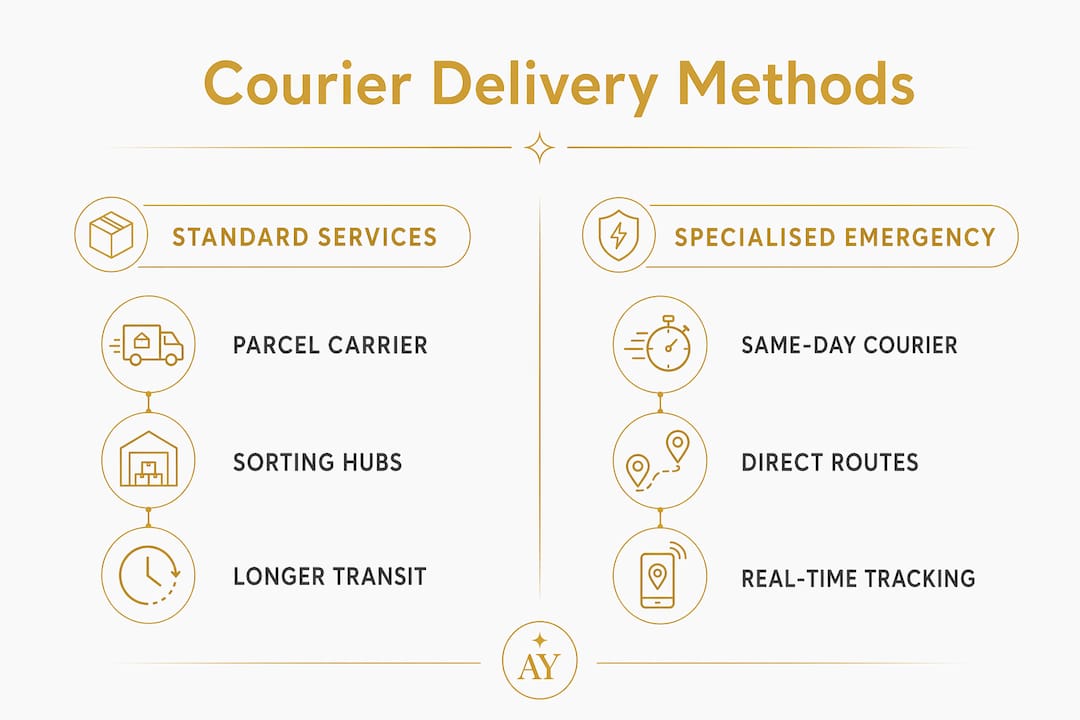
Direct point-to-point courier transport eliminates sorting hubs and reloading stops, ensuring faster transit and full chain-of-custody visibility. This is the defining feature of a genuine emergency logistics provider. Every additional depot stop introduces risk, delay, and the possibility of misrouting.
Collection times under 60 minutes are achievable within industrial hubs, with Europe-wide averages around 120 minutes. Providers with large, geographically distributed fleets achieve this by pre-positioning vehicles near key industrial zones rather than waiting for a booking before dispatching a driver.
Real-time GPS tracking is a standard expectation, not a premium add-on. It allows your operations team to monitor progress, adjust receiving arrangements, and communicate accurate ETAs to engineers waiting on site. Providers like Sddbyaba offer dedicated vehicle transport with live updates, so your team is never left guessing.
Pro Tip: Choose a courier with technical awareness of industrial parts. A driver who understands that a servo drive cannot be left in a cold van overnight, or that hydraulic components require upright transit, prevents damage that would make the delivery worthless.
What steps should managers follow from diagnosis to delivery?
A structured rapid-response process removes guesswork and compresses the time between fault detection and parts receipt. Follow these steps in order.
-
Diagnose the fault accurately. Contact the equipment manufacturer's technical support line directly. Expert engineers identify failed parts rapidly using error codes and LED patterns during emergency calls. Bypassing standard customer service channels and reaching technical specialists directly speeds up this stage considerably.
-
Prepare a detailed urgent RFQ. Include the part number, serial number, photos, quantity required, and your hard deadline. Submit to multiple verified suppliers simultaneously to maximise the chance of immediate stock availability.
-
Confirm supplier stock and realistic lead times. Do not assume availability. FANUC motors carry lead times of 6–12 weeks, ABB drives 4–8 weeks, and Yaskawa servo packs 3–6 weeks. If the OEM cannot supply immediately, a specialist parts broker or refurbished parts supplier may hold stock.
-
Book the courier with complete shipment details. Provide the collection address, delivery address with bay reference, part dimensions and weight, any handling requirements, and your named contacts at both ends. Confirm the vehicle type needed. A motorcycle courier suits a small electronic component. A Luton van or 7.5-tonne truck suits a hydraulic assembly.
-
Monitor in real time and prepare for receipt. Track the shipment actively. Have your engineering team ready at the delivery point. Verify the part against the order on arrival before signing off.
The following checklist supports step five:
- Confirm part number matches the order
- Check packaging integrity for transit damage
- Verify quantity received
- Log arrival time against the deadline
- Escalate immediately if anything is incorrect
What common pitfalls cause delays in emergency parts shipping?
Most failures in emergency parts logistics trace back to one of five avoidable mistakes. Knowing them in advance is the fastest way to prevent them.
-
Incomplete part information. Submitting a vague description such as "motor for conveyor line 3" without a part number or serial number forces suppliers to ask clarifying questions. Every query adds 30 to 60 minutes to the sourcing process.
-
Using non-specialised couriers. Standard parcel carriers route shipments through sorting depots. Direct-drive courier logistics eliminate sorting hubs and deliver parts to the bay exactly when promised. A next-day parcel service is not a substitute for a dedicated emergency courier.
-
Ignoring OEM lead times. Many managers assume that booking a fast courier solves the parts availability problem. It does not. If the part is not in stock anywhere in the UK, no courier speed compensates for a 12-week manufacturing lead time.
-
Failing to coordinate the receiving team. A courier arriving at an unmanned gate or an incorrect entrance wastes time that cannot be recovered. This is one of the most common and most preventable causes of delay.
-
Overlooking part compatibility. Ordering by description rather than exact part number risks receiving a visually similar but electrically or mechanically incompatible component. Always verify against the original equipment documentation.
"Many managers underestimate OEM lead times, making proactive spares stocking essential regardless of courier speed." AMD Machines Spare Parts Services
Pro Tip: Maintain a pre-approved list of critical spares for your highest-risk equipment. For components with lead times exceeding four weeks, holding one unit on the shelf is almost always cheaper than a single day of unplanned downtime.
For a broader view of time-critical delivery pitfalls, reviewing documented case studies from logistics specialists helps teams build institutional knowledge before a crisis occurs.
How can businesses reduce dependency on urgent parts delivery?
Emergency parts logistics is expensive. The most effective long-term strategy is reducing how often you need it, without eliminating the capability entirely.
Spare part criticality assessment should be based on operational impact, safety consequences, and procurement lead times rather than usage frequency alone. A component that fails once every three years but stops an entire production line is far more critical than a consumable replaced weekly.
The following factors define a high-priority stocking decision:
- Operational impact: Does failure halt production entirely or degrade output partially?
- Lead time: Is the part available off the shelf, or does it require weeks of manufacturing?
- Substitutability: Can an alternative part perform the same function in an emergency?
- Failure history: Has this component failed before on this or similar equipment?
Integrating an inventory management system with real-time stock data removes the guesswork from replenishment decisions. Systems that flag low stock on critical components automatically give procurement teams time to reorder before a crisis develops.
Inventory investment in critical spares yields a return on investment of 400–800% when measured against the cost of downtime it prevents. That figure reframes spare parts stocking from a cost centre to a risk management tool. The capital tied up in a shelf-held servo drive is trivial compared to a day of lost production.
Data-driven lifecycle management also reduces emergency dependency. Tracking component age, operating hours, and maintenance history allows teams to schedule replacements proactively rather than reactively. This approach is standard practice in aerospace and defence, and it translates directly to manufacturing and engineering environments.
Key takeaways
Effective emergency parts logistics requires precise information, specialised couriers, and proactive inventory management working together to prevent downtime.
| Point | Details |
|---|---|
| Information quality is decisive | Submit part numbers, serial numbers, and photos to avoid sourcing errors and delays. |
| Use dedicated emergency couriers | Direct point-to-point transport eliminates depot stops and delivers parts on time. |
| Diagnose before you dispatch | Contact technical support first to confirm the failed component before ordering. |
| Stock critical spares proactively | OEM lead times of 4–12 weeks make shelf-held spares a financial necessity, not a luxury. |
| Coordinate the receiving team | Confirm named contacts and access details at both ends before the courier departs. |
The detail that actually decides the outcome
I have seen well-funded logistics operations fail at emergency parts delivery not because of courier speed or supplier availability, but because of a single missing detail on the initial request. A wrong bay number. A site contact who did not answer their phone. A part ordered by description rather than serial number.
The uncomfortable truth is that most emergency parts delays are self-inflicted. The courier arrives on time. The part is wrong. Or the right part arrives and nobody is at the gate to receive it. These are process failures, not logistics failures.
What separates high-performing operations from reactive ones is preparation done before the breakdown occurs. That means pre-approved supplier lists, documented critical spares registers, and standing agreements with a reliable emergency courier. When a breakdown happens at 2am on a Sunday, you do not have time to research providers. You need a number you already trust.
Specialised couriers make a measurable difference in these scenarios. A provider with technical awareness, a distributed fleet, and genuine 24/7 dispatch capability is not the same as a standard next-day carrier offering an emergency surcharge. The distinction matters most when the pressure is highest.
For operations running complex automation equipment, I would also recommend building a direct relationship with the equipment manufacturer's technical support team before you need them. Knowing who to call and having your account details ready compresses the diagnosis stage from hours to minutes.
— Ayomide
How Sddbyaba supports urgent breakdown parts logistics
When a breakdown cannot wait, your logistics partner needs to move without hesitation. Sddbyaba provides same-day dedicated courier services across the UK, with direct point-to-point transport, real-time tracking, and a fleet ranging from motorcycle couriers to 26-tonne trucks. Whether you need a small electronic component collected from a supplier in Birmingham and delivered to a site in Leeds within three hours, or a heavy hydraulic assembly moved on a freight haulage vehicle, Sddbyaba dispatches the right vehicle for the job.
Sddbyaba operates nationwide with professional communication at every stage. Contact the team directly to discuss standing arrangements for emergency parts logistics or to book an urgent shipment now via Sddbyaba's nationwide dispatch service.
FAQ
What information do i need to book an urgent parts delivery?
Provide the exact part number, serial number, collection and delivery addresses with bay references, part dimensions and weight, a hard deadline, and named contacts at both ends. High-detail submissions reduce incorrect parts and shorten sourcing times significantly.
How fast can a dedicated emergency courier collect breakdown parts?
Collection within 60 minutes is achievable within industrial hubs. Providers with distributed fleets pre-position vehicles near key industrial zones to achieve rapid response times.
Why should i avoid standard parcel carriers for emergency parts?
Standard carriers route shipments through sorting depots, introducing delays and misrouting risk. Direct-drive courier logistics eliminate these stops and deliver parts to the correct bay exactly when required.
How do i reduce the frequency of emergency parts deliveries?
Conduct a criticality assessment of your key components and stock high-risk, long-lead-time parts on site. Inventory investment in critical spares delivers a return of 400–800% when measured against the cost of downtime it prevents.
What vehicle type do i need for urgent breakdown parts?
Vehicle selection depends on part size and weight. Motorcycle couriers suit small electronics, while Luton vans, 7.5-tonne trucks, or heavier haulage vehicles are appropriate for larger mechanical or hydraulic assemblies.