
Emergency parts delivery is defined as the urgent, time-critical transport of components, machinery parts, or equipment to a site where operations have stopped or are at risk of stopping. For manufacturers, construction companies, and logistics managers, the ability to arrange emergency parts delivery quickly is the difference between a two-hour fix and a two-day shutdown. The industry standard in 2026 requires five specific data points before any emergency shipment can be dispatched: pickup address, delivery address with dock or bay details, part description including dimensions and weight, delivery deadline, and an on-site contact name with a direct phone number. Getting these details right before you pick up the phone is the single most effective action you can take to cut response time.
What information do you need to arrange emergency parts delivery?
Incomplete shipment data is the leading cause of administrative delay in urgent logistics. Incomplete data causes 30–90 minutes of administrative delay in dispatch. That window is often longer than the actual transit time, which means poor preparation costs more than the journey itself.
Before contacting any courier, gather the following:
- Pickup address: Full postcode, building name, and any access instructions such as gate codes or security sign-in requirements.
- Delivery address: Full postcode plus dock number, bay reference, or receiving department name.
- Part description: Exact dimensions (length, width, height in centimetres), total weight in kilograms, and packaging type (pallet, crate, loose).
- Delivery deadline: Specific time and date, not "as soon as possible." Couriers schedule vehicle allocation based on hard deadlines.
- On-site contact: A named individual with a direct mobile number at both the pickup and delivery locations.
The table below shows how missing data affects dispatch speed.
| Missing detail | Typical delay caused |
|---|---|
| No dock or bay reference | Driver waits on arrival; 15–45 minutes lost |
| No part dimensions | Vehicle mismatch; re-dispatch required |
| No on-site contact number | Driver cannot gain access; delivery fails |
| No hard deadline | Low dispatch priority assigned |
Pro Tip: Prepare a one-page shipment brief template and keep it accessible to your operations team. When a breakdown occurs, filling in a pre-built form takes two minutes rather than twenty.
How do you choose the right vehicle and courier service?
Vehicle selection is not a secondary decision. Providing detailed part descriptions before confirming vehicle type prevents mismatches that cause severe on-site loading delays. A part that weighs 800 kg and arrives in a transit van with no tail lift will not move from the vehicle to the workshop floor without a forklift. If the delivery site has no forklift, the delivery fails.

Match vehicle type to part size and site constraints using this framework:
| Part type | Recommended vehicle | Key consideration |
|---|---|---|
| Small components under 100 kg | Long wheelbase van or Luton van | Speed and urban access |
| Medium machinery parts 100–500 kg | 7.5 tonne truck with tail lift | Tail lift essential if no dock |
| Heavy plant components over 500 kg | 18 tonne or 26 tonne truck | Confirm site access width |
| Oversized or containerised freight | Artic or container transport vehicle | Pre-book site access permit |
Beyond vehicle size, assess the courier's operational capabilities. Confirming recipient facility infrastructure such as loading dock availability or liftgate requirements is essential to avoid failed deliveries. A courier who asks these questions before dispatch is a courier worth using. One who does not is a liability.
Logistics experts advise prioritising providers who offer a single point of contact and direct driver communication. This prevents the "black hole" effect where a shipment goes quiet mid-transit and no one can confirm its location. For time-critical deliveries, that silence is unacceptable.
Pro Tip: Ask any courier directly: "Will I have a named driver contact and real-time tracking?" If the answer is vague, choose a different provider.
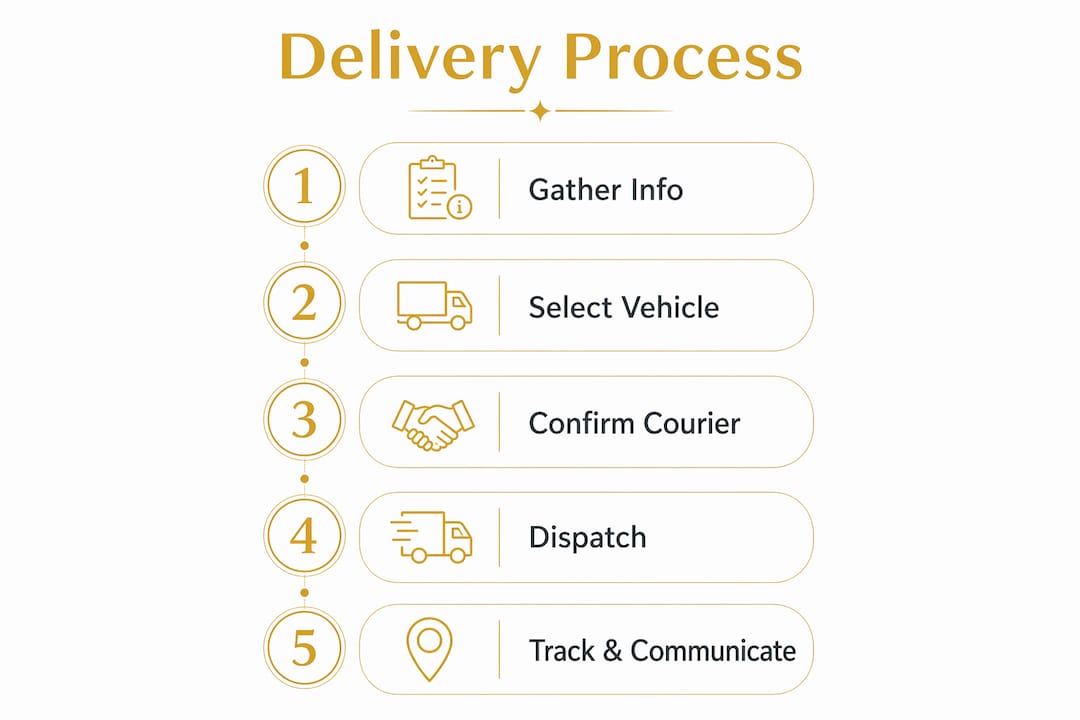
Step-by-step process to arrange urgent parts delivery efficiently
A clear process removes hesitation when every minute counts. Follow these steps to move from breakdown to confirmed dispatch in the shortest possible time.
-
Verify all shipment details. Confirm pickup address, delivery address with bay or dock reference, part dimensions and weight, hard delivery deadline, and on-site contact at both ends. Do not proceed until every field is complete.
-
Contact emergency courier services. Call directly rather than submitting an online form. Verbal confirmation of availability is faster and allows you to ask about vehicle suitability and driver contact protocols in real time.
-
Confirm vehicle allocation. State the part dimensions and weight explicitly. Ask the dispatcher to confirm the vehicle type and whether it carries a tail lift or pallet jack if required.
-
Define the handoff plan. Defining the handoff plan before the vehicle arrives at the delivery site avoids delays and ensures parts move directly from vehicle to technician without waiting. Specify the exact dock door, bay number, or technician name who will receive the part.
-
Monitor in real time. Use the courier's tracking system or maintain direct contact with the driver. Set a check-in time for halfway through the journey so you can flag any issues before arrival.
-
Verify delivery and obtain proof of receipt. Confirm the part has been received by the named contact. Request a signed proof of delivery or photographic confirmation. This closes the loop and protects you if a dispute arises.
Pro Tip: For repeat emergency scenarios such as regular plant breakdowns, build a pre-approved courier contact list with vehicle types, pricing, and driver contacts already confirmed. Activating a known provider takes minutes rather than hours.
Common mistakes that delay emergency parts delivery
The most common delivery mistakes include incomplete shipment data, unsuitable vehicle selection, and poor communication. Awareness of these errors and proactive management can reduce emergency delivery delays significantly.
The mistakes that cause the most damage are predictable and avoidable.
- Incomplete facility details. Failing to provide dock numbers, bay references, or access codes means drivers arrive and cannot proceed. This is the single most common cause of failed first-attempt delivery.
- Wrong vehicle for the part. Booking a small van for a 600 kg gearbox is not a minor error. It requires a full re-dispatch, which adds hours to the delay.
- No after-hours access confirmation. Many manufacturing sites and construction yards have restricted access outside core hours. If your delivery is scheduled for 21:00 and the gate closes at 18:00, the part sits in a vehicle overnight.
- Choosing on price alone. Selecting a courier based solely on price risks communication failures. The cheapest option rarely offers direct driver contact or a dedicated account manager.
When a delivery fails, act immediately. Contact the driver directly to confirm the vehicle's location. Call the facility manager at the delivery site to arrange alternative access or a new delivery window. If re-dispatch is required, treat it as a new emergency booking with full shipment details reconfirmed. Rapid recovery from failed deliveries requires direct contact with both drivers and facility managers to mitigate downtime impact.
Pro Tip: Keep a "failed delivery protocol" document on your operations desk. It should list driver contact numbers, facility manager contacts, and the steps to re-book within 15 minutes of a failed attempt.
Key takeaways
Arranging emergency parts delivery successfully requires complete shipment data, correct vehicle selection, and direct communication with both the courier and the receiving site before dispatch begins.
| Point | Details |
|---|---|
| Prepare five data points first | Pickup address, delivery address with bay details, part dimensions, deadline, and on-site contact are non-negotiable before dispatch. |
| Match vehicle to part and site | Confirm tail lift, dock access, and weight capacity before booking to prevent on-site loading failures. |
| Define the handoff plan | Specify the exact dock door, bay, or receiving technician so parts transfer immediately on arrival. |
| Choose communication over cost | Providers with a single point of contact and direct driver access reduce delays and prevent lost updates. |
| Act fast on failed deliveries | Contact driver and facility manager immediately and treat re-dispatch as a fresh emergency booking. |
What I've learned about emergency parts delivery after years in logistics
The biggest gap I see between businesses that handle breakdowns well and those that spiral into multi-day shutdowns is not budget or geography. It is preparation done before the crisis hits.
Most logistics managers I speak with treat emergency courier relationships as transactional. They call whoever is cheapest when a machine goes down. That approach works until it doesn't, and when it fails, it fails at the worst possible moment. The businesses that recover fastest have a short list of pre-vetted providers, with vehicle capabilities confirmed, pricing agreed, and a named contact saved in their phones. When the call comes at 02:00, they are booking within minutes.
The handoff plan is the detail most people underestimate. I have seen deliveries where the part arrived on time, the driver was professional, and the vehicle was correct, but the part sat on a loading bay for three hours because no one had told the night shift it was coming. That is not a courier failure. That is a planning failure. Specifying the receiving technician's name and direct number in the original booking brief costs nothing and saves everything.
Real-time tracking is not a luxury for emergency logistics. It is the baseline. If your courier cannot tell you where the vehicle is at any point during transit, you cannot manage the situation. The emergency courier reliability factors that matter most are transparency, direct communication, and the ability to adapt when something changes. Price is a distant fourth.
— Ayomide
Sddbyaba: same-day emergency parts transport across the UK
When a production line stops or a construction site loses critical equipment, you need a courier that is ready before you finish the call.
Sddbyaba provides same-day emergency delivery across the UK, with 24/7 dispatch, dedicated vehicles, and real-time tracking on every booking. The fleet covers everything from small vans for lightweight components to 26-tonne freight vehicles for heavy plant parts, with tail lifts and pallet jacks available where required. Manufacturers and construction companies use Sddbyaba because every booking comes with a single point of contact and direct driver communication, eliminating the communication gaps that turn a two-hour fix into a two-day shutdown. Request a quote at sddbyaba.com and have a vehicle confirmed within minutes.
FAQ
What is emergency parts delivery?
Emergency parts delivery is the urgent, dedicated transport of critical components to a site where operations have stopped or are at risk of stopping. It differs from standard courier services by prioritising speed, direct communication, and vehicle suitability over cost.
How do I arrange urgent parts delivery quickly?
Gather all five shipment data points (pickup address, delivery address with bay details, part dimensions and weight, deadline, and on-site contact) before calling a courier. Complete information removes the administrative delays that typically add 30–90 minutes to dispatch time.
What vehicle do I need for heavy engineering parts?
Parts weighing 100–500 kg typically require a 7.5 tonne truck with a tail lift. Parts over 500 kg need an 18 or 26 tonne vehicle. Always confirm whether the delivery site has a loading dock or forklift before booking.
Can I arrange emergency container transport in the UK?
Yes. Specialist couriers operating artic trucks and container transport vehicles handle oversized and containerised freight across the UK. Confirm site access width and any permit requirements before booking.
How do I recover from a failed emergency delivery?
Contact the driver immediately to confirm the vehicle's location, then call the facility manager at the delivery site to arrange alternative access. Treat re-dispatch as a new emergency booking with all shipment details reconfirmed from the start.