
A delivery exception is the industry term for any event that prevents a shipment from arriving as scheduled, and knowing how to resolve urgent delivery failure quickly is the difference between a recoverable situation and a lost customer. Most exceptions resolve within seven days if the right steps are taken immediately, but that window closes fast without decisive action. Carriers such as FedEx and UPS provide tracking tools and redelivery scheduling that, when used correctly, cut resolution time significantly. This guide gives you a precise, step-by-step framework to identify the failure type, act on it fast, and communicate clearly with both carriers and recipients.
How to resolve urgent delivery failure quickly: identify the problem first
The first step to fixing any urgent shipping issue is correctly diagnosing what type of failure you are dealing with. Not all delivery exceptions are equal, and treating a weather delay the same as an address error wastes critical time. Distinguishing a network delay from an address or signature issue directs you to the right corrective action immediately, potentially saving days in recovery.
The most common urgent delivery failures fall into these categories:
- Address errors: Incorrect postcode, missing flat number, or illegible label. These require immediate correction through the carrier's address amendment tool before the next delivery attempt.
- Failed delivery attempts: The driver attended but no one was available and no calling card was left. This is one of the most mishandled exceptions because recipients assume the parcel is lost.
- Customs delays: Common on international shipments where documentation is incomplete or duties are unpaid. Resolution requires direct contact with the customs broker or carrier's international team.
- Weather or operational disruptions: Temporary network delays that typically self-resolve within 24 to 48 hours. Proactive ETA updates to the recipient are the correct response here, not carrier escalation.
- Damaged or lost in transit: Requires formal claim filing with full documentation.
Reading the tracking scan history precisely is non-negotiable. Each scan entry contains a location code, timestamp, and status description. A status of "delivery attempted" without a subsequent "calling card left" scan is a red flag that warrants same-day escalation to the carrier. When you see consecutive "in transit" scans with no location change over 48 hours, that signals a physical hold or misroute rather than a simple delay.
Pro Tip: Screenshot the full tracking history the moment you identify an anomaly. Carriers frequently update or overwrite scan data, and your timestamped evidence becomes critical if you need to escalate or file a claim.
Which tools and methods enable fast resolution of delivery failures?
Speed in resolution comes from having the right tools ready before you need them, not scrambling to find them mid-crisis. The fastest first step for any failed delivery is always the carrier's own self-service redelivery tool. UPS My Choice, FedEx Delivery Manager, and Royal Mail's redelivery portal all allow recipients to reschedule or redirect a parcel without speaking to an agent, which is typically faster than phone queues.
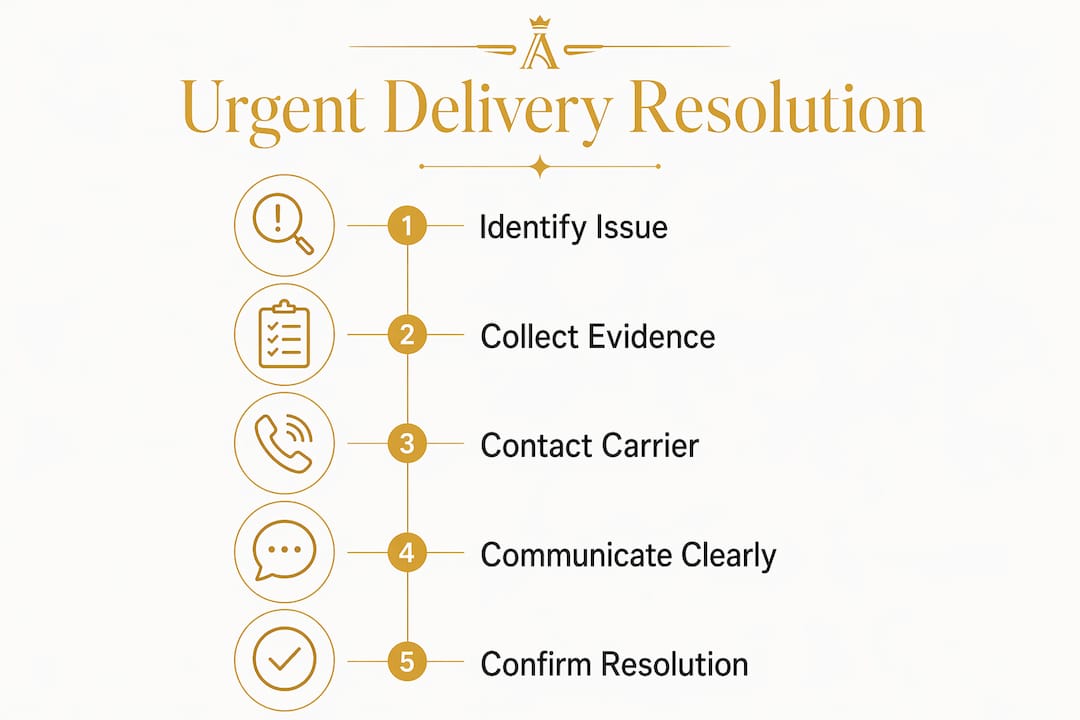
Beyond self-service, the single most effective preparation you can make is assembling a carrier evidence packet before you contact support. A complete evidence packet includes the tracking number, timestamped screenshots of every scan, photographs of any damage, the commercial invoice, and a concise written timeline of the issue. Agents process documented cases faster because they do not need to gather information from you during the call.
The table below compares the primary resolution methods and their typical timeframes:
| Method | Best used for | Typical resolution time |
|---|---|---|
| Carrier self-service redelivery portal | Failed delivery attempt, address amendment | Same day to 24 hours |
| Carrier live support with evidence packet | Misrouted, held, or damaged parcels | 1 to 3 business days |
| Formal damage or loss claim (e.g., UPS) | Confirmed damage or loss in transit | 10 to 15 business days |
| Recipient pickup from depot | Repeated failed attempts | Same day if depot is local |
| Same day courier re-dispatch | Time-critical consignments with no recovery window | Within hours |
SLA-based alerting and response-time workflows reduce the time between a failure being flagged and someone acting on it. For businesses managing volume shipments, setting automated alerts when a tracking status has not updated within a defined window prevents tickets from sitting unnoticed in an inbox. Tools such as AfterShip, Parcel Perform, and ShipBob all offer configurable exception alerts that trigger notifications to the responsible team member immediately.
Pro Tip: Create a shared internal template for carrier contact that includes the shipment reference, recipient details, the specific scan in question, and the resolution you are requesting. Vague support requests such as "my parcel is late" produce generic responses. Specific requests produce specific actions.
How to communicate with carriers and customers during a delivery failure
Delivery failures are most often caused by communication gaps, not driver error. Accurate, two-way notifications between carrier, sender, and recipient narrow the information gap and enable recipient readiness, which directly reduces failure rates. This means your communication strategy is as important as your operational response.

When contacting carrier support, use precise language that signals you are an informed shipper. Ask for the specific scan location, the name of the depot holding the parcel, and the next scheduled delivery attempt date. Request a case reference number at the start of every call and confirm the agent's name. These details matter because they create accountability and give you a reference point if you need to escalate.
For customer communication, the standard to meet is this: notify the recipient before they contact you. A proactive message that acknowledges the delay, explains the cause in plain terms, and confirms the next expected delivery date preserves trust far more effectively than a reactive apology. Offer a clear alternative, whether that is a rescheduled delivery, a depot collection, or a full reship, so the recipient has a decision to make rather than a problem to sit with.
Here are the communication dos and don'ts that separate fast resolution from prolonged disputes:
- Do provide a case number and a named contact in every customer update.
- Do set a specific follow-up time and honour it, even if there is no new information.
- Do escalate to a supervisor after two failed resolution attempts with front-line support.
- Don't promise a delivery date you cannot confirm with the carrier.
- Don't use passive language such as "the parcel appears to be delayed." State what is known and what is being done.
- Don't wait for the carrier to contact you. Own the recovery process from the first moment.
For mission-critical deliveries where the consignment has a hard deadline, escalate to supervisor level immediately rather than working through standard front-line queues.
Troubleshooting common mistakes that delay urgent delivery resolution
The most damaging mistake businesses make when addressing delivery problems fast is waiting. Waiting for the carrier to update the tracking, waiting to see if the parcel turns up, or waiting until the customer complains all add hours or days to a problem that could have been resolved in the first hour. Immediate ownership of the recovery process with transparent communication prevents wasted time and customer panic.
The second most common mistake is filing a vague support request. A message that reads "my parcel hasn't arrived" gives the carrier no actionable information. A message that reads "Tracking reference GB123456789. Last scan: Coventry depot, 14:32 on 3 June. Status shows 'delivery attempted' but recipient confirms no card was left and no attempt was recorded on the building's CCTV. Please confirm the driver's route log and schedule redelivery for 4 June before 12:00" produces a specific, measurable response.
For formal claims, UPS requires filing within 60 days of the shipment date with complete documentation, and claims typically resolve in 10 to 15 business days. Missing this window forfeits your right to compensation entirely. Royal Mail and DPD operate similar time limits. Document everything from day one, not after the claim is denied.
The comparison below outlines recovery options and what each requires:
| Recovery option | When to use it | Key requirement |
|---|---|---|
| Redelivery reschedule | Failed attempt, recipient available next day | Carrier portal access or live support |
| Depot collection | Repeated failed attempts, urgent need | Recipient ID and tracking reference |
| Address correction | Label or postcode error identified | Carrier amendment tool, before next attempt |
| Formal claim | Confirmed loss or damage | Full evidence packet, filed within carrier deadline |
| Re-dispatch via same day courier | Hard deadline, no carrier recovery window | New booking with a specialist courier |
For temperature-sensitive or specialist consignments, the re-dispatch option is often the only viable route when the original carrier cannot guarantee a recovery timeline. Multi-channel alerting with clear on-call ownership in larger operations prevents critical failures from falling into monitoring gaps where no single person takes responsibility.
Key takeaways
Resolving urgent delivery failures quickly requires immediate diagnosis, a documented evidence packet, and proactive communication with both the carrier and the recipient from the first moment a deviation is identified.
| Point | Details |
|---|---|
| Diagnose before acting | Identify whether the failure is an address error, failed attempt, or network delay before choosing a resolution method. |
| Prepare an evidence packet | Compile tracking screenshots, timestamps, photos, and invoices before contacting carrier support to accelerate processing. |
| Communicate proactively | Notify the recipient before they contact you, with a clear cause, status, and alternative delivery option. |
| File claims on time | Carriers such as UPS require claims within 60 days; missing the deadline forfeits compensation entirely. |
| Re-dispatch when necessary | When carrier recovery timelines exceed your deadline, a same day courier re-dispatch is the fastest resolution available. |
What I have learned about urgent delivery failures after years in logistics
The uncomfortable truth about most urgent delivery failures is that they were preventable. Not by the carrier, but by the sender. In my experience, the majority of exceptions I have seen trace back to a label printed in haste, a recipient who was never told their delivery window, or a business that assumed "booked" meant "sorted."
The businesses that recover fastest are not the ones with the most sophisticated tracking software. They are the ones with a named person who owns the problem the moment it appears. FedEx's own operational response during major disruptions demonstrates this: expanded staff and dedicated task forces for priority shipments produce measurably better outcomes than relying on standard workflows under pressure.
What I find most underestimated is the customer communication piece. A recipient who receives a clear, honest update within the first hour of a delay is almost always understanding. The same recipient who discovers the problem themselves, three hours later, is a complaint waiting to happen. Proactive communication does not just manage expectations. It actively turns a negative experience into evidence that you are a reliable partner.
My practical advice is this: build your resolution protocol before you need it. Have your carrier evidence packet template ready. Know your carrier's redelivery portal login. Have a customer notification template drafted. When a failure occurs at 07:00 on a Monday morning, you will not have time to build the process from scratch.
— Ayomide
How Sddbyaba supports urgent delivery recovery
When carrier recovery timelines simply do not fit your deadline, a specialist same day courier is the most direct solution available. Sddbyaba provides same day dispatch services across the UK with real-time tracking, dedicated vehicle options, and direct communication throughout every consignment. Whether you need a motorcycle courier for an urgent document or a Luton van for a time-critical pallet, Sddbyaba's fleet covers the full range of urgent delivery requirements.

For businesses that cannot afford to wait on a carrier's standard recovery process, Sddbyaba's emergency delivery service provides a rapid re-dispatch option with professional handling and direct escalation support. Contact Sddbyaba to discuss your urgent delivery requirements and get a consignment moving within the hour.
FAQ
What is a delivery exception and how long does it take to resolve?
A delivery exception is any event that prevents a shipment from arriving as scheduled, including failed attempts, address errors, or customs delays. Most exceptions resolve within seven days if the sender contacts the carrier promptly and provides accurate information.
What should I do immediately when a delivery shows "attempted" with no card left?
Check the full tracking scan history for a calling card scan, then contact the carrier the same day to confirm the attempt and schedule redelivery. Same-day escalation using the carrier's redelivery portal or live support is the fastest route to resolution.
How do I file a claim for a lost or damaged parcel with UPS?
File the claim through the UPS claims portal within 60 days of the shipment date, including the tracking number, timestamped photos, and the commercial invoice. UPS damage and loss claims typically resolve in 10 to 15 business days when documentation is complete.
When should I use a same day courier instead of waiting for carrier recovery?
Use a same day courier when the original carrier cannot confirm a recovery timeline that meets your deadline. For time-critical consignments in construction, medical, or retail sectors, re-dispatching with a specialist courier is faster and more reliable than waiting on a standard carrier escalation process.
How can businesses reduce urgent delivery failures in the first place?
Accurate two-way notifications between sender, carrier, and recipient reduce failure rates by ensuring the recipient is ready and the carrier has correct information. Verifying address details before booking and setting SLA-based tracking alerts are the two most effective preventive measures.