
Emergency out-of-hours delivery is defined as any urgent shipment that must be dispatched, transported, or received outside standard business hours, typically evenings, nights, weekends, or public holidays. For logistics managers and business owners, the ability to manage emergency out-of-hours delivery is not optional. It is a direct measure of operational resilience. A failed after-hours shipment can halt a production line, breach a service level agreement, or cost a client relationship. This guide covers the tools, processes, and protocols that make after-hours emergency logistics work reliably, not just occasionally.
What does managing emergency out-of-hours delivery actually require?
Effective after-hours delivery management rests on three foundations: preparation, technology, and communication. Without all three in place before an emergency arises, your team will always be reacting rather than controlling the situation.
The preparation layer starts with a documented emergency response plan. A ready emergency checklist should include shipment details, equipment requirements, driver contacts, and backup options. This document must be accessible to every on-call team member, not locked in a manager's inbox.

Technology is the second layer. Real-time tracking software gives coordinators visibility over vehicle location and estimated arrival at all hours. AI assistants and online tracking portals can handle routine after-hours delivery enquiries automatically, freeing your human team to focus only on high-priority cases. That separation of routine from critical is what prevents your on-call coordinator from being buried in low-urgency calls at 2am.
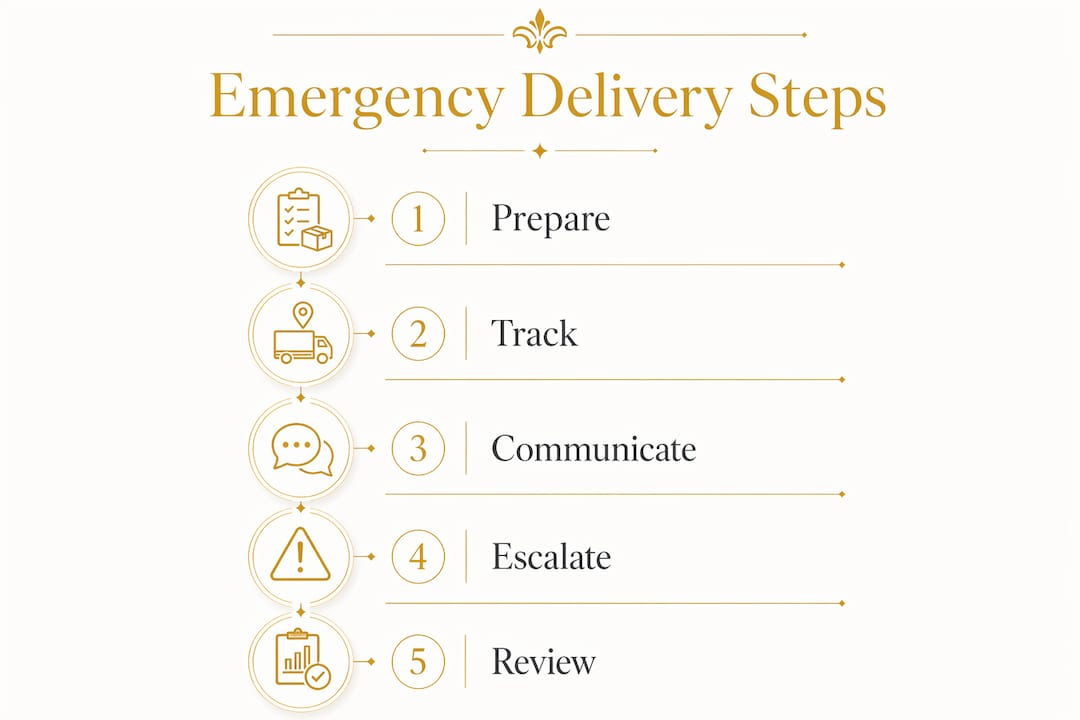
Communication protocols form the third layer. Every out-of-hours operation needs a clear escalation chain: who gets called first, who authorises a route change, and who updates the client. Without a defined chain, decisions stall.
Pre-dispatch checklist for emergency out-of-hours runs:
- Verified after-hours access codes for delivery sites
- Confirmed driver contact numbers and vehicle details
- Loading equipment availability confirmed at origin
- Client emergency contact number, not just the main office line
- Proof of delivery method agreed in advance (photo, signature, or digital confirmation)
- Backup driver or vehicle option identified
Pro Tip: Store your emergency checklist in a shared cloud folder, not a local drive. Your on-call coordinator needs it accessible from a mobile phone at midnight.
| Preparation area | What to confirm before dispatch |
|---|---|
| Site access | After-hours entry codes and security contact |
| Driver readiness | Vehicle condition, fuel, and route briefing |
| Client communication | Emergency contact and update frequency agreed |
| Proof of delivery | Method confirmed and equipment ready |
Step-by-step process for handling after-hours emergency shipments
A structured process is what separates a managed emergency from a chaotic one. The steps below apply whether you are coordinating a single urgent parcel or a time-critical freight movement.
-
Detect the deviation immediately. Recovery must start the moment a deviation is detected, not after a second missed update. Set your tracking system to trigger alerts on any schedule breach, not just final delivery failure.
-
Activate your escalation procedure. Contact the assigned on-call coordinator first. That person then contacts the driver directly using the dedicated driver-only hotline, not the general customer service line. Keeping these channels separate is critical.
-
Assess and reroute. The coordinator reviews the tracking data, contacts the driver for a live status, and determines whether a reroute, replacement vehicle, or client notification is needed. Nighttime logistics must be planned distinctly from daytime operations because traffic patterns, site access rules, and available support all differ after hours.
-
Update the client proactively. Do not wait for the client to call. Send a status update within 15 minutes of identifying any issue. Clients tolerate delays far better when they receive honest, timely communication.
-
Coordinate with the warehouse or loading team. If a replacement vehicle is needed, the warehouse contact must be reachable. Confirm this contact is on your emergency checklist before the run begins.
-
Maintain proof of delivery. Every after-hours delivery needs documented confirmation. Photo evidence, a digital signature, or a GPS-timestamped delivery record protects both your business and your client.
-
Log the incident. After resolution, record what happened, what decision was made, and how long recovery took. This data improves your process for the next emergency.
Pro Tip: Brief your drivers on the escalation process before they go out on an after-hours run. A driver who knows exactly who to call and when will resolve issues faster than one waiting for instructions.
Effective recovery in emergency freight combines tracking, training, communication, and operational control into a single coordinated process. Each element depends on the others.
How do you troubleshoot common after-hours delivery problems?
The most frequent causes of after-hours delivery failure are predictable. Recognising them in advance means you can prevent most of them.
Common failure points and how to address them:
- Site access problems. The delivery driver arrives and cannot enter the premises. This happens when access codes are not verified before dispatch. Always confirm after-hours entry details as part of your pre-dispatch checklist.
- Miscommunication between teams. The coordinator assumes the driver has the updated address. The driver assumes the coordinator has notified the client. Neither has done it. Assign one person to own each communication task explicitly.
- Unverified client contacts. The emergency contact number on file is a main office line that nobody answers at night. Collect a direct mobile number for every client who uses out-of-hours services.
- Driver unreachability. The driver is in a low-signal area. Establish a check-in protocol: drivers on after-hours runs should confirm their status every 30 minutes.
Out-of-hours driver communications should be separated from general customer enquiries using dedicated driver-only hotlines. This single change improves response speed and reduces confusion for on-call coordinators significantly.
"Open-ended, on-demand after-hours availability without defined boundaries leads to staff burnout and cost escalation. Structured availability windows with clear cut-off times protect both your team and your margins."
Avoid the trap of promising unlimited after-hours availability. Structured service with defined availability windows and pre-negotiated cut-off times is the only sustainable model. Without boundaries, your on-call team carries emergency-level pressure every night, which degrades performance and increases staff turnover.
For a deeper look at the errors that compound these problems, the guide on common delivery mistakes covers the patterns logistics managers encounter most often.
How do you balance cost and staff wellbeing in after-hours services?
Sustainable after-hours delivery management requires deliberate design. You cannot simply extend your daytime operation into the night and expect it to hold.
Strategies that protect both cost and people:
- Define your service windows clearly. Offer after-hours delivery between specific hours, for example 6pm to midnight, rather than open-ended availability. Publish these windows to clients so expectations are set from the start.
- Use technology to absorb routine workload. AI integration is reshaping after-hours logistics by automating routine interactions and freeing human teams for critical cases. Chatbots and tracking portals handle status enquiries. Your on-call coordinator handles genuine emergencies.
- Plan routes before the shift starts. Flexible scheduling and planned route optimisation reduce last-minute changes and driver fatigue. A driver who knows their route before leaving the depot makes fewer errors and completes runs faster.
- Train for operational control, not just delivery. Staff who understand escalation procedures, recovery tactics, and client communication protocols handle pressure better. Training reduces the number of calls that escalate to management unnecessarily.
- Review performance data weekly. Track incident frequency, recovery time, and client feedback. Patterns in this data reveal where your process needs adjustment before problems become costly.
Pro Tip: Set a monthly review of your after-hours incident log. If the same failure point appears more than twice, it is a process gap, not bad luck.
Pricing your after-hours service correctly also matters. Charge a defined premium for out-of-hours runs rather than absorbing the cost into standard rates. This covers the real cost of on-call staffing and vehicle availability, and it signals to clients that the service has genuine value.
For guidance on urgent delivery tracking methods that support after-hours operations, the 2026 best practices guide covers the technology choices worth considering.
Key takeaways
Effective after-hours emergency delivery management depends on structured escalation, verified pre-dispatch preparation, and clear communication protocols applied consistently across every out-of-hours run.
| Point | Details |
|---|---|
| Start escalation immediately | Initiate recovery the moment a deviation is detected, not after multiple missed updates. |
| Prepare before dispatch | Verify access codes, driver contacts, and proof of delivery method before every after-hours run. |
| Separate communication channels | Use dedicated driver-only hotlines to keep urgent operational calls distinct from customer enquiries. |
| Define availability windows | Set structured after-hours service hours with clear cut-offs to protect staff and control costs. |
| Use technology for routine tasks | Deploy AI and tracking portals to handle status enquiries, freeing your team for genuine emergencies. |
What I have learned from managing after-hours emergency logistics
The single biggest mistake I see logistics managers make is treating after-hours delivery as an extension of their daytime operation. It is not. The constraints are different, the failure modes are different, and the human cost of getting it wrong is higher.
The businesses that handle out-of-hours emergencies well share one trait: they have made decisions in advance. They know who calls whom, what triggers a reroute, and when to notify the client. They do not make those decisions at midnight under pressure.
Technology has genuinely changed what is possible here. AI-assisted query handling means a coordinator no longer has to field every status call personally. That matters at 3am. But technology only works if the underlying process is sound. Automation built on a broken escalation chain just fails faster.
The structured availability window is the insight I would push hardest. Businesses that offer open-ended after-hours availability burn through their on-call teams within months. Businesses that define their windows, communicate them clearly, and charge appropriately for the service build something that actually lasts.
Preparation is not glamorous. Verified access codes and pre-dispatch checklists do not feel urgent until the moment they prevent a failed delivery. Build the habit before the emergency arrives.
— Ayomide
Sddbyaba: built for time-critical deliveries
When an emergency shipment cannot wait until morning, Sddbyaba provides same day courier services with nationwide UK coverage and a fleet ranging from motorcycle couriers to artic trucks. Every booking includes dedicated vehicle transport, real-time tracking, and direct communication with your assigned driver.

Sddbyaba supports urgent deliveries across construction, manufacturing, medical, retail, and commercial logistics sectors. Whether you need a dedicated courier for a single time-sensitive consignment or a planned after-hours freight solution, the team is ready to respond. Contact Sddbyaba to discuss your out-of-hours delivery requirements and get a fast, accurate quote.
FAQ
What is emergency out-of-hours delivery?
Emergency out-of-hours delivery is an urgent shipment dispatched or received outside standard business hours, including evenings, nights, weekends, and public holidays. It requires dedicated coordination, pre-verified access, and a structured escalation process.
How do I start an escalation for an after-hours delivery problem?
Initiate recovery immediately upon detecting any deviation from the planned schedule. Contact your on-call coordinator first, then the driver via a dedicated hotline, and notify the client within 15 minutes.
What tools do I need for after-hours delivery management?
Real-time tracking software, a dedicated driver-only hotline, AI-assisted query handling, and a pre-dispatch emergency checklist are the core tools. Together, they cover visibility, communication, and preparation.
How do I prevent staff burnout in after-hours operations?
Define structured availability windows with clear cut-off times rather than offering open-ended on-demand availability. Use AI and tracking portals to absorb routine enquiries so your on-call team handles only genuine emergencies.
Should driver calls be handled separately from customer calls after hours?
Yes. Separating driver communications from general customer enquiries using dedicated hotlines improves response speed and reduces confusion for on-call coordinators during urgent situations.