
Urgent delivery tracking best practices are defined as the structured operational methods that give logistics managers full visibility over time-critical shipments from dispatch to proof of delivery. The core of efficient urgent shipment tracking rests on three pillars: standardised scan events, tiered real-time notifications, and proactive exception management. Tools like ShipStation, webhook APIs, and platforms such as Shopify order tracking each address part of the problem, but no single tool replaces disciplined process design. Businesses that get this right reduce inbound customer inquiries, avoid costly false escalations, and protect service-level agreements on their most important consignments.
1. urgent delivery tracking best practices: standardise your scan events
Scan discipline is the foundation of tracking accuracy. Standardising scan events across every custody handpoint gives you a reliable data trail that no GPS overlay or dashboard can substitute. In urgent delivery logistics, strict enforcement of a standard scan event graph is more effective for tracking accuracy than relying on GPS or dashboard aesthetics alone.
The minimum scan points every urgent shipment operation should enforce are:
- Label created — confirms the consignment exists in the system
- Picked — confirms physical collection from origin
- Origin scanned — first custody confirmation at the depot or collection point
- Manifest closed — shipment assigned to a vehicle or route
- Carrier acceptance — third-party carrier has taken physical custody
- Departures — vehicle leaves origin or hub
- Hub arrivals — confirms transit progress at intermediate points
- Out for delivery — driver is en route to the recipient
- Delivered — proof of delivery captured
- Exceptions — any failed attempt, address query, or damage flag
Each missed scan breaks the custody chain. A missing "carrier acceptance" scan, for example, makes it impossible to determine whether a delay occurred before or after handover. That ambiguity costs your support team time and erodes customer confidence.
Auditing scan compliance every shift, rather than daily, catches gaps before they compound. For fragile or high-value consignments, add a condition-check scan at each hub arrival to document the item's state throughout transit.

Pro Tip: Create a dedicated exception scan code for fragile or high-value items at every hub. This gives you a timestamped condition record at each stage, which is invaluable for insurance claims and customer disputes.
2. how tiered alerting improves real-time shipment monitoring
Alert design is a system-level decision, not a notification preference. Tiered alerting separates critical events from low-priority updates, which prevents notification fatigue and keeps your team focused on what actually needs attention.
The practical split works as follows:
- Immediate alerts for out-for-delivery status, delivery exceptions, customs holds, and delivery confirmations. These trigger instant SMS, push notification, or webhook to your CRM.
- Batched updates for intermediate hub scans, manifest closures, and label creation events. These can be grouped into hourly or shift-end digests without any loss of operational value.
- Escalation triggers for any shipment that has not progressed past a defined stage within a set timeframe. These feed directly into your support queue.
Delivery channels should match the urgency tier. Webhook APIs are the most reliable method for feeding real-time event data into CRM and support tools like Zendesk or Salesforce. SMS and push notifications serve the customer-facing layer. Email works for batched, lower-priority updates.
The operational KPIs worth tracking here are: alert delivery rate, time from scan event to customer notification, and the ratio of inbound "where is my order" calls to total shipments. A well-designed tiered system drives that last metric down measurably.
3. what proactive communication strategies reduce customer inquiries
Proactive messaging before customers raise concerns improves trust and reduces inbound order status inquiries. The trigger point for automated outreach is objective: automate communication when a shipment is more than 12 hours past its promised delivery window.
Generic delay messages do not work. Tailor each message to the specific issue type:
- Weather delays: Acknowledge the cause, give a revised estimate, and confirm no action is needed from the customer.
- Address verification issues: Request confirmation immediately with a direct link or reply mechanism. Every hour of delay here is avoidable.
- Carrier disruptions: Explain the disruption briefly, confirm the shipment is safe, and provide a revised delivery window.
- Customs holds (for cross-border consignments): State exactly what documentation or duty payment is required and from whom.
Placing tracking links prominently in order confirmation emails, account dashboards, and SMS updates reduces customer effort. Embedded clickable tracking widgets outperform plain-text tracking numbers because they eliminate the step of copying a reference into a carrier portal. Fewer steps mean fewer frustrated customers and fewer support calls.
Offering multiple update channels, including email, SMS, in-app push, and chatbot, allows customers to receive updates in the format they prefer. That flexibility has a direct impact on satisfaction scores.
Pro Tip: Build a message template library organised by exception type. When a delay occurs, your team selects the right template rather than drafting from scratch. This cuts response time and keeps messaging consistent across every customer touchpoint.
4. normal vs true tracking gaps: how to manage escalation correctly
Not every period of silence in a tracking feed is a problem. Tracking frozen periods of 12–48 hours on domestic routes and 2–4 days on international air legs are normal due to scan checkpoint delays. Treating these as exceptions wastes resource and generates false urgency.
The table below shows how to distinguish normal gaps from genuine exceptions requiring escalation:
| Scenario | Status | Action |
|---|---|---|
| No update for 12–48 hours, domestic | Normal transit gap | Monitor only, no escalation |
| No update for 2–4 days, international air | Normal checkpoint delay | Monitor only, no escalation |
| No movement for 7+ days, any route | True exception | Escalate immediately |
| Marked delivered but recipient reports missing | True exception | Escalate same day |
| New tracking number issued, no updates within 24 hours | Pending activation | Wait 24 hours before escalating |
| Exception scan logged (damage, address query) | Active exception | Escalate within agreed SLA |
Stage-aware escalation rules differentiate between acceptable tracking silence during transit legs and proximity stages where urgency increases. A shipment sitting at an origin depot for 18 hours warrants a different response than one that has been out for delivery for 18 hours with no delivery confirmation.
The practical rule is simple. Escalate immediately when there is no movement for seven or more days, or when a package is marked as delivered but the recipient has not received it. For everything else, apply the stage-aware thresholds in the table above. This approach protects your escalation resource for the cases that genuinely need it.
5. how to track urgent deliveries with the right technology stack
Centralised dashboards are the operational backbone of any serious tracking setup. ShipStation automates tracking updates, reduces manual work, and unifies operational and support teams around consistent data. Without a central view, support agents and logistics managers work from different data sources, which creates conflicting information and slower resolution times.
The key components of a reliable technology stack for urgent shipment tracking are:
- Central tracking dashboard (such as ShipStation) for multi-carrier consolidation and normalised delivery status across all carriers
- Webhook API integration for event-driven real-time updates pushed directly to your CRM or support platform, removing the need for manual polling
- Retry mechanisms and stale check detection to prevent silent alert failures during API or provider outages
- Delivery status normalisation layer to translate carrier-specific status codes into consistent internal terminology
Webhook resiliency deserves particular attention. Maersk's webhook retry strategy uses exponential backoff and marks subscriptions as stale when repeated delivery failures occur, requiring manual reactivation. This approach prevents a temporary outage from silently breaking your entire alert pipeline. Any webhook-based tracking integration should implement equivalent logic.
For courier tracking solutions that cover multiple carriers and vehicle types, the normalisation layer is non-negotiable. Different carriers return different status strings for the same event. Without normalisation, your dashboard shows inconsistent data and your automated alerts fire on the wrong triggers.
6. improving delivery tracking accuracy through continuous review
Tracking accuracy is not a one-time configuration. It degrades as carrier relationships change, new vehicle types are added to your fleet, and customer expectations shift. The businesses that maintain high accuracy treat it as an ongoing operational discipline, not a setup task.
Shift-level scan compliance audits are the most direct lever. Review scan completion rates by driver, route, and carrier every 24 hours. Any route consistently missing hub arrival scans or out-for-delivery confirmations needs immediate investigation. The cause is usually a process gap, such as a driver skipping a scan step under time pressure, rather than a system failure.
Carrier performance data feeds directly into this review cycle. Track on-time scan rates by carrier alongside delivery performance. A carrier with strong delivery times but poor scan compliance creates visibility gaps that undermine your entire tracking operation. Address scan compliance as a contractual requirement, not an optional courtesy.
The common pitfalls in time-critical delivery operations almost always trace back to inconsistent scan discipline or alert configurations that were set up once and never reviewed. Build a quarterly review of your scan event graph, alert thresholds, and escalation rules into your operational calendar.
Key takeaways
Effective urgent delivery tracking combines standardised scan compliance, tiered alert design, and stage-aware escalation to deliver consistent visibility and reduce operational waste.
| Point | Details |
|---|---|
| Standardise scan events | Enforce a minimum of ten scan points per shipment to maintain an unbroken custody chain. |
| Use tiered alerting | Separate critical event notifications from batched updates to prevent fatigue and focus attention. |
| Automate proactive communication | Trigger tailored customer messages when shipments exceed 12 hours past their promised delivery window. |
| Apply stage-aware escalation | Escalate only after 7+ days without movement or confirmed delivery discrepancies to protect resources. |
| Build webhook resiliency | Implement retry logic and stale detection to prevent silent failures in your alert pipeline. |
Scan discipline beats dashboard aesthetics every time
The most common mistake I see logistics managers make is investing in a premium tracking dashboard before fixing the underlying scan compliance problem. A polished interface displaying incomplete data is worse than a basic system displaying accurate data. You make decisions based on what the screen shows, and if the screen is wrong, your decisions are wrong.
The second mistake is setting escalation triggers once and never revisiting them. I have seen operations where the "no movement" escalation threshold was set at 48 hours during initial setup, which was appropriate for the carrier mix at the time. Two years later, the same operation had added international routes where 48-hour gaps are entirely normal. The result was a constant stream of false escalations consuming support resource that should have been directed at genuine exceptions.
Proactive communication is the area where most businesses underinvest relative to the return it delivers. Sending a tailored, specific message before a customer notices a delay costs almost nothing. Handling the inbound call from a frustrated customer costs significantly more, in time, in staff resource, and in the customer relationship itself.
My recommendation is to treat tracking as three separate disciplines: scan operations, alert engineering, and customer communication. Each needs its own owner, its own KPIs, and its own review cycle. When all three are running well, urgent delivery visibility takes care of itself.
— Ayomide
How Sddbyaba supports urgent delivery tracking in practice
Sddbyaba operates as a UK-wide same day courier and logistics provider built specifically for time-critical consignments. Every booking includes direct communication, dedicated vehicle assignment, and real-time status updates throughout the journey.
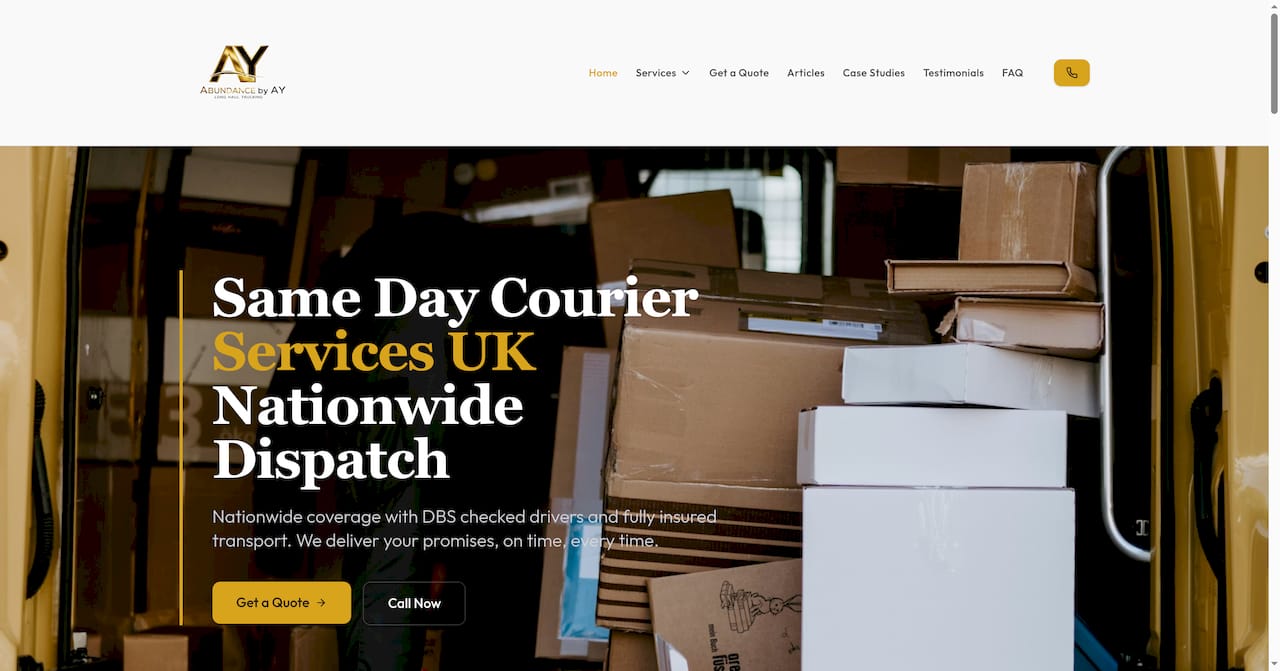
Whether you need a motorcycle courier for a single urgent parcel or a dedicated courier vehicle for a time-sensitive commercial consignment, Sddbyaba applies the same tracking discipline outlined in this article. Proactive updates, clear exception handling, and consistent communication are standard across every service. For businesses that need a reliable same day dispatch partner across the UK, Sddbyaba provides the operational backbone to keep urgent deliveries on track and customers informed at every stage.
FAQ
What scan events are most critical for urgent delivery tracking?
The ten minimum scan points are label created, picked, origin scanned, manifest closed, carrier acceptance, departures, hub arrivals, out for delivery, delivered, and exceptions. Missing any of these breaks the custody chain and reduces tracking accuracy.
How long should i wait before escalating a stalled urgent shipment?
Escalate after 7+ days without movement on any route, or immediately if a shipment is marked delivered but the recipient reports it missing. Domestic gaps of 12–48 hours and international gaps of 2–4 days are normal checkpoint delays.
What is the best alert channel for urgent delivery exceptions?
Webhook APIs are the most reliable channel for feeding real-time exception data into CRM and support tools. SMS and push notifications serve the customer-facing layer for immediate critical events such as delivery failures or customs holds.
How do i reduce "where is my order" calls for urgent shipments?
Embed tracking links directly in order confirmation emails and account dashboards, and automate proactive messages triggered by objective delay thresholds. Reducing customer effort at the tracking step is the fastest way to cut inbound inquiry volume.
Why do webhook retry mechanisms matter for delivery tracking?
Without retry logic, a temporary API outage silently breaks your alert pipeline. Implementing exponential backoff and stale subscription detection, as used in enterprise logistics integrations, prevents critical event notifications from being lost during provider disruptions.