
Courier consolidation is defined as the process of combining multiple smaller shipments into a single, larger load for delivery to a shared destination or region. Businesses that ship frequently pay far more than necessary when each parcel travels independently. Order consolidation reduces shipping expenses by 10% to 50%, with large-scale implementations saving up to US$1.28 million annually. Understanding what courier consolidation means is the first step to cutting transport costs without sacrificing delivery reliability.
What does courier consolidation mean in practice?
Courier consolidation, known in freight circles as shipment consolidation or groupage, is the practice of merging several smaller consignments into one shipment that travels as a single unit. A logistics provider collects parcels from multiple senders, groups them by destination or delivery window, and dispatches them together on one vehicle or one booking. The sender pays only for the space their goods occupy rather than the full cost of a dedicated vehicle.
The process follows a clear sequence:
- Collection. A courier or logistics provider collects individual parcels or pallets from multiple clients.
- Sorting at a consolidation hub. Goods arrive at a staging facility where they are sorted by region, postcode cluster, or agreed delivery window.
- Load building. Shipments heading to the same area are grouped into a single load, filling vehicle capacity as efficiently as possible.
- Route assignment. A driver or carrier is assigned a multi-stop route covering all delivery points in the consolidated batch.
- Scheduled delivery. Goods are delivered within agreed time windows, often the same day or next day depending on the service level chosen.
- Proof of delivery. Each consignment is tracked individually and confirmed on a courier manifest, giving full visibility despite travelling as part of a shared load.
Pro Tip: Ask your courier provider whether they use consolidation hubs or direct multi-stop routing. Hub-based models suit high-volume shippers; direct multi-stop routes work better for businesses with geographically clustered deliveries.
What are the primary benefits of courier consolidation?

Consolidation delivers measurable financial and operational gains. Businesses reduce courier costs by up to 58% on same-day delivery sets by using multi-stop route services instead of booking each delivery independently. That figure is not theoretical. A single consolidated run replacing five separate bookings can save hundreds of pounds per week for a mid-sized retailer or distributor.
The core benefits are:
- Lower cost per delivery. Shared vehicle space means shared transport costs. Each sender pays a proportional rate rather than a full trip fee.
- Reduced environmental impact. Fewer vehicles on the road means lower fuel consumption and fewer emissions per parcel delivered.
- Better capacity utilisation. Consolidating shipments increases load factor and reduces empty miles, cutting the per-unit cost of transport.
- Improved planning and control. Batching shipments forces businesses to plan ahead, which produces more predictable logistics and fewer last-minute costs.
- Greater delivery reliability. Scheduled consolidated runs follow fixed routes and windows, reducing the variability that comes with ad hoc bookings.
The environmental argument is worth taking seriously. Consolidation directly reduces the number of vehicle movements required to serve the same number of customers. For businesses with sustainability targets, that reduction is a concrete, reportable metric rather than a vague commitment.
What factors determine when courier consolidation is most effective?
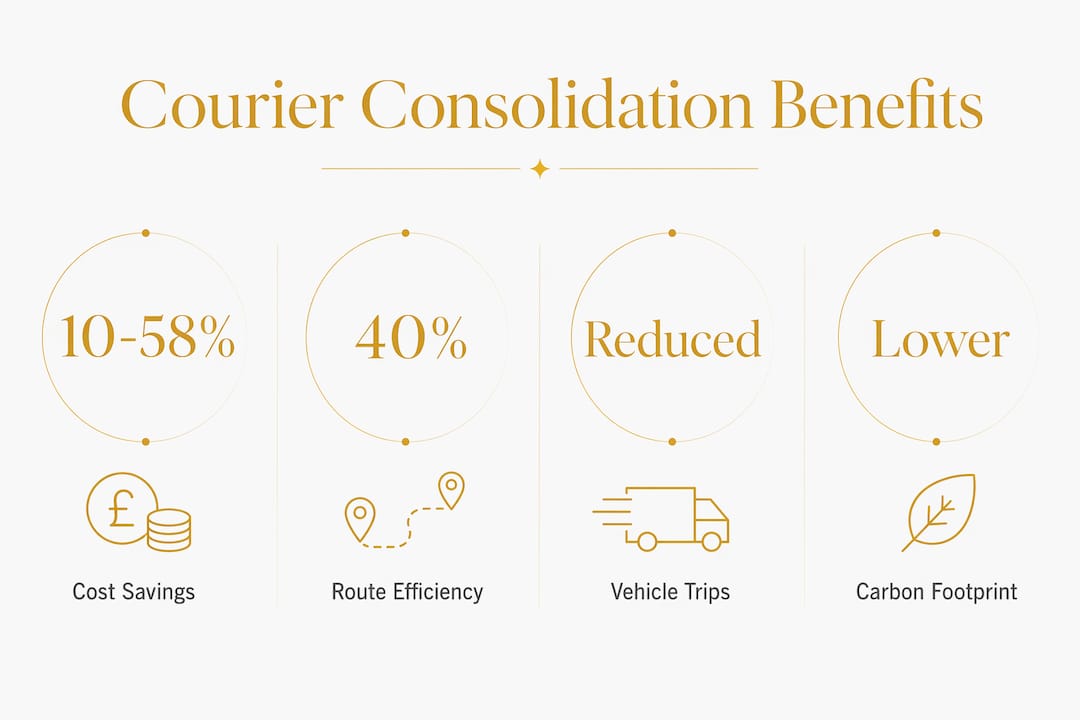
Consolidation works best under specific conditions. Organisations using strategic consolidation achieve 10%–25% improvements in cost control, but only when the right conditions are present. Applying consolidation to the wrong shipment profile produces delays without meaningful savings.
The conditions that make consolidation effective are:
- Sufficient shipment frequency. Consolidation requires enough volume to fill a shared load within a reasonable time window. Businesses shipping fewer than three to five parcels per day to similar destinations may not generate enough volume to benefit.
- Geographic clustering. Deliveries concentrated in the same postcode zones or regions are far easier and cheaper to consolidate than scattered nationwide drops.
- Flexibility in delivery windows. Shifting from urgent deliveries to planned shipping unlocks savings without degrading customer service. Businesses that insist on one-hour windows for every parcel cannot consolidate effectively.
- Data-driven planning. Reactive booking, where each shipment is booked as it arises, prevents consolidation. Businesses need to forecast volumes and group orders before dispatch.
- Consistent delivery destinations. Regular routes to the same clients or distribution points are ideal candidates for consolidation.
When consolidation is not the right fit, a dedicated courier or charter service is the better choice. Time-critical medical supplies, single urgent consignments, or deliveries requiring a dedicated vehicle for security reasons all call for direct transport rather than a shared load.
Pro Tip: Review your last 30 days of delivery data. If more than 40% of your drops cluster within the same three to five postcode areas, you almost certainly have an untapped consolidation opportunity.
What types of courier consolidation services are available?
Courier consolidation services fall into several distinct categories, each suited to a different shipment profile and business need.
| Service type | Best suited for | Cost model | Speed |
|---|---|---|---|
| Multi-stop route courier | Local or regional deliveries, same-day needs | Per-stop or route-based pricing | Same day |
| Groupage freight | Palletised or heavy cargo, national distribution | Per-pallet or per-cubic-metre | 1–3 days |
| Courier aggregator platform | Businesses needing multiple carrier options | Comparison-based, per-shipment | Varies |
| Consolidated air cargo | International or time-sensitive freight | Per-kilogram, shared aircraft space | 1–5 days |
Courier aggregators function as logistics marketplaces, connecting businesses with multiple courier companies through a single platform. They provide broader coverage and competitive pricing without the business needing to manage separate carrier contracts. That makes them particularly useful for e-commerce operations shipping to varied destinations.
Multi-stop route services are the most practical option for businesses with regular local deliveries. Booking multiple urgent deliveries individually incurs repeated base-trip fees. Route-based pricing eliminates that duplication and reveals significant savings that standard per-trip bookings obscure.
Businesses mature through stages with courier services evolving from single-parcel courier to consolidated cargo as volume and regularity grow. Choosing the right service type is a question of matching your current shipment profile to the model that fits it, not simply choosing the cheapest option on the day.
Pro Tip: Request route-based pricing from your courier provider rather than accepting standard per-trip rates. Many providers offer multi-stop discounts that are not advertised on their standard rate cards.
How can businesses implement courier consolidation effectively?
Implementing consolidation is a planning exercise before it is a logistics exercise. The businesses that extract the most value treat it as a standing process rather than an occasional tactic.
- Batch your orders before booking. Hold orders for a defined cut-off time each day and book them together rather than dispatching each one as it arrives.
- Communicate delivery windows to customers. Customers who accept a four-hour delivery window rather than a one-hour slot give you the flexibility to consolidate without complaints.
- Select providers with multi-stop capability. Not every courier offers genuine consolidation or multi-stop routing. Confirm this before signing a contract.
- Use dispatch software to track consolidated shipments. Visibility across a shared load requires technology that logs each consignment individually within the batch.
- Review cost savings monthly. Compare your consolidated delivery costs against your previous per-trip spend. Adjust your cut-off times and grouping criteria based on what the data shows.
The most common mistake businesses make is treating consolidation as a one-time decision. Shipment volumes change, customer locations shift, and carrier pricing evolves. A consolidation strategy that worked well six months ago may need adjustment as your order profile changes.
Pro Tip: Shifting from just-in-time dispatch to forecasted shipping is the single biggest lever for consolidation savings. Even a 24-hour planning horizon gives a courier provider enough time to group your parcels with compatible loads.
Key takeaways
Courier consolidation is the most cost-effective shipping method for businesses with regular, geographically clustered deliveries and flexible delivery windows.
| Point | Details |
|---|---|
| Core definition | Consolidation combines multiple smaller shipments into one load, reducing cost per delivery. |
| Savings potential | Businesses can cut courier costs by 10%–58% depending on volume and route structure. |
| Key success factors | Geographic clustering, shipment frequency, and flexible delivery windows drive consolidation results. |
| Service options | Multi-stop routes, groupage freight, and aggregator platforms each suit different shipment profiles. |
| Implementation priority | Batch orders before booking and request route-based pricing to unlock the full cost benefit. |
Why consolidation is misunderstood more often than it is misused
Most businesses I speak with assume courier consolidation is simply about paying less. That framing leads them to try it once, find the savings modest, and revert to individual bookings. The real value of consolidation is not in the rate. It is in the discipline it forces on your shipping operation.
When you consolidate, you stop reacting and start planning. That shift alone reduces wasted spend across your entire logistics function, not just the line items where consolidation applies directly. The businesses that see the largest savings are not those with the highest volumes. They are the ones that restructured their order processing to make consolidation the default rather than the exception.
The tradeoff between speed and economics is real, but it is narrower than most people expect. A well-run consolidated route can deliver to ten addresses in the same time a single-drop booking would serve three, because the routing is planned rather than improvised. Speed and consolidation are not opposites. Poor planning and consolidation are.
My honest advice: pull your last month of delivery invoices, map the drop locations, and count how many fell within five miles of each other. The answer will almost certainly surprise you.
— Ayomide
Professional courier and consolidation services across the UK
Sddbyaba provides same-day courier, multi-stop delivery, pallet distribution, and freight haulage services for businesses across the UK. Whether you need a single urgent consignment or a consolidated batch of deliveries across a region, Sddbyaba operates a full fleet from motorcycles to artic lorries to match your load to the right vehicle.
Sddbyaba works with businesses in retail, manufacturing, construction, and commercial logistics to build delivery solutions that reduce cost without compromising on speed or reliability. If your current shipping spend feels higher than it should be, a conversation about nationwide dispatch options is a practical starting point. Contact Sddbyaba to discuss your shipment profile and find out which consolidation approach fits your operation.
FAQ
What does courier consolidation mean?
Courier consolidation is the process of combining multiple smaller shipments into a single load for delivery, reducing the cost per parcel by sharing vehicle space and transport fees across several senders.
How much can businesses save with courier consolidation?
Savings range from 10% to 58% depending on shipment volume, route structure, and delivery window flexibility, with large-scale implementations generating significant annual reductions in transport spend.
When is courier consolidation not the right choice?
Consolidation is not suitable for time-critical single consignments, deliveries requiring a dedicated vehicle for security, or shipments with rigid one-hour delivery windows that cannot be batched with compatible loads.
What is the difference between a courier aggregator and a traditional courier?
A courier aggregator is a platform that connects businesses with multiple courier companies through one system, offering broader coverage and competitive pricing, whereas a traditional courier operates its own fleet and handles bookings directly.
How does multi-stop routing relate to consolidation?
Multi-stop routing is the delivery-side mechanism of consolidation, where a single driver covers several drop points on one planned route, replacing multiple independent bookings and eliminating repeated base-trip fees.