
Courier tracking is defined as the real-time monitoring of a shipment's location and status from dispatch to delivery. It is the single most effective tool for building trust in delivery services because it replaces uncertainty with verifiable, live information. 71% of shoppers say transparent real-time tracking makes them more likely to return to a retailer. That figure alone tells you tracking is not a convenience feature. It is a commercial necessity. 93% of consumers report that delivery performance directly shapes their perception of a brand, which means every shipment is a trust transaction.
Why courier tracking improves trust through transparency
Transparency is the mechanism by which courier tracking converts a passive wait into an informed experience. When a customer can see exactly where their parcel is, the anxiety of not knowing disappears. That shift from uncertainty to clarity is why tracking builds confidence more reliably than any marketing promise.
Real-time visibility works because it gives customers control. They can plan their day around an accurate delivery window, redirect a parcel if needed, and verify that their goods are moving as expected. Without that visibility, customers are left guessing, and guessing breeds doubt.
The benefits of courier tracking for customer confidence include:
- Live location updates that confirm the driver is en route and on schedule
- Estimated arrival windows that allow recipients to be present or make alternative arrangements
- Delivery confirmation notifications with electronic proof of delivery, removing disputes about whether a parcel arrived
- Proactive delay alerts that inform customers before frustration sets in
- Self-service tracking portals that reduce the need to contact customer support
Self-service order tracking reduces "Where's my order?" support queries by up to 40%. That reduction frees up operational resource and signals to customers that the courier is organised and reliable.
Pro Tip: Set up automated SMS or email notifications at each key stage: dispatch, out for delivery, and delivered. Customers who receive proactive updates are significantly less likely to contact support or leave negative feedback.
What does the trust gap in delivery actually look like?
The trust gap in delivery is the distance between what couriers and retailers promise and what customers actually believe. Less than 10% of consumers believe retailers consistently meet fast or guaranteed delivery promises. In the UK specifically, that figure sits at just 7%. That is a near-total collapse of confidence in delivery commitments.
The consequences of that gap are direct and measurable. Customers who do not trust delivery promises either abandon purchases, pay for premium options they feel are more reliable, or simply shop elsewhere. The trust gap is not an abstract problem. It costs businesses revenue.
"Notifying customers of delays early builds more trust than silence. 96% of consumers say transparency matters more than delivery perfection."
Tracking closes the trust gap by making the delivery process visible and verifiable. When a customer receives a notification that their parcel has been collected, is in transit, and is two stops away, they are not relying on a promise. They are observing a fact. That shift from belief to evidence is what makes tracking so powerful for trust in delivery services.
False "delivered" notices and missed delivery windows are two of the most damaging trust failures in logistics. Both are significantly reduced when tracking data is accurate and updated in real time. Proactive alerts when a delivery exception or delay is expected reduce frustration and support costs significantly. The customer feels informed rather than abandoned.
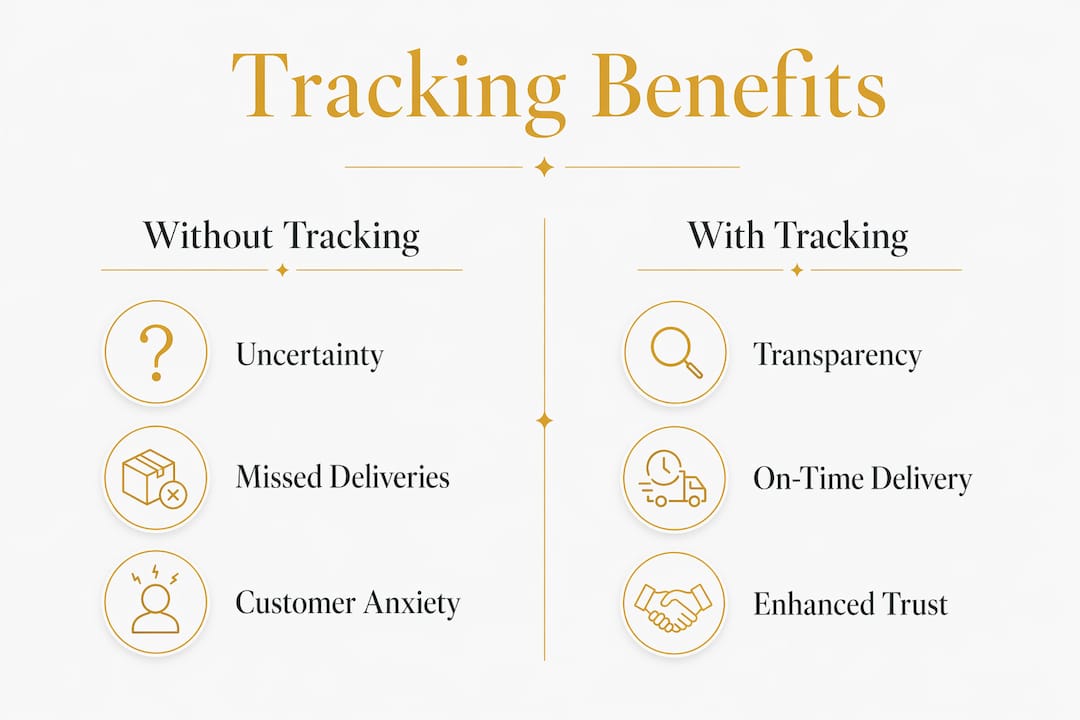
| Trust failure | Impact without tracking | Impact with tracking |
|---|---|---|
| Missed delivery window | Customer unaware until after the fact | Customer alerted in advance, can reschedule |
| False "delivered" notice | Dispute with no evidence | Electronic proof of delivery resolves instantly |
| Unexplained delay | Customer contacts support, frustration builds | Proactive notification sent automatically |
| Parcel location unknown | Customer anxiety, repeat support calls | Live location visible via tracking portal |
How do different tracking technologies compare for building reliability?
Real-time tracking technologies including GPS, RFID, and AI-based prediction systems each contribute differently to delivery transparency. Understanding the differences helps businesses choose the right approach for their shipment type and customer expectations.

GPS tracking is the most widely used method in road-based courier services. It provides continuous location data, allowing customers and dispatchers to see a vehicle's exact position at any moment. GPS is highly effective for same day courier deliveries where the customer expects live updates throughout the journey.
RFID (Radio Frequency Identification) is more common in warehouse and pallet environments. It tracks individual items through scanning points rather than continuously. RFID is particularly useful for freight and multi-stop distribution, where confirming that a consignment has passed through a specific depot or loading bay matters more than live vehicle location.
AI-based prediction systems add a layer of intelligence on top of GPS and RFID data. They analyse traffic patterns, historical delivery times, and route conditions to generate accurate estimated arrival times. That accuracy is what turns a vague "between 8am and 6pm" window into a specific "arriving between 2pm and 3pm" notification. You can explore how these technologies are applied in practice through this 2026 courier technology guide.
| Technology | Best use case | Trust benefit |
|---|---|---|
| GPS | Road-based same day deliveries | Live location visible to customer in real time |
| RFID | Freight, pallets, warehouse operations | Confirms item movement through key checkpoints |
| AI prediction | All delivery types | Accurate ETAs reduce uncertainty and missed windows |
| Electronic proof of delivery | All delivery types | Removes disputes, confirms receipt with timestamp |
Pro Tip: For time-critical or high-value consignments, combine GPS tracking with electronic proof of delivery. The combination gives both sender and recipient a complete, auditable record of the shipment from collection to handover.
Best practices for managing delivery expectations through tracking
Managing delivery expectations is an operational discipline, not a customer service afterthought. Retailers and couriers must treat delivery windows as operational commitments supported by unified data visibility, not as marketing copy. The difference between a trusted courier and an unreliable one often comes down to how exceptions are handled, not how smoothly standard deliveries run.
The following practices define how tracking data should be used to maintain customer trust:
- Send notifications at every status change. Dispatch, collection, in transit, out for delivery, and delivered. Each update reduces the window in which a customer can feel uninformed.
- Alert customers before a delay occurs, not after. Automated rerouting and dynamic adjustments based on tracking data allow logistics teams to manage exceptions in real time. That means a delay alert can go out the moment a problem is identified, not when the customer calls to complain.
- Provide a self-service tracking link in every confirmation. Customers who can check status themselves are less likely to contact support. That reduces operational cost and signals confidence in the service.
- Use electronic proof of delivery for every consignment. A timestamped photo or signature confirmation removes ambiguity and protects both the courier and the recipient.
- Review tracking data to identify recurring failure points. If a particular route or time window consistently produces delays, the data will show it. Fixing the root cause is more effective than apologising repeatedly.
For businesses managing urgent delivery tracking, these practices are not optional. A single failed time-critical delivery can cost a client relationship that took months to build.
What are the practical business benefits of courier tracking beyond trust?
Courier tracking delivers measurable financial and operational benefits that extend well beyond customer satisfaction. Failed delivery attempts cost businesses an average of $17.20 each. Tracking reduces failed attempts by enabling precise delivery windows and giving customers the information they need to be available. That saving compounds quickly across high-volume operations.
The operational benefits of tracking systems include:
- Reduced support costs through self-service tracking, cutting "Where's my order?" enquiries by up to 40%
- Lower re-delivery costs by providing accurate windows that reduce missed first attempts
- Improved route efficiency through real-time data that allows dispatchers to adjust routes dynamically
- Stronger customer retention because delivery reliability drives long-term loyalty more than speed alone
- Fewer disputes through electronic proof of delivery that provides an auditable record
Combining order, inventory, route, and carrier data in a unified platform enables better delivery promises and reduces the failures that damage trust. Businesses that invest in integrated tracking infrastructure do not just serve customers better. They operate more efficiently and spend less on failure recovery.
Key takeaways
Courier tracking improves trust by replacing delivery uncertainty with real-time, verifiable information that customers and businesses can act on.
| Point | Details |
|---|---|
| Transparency drives return intent | 71% of shoppers are more likely to return to a retailer that offers real-time tracking. |
| The trust gap is severe | Only 7% of UK consumers believe retailers consistently meet delivery promises. |
| Proactive communication is non-negotiable | 96% of consumers value transparency over perfection; alert customers before delays, not after. |
| Technology choice matters | GPS, RFID, and AI prediction each serve different shipment types and trust-building needs. |
| Tracking saves money directly | Failed deliveries cost an average of $17.20 each; accurate tracking windows reduce that cost significantly. |
Transparency beats speed: what I have learned from logistics in practice
The most common mistake I see businesses make is treating tracking as a bolt-on feature rather than a core part of the service promise. They invest in fast vehicles and competitive pricing, then send a single dispatch email with no further updates. That approach worked a decade ago. It does not work now.
What I have observed consistently is that customers forgive delays far more readily than they forgive silence. A parcel that arrives two hours late with three proactive updates along the way generates less frustration than a parcel that arrives on time with no communication at all. The data supports this. Transparency matters more than perfection to the overwhelming majority of consumers.
The businesses that build the strongest delivery reputations are not always the fastest. They are the most communicative. They use tracking data to get ahead of problems rather than react to complaints. That shift from reactive to proactive is the real competitive advantage that tracking provides.
My advice for any business selecting a courier partner is simple: ask specifically how they handle exceptions. A courier that can show you their delay notification process, their proof of delivery system, and their live tracking portal is a courier that has built trust into their operations. One that cannot answer those questions clearly is a risk, regardless of their headline delivery times.
— Ayomide
How Sddbyaba builds delivery trust into every shipment
Sddbyaba operates as SDD by ABA, a UK-based same day courier and logistics company with nationwide coverage. Every service Sddbyaba provides is built around the communication and reliability standards that tracking makes possible. From motorcycle couriers handling urgent parcels to 26-tonne freight movements, Sddbyaba combines dedicated vehicle transport with professional communication at every stage of the delivery process.
For businesses in construction, retail, manufacturing, medical, and commercial logistics, reliable tracking is not a luxury. It is the foundation of a working supply chain. Sddbyaba's same day courier services are designed for businesses that cannot afford delivery failures or communication gaps. If your operation depends on time-critical consignments arriving on schedule and with full visibility, contact Sddbyaba to discuss a solution built around your requirements.
FAQ
Why does courier tracking improve customer trust?
Courier tracking replaces uncertainty with real-time, verifiable information. Customers who can see their parcel's location and receive proactive updates are significantly less likely to doubt the service or contact support.
What percentage of consumers value delivery transparency?
96% of consumers say transparency matters more than delivery perfection. Notifying customers of delays early builds more trust than delivering silently on time.
How much do failed deliveries cost businesses?
Failed delivery attempts cost businesses an average of $17.20 each. Accurate tracking windows reduce missed first attempts and the re-delivery costs that follow.
What tracking technologies are most effective for building trust?
GPS, RFID, and AI prediction systems each serve different needs. GPS provides live location for road deliveries, RFID confirms checkpoint movement for freight, and AI prediction generates accurate estimated arrival times that reduce missed windows.
Does tracking reduce customer support enquiries?
Self-service order tracking reduces "Where's my order?" support queries by up to 40%. Customers who can check status independently are less likely to call, which reduces operational cost and signals service confidence.