
Real-time tracking is defined as the continuous, live monitoring of a shipment's location and status from dispatch to delivery. For emergency logistics, which the industry also calls expedited or time-critical freight, this capability is not a convenience. It is the operational foundation that separates a successful urgent delivery from a costly failure. 86% of customers expect real-time updates on their shipments, and that expectation intensifies sharply when the consignment is time-sensitive. Technologies including GPS, RFID, IoT sensors, and telematics platforms make this visibility possible. Understanding why emergency deliveries need real-time tracking means understanding how live data changes every decision in the delivery chain.
Why does real-time tracking matter for emergency deliveries?
Real-time tracking gives every stakeholder in an emergency delivery a single, accurate picture of where a shipment is and when it will arrive. Without that picture, decisions are based on guesswork, and guesswork is expensive in time-critical logistics.
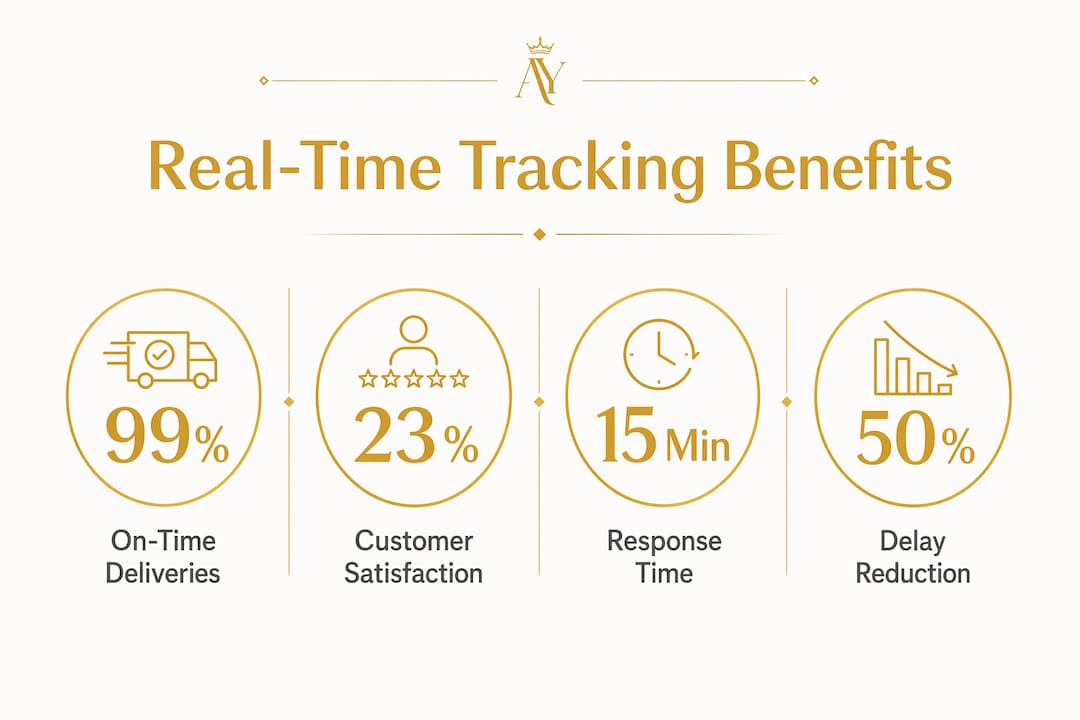
Integrating real-time tracking improves customer satisfaction by up to 23% and supply chain efficiency by 15%. Those two figures are connected. When customers receive live updates, they make fewer support calls, freeing operations teams to focus on the delivery itself rather than fielding enquiries.
The benefits of emergency delivery tracking extend beyond customer experience. Live visibility enables immediate response to delivery exceptions. A courier delayed by a road closure can be rerouted within minutes rather than hours. In pharmaceutical or medical courier scenarios, where a delayed consignment can halt a surgical procedure or interrupt patient care, that speed of response is the difference between an acceptable outcome and a serious operational failure.
- Live location updates give dispatchers the ability to redirect vehicles before a delay compounds.
- Automated customer notifications reduce inbound support calls by 30–40%, easing pressure on customer service teams.
- Exception alerts flag problems the moment they occur, not after the delivery window has passed.
- Accurate ETAs allow recipients to prepare for arrival, which is critical in construction, manufacturing, and healthcare settings.
- Audit trails provide a timestamped record of every stage, supporting compliance and dispute resolution.
Pro Tip: Set up automated SMS or email alerts at key delivery milestones, not just at final delivery. Clients managing time-critical operations need progress confirmation, not just a completion notice.
Transparent live tracking builds the kind of trust that transforms logistics from an uncertain cost into a reliable, value-added service. Businesses that provide this level of visibility retain clients more effectively than those that do not.
What technologies enable real-time tracking in emergency logistics?
GPS, RFID, IoT sensors, and telematics form the technical backbone of any credible real-time tracking system. Each plays a distinct role, and understanding those roles helps businesses choose the right logistics partner.

Deployment of GPS, RFID, and IoT sensors integrated with cloud-based Transportation Management Systems (TMS) enables real-time monitoring and rapid response in emergency logistics. A TMS aggregates data from all these sources and presents it through a single dashboard, accessible to dispatchers, drivers, and clients simultaneously.
| Technology | Primary function | Emergency logistics benefit |
|---|---|---|
| GPS | Continuous vehicle location | Live ETA calculation and rerouting |
| RFID | Parcel-level identification | Confirms correct consignment is in transit |
| IoT sensors | Condition monitoring (temperature, shock) | Critical for pharmaceutical and medical freight |
| Telematics | Driver behaviour and vehicle data | Supports compliance and route efficiency |
| Cloud TMS | Data aggregation and communication | Single source of truth for all stakeholders |
Continuous synchronisation of data between dispatch, drivers, and customers is what maintains accurate ETAs and allows dynamic route adjustment under fluctuating conditions. A static plan built the night before cannot account for a motorway closure at 7am. A live system can.
Predictive logistics partners use live traffic and weather data to anticipate bottlenecks rather than reacting after delays occur. This is the critical distinction between reactive and predictive logistics. Reactive systems tell you a delivery is late. Predictive systems prevent the delay from happening.
Pro Tip: When evaluating a courier or logistics partner, ask specifically whether their TMS triggers automatic downstream route recalibration when a delay is detected. If the answer is no, their tracking is informational only, not operational.
What happens to emergency deliveries without live tracking?
Operating urgent shipments without live tracking creates a chain of compounding problems. Each one is manageable in isolation. Together, they represent a serious operational and commercial risk.
The most immediate consequence is inaccurate ETA information. Static or delayed data means dispatchers cannot give recipients a reliable arrival window. In a hospital waiting for surgical supplies or a production line waiting for a critical component, an inaccurate ETA causes downstream disruption that far exceeds the cost of the delivery itself.
- Inaccurate ETAs force recipients to operate on assumptions, leading to wasted preparation time and resource misallocation.
- Reactive problem-solving increases operational costs. Teams spend time investigating delays that a live system would have flagged and resolved automatically.
- Higher support call volume consumes customer service capacity. Without self-service tracking, clients call to ask for updates that should be available instantly.
- Security and mishandling risks increase when there is no continuous visibility of a consignment's location or condition.
- Loss of client trust follows repeated uncertainty. Businesses that cannot demonstrate delivery transparency lose contracts to competitors who can.
"Exception management, more than location, is the true value of real-time tracking in emergencies. The ability to identify and resolve delays immediately protects relationships and operational continuity." — DCS Delivery
The common emergency delivery mistakes that businesses make most frequently trace back to a single root cause: operating without live data. The cost of tracking technology is consistently lower than the cost of a failed time-critical delivery.
How can businesses implement real-time tracking for urgent shipments?
Effective implementation of real-time tracking for urgent shipments requires more than selecting a courier with a GPS device. It requires a structured approach to data, communication, and continuous improvement.
Emergency freight shipping relies on expedited lanes, dedicated equipment, and continuous tracking to meet strict delivery windows. The core advantage is minimising downtime through real-time intervention and priority handling. Businesses should select logistics partners who can demonstrate all three capabilities, not just one.
- Choose partners with predictive routing. A courier using live traffic and weather data to adjust routes proactively is more reliable than one who reroutes only after a delay is confirmed.
- Integrate tracking into your existing systems. A TMS that connects with your order management or ERP platform removes the need for manual status checks and reduces human error.
- Establish multi-stakeholder communication protocols. Real-time tracking enables proactive communication via phone, email, and platform notifications, keeping every party aligned without manual intervention.
- Monitor KPIs consistently. On-time delivery rate, exception frequency, and average resolution time are the three metrics that reveal whether your tracking system is genuinely improving performance.
- Use 24/7 dispatch support. Live tracking is only as useful as the team monitoring it. Round-the-clock dispatch ensures that alerts trigger action at any hour.
For businesses managing urgent delivery tracking, the 2026 standard is a fully integrated system where delays trigger automatic recalibration of routes and instant client notification. Anything less leaves operational gaps that become visible only when something goes wrong.
Pro Tip: Review your exception resolution time monthly. If your logistics partner takes more than 15 minutes to respond to a flagged delay on an emergency shipment, the tracking system is not being used to its operational potential.
Key takeaways
Real-time tracking is the single most important operational tool for emergency deliveries because it converts live location data into immediate, corrective action before delays become failures.
| Point | Details |
|---|---|
| Live visibility prevents failures | Real-time data allows rerouting and intervention before a delay compounds into a missed window. |
| Customer satisfaction rises measurably | Tracking integration improves satisfaction by up to 23% and cuts support enquiries by 30–40%. |
| Technology must be integrated | GPS, RFID, IoT sensors, and a cloud TMS must work together to deliver genuine operational benefit. |
| Absence of tracking compounds risk | Without live data, ETAs are inaccurate, costs rise, and client trust erodes over time. |
| Partner selection is critical | Choose logistics providers with predictive routing, 24/7 dispatch, and multi-stakeholder communication. |
Why live tracking changed how I think about emergency logistics
I have worked alongside logistics operations long enough to see the same mistake repeated: businesses treat tracking as a reporting tool rather than an operational one. They use it to answer the question "where is it?" after a problem has already occurred. That is the wrong frame entirely.
The real value of live tracking in emergency deliveries is not location. It is the ability to act on location data before a situation deteriorates. A dispatcher who sees a vehicle stationary for eight minutes on a known congestion route can make a decision. A dispatcher who receives a delay notification 40 minutes later cannot recover the time.
What I find genuinely underappreciated is the competitive advantage that tracking transparency creates. Clients who can see their consignment moving in real time do not call. They do not escalate. They trust the process. That trust is worth more commercially than any single on-time delivery, because it compounds across every future booking.
The technology is no longer the barrier. GPS, RFID, and cloud TMS platforms are accessible to couriers of every scale. The barrier is the willingness to build operational processes around the data rather than treating it as a dashboard to glance at occasionally. Businesses that make that shift will consistently outperform those that do not, particularly in the medical, manufacturing, and construction sectors where a missed delivery window has real consequences beyond the logistics cost.
— Ayomide
Sddbyaba: same day emergency delivery with full tracking visibility
Sddbyaba operates nationwide same day and emergency courier services built around live operational transparency. Every urgent consignment is handled by a dedicated vehicle, with real-time location updates available to clients throughout the delivery.

Whether the requirement is a motorcycle courier for a critical document, a Luton van for time-sensitive retail stock, or a 26-tonne truck for emergency freight, Sddbyaba matches the vehicle to the consignment and the urgency. The fleet covers everything from small parcels to full pallet loads and heavy haulage across the UK. For businesses that cannot afford uncertainty on a time-critical shipment, same day emergency delivery with continuous tracking is the standard Sddbyaba delivers to. Explore the full range of nationwide dispatch services to find the right solution for your next urgent consignment.
FAQ
What is real-time tracking in emergency logistics?
Real-time tracking is the continuous, live monitoring of a shipment's location and status using GPS, RFID, and IoT sensors integrated with a cloud-based TMS. It gives dispatchers, drivers, and clients an accurate, up-to-the-minute view of every consignment.
How does live tracking reduce delivery delays?
Live tracking enables dynamic rerouting based on current traffic and weather conditions, allowing dispatchers to intervene before a delay becomes a missed delivery window. Predictive logistics systems anticipate bottlenecks rather than reacting after the fact.
Does real-time tracking improve customer satisfaction?
Integrating real-time tracking improves customer satisfaction by up to 23% and reduces "Where is my order?" enquiries by 30–40%. Clients who receive automatic updates require less manual support and report higher confidence in the service.
What are the risks of emergency deliveries without tracking?
Without live tracking, ETAs are inaccurate, exception management is reactive, and client trust deteriorates over time. Security and mishandling risks also increase when there is no continuous visibility of a consignment's location or condition.
How do I choose a courier with genuine real-time tracking capability?
Ask whether the courier's system triggers automatic route recalibration and client notification when a delay is detected. A system that only reports location without triggering operational responses is informational, not functional, for emergency deliveries.