
A reliable courier supplier relationship is defined as a formal, ongoing partnership between a business and a courier provider, governed by agreed service standards, measurable performance targets, and consistent communication. For logistics managers and business owners, the ability to build reliable courier supplier relationships directly determines whether customers receive their goods on time and whether operations hold steady under pressure. Supplier relationship management in logistics, the recognised industry term for this discipline, goes far beyond signing a contract. It requires structured onboarding, clear KPIs such as on-time delivery rates and claims rates, and a communication culture that resolves problems before they escalate. This guide covers every stage, from preparation through to long-term partnership management.
What does it take to build a reliable courier supplier relationship?
The groundwork you lay before engaging a courier supplier determines the quality of every interaction that follows. Businesses that skip this stage often find themselves locked into partnerships that looked acceptable on paper but fail under real operational pressure.
Start by defining your service requirements in writing. Specify delivery speed expectations, typical shipment volumes, any special handling needs such as temperature control or fragile goods, and the geographic coverage you require. Without this baseline, you cannot evaluate a courier fairly or hold them accountable later.
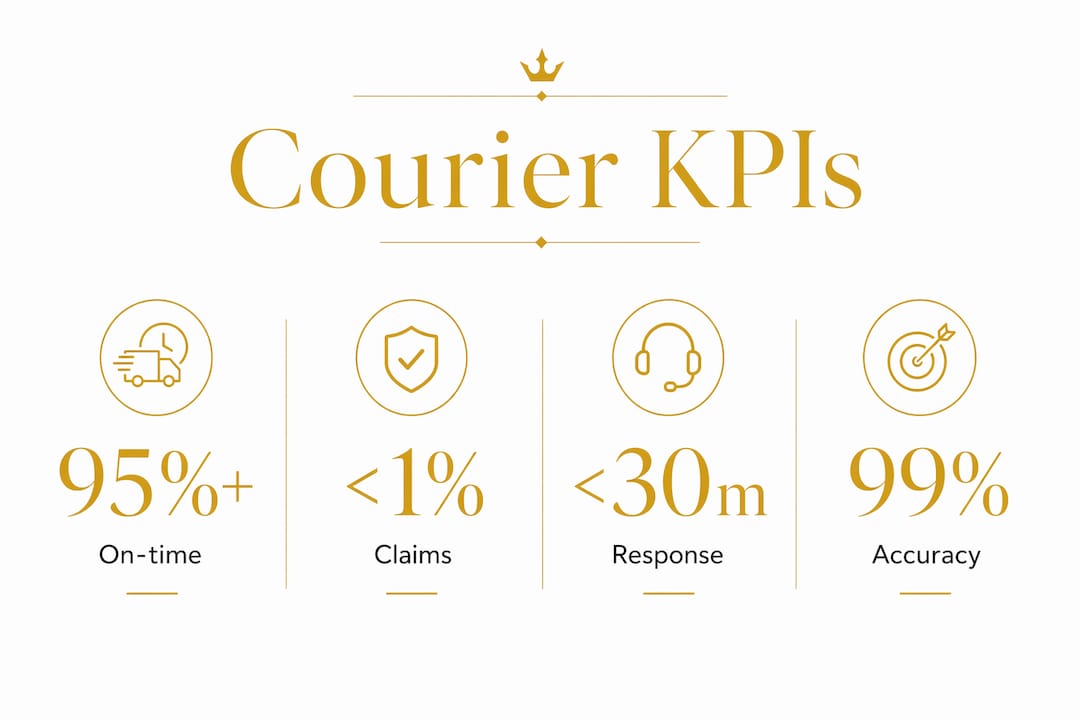
Once your requirements are clear, prepare measurable KPIs that will govern both selection and ongoing monitoring. The most widely used metrics in courier supplier management include:
- On-time delivery rate: the percentage of shipments delivered within the agreed window
- Claims rate: the proportion of shipments resulting in damage or loss claims
- Exception response time: how quickly the courier notifies you of delays or problems
- Proof of delivery accuracy: the rate at which signed delivery confirmations are captured correctly
These KPIs give you an objective basis for comparison during selection and a clear standard to enforce once a supplier is onboarded.
Internal governance matters equally. Appoint a dedicated logistics liaison or a small supplier board responsible for courier relationships. This person or group owns the relationship, tracks performance data, and escalates issues through a defined path. Without a named owner, accountability diffuses and problems go unresolved.

Contract essentials complete the foundation. Every courier agreement should include a service level agreement (SLA) specifying minimum performance thresholds, an escalation matrix that names who contacts whom when things go wrong, and a structured trial period before long-term commitments are made. Courier documentation forms the paper trail that makes all of this enforceable.
Pro Tip: Draft your KPI targets and SLA terms before you approach any courier supplier. Arriving with defined standards signals professionalism and filters out providers who cannot meet your requirements.
How do you select and onboard new courier suppliers effectively?
Selecting a courier supplier under pressure is one of the most common mistakes logistics managers make. Pre-emptive evaluation of courier providers, rather than reactive selection, reduces risk and improves partnership quality. Vet suppliers when you are not in urgent need, so that rational assessment replaces desperation.
Follow this sequence when onboarding a new courier supplier:
- Issue a structured brief. Share your service requirements, volume data, and KPI expectations upfront. Ask the courier to confirm in writing that they can meet each point.
- Conduct an initial audit. Review the courier's fleet capability, insurance cover, tracking technology, and any relevant accreditations before signing anything.
- Negotiate a trial period. A 60 to 90-day trial gives you enough real-world data to assess on-time delivery rates, claims percentages, and exception response times without committing to a long-term contract.
- Set expectations in the SLA. Define minimum acceptable performance thresholds for each KPI. Make clear what happens if the courier falls below them.
- Review trial data formally. At the end of the trial period, score the courier against each KPI. Use this data to decide whether to proceed, renegotiate, or walk away.
The table below shows the KPIs most relevant to courier supplier evaluation and the performance thresholds that indicate a reliable partner.
| KPI | Minimum acceptable threshold |
|---|---|
| On-time delivery rate | 95% or above |
| Claims rate | Below 1% of total shipments |
| Exception response time | Within 2 hours of incident |
| Proof of delivery accuracy | 98% or above |
Real-time tracking visibility during the trial period gives you independent confirmation of the courier's reported performance. Do not rely solely on the supplier's own data.
Pro Tip: Run a short trial on a defined shipment lane rather than your full volume. This limits exposure if the courier underperforms and gives you a clean, comparable data set.
What communication strategies build trust with courier suppliers?
Courier relationships built on consistent standards and predictable communication outperform purely transactional models. This is not a soft observation. When a supplier knows your expectations and trusts that you will communicate fairly, they prioritise your account during disruptions.
Effective communication in courier supplier management rests on four practices:
- Shared tracking visibility. Give your courier access to your order management system, and require them to provide real-time shipment updates. Both sides should see the same data at the same time.
- Proactive exception management. Require your courier to notify you of delays or problems within a defined window, typically two hours of an incident. Early notification allows you to manage customer expectations before complaints arrive.
- Dedicated account contacts. Assign a named account manager on both sides. Generic customer service lines slow resolution times and erode trust. Named contacts build personal accountability.
- Formal review meetings. Schedule monthly or quarterly performance reviews. These meetings are not complaints sessions. They are structured conversations covering KPI scores, recurring issues, volume forecasts, and improvement targets.
The escalation matrix you built during onboarding becomes critical here. When a problem exceeds the account manager's authority, both parties need to know immediately who the next contact is and what the expected response time is.
Pro Tip: Send a brief written summary after every review meeting. A shared record of what was agreed prevents disputes and keeps both parties aligned between meetings.
How do you maintain and grow courier partnerships over time?
Maintaining a trustworthy courier relationship requires the same discipline as building one. Performance does not sustain itself. Managing multiple courier relationships works best with a dedicated governance board and clear escalation paths to maintain alignment and accountability.
Apply these practices to sustain performance over the long term:
- Monthly KPI reporting. Produce a written performance report each month covering on-time delivery rate, claims rate, and exception response times. Share it with the courier and require a written response to any metric below threshold.
- Transparent handling of service failures. When a courier fails, address it formally through the escalation matrix. Document the failure, the root cause, and the corrective action agreed. This prevents repeat failures and builds mutual respect.
- Incentivise continuous improvement. Offer volume growth or preferred supplier status to couriers who consistently exceed KPI targets. Direct client relationships are built through trust and operational readiness, not price alone.
- Review contract terms annually. Business volumes, delivery routes, and service requirements change. Annual renegotiation keeps the SLA aligned with current operational reality.
- Diversify where appropriate. Relying on a single courier for all volume creates fragility. Maintain at least two approved suppliers for critical lanes so that disruption to one does not halt operations.
The comparison below shows how a governance-led approach differs from a purely transactional one across key management areas.
| Management area | Transactional approach | Governance-led approach |
|---|---|---|
| Performance tracking | Ad hoc, reactive | Monthly KPI reports, formal review |
| Issue resolution | Informal complaints | Escalation matrix with named contacts |
| Contract management | Set and forget | Annual review and renegotiation |
| Supplier development | No investment | Volume incentives, improvement targets |
Courier dispatch technology supports this governance model by automating performance data collection and reducing the manual effort required to produce monthly reports.
Key takeaways
Reliable courier supplier relationships require structured governance, measurable KPIs, and consistent communication from the first day of engagement through every subsequent review cycle.
| Point | Details |
|---|---|
| Define requirements first | Write down delivery speed, volume, and handling needs before approaching any courier. |
| Use trial periods | A 60 to 90-day trial gives real performance data before long-term commitment. |
| Set and enforce KPIs | On-time delivery, claims rate, and exception response time are the three core metrics to track. |
| Communicate proactively | Shared tracking visibility and named account contacts resolve problems faster than reactive complaints. |
| Govern continuously | Monthly KPI reports and annual contract reviews prevent performance drift over time. |
What I have learned about courier supplier relationships that most guides miss
The most common mistake I see logistics managers make is treating the contract as the relationship. Once the SLA is signed, they step back and wait for problems to surface. By the time a pattern of failure becomes visible, weeks of disrupted deliveries have already damaged customer trust.
Trusted carriers prioritise shipments beyond their contractual obligations during tight situations. That priority treatment is not written into any agreement. It comes from the relationship you have built through consistent communication, fair treatment, and prompt payment. You cannot buy it with a lower rate card.
The second pitfall is selecting on price. Prioritising lowest price in courier selection often leads to unstable partnerships and increased switching. Every time you switch couriers, you restart the onboarding process, retrain your team, and absorb the performance risk of an untested supplier. The cost of switching almost always exceeds the saving from the lower rate.
Trial periods are non-negotiable in my view. I have seen businesses skip them under time pressure and regret it within a month. A structured 60 to 90-day trial is not a bureaucratic formality. It is the only honest way to know whether a courier can deliver to your standard before you depend on them for your most critical shipments.
The businesses that build the strongest courier partnerships treat their suppliers as operational partners, not interchangeable vendors. They share volume forecasts, flag seasonal peaks early, and acknowledge good performance in writing. That behaviour generates loyalty that no contract clause can replicate.
— Ayomide
How Sddbyaba supports reliable courier partnerships
Sddbyaba operates as a UK-wide same day courier and logistics provider built around the principles this article describes: defined SLAs, dedicated account management, and full shipment visibility from dispatch to delivery.

Every client engagement at Sddbyaba begins with a clear service brief and agreed performance targets. The fleet spans motorcycles through to artic lorries, covering urgent parcels, commercial freight, and time-critical consignments across all industries. Businesses that need a dedicated courier service can trial Sddbyaba's performance on a defined lane before committing to full-volume operations. For businesses managing larger freight movements, the nationwide dispatch services cover everything from pallet distribution to 26-tonne haulage with the same communication standards applied throughout.
FAQ
What is courier supplier relationship management?
Courier supplier relationship management is the structured practice of selecting, onboarding, monitoring, and developing courier providers using agreed KPIs, SLAs, and formal governance processes. It replaces ad hoc supplier contact with consistent, measurable accountability.
How long should a courier trial period last?
A structured trial of 60 to 90 days gives sufficient real-world data to assess on-time delivery rates, claims percentages, and exception response times before committing to a long-term contract.
What KPIs should I use to measure courier performance?
The four core KPIs are on-time delivery rate, claims rate, exception response time, and proof of delivery accuracy. A reliable courier should achieve at least 95% on-time delivery and a claims rate below 1%.
Why does communication matter more than price in courier partnerships?
Reliable communication and human support foster loyalty and reduce switching, whereas lowest-price selection attracts accounts that change providers frequently and absorb repeated onboarding costs.
When should I diversify across multiple courier suppliers?
Diversify when a single courier handles all volume on a critical delivery lane. Maintaining at least two approved suppliers for high-priority routes protects operations if one supplier experiences capacity or service problems.