
Courier dispatch software is defined as the digital operational layer that manages the full delivery lifecycle, from order intake through to proof of delivery. Also known in the industry as a courier management system, it automates driver allocation, route optimisation, real-time tracking, and delivery confirmation. Businesses that rely on manual dispatching face blind spots, administrative overhead, and scaling limits that software directly resolves. For logistics professionals handling dozens to hundreds of daily deliveries, adopting a courier management system is a foundational operational decision, not a technical luxury.
What is courier dispatch software and what does it actually do?
Courier dispatch software manages the entire delivery lifecycle from order intake to proof of delivery, automating key steps to reduce manual labour and improve operational efficiency. The software sits between your order confirmation process and your drivers on the road, acting as the control layer that keeps every job moving correctly.
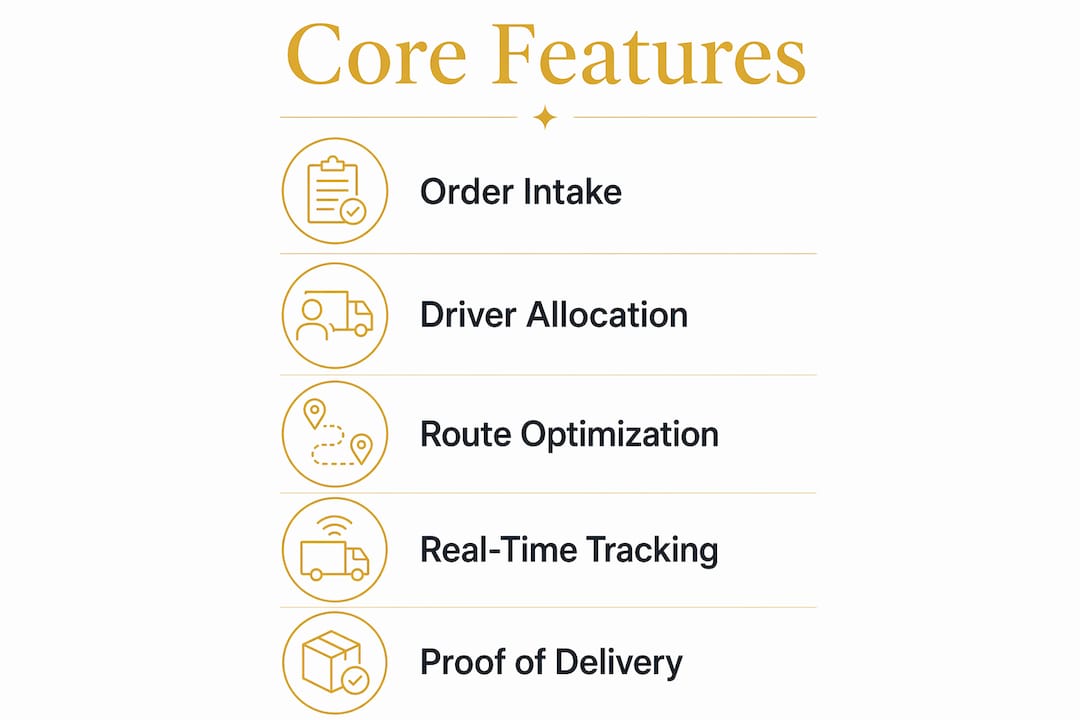
At its core, the system receives orders, assigns them to the most suitable driver, calculates the most efficient route, monitors progress in real time, and records delivery confirmation. Without this layer, dispatchers rely on phone calls, spreadsheets, and guesswork. That approach fails at scale.

The distinction between a courier management system and a basic GPS tracker is significant. GPS tracking tells you where a vehicle is. Courier dispatch software tells you where a vehicle is, whether the job was completed, whether the customer was notified, and whether the delivery data has updated your ERP system. The operational gap between those two capabilities is where most logistics businesses lose money.
Businesses typically reach the tipping point for software adoption when manual processes create blind spots and administrative overhead, which commonly occurs at dozens to hundreds of daily deliveries. At that volume, a single missed delivery or disputed proof of delivery becomes a measurable cost.
What core features define courier dispatch software?
Effective courier dispatch software includes five functional layers that work together to manage delivery operations end to end. Understanding each layer helps logistics professionals evaluate whether a system will genuinely improve operations or simply add a digital interface to existing manual processes.
The five standard layers are:
- Order intake and dispatch logic. The system receives orders from multiple channels, applies business rules, and assigns jobs to drivers based on location, vehicle type, shift hours, and load capacity.
- AI route optimisation. Algorithms calculate the most efficient sequence of stops, accounting for traffic, vehicle constraints, and delivery time windows. This directly increases drop density and reduces fuel consumption.
- Real-time GPS tracking. Live vehicle positions are visible to dispatchers and, in many systems, to customers via automated notifications. This layer reduces inbound "where is my delivery?" calls significantly.
- Multi-format proof of delivery. Photo capture, digital signature, GPS stamp, and timestamp combine to create an indisputable delivery record. This protects revenue and reduces dispute resolution time.
- ERP integration. Delivery status updates flow back into your inventory, billing, and customer management systems automatically. This closes the operational loop and gives management accurate, real-time data.
Beyond these five layers, well-built systems also handle automated invoicing and customer notifications. When a delivery is completed, the system can trigger an invoice and send a confirmation to the recipient without any manual input.
Pro Tip: When evaluating dispatch software, ask vendors specifically how driver allocation handles vehicle constraints and shift hours. A system that ignores a driver's available hours or vehicle payload limits will create compliance risks and operational failures.
The difference between standalone GPS tracking and integrated dispatch software is not a matter of degree. It is a matter of function. Closed-loop communication, where delivery status updates automatically flow back to ERP and inventory systems, delivers operational transparency that GPS alone cannot provide.
How does courier dispatch software improve delivery efficiency?
Automation is the primary mechanism through which courier software improves efficiency. When order intake, driver assignment, route calculation, and customer notification all happen automatically, dispatchers shift from reactive firefighting to proactive management.
The operational benefits are concrete and measurable across several areas:
- Reduced administrative workload. Automated dispatch eliminates manual job entry, phone-based driver communication, and paper-based proof of delivery. Dispatchers handle exceptions rather than routine tasks.
- Higher drop density. Route optimisation algorithms consistently outperform manual routing by sequencing stops to minimise travel distance. More deliveries per vehicle per shift means lower cost per delivery.
- Fewer failed deliveries. Real-time tracking and customer notifications reduce failed deliveries by keeping recipients informed and enabling drivers to respond to access issues before they become failed attempts.
- Revenue protection through proof of delivery. Multi-format proof of delivery creates indisputable records that significantly reduce costly delivery disputes. Photo, signature, timestamp, and GPS stamp together remove ambiguity from any claim that a delivery did not occur.
- Automated failed delivery workflows. When a delivery attempt fails, the best systems automatically reschedule, notify the customer, and update the ERP record. This removes a significant manual burden from dispatch teams.
Failed delivery handling represents a meaningful proportion of total jobs and directly impacts operational cost and reputation. Businesses that underestimate this complexity often find that their software investment delivers less than expected because the system cannot handle exceptions without manual intervention.
Pro Tip: Before selecting a system, map your current failed delivery workflow in detail. Count how many manual steps it involves. Then ask each vendor to demonstrate exactly how their software handles a failed first attempt, including customer notification and redelivery scheduling.
The role of technology in courier services has shifted from optional enhancement to operational necessity. Businesses that hold onto manual dispatching too long introduce blind spots that lead to lost business and inefficient routes. Software adoption is a foundational requirement for scaling delivery operations reliably.
What deployment models and pricing structures are available?
Courier dispatch software pricing varies considerably based on fleet size, feature complexity, and integration requirements. Understanding the typical structures helps logistics managers budget accurately and avoid committing to a tier that does not match their operational scale.
| Deployment tier | Typical user profile | Key cost drivers |
|---|---|---|
| Free or entry-level | Small operators, low monthly order volumes | Order caps, limited integrations |
| Subscription (SME) | Growing fleets, multi-driver operations | Driver count, feature modules |
| Enterprise | Large fleets, complex integrations | Custom pricing, dedicated support |
| On-premise | Businesses with strict data requirements | Upfront licence, IT infrastructure |
Pricing models vary widely, with small businesses accessing free or entry-level tiers that carry limits on monthly orders, while enterprise solutions carry higher fees based on fleet size and feature depth. The cost difference between tiers is substantial, but so is the capability gap.
Cloud-based systems dominate the market for good reason. They require no on-premise infrastructure, receive automatic updates, and scale without hardware investment. On-premise solutions suit businesses with strict data sovereignty requirements or complex legacy system integrations, but they carry higher upfront costs and ongoing IT overhead.
ROI calculations for courier software should account for fuel savings from route optimisation, reduced labour costs from automation, and the financial impact of fewer failed deliveries and disputes. Businesses that factor only the subscription cost into their evaluation consistently underestimate the return.
What pitfalls should businesses avoid when adopting dispatch software?
The most common adoption mistake is treating courier dispatch software as a plug-and-play solution. It is not. Software effectiveness depends on automated, clean data flow from ERP and order intake systems. Without that upstream integration, the software simply digitises existing manual errors rather than eliminating them.
Key pitfalls to avoid:
- Skipping upstream integration. If your order intake process is still manual, dispatch software will inherit those errors. Automate order intake before or alongside dispatch software adoption.
- Overvaluing GPS tracking alone. GPS tells you where vehicles are. It does not close the operational loop. Prioritise systems where delivery status updates flow back to ERP in real time.
- Underestimating failed delivery complexity. Businesses frequently discover that their chosen system handles successful deliveries well but requires manual intervention for every failed attempt. That gap erodes the efficiency gains quickly.
- Ignoring proof of delivery requirements. Disputes arising from inadequate delivery proof are a hidden cost. Multi-factor proof of delivery, covering photo, signature, GPS stamp, and timestamp, mitigates this risk directly.
Pro Tip: Run a structured pilot with a subset of your fleet before full deployment. Use the pilot period specifically to stress-test failed delivery workflows, ERP data return, and driver app usability. Issues discovered in a pilot cost far less to fix than issues discovered after full rollout.
Viewing software adoption as purely a technical upgrade is the wrong frame. The decision affects billing accuracy, customer communication, driver management, and management reporting simultaneously. Treat it as a business process change that happens to involve software.
Key takeaways
Courier dispatch software is the operational control layer that connects order intake to proof of delivery, and its value depends entirely on how well it integrates with your existing business systems.
| Point | Details |
|---|---|
| Five functional layers | Effective systems cover order intake, route optimisation, GPS tracking, proof of delivery, and ERP integration. |
| Integration is non-negotiable | Software without clean upstream data flow from ERP systems digitises errors rather than eliminating them. |
| Proof of delivery protects revenue | Multi-format records covering photo, signature, GPS stamp, and timestamp reduce costly disputes. |
| Failed delivery workflows matter | Automated rescheduling and customer notification for failed attempts deliver measurable cost savings. |
| Pricing scales with fleet size | Entry-level tiers suit small operators; enterprise systems carry higher costs but handle complex, high-volume operations. |
Why integration matters more than the software itself
Having worked closely with logistics operations across the UK, the pattern I see most consistently is this: businesses invest in capable dispatch software and then wonder why the efficiency gains are smaller than expected. Almost every time, the answer is the same. The software is fine. The data feeding into it is not.
Courier dispatch software is only as effective as the systems it connects to. A well-configured system with clean, automated order intake and a properly mapped ERP integration will outperform a more feature-rich system running on manual data entry every single time. The software is the engine. Integration is the fuel.
The proof of delivery piece is where I see the clearest financial impact. Businesses that implement multi-format proof of delivery, and actually use the data to resolve disputes, recover costs they did not know they were losing. Delivery disputes are a hidden drain on revenue that most operations do not quantify until they start capturing proper records.
My honest view is that the businesses that get the most from courier dispatch software are the ones that treat adoption as a process redesign project. They map their workflows before selecting a system, they pilot rigorously, and they measure outcomes against specific operational metrics. The businesses that struggle are the ones that buy software and expect it to fix problems they have not yet defined.
For time-critical operations, the real-time tracking capability is not a feature. It is the baseline expectation of every professional client. If your system cannot tell a client exactly where their consignment is at any given moment, you are operating below the standard the market now demands.
— Ayomide
Sddbyaba: same day dispatch backed by professional logistics
Businesses that understand courier dispatch software also understand what to look for in a professional logistics partner. Sddbyaba operates same day courier services across the UK, with a fleet ranging from motorcycle couriers to artic lorries, all managed through integrated dispatch and tracking systems.

Whether you need dedicated courier transport, freight haulage, or pallet delivery, Sddbyaba provides real-time updates, professional communication, and reliable proof of delivery on every job. The same operational principles covered in this guide, from closed-loop tracking to automated dispatch, underpin every service Sddbyaba provides. Contact Sddbyaba directly to discuss your logistics requirements or request a quote for same day or scheduled delivery services nationwide.
FAQ
What is courier dispatch software used for?
Courier dispatch software manages the full delivery lifecycle, from order intake and driver allocation through to real-time tracking and proof of delivery capture. It automates key operational steps to reduce manual labour and improve delivery accuracy.
How does courier dispatch software differ from GPS tracking?
GPS tracking shows vehicle locations. Courier dispatch software manages driver assignments, optimises routes, captures proof of delivery, and returns status updates to ERP systems automatically. The operational scope is significantly broader.
What features should I prioritise when choosing dispatch software?
Prioritise ERP integration, multi-format proof of delivery, automated failed delivery workflows, and AI route optimisation. GPS tracking alone is the least valuable feature without closed-loop data return to your business systems.
Is courier dispatch software suitable for small businesses?
Entry-level and free tiers exist for small operators with lower monthly order volumes. Businesses should assess their daily delivery count and failed delivery rate to determine which pricing tier delivers a positive return.
How does proof of delivery reduce costs?
Multi-format proof of delivery, covering photo, signature, GPS stamp, and timestamp, creates indisputable delivery records that reduce dispute resolution time and protect revenue from unwarranted claims.