
Emergency courier booking is the process of requesting, dispatching, and tracking an urgent delivery through a specialised service designed for immediate response, transparent handling, and time-critical execution. Unlike standard parcel services, emergency courier services operate on the principle that every minute of delay carries a measurable cost. Whether you are a manufacturer facing a production stoppage, a medical facility awaiting critical supplies, or a business with a legal deadline, understanding how emergency courier booking works gives you the control to act decisively when it matters most.
What are the main steps in the emergency courier booking process?
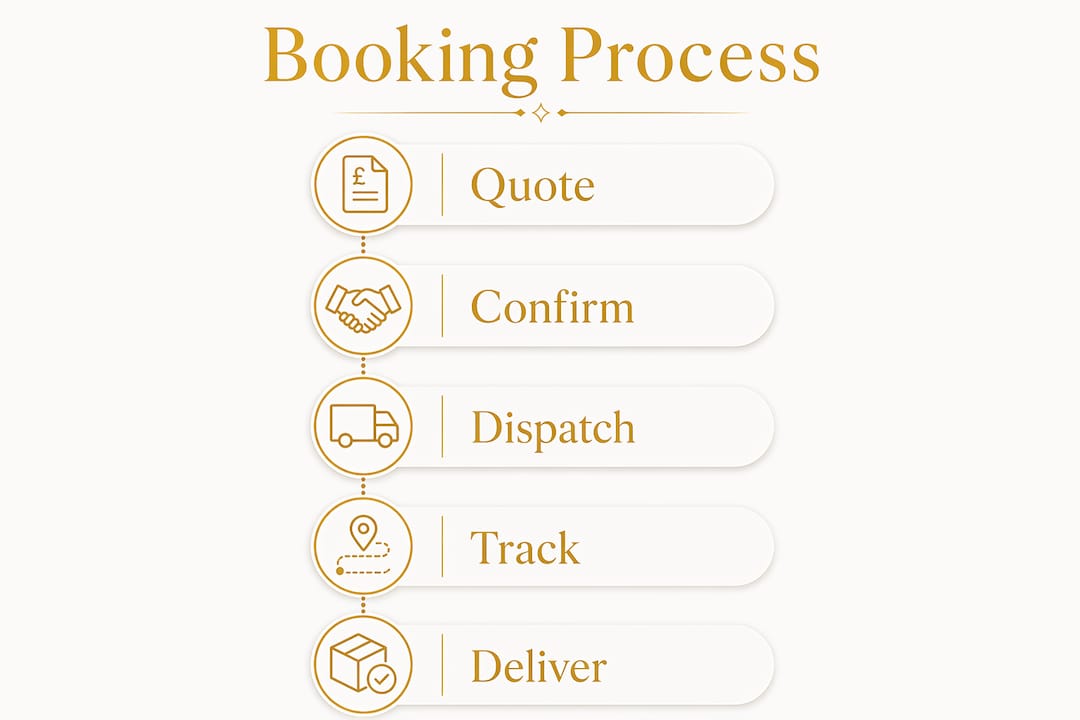
The emergency courier booking process follows a clear four-step workflow: request an instant quote, confirm your booking, track the courier in real time, and receive proof of delivery. Each step is designed to remove friction and compress the time between need and fulfilment.
-
Request an instant quote. Provide the pickup and drop-off addresses, package dimensions, weight, and any special handling requirements. Most modern courier platforms generate a quote instantly based on distance, vehicle size, and urgency. This takes under two minutes when your details are ready.
-
Confirm the booking. Once you accept the quote, the system triggers immediate courier dispatch. A key advantage here is that no account setup is required with most high-end emergency providers. You can book as a guest during a critical situation without lengthy registration.
-
Track in real time. After dispatch, you receive live GPS updates showing the courier's location and estimated arrival time. Live GPS tracking and automated ETA notifications give both sender and recipient full visibility throughout transit. This transparency removes the anxiety of not knowing where your consignment is.
-
Receive proof of delivery. On completion, the courier captures a digital signature or photo as confirmation. This creates an auditable record, which is particularly important for medical, legal, and commercial consignments where chain of custody matters.
Pro Tip: Have your full pickup and drop-off details, including floor number, access codes, and contact names, ready before you start the booking. Incomplete information is the single most common cause of dispatch delays.
How does pricing work for emergency courier bookings?

Emergency courier pricing is highly dynamic and depends on vehicle type, total mileage, and time of day. Premium rates apply to on-demand services that guarantee collection within one to two hours. Understanding this structure helps you choose the right service level without overspending.
The table below compares the two main service tiers:
| Factor | Standard same-day service | Emergency on-demand service |
|---|---|---|
| Booking window | Morning cut-off applies | 24/7/365, no cut-off |
| Collection speed | Within a few hours | Within 60–120 minutes |
| Pricing | Lower base rate | Premium rate |
| Driver availability | Scheduled network | On-call floating network |
| Best for | Planned urgent deliveries | Crisis or unplanned situations |
Several variables push costs higher in the emergency tier:
- Vehicle size. A motorcycle courier costs less than a Luton van. Matching vehicle to load size keeps costs proportionate.
- Distance. Longer routes increase fuel and driver time costs directly.
- Time of day. Night, weekend, and bank holiday bookings carry surcharges due to reduced driver availability.
- Urgency level. VIP or guaranteed collection windows command the highest rates.
The critical question is not whether emergency pricing is expensive. The question is whether the cost of delay exceeds the premium. Irreversible harm from delay, such as a halted production line or a failed medical procedure, almost always justifies the premium. When the risk of delay is low, a standard same-day service is the more cost-effective choice.
What technology supports emergency couriers?
A functional emergency courier operation depends on technology at every stage. Staffed dispatch centres, on-call driver networks, real-time tracking, and escalation protocols are the minimum requirements for a service that genuinely qualifies as emergency-grade. An automated order queue that holds bookings for morning review does not meet this standard.
The key technologies that underpin reliable emergency courier services include:
- Real-time GPS tracking. Couriers are tracked continuously, with location data shared directly with the sender and recipient. This removes guesswork and allows both parties to plan around the arrival.
- Automated ETA notifications. The system sends status updates at key milestones: courier assigned, en route, nearby, and delivered. These updates reduce inbound enquiries and keep all parties informed without manual intervention.
- Digital proof of delivery. Photo capture and electronic signatures create an immediate, time-stamped record. For industries such as healthcare, construction, and legal services, this record is not optional.
- Live dispatcher communication. A staffed dispatcher monitors active jobs and can intervene if a courier encounters an obstacle. This escalation capability is what separates a true 24/7 emergency service from a basic booking platform.
Pro Tip: When evaluating a courier provider, ask directly whether their dispatch centre is staffed around the clock or whether bookings outside office hours go into an automated queue. The answer tells you everything about their actual emergency capability.
Emergency providers also use advanced routing technology and floating driver networks to guarantee rapid response even during off-hours. This means a courier can be assigned and moving within minutes of your booking confirmation, regardless of the time.
For a detailed look at how live updates are managed during urgent jobs, the guide on how emergency couriers communicate updates covers the operational detail behind real-time communication.
What practical tips help you get the most from urgent delivery bookings?
Preparation is the single biggest factor separating a smooth emergency delivery from a costly one. The steps below reflect what experienced shippers consistently apply when time is short.
-
Book outside peak traffic windows where possible. Rush hour periods between 7–9 AM and 5–7 PM add significant transit time due to congestion. If your situation allows even a 30-minute delay in dispatch, booking just before or after these windows can meaningfully improve delivery speed.
-
Provide exact location details upfront. Include the full address, building name, floor, access code, and the name of the person receiving the goods. Vague instructions force the courier to stop and call, which costs time you do not have.
-
Select the right vehicle for your goods. Fragile, oversized, or temperature-sensitive items need appropriate space and handling. Choosing a vehicle matched to your load reduces the risk of damage during rapid transit. Sddbyaba operates a fleet ranging from motorcycle couriers to artic trucks, so there is always a fit for the consignment type.
-
Add a time buffer for congestion. Even with the best routing, urban congestion is unpredictable. Experienced shippers build a buffer of 20–30 minutes into their deadline calculations to account for real-world conditions.
-
Avoid last-minute changes. Changing the pickup address or adding stops after dispatch disrupts the courier's route and can invalidate the original quote. Confirm all details before you click book.
Avoiding common pitfalls is equally important. The guide on common emergency delivery mistakes covers the errors businesses make most often, including misjudging urgency levels and selecting the wrong service tier.
Key takeaways
Emergency courier booking works because it combines instant quoting, immediate dispatch, real-time tracking, and digital proof of delivery into a single, time-compressed workflow built for situations where delay causes direct harm.
| Point | Details |
|---|---|
| Four-step booking process | Quote, confirm, track, and receive proof of delivery are the core stages of every emergency booking. |
| Dynamic pricing factors | Vehicle type, distance, time of day, and urgency level all directly affect the cost of emergency courier services. |
| Technology is non-negotiable | Real-time GPS, digital proof of delivery, and staffed dispatch are the minimum standard for genuine emergency services. |
| Preparation reduces risk | Having full address details, correct vehicle selection, and time buffers ready before booking prevents the most common delays. |
| Match service to risk level | Use emergency on-demand services only when delay causes irreversible harm; standard same-day is sufficient for lower-risk situations. |
What I have learned from years of watching emergency logistics under pressure
The most common mistake I see businesses make is treating emergency courier services as a last resort they will figure out when the crisis hits. By the time the crisis arrives, there is no time to evaluate providers, compare pricing structures, or learn how the booking platform works. The businesses that handle urgent deliveries well are the ones that have already tested the process before they needed it.
The second thing I have noticed is that people consistently underestimate the value of a staffed dispatch centre. Automated platforms are fine for standard bookings. For a genuine emergency at 2 AM on a Sunday, you need a human dispatcher who can reassign a driver, reroute around an incident, or escalate a problem in real time. That capability is not universal, and it is worth verifying before you commit to a provider.
Technology has raised client expectations significantly. Senders now expect live tracking as standard, not as a premium add-on. Providers who cannot offer real-time GPS updates and automated notifications are operating below the current baseline. If a courier company cannot show you where your consignment is at any given moment, that is a gap in accountability you should not accept for time-critical goods.
My practical advice is straightforward. Identify your emergency courier provider now. Test the booking process with a non-critical shipment. Confirm that their dispatch is genuinely staffed around the clock. Then, when the situation that demands immediate action arrives, you will act in seconds rather than spending precious minutes searching for options.
— Ayomide
Sddbyaba's emergency and same day courier services
When an urgent delivery cannot wait, Sddbyaba provides immediate dispatch across the UK with a fleet that covers everything from motorcycle couriers to artic trucks.

Sddbyaba's emergency delivery service operates with staffed dispatch, real-time tracking, and transparent pricing across all vehicle types. Whether you need a small parcel collected within the hour or a dedicated vehicle for a time-critical commercial consignment, the same day courier service is built to respond without delay. Businesses across construction, manufacturing, healthcare, and retail rely on Sddbyaba for dependable urgent transport nationwide. Request a quote directly to get an instant price based on your route, vehicle requirement, and urgency level.
FAQ
What is emergency courier booking?
Emergency courier booking is the process of requesting an immediate, time-critical delivery through a specialised courier service that dispatches within minutes of order placement. It includes real-time tracking and digital proof of delivery as standard.
How quickly can an emergency courier collect a parcel?
Most genuine emergency courier services guarantee collection within 60–120 minutes of booking confirmation. True on-demand providers operate 24/7/365 with no morning cut-off restrictions.
Do I need an account to book an emergency courier?
Most high-end emergency courier providers allow instant bookings without an account, enabling rapid access during critical situations. This removes the barrier of lengthy registration when time is short.
How is emergency courier pricing calculated?
Emergency courier pricing is based on vehicle type, total distance, time of day, and the urgency of the collection window. Premium rates apply to on-demand services that guarantee immediate dispatch.
When should I use emergency courier services instead of standard same-day?
Use emergency courier services when delay causes irreversible operational, clinical, or financial harm. For lower-risk situations, standard same-day delivery is more cost-effective.