
A courier manifest is defined as a structured listing of all parcels or cargo on a single transport leg, serving as the primary document for operational control and regulatory compliance. In the logistics industry, the term "delivery manifest" is the recognised standard, though "courier manifest" is widely used in parcel and last-mile operations to describe the same document. Carriers, customs authorities, and warehouse teams all rely on manifests to verify shipment contents, confirm handling requirements, and maintain an auditable record of every consignment in transit. Understanding what a courier manifest means, and how it functions across different stages of a delivery operation, is non-negotiable for any logistics professional managing shipments at scale.
What is a courier manifest and what does it contain?
A courier manifest records every parcel or consignment assigned to a transport leg in a single, consolidated document. Manifest contents typically include the cargo list, sender and recipient details, weights and dimensions, handling instructions, and references to underlying shipment documents such as bills of lading or waybills. This consolidation means that instead of managing dozens of individual shipment papers, a dispatcher or customs officer works from one authoritative source per transport leg.
The data fields on a well-constructed manifest serve two distinct purposes. Operationally, they give drivers, sorters, and depot staff the information needed to handle each parcel correctly. From a compliance standpoint, they provide customs authorities and auditors with the evidence required to verify that shipment contents match declarations.

Accuracy at the data entry stage is where most manifest problems originate. A single transposed postcode or incorrect weight can trigger a customs query, delay a delivery, or create a discrepancy that takes hours to resolve. Manifest completeness and timeliness directly affect customs clearance speed and regulatory compliance, which means errors do not stay administrative. They become operational delays with real cost implications.
Key data fields found on a standard courier manifest include:
- Consignment reference numbers and tracking identifiers for each parcel
- Sender and recipient names, addresses, and contact details
- Item descriptions, quantities, and declared values
- Gross and volumetric weights per consignment
- Special handling instructions such as fragile, temperature-controlled, or hazardous goods flags
- Service type (same day, next day, economy) and vehicle or route assignment
- Total parcel count and cumulative weight for the transport leg
Pro Tip: Validate manifest data against the booking system before the vehicle departs. Catching a weight discrepancy or missing address at the depot is a five-minute fix. Catching it at a customs border or a failed delivery attempt costs significantly more.
How does a courier manifest differ from a bill of lading or packing list?
Confusing manifests with bills of lading is one of the most common process errors in logistics teams, and the distinction matters because each document carries different legal weight and serves a different operational function.
A bill of lading is a contract of carriage between a shipper and a carrier. It serves as a receipt for goods, a title document, and a legal agreement governing the transport. A packing list, by contrast, is a shipment-level document detailing the contents of a specific consignment, typically prepared by the shipper. A courier manifest sits above both of these. It is an operational summary compiled by the carrier that aggregates multiple shipments into a transport-leg-level record.
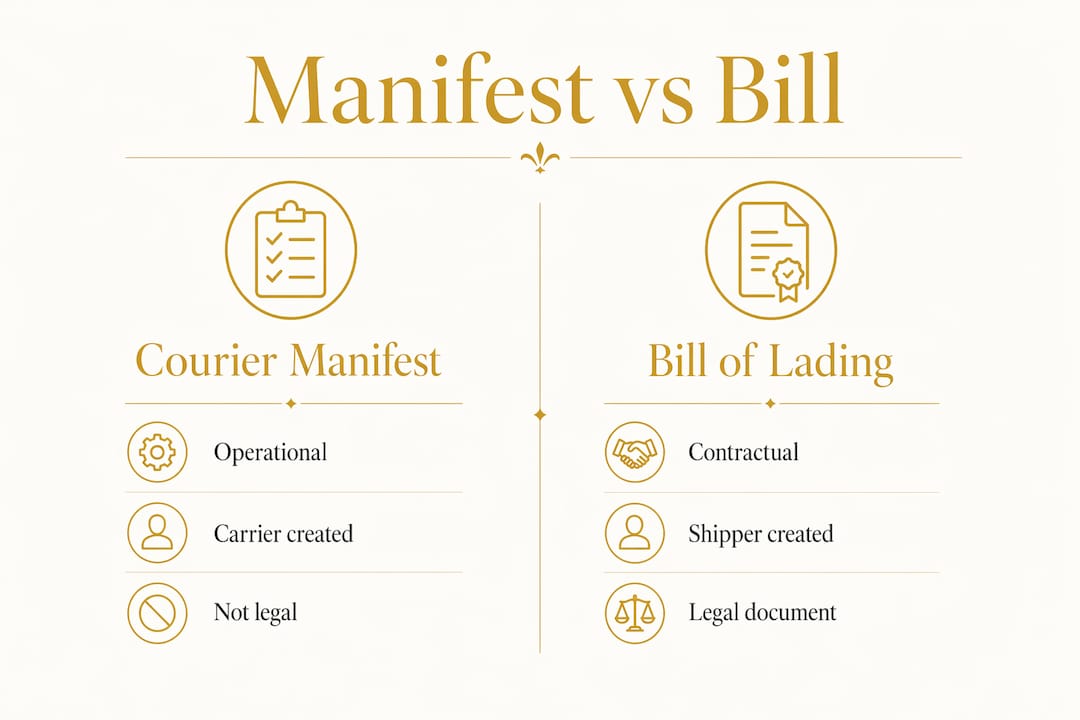
The table below summarises the key distinctions:
| Document | Primary function | Who creates it | Legal status |
|---|---|---|---|
| Courier manifest | Operational summary of all parcels on a transport leg | Carrier or courier operator | Regulatory and operational record |
| Bill of lading | Contract of carriage and title document | Carrier, countersigned by shipper | Legally binding contract |
| Packing list | Itemised contents of a single consignment | Shipper | Supporting commercial document |
| Waybill | Non-negotiable transport instruction | Carrier | Operational instruction, not title |
The practical implication is straightforward. A manifest does not transfer ownership of goods and cannot be used as proof of contract. Manifests assist customs clearance and act as legal evidence in disputes about shipment contents, but they do not replace the bill of lading in contractual or financial transactions. Logistics teams that treat a manifest as a substitute for a bill of lading in cross-border freight will encounter problems at customs or in dispute resolution.
For mission-critical deliveries where documentation errors carry the highest risk, understanding which document does what is the difference between a smooth clearance and a costly hold.
What does "manifested for delivery" mean in shipment tracking?
"Manifested for delivery" is one of the most frequently misunderstood tracking statuses in parcel logistics. "Manifested for delivery" means the shipment has been recorded on the carrier's delivery manifest and is administratively ready for dispatch, but has not yet physically left the depot or sorting facility.
The distinction between "manifested for delivery" and "out for delivery" is operationally significant:
- Manifested for delivery: The parcel is assigned to a delivery run and recorded on the manifest. The vehicle may not yet have departed. This is an administrative status confirming readiness.
- Out for delivery: The parcel is physically on a vehicle that is actively making deliveries. The driver has departed the depot with the parcel loaded.
- Delivered: The parcel has been handed over to the recipient or left in a designated safe place, with a scan event confirming completion.
Parcel networks generate delivery manifests compiling shipment details including addresses, weights, and tracking numbers to control and scan parcels during transit. This process improves parcel accountability before final-mile delivery begins, which is why the manifest status appears before physical dispatch.
The gap between "manifested for delivery" and "out for delivery" can range from minutes to several hours depending on depot processing volumes and vehicle departure schedules. High-volume courier operations configure scan events differently, so the same tracking label may represent different physical realities across carriers. This is why customer service teams at courier companies receive a high volume of queries about parcels that appear "manifested" but have not yet moved. The status is accurate. It simply describes an administrative state, not a physical one.
How to create and manage courier manifests effectively
Creating a courier manifest accurately is a process that depends on structured data capture, validated inputs, and a clear audit trail from booking through to delivery confirmation. The following steps reflect best practice for logistics operations of any scale.
-
Capture shipment data at the point of booking. Every consignment should generate a record with all required manifest fields populated before it reaches the depot. Manual transcription from paper booking forms is the single largest source of manifest errors.
-
Validate data against carrier and customs requirements before manifest generation. Weight thresholds, prohibited item checks, and address format validation should run automatically. For international shipments, air IGMs require submission 24 hours before arrival, meaning late or incomplete data has direct customs consequences.
-
Consolidate underlying shipment documents into the manifest. Vessel export manifests require all related bills of lading attached, and the same consolidation principle applies across transport modes. Each manifest should reference every underlying shipment document for traceability.
-
Assign manifests to specific vehicles and routes before departure. Linking the manifest to a route plan and driver record creates the audit trail needed for tracking, proof of delivery, and any subsequent investigation.
-
Scan parcels against the manifest at loading. Every parcel loaded onto a vehicle should be scanned to confirm it matches the manifest. Discrepancies caught at loading are resolved in minutes. Discrepancies discovered at the delivery address or customs point are resolved in hours or days.
-
Retain completed manifests with delivery confirmation data. A closed manifest with scan events, delivery timestamps, and exception notes is the primary evidence in any dispute about whether a shipment was carried, delivered, or lost.
Cross-border manifest inaccuracies can cause holds and penalties, and manual entry workflows carry the highest risk of producing those inaccuracies. Automated manifest generation, integrated with transport management systems, removes the human error variable from the most compliance-sensitive part of the process.
Pro Tip: Integrate manifest generation directly with your routing and scanning systems. When a parcel scan at the depot automatically populates the manifest and triggers a route assignment, you eliminate the manual handoff where most data errors occur. This is particularly valuable for same-day courier routing where there is no time to correct errors after departure.
Key takeaways
A courier manifest is the operational backbone of any transport leg, and its accuracy determines both compliance outcomes and delivery reliability.
| Point | Details |
|---|---|
| Core definition | A courier manifest lists all parcels on a transport leg for operational control and regulatory compliance. |
| Document distinctions | Manifests are operational summaries; bills of lading are contracts of carriage. Never substitute one for the other. |
| Tracking status clarity | "Manifested for delivery" confirms administrative readiness, not physical dispatch from the depot. |
| Compliance risk | Cross-border manifest inaccuracies cause customs holds and penalties; automated data capture reduces this risk. |
| Best practice | Scan every parcel against the manifest at loading and retain completed manifests with delivery confirmation data. |
Why manifest accuracy is the most underrated discipline in courier operations
I have spent years working alongside logistics teams that treat the manifest as a back-office formality. It gets generated, it gets filed, and it only gets looked at when something goes wrong. That attitude is expensive.
The manifest is not a summary of what happened. It is the document that makes everything else possible: tracking, customs clearance, proof of delivery, dispute resolution, and route auditing. When a parcel goes missing, the manifest is the first document anyone reaches for. When a customs authority queries a shipment, the manifest is what they check. When a client disputes a delivery, the manifest with its scan events is the evidence that resolves it.
What I find particularly telling is how often "manifested for delivery" generates customer service contacts. Customers see the status and assume something is wrong because the parcel has not moved. The status is working exactly as intended. The problem is that the gap between administrative readiness and physical dispatch is invisible to anyone outside the operation. Better communication at that stage, whether through automated notifications or clearer status descriptions, would eliminate a significant proportion of inbound queries for most courier businesses.
The shift towards automated manifest filing is the right direction. Automated, structured data capture reduces compliance risks in manifest filing and avoids the penalties common with manual workflows. For high-volume operations, the return on that investment is measured in avoided delays, not just saved time. For time-critical same-day operations, where there is no recovery window if a manifest error grounds a shipment, it is not optional.
My advice to logistics professionals: treat manifest accuracy as a strategic discipline, not an administrative task. The teams that do this consistently are the ones that rarely have to explain to a client why their shipment is sitting in a customs hold.
— Ayomide
How Sddbyaba manages manifests for reliable nationwide delivery

Sddbyaba builds manifest management into every stage of its dispatch process, from booking confirmation through to delivery scan. As a UK-based dedicated courier service operating nationwide, Sddbyaba handles same-day consignments, commercial freight, pallet distribution, and time-critical haulage across a fleet ranging from motorcycle couriers to artic lorries. Every shipment is documented, tracked, and auditable. For businesses that need nationwide courier coverage with the operational rigour that manifest accuracy demands, Sddbyaba provides the logistics infrastructure to match. Contact Sddbyaba directly to discuss a tailored solution for your delivery requirements.
FAQ
What is a courier manifest in simple terms?
A courier manifest is a document listing all parcels or cargo assigned to a single transport leg, used by carriers to manage, track, and verify shipments during transit. It serves both operational and regulatory purposes across road, air, and sea freight.
What does "manifested for delivery" mean?
"Manifested for delivery" means the parcel has been recorded on the carrier's delivery manifest and is ready for dispatch, but has not yet physically left the depot. It is an administrative status, not confirmation of active delivery.
What is the difference between a courier manifest and a bill of lading?
A courier manifest is an operational summary compiled by the carrier covering all shipments on a transport leg. A bill of lading is a legally binding contract of carriage between shipper and carrier for a specific consignment. The two documents serve different legal and operational functions.
Why is a courier manifest necessary for cross-border shipments?
Cross-border shipments require accurate manifests because customs authorities use them to verify shipment contents and confirm compliance before releasing cargo. Incomplete or inaccurate manifests cause customs holds and can result in financial penalties for the carrier or shipper.
How do parcel carriers use manifests for shipment tracking?
Carriers generate manifests that compile tracking numbers, addresses, and weights for each parcel on a delivery run. Scan events at loading and delivery are recorded against the manifest, creating the audit trail that supports real-time tracking and proof of delivery confirmation.