
Courier routing is not a mapping task. It is a mathematical and operational discipline, and businesses that treat it as the former are quietly losing money every day. Failing to use modern optimisation costs businesses 15 to 30% of their total fleet capacity. That is not a marginal inefficiency. For any operation running multiple vehicles across the UK, that figure represents missed deliveries, excess fuel spend, and drivers finishing late. Understanding how courier routing works is the first step toward closing that gap.
Table of Contents
- Key takeaways
- How courier routing works: planning vs optimisation
- The technology behind modern routing systems
- Advanced routing strategies for urban delivery
- The operational impact of routing optimisation
- My perspective on what most logistics teams get wrong
- How Sddbyaba supports routing-informed logistics
- FAQ
Key takeaways
| Point | Details |
|---|---|
| Routing is not planning | Route optimisation solves a mathematical problem; basic planning tools simply cannot do this. |
| Constraints drive complexity | Time windows, vehicle capacity, and driver hours all affect how stops are sequenced. |
| Technology is the differentiator | Machine learning and real-time re-optimisation separate high-performing fleets from average ones. |
| Driver knowledge matters | Encoding tribal knowledge into routing systems significantly improves delivery success rates. |
| Model choice shapes routing | Dedicated fleets offer more routing control; on-demand models trade that control for flexibility. |
How courier routing works: planning vs optimisation
Most logistics professionals understand route planning. You have a list of stops, a start point, and a vehicle. You assign the stops and send the driver out. That is planning. Route optimisation is something different entirely.
Route optimisation is the process of finding the mathematically best sequence and assignment of stops, given a set of real-world constraints. The underlying problem is known as the Vehicle Routing Problem, or VRP. It is a well-studied challenge in operations research, and it scales in complexity faster than most people expect. Add 20 stops across three vehicles with different time windows and you have a problem space with billions of possible solutions. No human dispatcher can evaluate those options manually.
The constraints that make VRP complex include:
- Time windows: customers or recipients who are only available within specific hours
- Vehicle capacity: weight and volume limits that vary by vehicle type
- Driver hours: legal limits on working time and mandatory rest breaks
- Road restrictions: weight limits, low-emission zones, and access rules
- Priority stops: time-critical deliveries that must be sequenced first
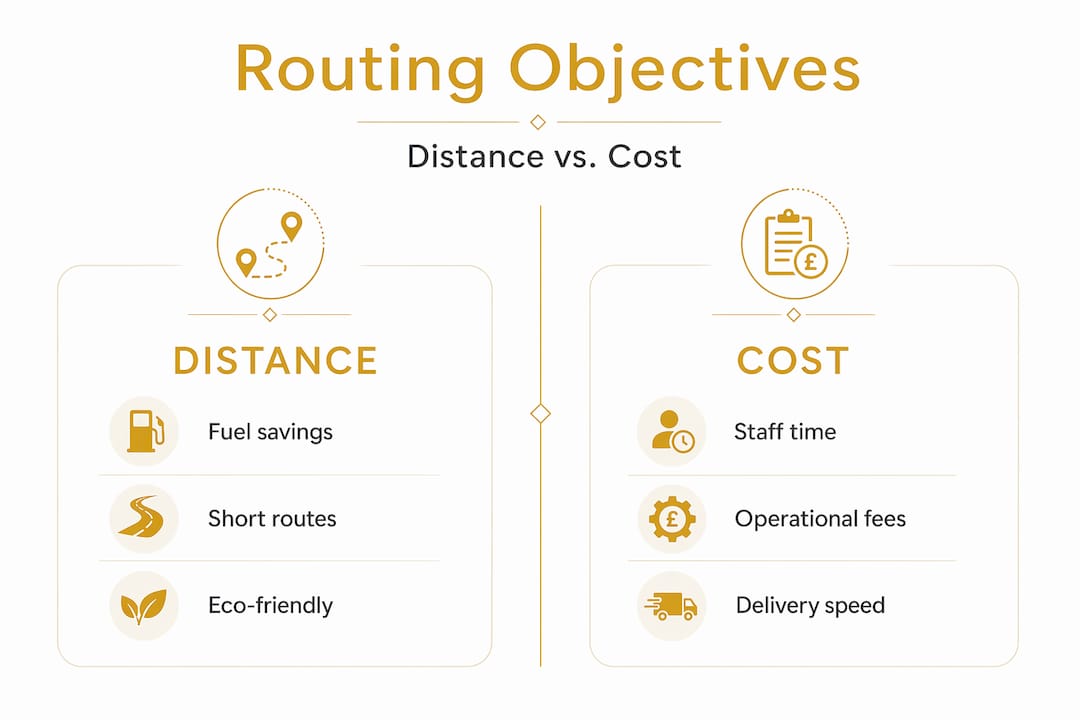
The objective is not always the same. Some operations want to minimise total distance. Others prioritise time, cost per delivery, or the number of vehicles used. The right objective depends on your business model. A same day courier operation, for example, will weight time far more heavily than a standard next-day parcel carrier.
Standard mapping applications limit users to around 10 stops and apply no optimisation logic at all. Dedicated courier routing software handles 30 or more stops and computes optimised sequences in under 400 milliseconds. That difference is not incremental. It is the difference between a functional courier operation and one that is genuinely competitive.
Pro Tip: If your team is still using a consumer mapping app to plan multi-stop routes, you are not saving time. You are spending it on a tool that was never designed for courier logistics.
The technology behind modern routing systems
Understanding courier logistics at a technical level means understanding the layers of technology that work together to produce a route. These are not single systems. They are integrated stacks, and each layer contributes something specific.
-
Geocoding and location data. Before any optimisation can occur, every address must be converted into precise coordinates. Good geocoding includes not just the building location but entrance points and parking availability. A delivery to a large distribution centre or hospital campus can add significant time if the driver approaches from the wrong side.
-
Machine learning for travel time prediction. Static map data gives average speeds. Machine learning models trained on historical delivery data give accurate predictions by time of day, day of week, and local conditions. This is the foundation for realistic route scheduling.
-
Operations research solvers. These are the engines that sequence stops. They use heuristics, constraint programming solvers such as CP-SAT, and metaheuristic approaches to find near-optimal solutions at speed. Hybrid ML and OR systems combine both disciplines to satisfy hard constraints like vehicle weight limits and driver hours while sequencing stops efficiently.
-
Real-time re-optimisation. Routes do not survive contact with the real world unchanged. Traffic incidents, failed delivery attempts, and new urgent pickups all require the route to be recalculated. Dynamic re-optimisation triggers recalculations within 30 seconds of a change, maintaining operational usefulness without disrupting the driver mid-route.
-
Driver app integration. The optimised sequence is only useful if it reaches the driver in a format they can act on. Integration with driver-facing apps allows real-time updates, proof-of-delivery capture, and exception reporting that feeds back into the system.
Enterprise-scale routing systems demonstrate what is possible at the upper end. Operations running tens of thousands of drivers have used stop-sequencing optimisation to save up to 100 million miles annually, reducing fuel costs and carbon output simultaneously.
The integration of these layers is what separates genuine courier routing software from a tool that simply draws lines on a map. For logistics professionals evaluating platforms, the question to ask is not "does it optimise?" but "what constraints does it model, and how quickly does it re-optimise?"
Advanced routing strategies for urban delivery
Urban delivery presents challenges that standard routing models struggle to handle. Dense stop clusters, restricted access, unpredictable parking, and building-specific access rules all affect how a route performs in practice. Advanced routing strategies address these problems directly.
Micro-cluster routing and dead mileage
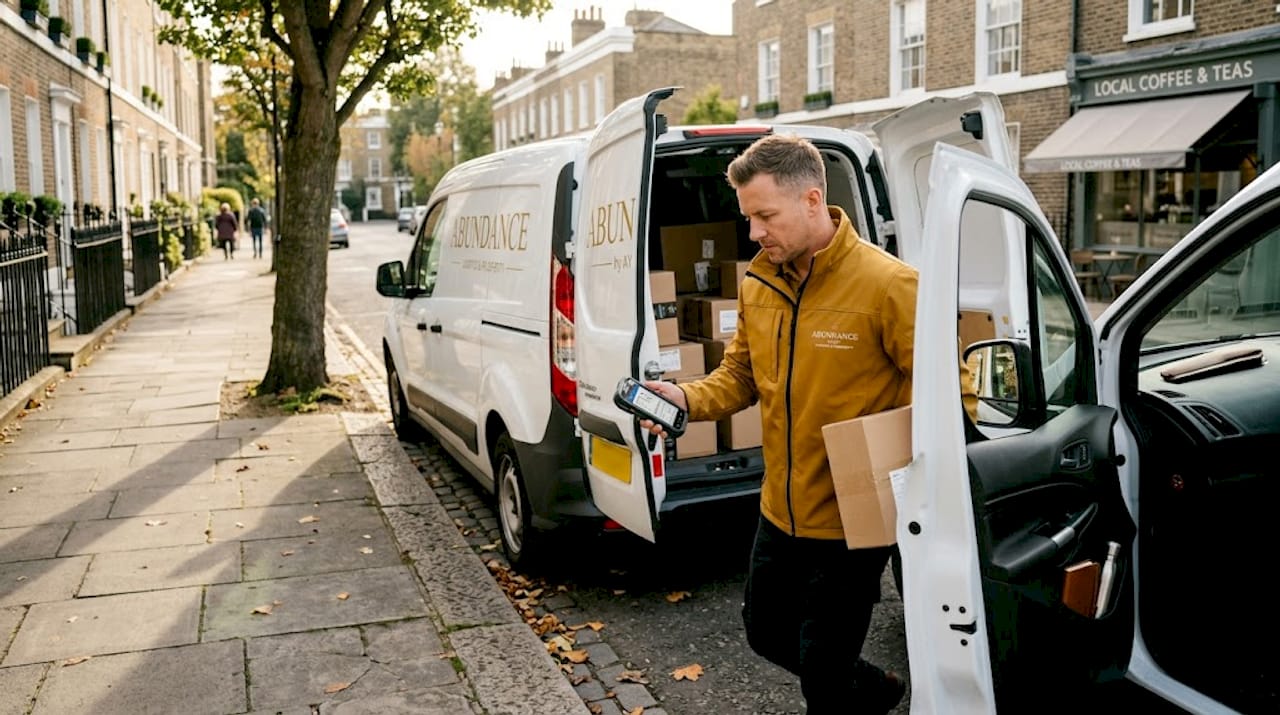
Micro-cluster routing groups deliveries spatially within tight geographic areas, reducing both van mileage between stops and the time drivers spend on foot between the vehicle and the delivery point. In dense urban environments, this approach can meaningfully cut the total time per delivery cycle. The driver parks once and completes multiple stops on foot, rather than moving the vehicle for each one.
Parking-spot detection and tribal knowledge
Two of the most underrated inputs in effective courier route planning are parking intelligence and operational experience. Advanced routing systems now detect precise vehicle parking spots using GPS and accelerometer data, building a proprietary parking layer that new drivers can benefit from immediately. This removes one of the most common sources of urban delivery delay.
Tribal knowledge is the accumulated understanding that experienced drivers carry about specific locations. Which entrance to use. Which loading bay is accessible at which time. Where not to park on a Tuesday morning. Routing engines encode this knowledge as hard or soft constraints within the optimisation model, making it available system-wide rather than locked inside one driver's memory.
Dedicated vs on-demand routing implications
The model you operate under shapes how routing functions in practice. Here is how the two main approaches compare:
| Factor | Dedicated fleet | On-demand courier |
|---|---|---|
| Routing control | High. Routes planned in advance with full constraint modelling. | Lower. Routing depends on courier availability at time of booking. |
| Cost predictability | Predictable. Fixed operational costs per vehicle. | Variable. Costs fluctuate with demand and availability. |
| Adaptability | Moderate. Changes require re-optimisation. | High. New couriers can be dispatched immediately. |
| Tribal knowledge | Builds over time within the fleet. | Limited. Each courier may be unfamiliar with the route. |
| Regulatory compliance | Easier to manage driver hours and vehicle restrictions. | More complex across a dispersed network. |
Dedicated fleets offer predictability and operational control, while on-demand models provide flexibility at the cost of routing consistency. For businesses with regular, high-volume delivery needs, the dedicated model typically produces better routing outcomes over time.
Pro Tip: If your operation has consistent delivery corridors, encoding those routes with driver feedback and parking data will outperform any generic routing software configuration. The system improves only with the inputs you give it.
The operational impact of routing optimisation
The business case for investing in proper courier routing is not theoretical. The savings are measurable across fuel, time, fleet capacity, and customer satisfaction.
- Fleet capacity recovery. Businesses without optimisation systems lose 15 to 30% of capacity to inefficient sequencing and dead mileage. Recovering even half of that through optimisation means more deliveries per vehicle per day without adding to the fleet.
- First-attempt delivery rates. Poor routing contributes to missed time windows, which drives failed first attempts. Optimised routing with accurate time predictions increases the proportion of deliveries completed on the first visit, reducing the cost of redelivery.
- Driver productivity. When drivers follow optimised sequences with accurate stop data, they spend less time making decisions and more time completing deliveries. This also reduces fatigue and the errors that come with it.
- Regulatory compliance. Routing systems that model driver hours and vehicle restrictions help operations stay within legal limits without requiring manual oversight of every route. This is particularly relevant for nationwide courier services operating across multiple regions with different local restrictions.
- Customer experience. Accurate estimated arrival times, enabled by ML-driven travel time prediction, reduce inbound enquiries and improve recipient satisfaction. This matters more as customer expectations for delivery precision continue to rise.
Predictive logistics replaces fixed rule-based assignments by analysing live performance data to dynamically adjust routing and courier selection. Static systems fail during demand spikes. Predictive models adapt, which is why the shift from rule-based to predictive logistics is one of the most significant operational changes available to courier businesses in 2026.
My perspective on what most logistics teams get wrong
I have spent a significant amount of time working through courier logistics operations, and the pattern I see most consistently is this: teams invest in routing software and then underuse it. They configure it once, accept the defaults, and assume the system is working. It rarely is, not to its full potential.
The distinction between planning and optimisation is not just semantic. It changes how you think about your fleet. Planning asks "how do I get all these stops covered?" Optimisation asks "what is the most efficient way to cover these stops given every constraint I can model?" Those are fundamentally different questions, and the second one requires ongoing input to answer well.
What I have found is that the operations performing best are the ones treating routing as a living system. They collect driver feedback after every shift. They update parking data when conditions change. They review failed deliveries and trace them back to routing decisions. They understand that predictive logistics only works when the data feeding it is current and accurate.
The future of courier routing will be more personalised. Driver-specific routing that accounts for individual strengths, familiarity with particular areas, and vehicle handling preferences is already emerging. Customer slot negotiation, where the routing system and the customer's availability are aligned before the route is even built, will become standard. The businesses that will benefit most are the ones building that feedback culture now, not waiting until the technology forces them to.
— Ayomide
How Sddbyaba supports routing-informed logistics
Understanding how delivery routing functions is one thing. Having a courier partner that applies those principles operationally is another. At Sddbyaba, we provide same day courier services built around the kind of reliability that routing-aware logistics demands. Our dedicated vehicle options give businesses the operational control that on-demand models cannot match, with consistent drivers, known routes, and the capacity to build genuine delivery intelligence over time.
Whether you need a dedicated courier for a regular corridor or a time-critical consignment dispatched at short notice, our fleet covers everything from motorcycles to artic lorries across the UK. We work with businesses in construction, manufacturing, retail, healthcare, and commercial logistics, sectors where delivery timing is not a preference but a requirement. Contact Sddbyaba to discuss a courier solution built around your operational needs.
FAQ
What is courier route optimisation?
Courier route optimisation is the process of calculating the most efficient sequence and assignment of delivery stops, accounting for constraints such as time windows, vehicle capacity, and driver hours. It goes beyond basic planning by applying mathematical solvers to find near-optimal solutions across large stop sets.
How does real-time re-optimisation work?
When a route changes due to traffic, a failed delivery, or a new pickup, the routing system recalculates the sequence and pushes an updated route to the driver. Advanced systems complete this within 30 seconds to maintain operational usefulness.
Why are standard mapping apps insufficient for courier routing?
Consumer mapping apps handle around 10 stops and apply no optimisation logic. Courier routing software manages 30 or more stops, models complex constraints, and computes optimised sequences in under 400 milliseconds, making it the only practical tool for professional delivery operations.
What is the Vehicle Routing Problem?
The Vehicle Routing Problem is the mathematical challenge of finding the best routes for a fleet of vehicles to serve a set of delivery locations. It grows exponentially in complexity as stops and vehicles are added, which is why dedicated solvers rather than manual planning are required.
How does dedicated courier routing differ from on-demand?
Dedicated courier models allow full constraint modelling, tribal knowledge accumulation, and consistent routing performance over time. On-demand models offer flexibility but less routing control, making them better suited to irregular or unpredictable delivery needs.