
Handling return collections with a courier service is defined as the end-to-end process of scheduling parcel pickups from customers, routing goods back through a courier network, and processing items at a warehouse or fulfilment centre. Businesses that treat this as a planned workflow rather than an afterthought gain measurable advantages in cost control, customer satisfaction, and stock recovery. Platforms like Shipway and Parcel Perform have made it possible to automate the entire return lifecycle, from label generation to refund processing. On-demand services such as Uber's Return a Package have further lowered the barrier to doorstep collection. The result is a reverse logistics model that is faster, more accountable, and far less reliant on manual intervention.
What tools do businesses need to handle return collections courier-ready?
The right technology is the foundation of any efficient return collection service. Without it, businesses rely on manual processes that create delays, lost parcels, and poor customer experiences.
Courier aggregation software sits at the centre of modern parcel return logistics. Platforms like Shipway automate the full return lifecycle, from generating return labels on request approval to triggering instant refunds via integrations with payment processors such as Razorpay. This removes manual touchpoints at every stage and allows smarter courier allocation based on geography, parcel weight, and service level.

Warehouse integration tools are equally critical. Apps like Receive & Grade connect directly to warehouse workflows, allowing teams to inspect and grade returned items rapidly upon arrival. This turns a cost centre into a partial revenue recovery opportunity by identifying resaleable stock immediately.
The table below summarises the core tools and their primary function:
| Tool | Primary function |
|---|---|
| Courier aggregation software (e.g., Shipway) | Automates label generation, courier selection, and refund triggers |
| Parcel Perform | Provides end-to-end tracking visibility and return status updates |
| Receive & Grade apps | Enables rapid warehouse inspection and stock grading on arrival |
| Scan gate systems | Records parcel handoffs at load, transfer, and acceptance points |
| Branded return portals | Gives customers a self-service return request interface |
Key features to require from any courier service for returns include:
- Scan gates at load, transfer, and acceptance points to record every handoff
- Ownership assignment at each stage so accountability never falls into a gap
- Real-time tracking feeds that connect to customer-facing notifications
- Return label automation triggered immediately on request approval
- Flexible vehicle options to match parcel size, from motorcycles for single parcels to Luton vans for bulk returns
Pro Tip: Before selecting a courier aggregation platform, confirm it integrates directly with your warehouse management system. A platform that cannot push data to your stock system will still require manual reconciliation, which defeats the purpose of automation.
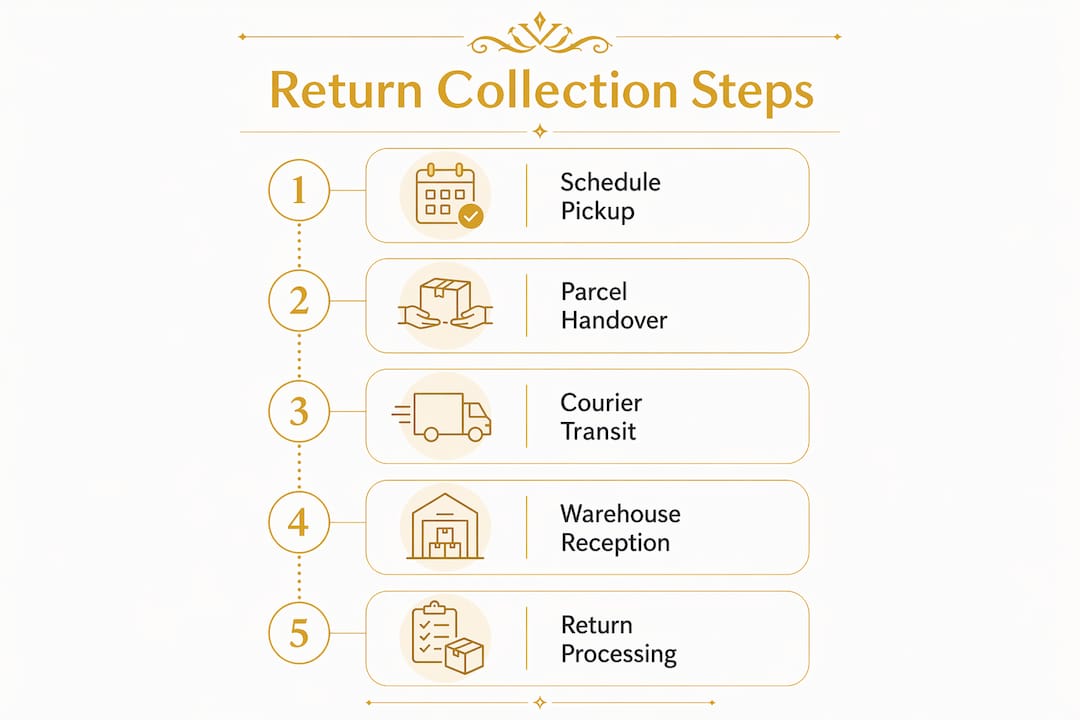
How to set up a return collection process with a courier
A structured, step-by-step workflow is what separates businesses that handle returns profitably from those that absorb them as pure cost. The process below reflects current best practice for reverse logistics in 2026.
-
Approve the return request and generate a label automatically. The customer submits a return request through a branded portal. The system approves it based on pre-set rules and immediately generates a prepaid return label. No manual intervention is required at this stage.
-
Schedule the courier pickup. The courier service receives a pickup instruction linked to the customer's address and a collection window. Courier sequencing integrates the return pickup with nearby delivery tasks on the same route, reducing empty miles and re-attempt costs.
-
Apply scan gates at every handoff point. When the courier collects the parcel, a scan records the pickup. At every transfer point, including depot intake and onward routing, another scan confirms custody. This creates an unbroken chain of accountability.
-
Send automated tracking updates to the customer. At each scan milestone, the system triggers a notification via WhatsApp, SMS, or email. Automated customer notifications reduce inbound service queries and improve the post-purchase experience significantly.
-
Process the parcel at the warehouse using a grading app. On arrival, the Receive & Grade app prompts the warehouse team to inspect and categorise the item. Resaleable stock is returned to inventory immediately. Damaged goods are flagged for disposal or supplier claim.
-
Trigger the refund or exchange. Once grading is complete, the system automatically initiates the refund or exchange based on the outcome. Payment integrations with processors like Razorpay make this near-instant.
Pro Tip: Avoid double-handling by ensuring the courier who collects the return is routed directly to the processing depot, not a holding facility. Every additional stop adds cost and increases the risk of a scan gap in the chain.
What are the common challenges in return collections and how do you fix them?
Most parcel operations fail at returns not because of poor intentions but because of poor planning. Treating returns as end-of-day cleanup rather than integrated planned workflows is the single most common cause of double-handling, which drives up cost and delays stock recovery.
The most frequent operational mistakes and their corrections are:
- No scan at collection: The courier picks up the parcel but does not scan it. The fix is to make scanning mandatory before the vehicle moves, enforced by the dispatch system.
- Unclear handoff ownership: When a parcel transfers between courier legs, no one is assigned responsibility. The fix is to assign a named owner at every scan gate, recorded in the tracking system.
- Failed pickups with no re-attempt logic: The courier arrives and the customer is unavailable. Without a re-attempt rule, the return stalls. The fix is to build automatic re-scheduling into the courier platform.
- No visibility between collection and warehouse arrival: The business cannot tell customers where their return is. The fix is end-to-end tracking with milestone notifications.
- Manual refund processing: Staff process refunds by checking emails. The fix is to connect the grading app output directly to the payment processor.
"Lack of visibility is a primary challenge in reverse logistics. Digitised, end-to-end tracking improves predictions and reduces return friction for both businesses and their customers."
Scan discipline is the most underrated operational control in return logistics. A single missed scan breaks the accountability chain and makes exception management reactive rather than proactive. Businesses that enforce scan gates at load, transfer, and acceptance points consistently report fewer disputes and faster resolution times.
How does technology in 2026 improve return collection courier services?
Technology has shifted the return collection service from a reactive cost function to a proactive operational asset. Courier aggregation platforms now handle tasks that previously required dedicated returns teams.
Branded return portals give customers a self-service interface to submit requests, select collection windows, and track their parcel without contacting customer service. This reduces inbound query volume and gives businesses clean data on return reasons, which feeds directly into product improvement decisions.
Real-time tracking dashboards, available through platforms like Parcel Perform, give operations managers a live view of every return in transit. For businesses managing high volumes, this end-to-end tracking visibility is the difference between proactive exception management and reactive firefighting. You can read more about how these systems integrate with courier fleets in this courier technology guide.
On-demand return collection has also matured. Uber's Return a Package service, for example, uses gig drivers to collect parcels from customers' doors for between $3 and $5 per pickup. Items must weigh under 30 lbs and carry a minimum retail value of $20. This model works well for low-volume, consumer-facing returns but carries service limitations that make it unsuitable for high-frequency B2B reverse logistics.
| Technology | Business benefit |
|---|---|
| Courier aggregation platforms | Reduces manual touchpoints across the full return cycle |
| Branded return portals | Lowers customer service query volume and captures return reason data |
| Real-time tracking dashboards | Enables proactive exception management and customer communication |
| Receive & Grade apps | Accelerates stock recovery and reduces write-off rates |
| On-demand collection services | Extends collection reach for consumer-facing, low-volume returns |
For businesses managing urgent delivery tracking, integrating return tracking into the same dashboard as outbound shipments gives a complete operational picture.
Key takeaways
Efficient return collection courier operations require planned workflows, scan gate discipline, and courier aggregation technology working together from the moment a return request is submitted.
| Point | Details |
|---|---|
| Plan returns as workflows | Treat every return as a scheduled task, not an afterthought, to eliminate double-handling. |
| Use scan gates at every handoff | Record custody at collection, transfer, and warehouse acceptance to maintain accountability. |
| Automate label and refund processing | Courier aggregation platforms remove manual steps and speed up the full return cycle. |
| Communicate at every milestone | Automated WhatsApp, SMS, or email updates reduce inbound queries and improve customer trust. |
| Grade stock on arrival | Receive & Grade apps turn returns into recoverable inventory rather than written-off cost. |
Why I think most businesses are still getting returns wrong
Returns are treated as a logistics afterthought in most businesses I have observed. The outbound operation gets the investment, the technology, and the process rigour. The return flow gets whatever is left over at the end of the day. That gap is where cost accumulates.
The businesses that handle this well share one characteristic: they design the return workflow before they need it. They build scan gates into courier contracts, not as an optional extra but as a contractual requirement. They connect their grading app to their stock system before the first return arrives. They choose a courier partner based on reverse logistics capability, not just outbound price.
The emergence of on-demand collection services is genuinely useful for consumer-facing businesses, but it is not a substitute for a structured reverse logistics programme. A gig driver collecting a parcel for $5 does not solve the warehouse grading problem or the refund trigger problem. Those require platform integration.
My advice is straightforward. Choose a dedicated courier partner that treats return collections as a primary service, not a bolt-on. Require scan gate compliance in writing. Connect your technology stack before you go live. The businesses that do this recover stock faster, spend less on exception management, and retain more customers after a return experience.
— Ayomide
How Sddbyaba supports businesses with return collections
Sddbyaba operates as a UK-wide same day courier and commercial logistics provider, with a fleet that spans motorcycles through to artic lorries. That range matters for return collections, where parcel size and urgency vary considerably.
For businesses that need a reliable courier service for returns, Sddbyaba's same day dispatch services cover urgent collections nationwide, with dedicated vehicles assigned to a single job rather than shared loads. This eliminates the handoff ambiguity that causes scan gaps and delays. For larger reverse flows, the commercial logistics capability handles bulk returns with the same priority given to outbound freight. If your business needs a courier partner that treats return collections as a planned, accountable operation rather than a secondary task, Sddbyaba is built for exactly that.
FAQ
What does it mean to handle return collections with a courier?
Handling return collections with a courier means coordinating scheduled pickups from customers, routing parcels back through a courier network, and processing items at a warehouse or fulfilment centre as a planned workflow.
What is the best courier for returns in the UK?
The best courier for returns is one that offers scan gate compliance, real-time tracking, and dedicated vehicle options. Sddbyaba provides same day dedicated courier services nationwide, making it well suited for time-sensitive return collections.
How do scan gates reduce costs in return logistics?
Scan gates at load, transfer, and acceptance points assign clear ownership at every handoff, preventing double-handling and reducing the operational errors that drive up return processing costs.
Can on-demand courier services handle business return collections?
On-demand services like Uber's Return a Package work for low-volume consumer returns, with items restricted to under 30 lbs and a minimum retail value of $20. They are not suited to high-frequency B2B reverse logistics without additional platform integration.
How does courier aggregation software improve return management?
Courier aggregation platforms like Shipway automate the return lifecycle from label generation to refund processing, reducing manual touchpoints and enabling smarter courier allocation across the full return cycle.