
Emergency vehicle availability is defined as the operational readiness of a suitably equipped and properly crewed vehicle to respond immediately to an urgent incident. Understanding how emergency vehicle availability works requires examining three interlocking systems: structured dispatch protocols, real-time resource tracking, and crew qualification matching. Together, these systems determine whether the right vehicle reaches the right incident in time. For organisations managing logistics, healthcare procurement, or critical supply chains, the principles governing emergency response readiness carry direct lessons for any time-sensitive operation.
How does the emergency vehicle dispatch process work?
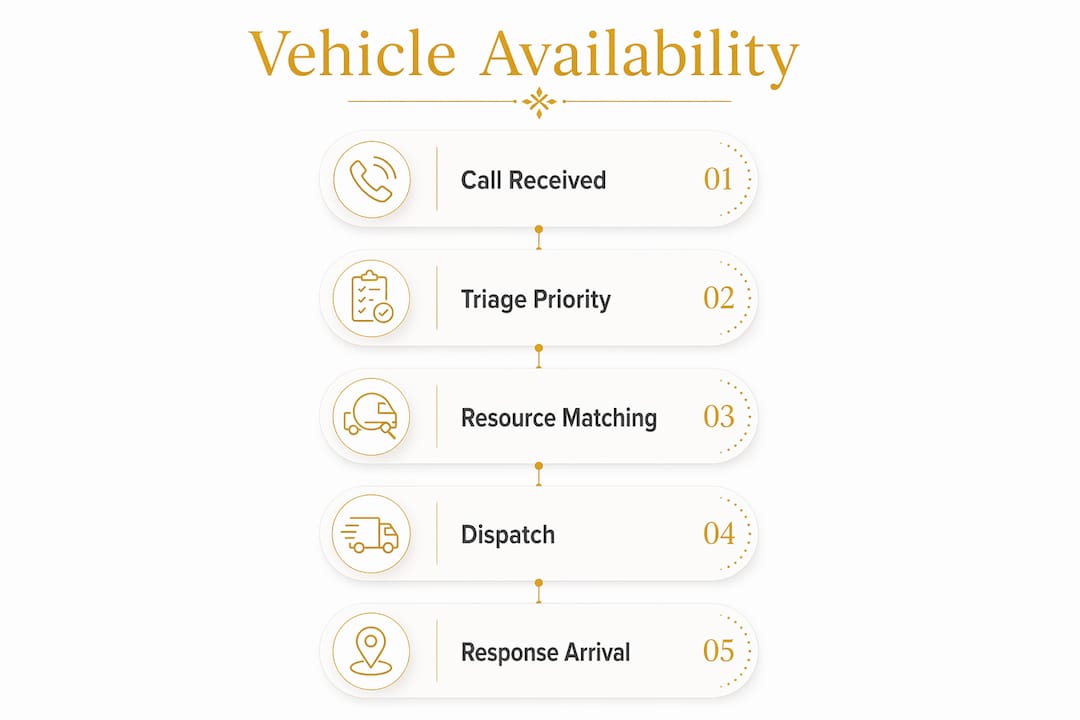
The emergency vehicle dispatch process begins the moment a call reaches a 911 or 999 centre. A trained dispatcher receives the call, gathers incident details, and assigns a priority level before any vehicle moves. This sequence is highly structured to prioritise the highest-acuity calls and protect against liability.
The Medical Priority Dispatch System, known as MPDS, is the most widely used triage framework in emergency medical dispatch. MPDS assigns one of five determinant levels based on reported symptoms, governing both the response tier and the pre-arrival instructions given to callers. That structure removes guesswork and creates a consistent, defensible record of every dispatch decision.
Once a priority level is set, Computer Aided Dispatch (CAD) systems take over. CAD platforms cross-reference real-time vehicle location data, crew certification records, and call volume to identify the closest appropriate unit. Automatic Vehicle Location (AVL) technology feeds live GPS positions into the CAD system, so dispatchers see every available unit on a digital map at all times.

Staffing vacancies directly undermine this process. The Columbia-Richland 911 centre lost 23% of calls in 2025 due to a 21.5% staffing vacancy rate, with callers waiting an average of 24 seconds before disconnecting. That figure illustrates how a single staffing gap cascades into a public safety failure before a single vehicle has moved.
The dispatch workflow follows this sequence:
- Call receipt and caller verification
- Symptom or incident triage using MPDS or equivalent protocol
- Priority level assignment (determinant code)
- CAD-assisted unit selection based on location, certification, and availability
- Dispatch instruction transmitted to crew
- Real-time monitoring and redeployment if the situation changes
Pro Tip: If you manage logistics operations, study how CAD systems handle simultaneous demand spikes. The same logic applies to courier fleet management during peak periods.
Vehicle types and crew qualifications: what is the difference?
Not every emergency vehicle can respond to every call. The distinction between Basic Life Support (BLS) and Advanced Life Support (ALS) vehicles defines which unit is appropriate for a given incident. BLS vehicles carry equipment for airway management, CPR, and basic trauma care. ALS vehicles carry advanced medications, cardiac monitors, and equipment requiring paramedic-level certification to operate.
The critical constraint is crew-to-vehicle matching. A licensed ALS vehicle cannot be dispatched with only a BLS-certified crew, even if that vehicle is the closest unit available. This mismatch creates operational gaps that reduce the effective availability of emergency services, regardless of how many vehicles are physically present in a fleet.
Common availability challenges caused by qualification mismatches include:
- Crew shortages at paramedic level forcing ALS vehicles to stand down
- Cross-certification gaps leaving vehicles licensed for specialist response without qualified operators
- Shift scheduling failures where qualified crew are off-duty during peak demand windows
- Licence renewal delays temporarily removing certified staff from active rosters
These gaps are not theoretical. They represent real reductions in the availability of emergency services that data systems must track and administrators must address through targeted recruitment and training investment.
Pro Tip: Organisations procuring medical transport or specialist courier services should verify crew certification against vehicle capability before confirming a booking. Capability on paper and operational readiness are not the same thing.
What standards and data benchmarks measure response performance?
Response time standards give emergency services a measurable target against which actual performance can be assessed. The National Fire Protection Association (NFPA) and the National Emergency Number Association (NENA) both publish recommended response time thresholds. NFPA 1710, for example, sets a target of four minutes for first-responder arrival at life-threatening incidents in urban areas.
Real-world performance frequently falls short. In Urbana, Illinois, the local ambulance service failed to meet the 10-minute response standard in 21% of calls. Champaign recorded a 13% failure rate. Those figures confirm that meeting published standards is an active operational challenge, not a default outcome.
Positive reform is possible with sustained investment. In Chennai, the average urban ambulance response time improved from 7:45 minutes to 6:14 minutes between 2023 and 2026 following network restructuring. That improvement of nearly 90 seconds per call translates directly into better patient outcomes at scale.
| Metric | Purpose | Example |
|---|---|---|
| Response time compliance rate | Measures how often services meet published standards | Champaign: 87% compliance; Urbana: 79% compliance |
| Zero-unit availability frequency | Tracks how often no vehicle is free to respond | Used as a system stress indicator for resource planning |
| Call abandonment rate | Reveals dispatch centre capacity failures | Columbia-Richland: 23% of calls lost in 2025 |
| Average response time trend | Shows improvement or deterioration over time | Chennai: 7:45 to 6:14 minutes (2023 to 2026) |
"Tracking system stress indicators such as zero-unit availability promotes patient safety-focused resource allocation and converts anecdotal delay complaints into evidence-based advocacy for funding." — JEMS, Why EMS System Capacity Standards are Critical
Data-driven EMS reforms using availability metrics give administrators the evidence they need to secure budget increases and justify staffing changes. Without that data, resource requests remain opinion. With it, they become policy.
How does technology improve emergency vehicle access and coordination?
Technology is the primary lever for improving vehicle response times for emergencies without adding vehicles to a fleet. Several systems now work together to reduce delays at every stage of the response chain.
- Emergency Vehicle Preemption (EVP) Systems communicate directly with traffic signal controllers to clear intersections ahead of an approaching unit. EVP systems adjust traffic lights in real time, reducing journey time through urban areas where signal delays are a major contributor to late arrivals.
- Geographic Information Systems (GIS) layer demographic risk data, road network conditions, and historical incident patterns onto dispatch maps. Dispatchers use GIS to position vehicles proactively in high-demand zones rather than waiting for calls to arrive.
- Automatic Vehicle Location (AVL) provides live GPS tracking for every unit in a fleet, enabling dispatchers to identify the genuinely closest available vehicle rather than relying on estimated positions.
- Next Generation 911 (NG911) technology allows dispatch centres to receive text, images, video, and precise location data from callers. That richer information improves triage accuracy and reduces the time spent gathering details during the call.
- Dispatch automation platforms apply algorithmic logic to unit selection, removing manual bottlenecks during simultaneous call surges. Transport management software now applies similar automation logic to commercial fleet coordination, demonstrating how these principles transfer across sectors.
- Scientific deployment modelling uses historical call data to predict demand by time of day, day of week, and geographic zone. Services using deployment models position units closer to anticipated incidents before those incidents occur.
During multiple simultaneous emergencies, dispatch systems triage resources to protect availability for the most life-threatening calls. Lower-priority responses may be delayed as a direct result. Technology does not eliminate this constraint, but it reduces how often it occurs by improving the efficiency of every individual dispatch decision. Understanding how emergency dispatch is triggered gives organisations a clearer picture of where technology interventions have the greatest effect.
Dispatch automation benefits extend beyond speed. Automated systems generate auditable records of every resource allocation decision, supporting compliance reporting and post-incident review.
Key takeaways
Emergency vehicle availability depends on matching qualified crew to licensed vehicles, supported by structured dispatch protocols and real-time technology, to meet defined response time standards consistently.
| Point | Details |
|---|---|
| Dispatch protocol is the foundation | MPDS assigns priority levels that govern which vehicle type and crew respond to each call. |
| Crew-vehicle matching is non-negotiable | An ALS vehicle without paramedic-certified crew cannot be dispatched, reducing effective fleet availability. |
| Data reveals hidden capacity failures | Metrics like zero-unit availability and call abandonment rates expose gaps that anecdotal reports cannot quantify. |
| Technology reduces response time at every stage | EVP systems, GIS, AVL, and NG911 each remove a specific delay from the response chain. |
| Staffing vacancies are the leading operational risk | A 21.5% vacancy rate caused 23% call loss at one US dispatch centre, illustrating the human dependency of the entire system. |
Why emergency vehicle availability is more fragile than most people realise
I have spent considerable time studying logistics systems under pressure, and the one conclusion I keep returning to is this: emergency vehicle availability is not a fixed resource. It is a dynamic state that changes minute by minute based on call volume, crew certification, vehicle maintenance status, and traffic conditions. Most public discussions treat it as a binary, either a vehicle is available or it is not. The operational reality is far more granular.
What strikes me most is how much of the system depends on data that many services still do not collect consistently. Zero-unit availability, the moment when no vehicle is free to respond anywhere in a coverage zone, is one of the most telling indicators of system stress. Yet many services track it only after a complaint surfaces. Collecting it proactively, and publishing it, would change budget conversations overnight.
The crew qualification gap is equally underappreciated. Fleet size is the metric that gets reported in press releases. Qualified crew hours are the metric that actually determines operational capacity. An organisation with 20 ALS vehicles and only enough paramedics to staff 12 of them has an effective fleet of 12. Administrators who understand this distinction make better resource decisions than those who count vehicles.
My advice to any organisation reviewing its emergency response logistics is to start with the data you are not collecting. The gaps in your records are usually the gaps in your service.
— Ayomide
Rapid, reliable dispatch: how Sddbyaba supports critical logistics
The principles behind emergency vehicle coordination, fast dispatch, qualified operators, real-time tracking, and dedicated vehicles, apply directly to commercial logistics when time is the primary constraint.
Sddbyaba operates as a UK-wide same day courier and logistics service built around exactly these principles. Whether a business needs an urgent parcel collected within the hour or a time-critical freight consignment moved across the country, Sddbyaba provides dedicated courier transport with professional drivers, tracked vehicles, and direct communication throughout. For organisations that cannot afford delays, Sddbyaba's emergency delivery service offers the same commitment to readiness that defines effective emergency response. Visit Sddbyaba to discuss your logistics requirements with the team today.
FAQ
What does emergency vehicle availability mean?
Emergency vehicle availability is the operational readiness of a correctly equipped and properly crewed vehicle to respond immediately to an urgent call. It depends on vehicle maintenance status, crew certification, and dispatch system capacity working together at the same moment.
How does the emergency vehicle dispatch process prioritise calls?
Dispatch centres use structured protocols such as MPDS to assign one of five priority levels to each call based on reported symptoms or incident type. Higher-priority calls receive faster response tiers and dedicated unit assignment before lower-priority calls are addressed.
What factors affect emergency service availability most?
Staffing vacancies, crew qualification mismatches, simultaneous call volume, and vehicle maintenance downtime are the four primary factors affecting emergency service availability. Data from the Columbia-Richland 911 centre shows that a 21.5% staffing vacancy alone caused 23% of calls to be lost before being answered.
How are vehicle response times for emergencies measured?
Response times are measured from the moment a call is received to the moment the first unit arrives on scene. Standards such as NFPA 1710 set a four-minute target for life-threatening urban incidents, though real-world compliance rates vary significantly between services.
How does technology improve emergency vehicle coordination?
Emergency Vehicle Preemption systems, GIS deployment modelling, AVL tracking, and NG911 multimedia data each reduce a specific delay in the response chain. Together, they allow dispatch centres to position, select, and route vehicles more accurately than manual methods allow.