
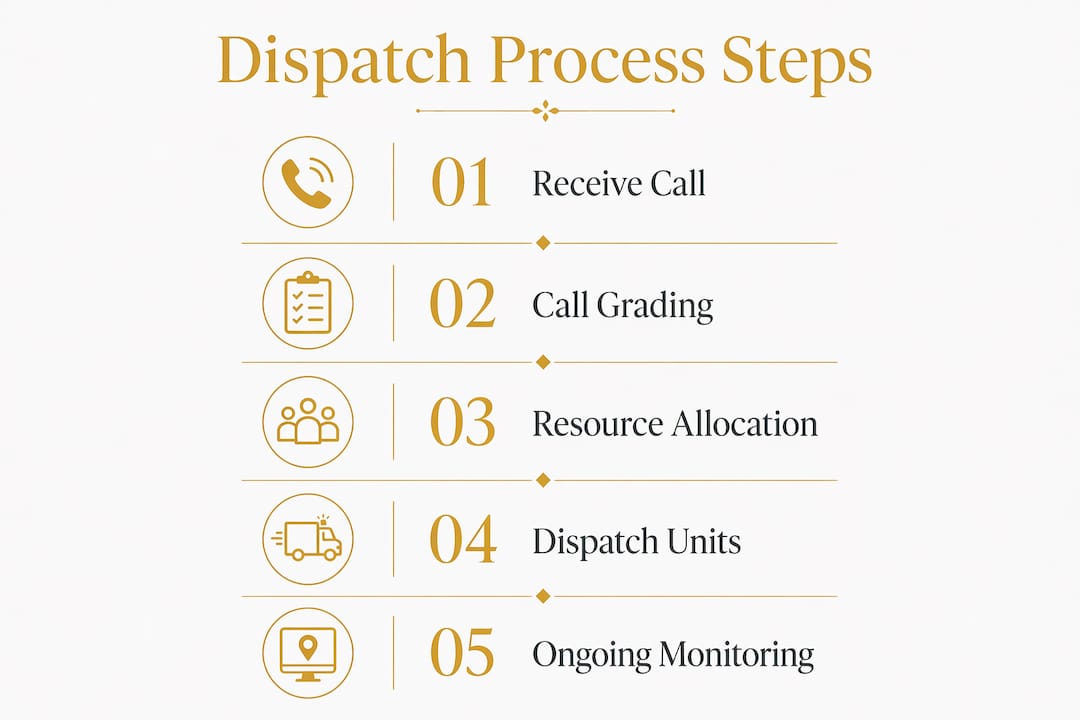
Emergency dispatch centres are specialised coordination hubs that receive emergency calls, assess incident severity, and deploy the correct resources using structured protocols, trained personnel, and technology systems. Understanding how emergency dispatch centres operate matters not just for public safety professionals but for anyone managing time-critical logistics, transport, or response operations. The core process moves through three distinct phases: call receipt and grading, resource allocation, and live incident management. Each phase relies on computer-aided dispatch (CAD) systems, medically approved scripts, and workforce planning tools to deliver consistent, rapid outcomes.
How emergency dispatch centres receive and process calls
The moment a 999 call connects in the UK, a call handler begins a structured questioning sequence to establish six critical data points: the nature of the incident, exact location, any immediate danger, injuries present, suspect details if relevant, and the caller's own information. This sequence is not conversational. It follows a fixed protocol designed to extract actionable intelligence under pressure, in the shortest possible time.
Once the handler has gathered sufficient information, the call is assigned a grade. The UK police grading system works as follows:
- Grade 1 (immediate): Response required within 15 minutes. Used for incidents posing direct risk to life or ongoing serious crime.
- Grade 2 (prompt): Attendance required soon but not immediately. Covers incidents that are serious but not life-threatening at the moment of the call.
- Grade 3 (scheduled): An appointment-based response where an officer attends at an agreed time.
- Grade 4 (resolution without deployment): The incident is resolved via telephone advice, referral, or signposting without sending a unit.
This call grading process ensures dispatchers receive structured summaries that enable faster, safer, and more targeted resource allocation. Without it, dispatchers would be making deployment decisions on incomplete or unverified information.
In Emergency Medical Dispatch (EMD), the process is governed by the Medical Priority Dispatch System (MPDS). EMD is a medically governed subdiscipline using scripted decision trees approved by a physician. Dispatchers are not clinical staff and must adhere precisely to these scripts. Pre-arrival instructions (PAI) include CPR guidance and are only delivered when authorised by the local medical director. This strict protocol fidelity reduces dispatcher variability and improves response consistency across thousands of calls.
Pro Tip: If you manage a logistics or transport operation, the call grading model used in emergency dispatch translates directly to delivery prioritisation. Assigning urgency tiers at the point of order intake, rather than later in the process, reduces decision delays and improves fleet allocation.
What do dispatch operators do once a call is graded?
The emergency dispatch process splits into two distinct roles. Call handlers gather and grade information. Dispatch operators take that graded summary and coordinate the physical response. This handoff is where technology becomes the primary tool.
Dispatch operators work within CAD systems that display available units, their locations, current assignments, and response capacity in real time. When a Grade 1 incident is received, the CAD system identifies the nearest appropriate unit and the operator confirms deployment via radio or mobile data terminal (MDT). Modern predictive dispatch logic means vehicles mobilise within 35 seconds of a 999 call being received. This speed reflects system design as much as unit proximity. Workflow automation, pre-loaded unit data, and alert logic all reduce the gap between call receipt and deployment.

Greater Manchester Police dispatch operators handled 141,000 Grade 1 incidents in a single year, with an average attendance time of 7 minutes 49 seconds and up to 500 Grade 1 incidents managed on a single day. That volume illustrates the operational intensity dispatchers sustain continuously, not just during major events.
During major incidents, dispatch centres create a live incident picture shared across all responding agencies, including fire, EMS, and police operating on different radio channels. This unified record reduces duplication, prevents conflicting instructions, and ensures every responder acts on the same information. The core function of dispatch is not just sending units. It is creating and maintaining a single operational truth that underpins coordination across the entire response.
Key capabilities that define how dispatch centres function at this stage include:
- CAD system integration: Real-time unit tracking, automated nearest-unit identification, and incident logging.
- Radio and MDT communication: Direct two-way contact with field units for dynamic updates and welfare checks.
- Multi-agency coordination: Shared incident records across police, fire, and ambulance services.
- Major incident protocols: Parallel preparation across agencies triggered by a single dispatch command.
- Continuous re-assessment: Operators monitor live incidents and adjust resource allocation as conditions change.
Pro Tip: For fleet managers handling urgent deliveries, adopting a live job-tracking dashboard that mirrors CAD logic, showing vehicle location, current task, and estimated completion, reduces the coordination overhead that causes delays in time-critical runs.
| Dispatch function | Technology or method used |
|---|---|
| Call grading and summary | Structured protocol scripts and call handler assessment |
| Unit identification and deployment | CAD system with GPS unit tracking |
| Field communication | Radio networks and mobile data terminals |
| Multi-agency coordination | Shared live incident records |
| Predictive mobilisation | Automated dispatch logic and workflow alerts |
How do dispatch centres manage workforce and operational pressure?
Staffing an emergency operations centre (EOC) is not a fixed-headcount problem. Call volume fluctuates sharply by time of day, day of week, and season. Workforce management systems forecast expected call demand and schedule staff accordingly, scaling from 30 to 40 handlers during early morning hours to nearly 200 at peak periods. This scalability is not optional. Understaffing during high-demand windows directly degrades response times and increases the risk of calls being queued rather than answered.
The pressure on individual dispatchers is significant and sustained. Dispatchers make consequential decisions repeatedly across long shifts, often with incomplete information and under time constraints. The cognitive load of monitoring multiple live incidents, managing radio traffic, and re-assessing priorities simultaneously is one of the most demanding aspects of the role. Dispatch centres that invest in structured debriefs, peer support programmes, and regular simulation training see measurably better performance and lower attrition than those that treat workforce wellness as secondary.
Evolving clinical roles within ambulance dispatch add further complexity. In some services, call handlers are now supported by clinical advisors who can authorise referral pathways, reducing unnecessary deployments and freeing up advanced life support (ALS) units for the highest-acuity calls. This tiered clinical model requires additional training, clear escalation protocols, and governance frameworks that sit alongside the operational dispatch function.
Rising call volumes across UK emergency services mean that workforce planning is no longer a back-office function. It is a frontline operational discipline that directly determines whether the right resource reaches the right incident on time.
The challenges facing dispatch centre workforce management include:
- Accurately forecasting demand across multiple incident types and geographies.
- Maintaining trained staff reserves for surge events without carrying unsustainable permanent headcount.
- Supporting dispatcher mental health and decision-making resilience under sustained pressure.
- Integrating clinical and non-clinical roles within a single operational environment.
- Adapting to rising call volumes without proportional increases in budget or staffing.
How do dispatch protocols compare across services and regions?
Emergency dispatch protocols are not uniform. They vary by service type, geography, and governance model. Understanding these differences is useful for anyone working across public safety, logistics, or transport sectors where dispatch coordination intersects with multiple agencies.
In medical dispatch, the MPDS is the most widely used structured protocol system globally. EMD protocols reduce dispatcher variability by enforcing strict adherence to scripted decision trees, with determinant levels ranging from low acuity to the highest, influencing whether a Basic Life Support (BLS) or Advanced Life Support (ALS) unit is sent. The decision is not made by the dispatcher's clinical judgement. It is made by the protocol, with the dispatcher as the executor.
In British Columbia, Canada, E-Comm handles over 5,500 daily 911 calls, answering 99% within one minute and routing them to police, fire, or ambulance services. Notably, E-Comm does not dispatch ambulances directly. That function sits with BC Emergency Health Services, illustrating how dispatch responsibilities can be split across organisations even within a single regional system.
UK police dispatch follows the four-tier grading model described earlier, with governance sitting within individual force control rooms. The US model varies by jurisdiction, with some centres operating consolidated public safety answering points (PSAPs) that handle police, fire, and EMS from a single facility, while others maintain separate dispatch functions per service.
| Protocol system | Service type | Governance | Key feature |
|---|---|---|---|
| MPDS (Medical Priority Dispatch System) | Ambulance and EMD | Medical director | Scripted decision trees, BLS/ALS tiering |
| UK police call grading (Grades 1 to 4) | Police | Force control room | Urgency-based response allocation |
| E-Comm 911 (British Columbia) | Police and fire | Regional authority | Ambulance dispatched separately by BCEHS |
| US PSAP model | Police, fire, EMS | Jurisdiction-specific | Consolidated or split by service type |
The governance distinction matters. Medical dispatch protocols require physician oversight and approval for every pre-arrival instruction. Police and fire protocols are operationally governed, with less clinical oversight but equally structured response frameworks. For logistics professionals, the lesson is that protocol governance, whether clinical or operational, is what makes dispatch consistent and auditable at scale.
Key takeaways
Emergency dispatch centres operate through a precise sequence of call receipt, grading, resource allocation, and live incident management, underpinned by CAD systems, structured protocols, and scalable workforce planning.
| Point | Details |
|---|---|
| Call grading drives speed | Structured grading at intake gives dispatchers the information needed for fast, targeted deployment. |
| CAD systems are the operational backbone | Computer-aided dispatch enables real-time unit tracking, predictive mobilisation, and multi-agency coordination. |
| Protocol fidelity reduces variability | Systems like MPDS enforce scripted responses that improve consistency and remove individual clinical guesswork. |
| Workforce scalability is a frontline issue | Scaling from 30 to 200 handlers based on demand forecasting directly determines response reliability. |
| Unified incident records enable coordination | A single live incident picture shared across agencies is what makes multi-service response coherent. |
What I have learned from watching dispatch operations evolve
The most underappreciated shift in emergency dispatch over the past decade is not the technology. It is the recognition that protocol fidelity and dispatcher judgement are not opposites. They are complementary. The best dispatch operations I have observed use structured protocols as the floor, not the ceiling. Dispatchers who understand why a protocol exists make better decisions at the edges of those scripts, where real incidents rarely fit perfectly.
Predictive dispatch and real-time data sharing have genuinely compressed response times. But the gains from technology plateau quickly if the workforce is under-supported. A CAD system does not compensate for a dispatcher managing 12 simultaneous incidents without adequate supervision or rest. The centres that perform consistently well invest in both.
What strikes me most, from a logistics perspective, is how directly these principles transfer. The emergency delivery escalation process in commercial logistics mirrors the Grade 1 to Grade 4 model almost exactly. Triage at intake, dedicated resource allocation, live tracking, and multi-party communication are not public safety inventions. They are universal principles for managing time-critical operations under pressure.
The workforce wellness piece is where logistics still lags behind public safety. Dispatch coordinators in courier and freight operations face similar cognitive loads to emergency dispatchers, but with far less structured support. That gap is worth closing.
— Ayomide
Need fast, reliable dispatch for urgent deliveries?
Understanding how professional dispatch centres operate reveals what separates reactive logistics from genuinely reliable ones: structured intake, dedicated resource allocation, and real-time coordination. Sddbyaba applies those same principles to commercial courier and freight operations across the UK.

Whether you need a motorcycle courier for an urgent document, a dedicated van for time-critical medical supplies, or a heavy goods vehicle for same-day freight, Sddbyaba coordinates the right vehicle to the right location without delay. The team handles emergency deliveries across all industries, with nationwide coverage and direct communication at every stage. For businesses where speed and reliability are non-negotiable, explore same day dispatch services built around your operational requirements.
FAQ
What is the emergency dispatch process in the UK?
In the UK, the emergency dispatch process begins when a 999 call is received by a call handler who uses structured questioning to grade the incident from Grade 1 (immediate) to Grade 4 (resolved without deployment). A dispatch operator then allocates the nearest appropriate unit using a CAD system and manages the incident in real time.
What does an emergency dispatcher do?
An emergency dispatcher allocates resources to graded incidents, communicates with field units via radio or mobile data terminals, monitors live incidents, and coordinates multi-agency responses. Greater Manchester Police dispatchers, for example, managed 141,000 Grade 1 incidents in a single year with an average attendance time under eight minutes.
How do dispatch centres function during major incidents?
During major incidents, dispatch centres generate a live incident picture shared across all responding agencies, including police, fire, and EMS, enabling parallel preparation and real-time updates even across different radio channels. This unified record is the primary coordination tool for complex, multi-agency responses.
What is Emergency Medical Dispatch (EMD)?
Emergency Medical Dispatch is a medically governed subdiscipline that uses the Medical Priority Dispatch System (MPDS) to assess calls, assign priority determinants, and deliver physician-approved pre-arrival instructions. Dispatchers follow scripted decision trees precisely and are not permitted to apply independent clinical judgement.
How do dispatch centres manage fluctuating call volumes?
Dispatch centres use workforce management systems that forecast call demand and scale staffing from as few as 30 handlers during quiet periods to nearly 200 at peak times. This demand-led scheduling model is the primary mechanism for maintaining response reliability without permanently overstaffing the operation.