
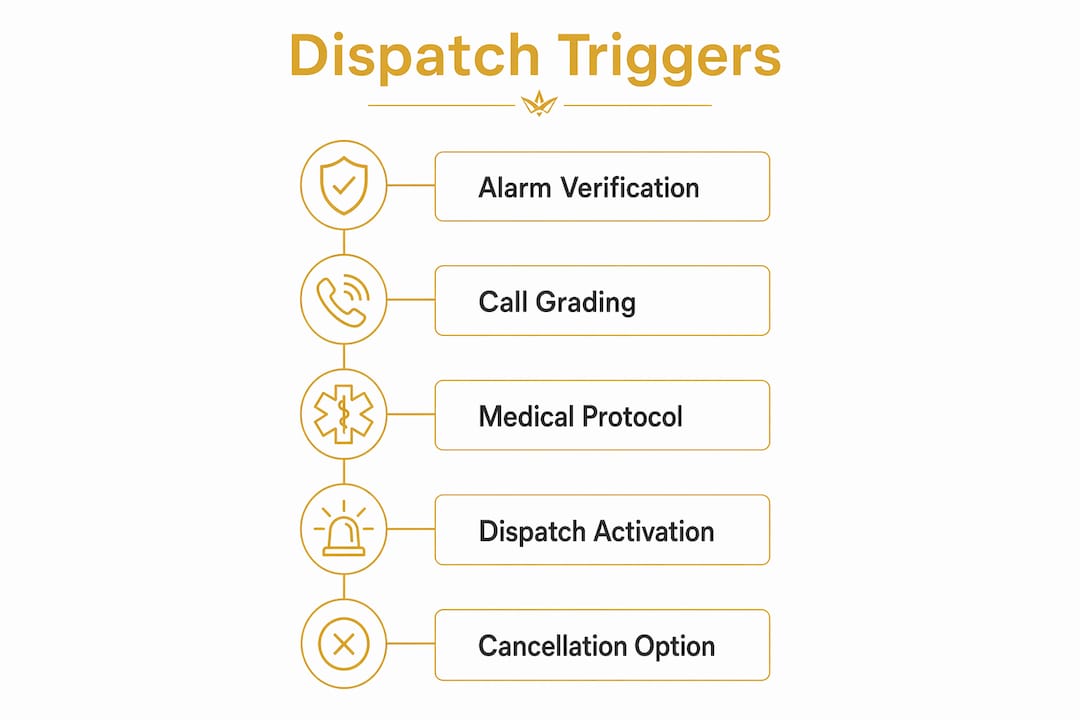
Emergency dispatch is the process by which qualified emergency responders are sent to an incident after a verified alarm signal or graded call confirms a genuine need for assistance. The three primary systems that govern how emergency dispatch is triggered are monitored alarm centres, Public Safety Answering Points (PSAPs), and Emergency Medical Dispatch (EMD) protocols. Each system uses structured verification or interrogation workflows to assess urgency before committing resources. Understanding the criteria for emergency dispatch matters whether you are a business owner with a monitored alarm, a member of the public calling 999, or a logistics professional managing time-critical operations.
How emergency dispatch is triggered by monitored alarm systems
Monitored alarms trigger dispatch only after alarm receipt and verification attempts, not immediately after a sensor activates. This distinction is critical. The moment a sensor detects an intrusion, fire, or panic event, it transmits a coded signal to a monitoring centre via a secured communication channel, typically within seconds. The signal carries an alarm event code that identifies the protection zone and incident type, allowing operators to classify the alert before taking any action.
The verification workflow then follows a defined sequence:
- Signal receipt. The monitoring centre receives the alarm event code and logs the time, zone, and alarm type.
- Internal assessment. Operators review any available video footage or audio to assess whether the alarm appears genuine.
- Verification calls. Enhanced Call Verification requires at least two call attempts to designated contacts before police dispatch is requested. This reduces unnecessary emergency service deployment.
- Keyholder contact. If the primary contact is unreachable, operators attempt secondary keyholders in sequence.
- Dispatch request. If verification confirms an incident, or if all contact attempts fail, the operator contacts the relevant emergency service and requests dispatch.
Pro Tip: If you manage a monitored alarm system, confirm with your provider whether your site is configured for Immediate Dispatch or Standard response. Immediate Dispatch contacts police before attempting customers, which is appropriate for high-risk premises.
The distinction between Immediate Dispatch and Standard response is significant. Immediate Dispatch configurations contact police before customers, maintaining active alarm status for hours post-dispatch unless the incident is resolved. Standard response attempts keyholder contact first and dispatches only after those attempts fail. Local jurisdiction requirements and any permit conditions attached to a premises also influence which configuration applies.
| Configuration | First action | Dispatch trigger |
|---|---|---|
| Immediate Dispatch | Contact police directly | Alarm signal confirmed |
| Standard response | Contact keyholders first | After failed contact attempts |
Monitoring centres continue contact attempts even after dispatch has been initiated, enabling cancellation if the incident is resolved before responders arrive. This ongoing communication loop is a deliberate safeguard against wasted emergency service resources.
What is the emergency call grading process and how does it trigger dispatch?
The emergency call grading process is the structured method by which 999 or 911 call handlers at PSAPs assess incoming calls and assign a response priority. Call handlers use structured questions to grade calls by urgency, and that grade directly determines dispatch priority and resource allocation. The process is not improvised. Handlers follow scripted interrogation frameworks designed to extract the information needed to make an accurate grading decision quickly.
Typical structured questions cover:
- Type of incident. Is this a medical emergency, fire, or crime in progress?
- Location. Exact address or nearest landmark to direct responders accurately.
- Immediate danger. Is the caller or anyone else in immediate physical danger?
- Injuries. Are there casualties requiring medical attention?
- Suspect presence. For police calls, is a suspect still on scene or nearby?
The answers to these questions map directly to grading categories. UK police call grading links Immediate Grade calls to responses within 15 minutes for life threats or active crimes. Priority Grade calls receive a prompt response after immediate threats are addressed. Scheduled calls are allocated a specific attendance time, and some incidents are resolved without deployment through telephone advice or referral.
Grading controls not just speed but also the type and number of units dispatched. An Immediate Grade incident may trigger multiple units simultaneously, while a Scheduled Grade call may result in a single officer attending hours later. Dispatchers rely on structured grading tools rather than personal judgement to maintain consistency and comply with response time standards. This is what makes the emergency dispatch process defensible and auditable.
The practical implication for callers is clear. Providing accurate, direct answers to the handler's questions accelerates grading and therefore accelerates dispatch. Vague or incomplete answers force handlers to ask follow-up questions, adding seconds that matter in life-threatening situations.
How emergency medical dispatch protocols determine response activation
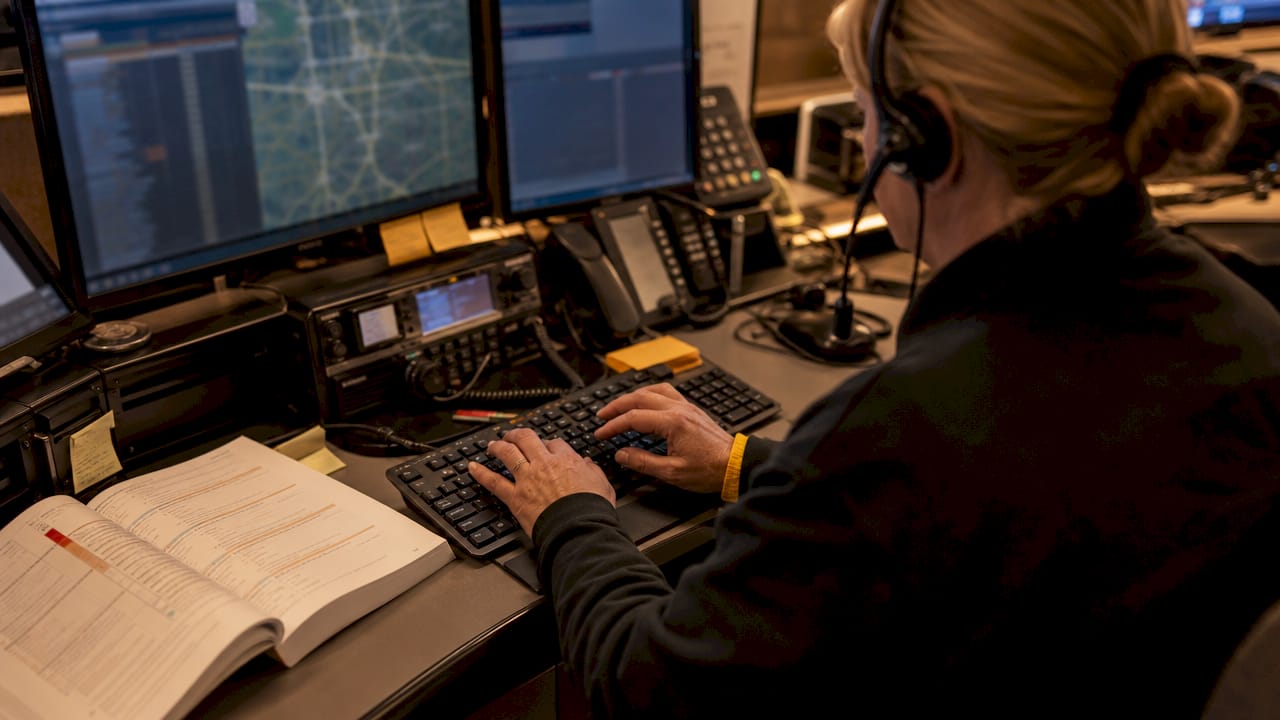
Emergency Medical Dispatch (EMD) is the medically approved system used by call handlers to assess medical calls and determine the appropriate level of EMS response. The most widely used framework is the Medical Priority Dispatch System (MPDS), which maps caller-reported symptoms to determinant levels through scripted interrogation. MPDS protocols classify calls using over 30 chief complaint scripts, each guiding the dispatcher through a defined question sequence.
The scripted process works as follows:
- Chief complaint identification. The handler identifies the primary symptom or incident type from the caller's opening statement.
- Scripted interrogation. The relevant MPDS script is applied, asking specific questions about consciousness, breathing, age, and symptom severity.
- Determinant level assignment. Responses map to a determinant code that classifies the incident from Alpha (minor) through Echo (life-threatening).
- Resource deployment. The determinant level governs whether Basic Life Support (BLS), Advanced Life Support (ALS), or multiple units are dispatched.
- Pre-arrival instructions. While EMS is en route, the dispatcher provides the caller with scripted instructions, including CPR guidance where applicable.
Pro Tip: If you call 999 for a medical emergency, stay on the line after giving your location. The dispatcher's pre-arrival instructions are medically approved and can directly improve patient outcomes before the ambulance arrives.
Protocol adherence is not optional in EMD systems. Deviating from the script introduces inconsistency and increases the risk of under-resourcing a serious incident. The determinant level system also enables tiered deployment, meaning a minor fall may receive a single BLS crew while a cardiac arrest triggers an ALS unit alongside a first responder. This tiering is what makes the emergency response activation process both efficient and proportionate.
How variations in dispatch protocols affect timing and decisions
Dispatch protocol variations across jurisdictions and alarm configurations create meaningful differences in how quickly and under what conditions emergency services are sent. Verification serves to reduce false alarms and unnecessary deployment, but the threshold for proceeding to dispatch differs depending on local ordinance, site history, and alarm permit conditions.
Several factors shape these variations:
- False alarm history. Sites with repeated false alarms may face stricter verification requirements or reduced dispatch priority from local police.
- Permit conditions. Some UK and US jurisdictions require alarm permits, and non-compliant sites may be deprioritised or refused police response.
- Site-specific settings. High-risk premises such as banks or pharmacies may be pre-approved for Immediate Dispatch regardless of verification outcome.
- Cancellation windows. Once dispatch is initiated, the monitoring centre continues attempting to cancel if the incident is resolved, but cancellation is not guaranteed once responders are en route.
The timing consequences of these variations are real. A Standard response configuration at a site with a history of false alarms may add several minutes to the dispatch trigger compared with an Immediate Dispatch configuration at a verified high-risk site. For businesses managing time-critical delivery pitfalls or urgent logistics operations, the parallel lesson is identical. Protocols that account for risk level and site history produce faster, more accurate responses than one-size-fits-all approaches.
The balance between speed and accuracy is the central tension in all dispatch systems. Effective emergency dispatch balances urgency with false alarm reduction through protocols like Enhanced Call Verification and graded call assessments. Neither speed alone nor caution alone produces the best outcomes. The protocol is the mechanism that holds both in tension.
Key takeaways
Emergency dispatch is triggered through a structured sequence of alarm verification, call grading, or scripted medical interrogation that determines the urgency and type of response deployed.
| Point | Details |
|---|---|
| Verification before dispatch | Monitored alarms require at least two contact attempts before emergency services are requested. |
| Call grading drives speed | UK Immediate Grade calls demand a response within 15 minutes; grading controls unit type and number. |
| MPDS governs medical activation | Over 30 scripted chief complaint protocols map symptoms to determinant levels that set EMS tier. |
| Protocol variations matter | Jurisdiction rules, false alarm history, and site configuration all affect when dispatch is triggered. |
| Cancellation remains possible | Monitoring centres continue contact attempts post-dispatch, enabling cancellation if incidents resolve. |
Why structured dispatch triggers are more important than most people realise
I have spent considerable time studying how emergency response systems operate under pressure, and the detail that consistently surprises people is how little of the process relies on human instinct. The entire architecture of emergency dispatch, from MPDS scripts to Enhanced Call Verification, is designed to remove improvisation from decisions that carry life-or-death consequences. That is not a criticism of dispatchers. It is the opposite. It is a recognition that structured protocols outperform individual judgement when stakes are highest and time is shortest.
What I find genuinely underappreciated is the role of caller behaviour in the outcome. A caller who answers the handler's questions directly and stays on the line enables faster grading and better pre-arrival support. A caller who panics, interrupts, or provides vague location information slows the entire chain. The protocol can only work as fast as the information it receives. This is a practical point that most public guidance on emergency calls does not make clearly enough.
The tension between false alarm reduction and rapid response is also more nuanced than it appears. Verification steps protect emergency service capacity, but they introduce delay. The solution is not to remove verification. It is to design verification that is fast, evidence-based, and proportionate to risk. Video verification, for example, allows monitoring centres to confirm an intrusion visually within seconds, collapsing the verification window dramatically. Jurisdictions and operators that have adopted video verification report fewer unnecessary dispatches and faster confirmed responses. That is the direction the industry is moving, and it is the right one.
The broader lesson applies beyond emergency services. Any system that dispatches resources under time pressure, whether ambulances, fire crews, or engineering emergency deliveries, performs better when it operates from a defined protocol rather than ad hoc decisions. Speed without structure produces errors. Structure without speed produces delays. The best dispatch systems achieve both.
— Ayomide
Need fast, reliable dispatch for urgent logistics?
Understanding how emergency dispatch is triggered highlights one principle that applies equally to commercial logistics: speed and accuracy depend on having the right protocol in place before an urgent need arises.

Sddbyaba provides same day courier services across the UK for businesses that cannot afford delays. Whether you need urgent freight movement, dedicated vehicle transport, or pallet distribution on short notice, Sddbyaba operates a nationwide fleet from motorcycles to artic lorries. The dispatch process is fast, communication is direct, and vehicles are matched to load requirements. For time-critical consignments where the cost of delay is real, explore dedicated courier options and get your goods moving today.
FAQ
How is emergency dispatch triggered in the UK?
Emergency dispatch in the UK is triggered when a 999 call handler grades an incident as Immediate or Priority, or when a monitored alarm centre completes verification and contacts the relevant emergency service. The grade or verification outcome determines which service is dispatched and how quickly.
What is Enhanced Call Verification in alarm dispatch?
Enhanced Call Verification requires monitoring centre operators to make at least two call attempts to designated contacts before requesting police dispatch. This process reduces false alarm deployments and is a standard protocol across most UK and US monitored alarm providers.
What does a PSAP do in the emergency dispatch process?
A Public Safety Answering Point (PSAP) is the call centre that receives 999 or 911 calls and routes them to the appropriate emergency service. Call handlers at PSAPs use structured interrogation scripts to grade urgency and initiate dispatch to police, fire, or ambulance services.
Can emergency dispatch be cancelled after it is triggered?
Monitoring centres continue attempting to contact keyholders after dispatch is initiated and can request cancellation if the incident is confirmed as resolved. However, once responders are en route, cancellation is not guaranteed and depends on the responding unit's proximity and local policy.
What is the MPDS and how does it affect ambulance dispatch?
The Medical Priority Dispatch System (MPDS) is a scripted protocol used by emergency call handlers to classify medical incidents into determinant levels from Alpha to Echo. The determinant level governs whether a Basic Life Support crew, an Advanced Life Support unit, or multiple resources are dispatched to the scene.