
Emergency courier vehicle matching is the specialised practice of assigning the most suitable vehicle to an urgent delivery task based on load dimensions, environmental requirements, regulatory constraints, and real-time operational conditions. The industry term for this process is dispatch optimisation, though vehicle matching describes the specific assignment decision within that broader framework. Getting this decision wrong on a time-critical consignment does not just delay delivery. It can breach a service level agreement, compromise cargo integrity, or create a compliance liability. Platforms such as RationalGo and fleet management systems like SuiteFleet have made this process faster and more precise, but the underlying logic applies whether you are organising an emergency delivery by motorcycle or a 26-tonne artic lorry.
What is emergency courier vehicle matching and why does it matter?
Emergency courier vehicle matching is defined as the process of selecting and assigning a specific vehicle type to an urgent courier task, accounting for cargo characteristics, route constraints, compliance requirements, and delivery windows. It is the decision that sits between receiving an urgent order and dispatching a driver. Every other part of the delivery depends on getting it right.
The stakes are particularly high for what is emergency medical courier work, where temperature-sensitive pharmaceuticals or biological samples must travel in refrigerated units with validated cold chain compliance. A standard cargo van assigned to a cryogenic sample shipment is not just operationally wrong. It is a regulatory failure. The same logic applies to what is emergency document courier work, where chain-of-custody requirements may demand a specific vehicle class or security configuration.
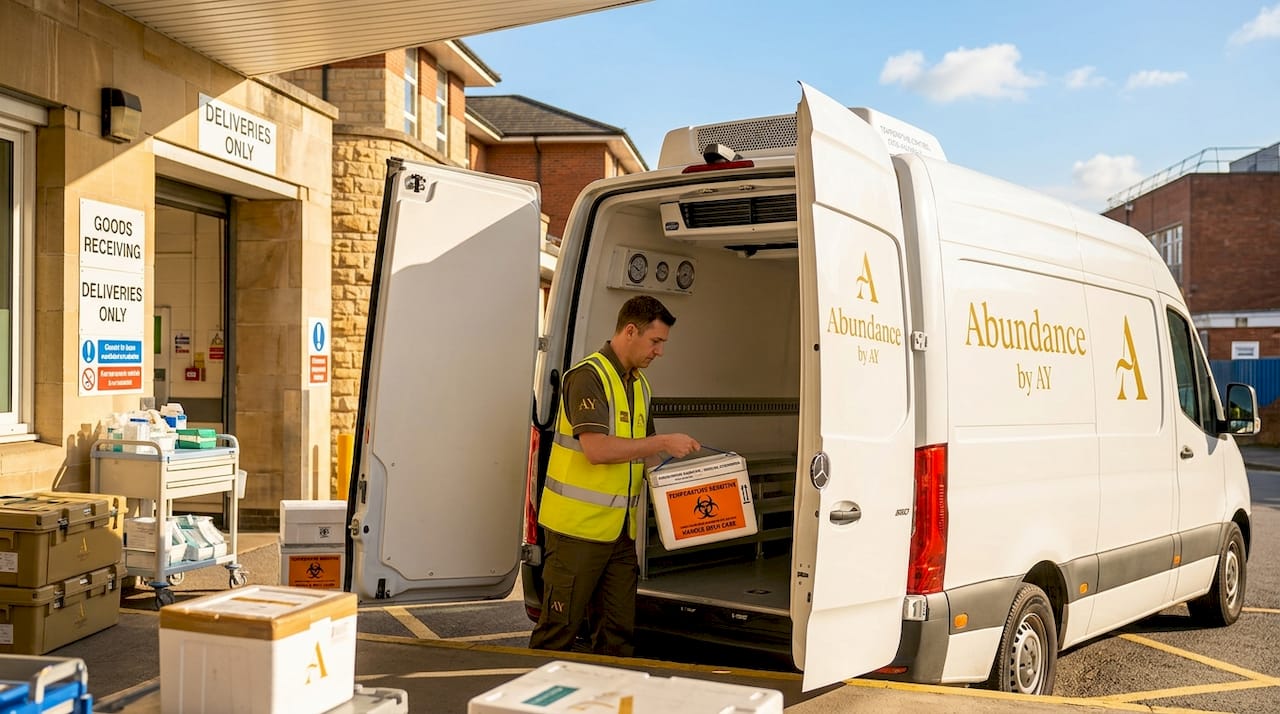
Specialty dispatch requires technical and compliance depth beyond distance, factoring in cargo-specific environmental needs and regulatory constraints. This means vehicle matching is never a simple proximity calculation. It is a multi-variable decision that directly determines whether an urgent delivery succeeds or fails.
What factors determine the right vehicle for an emergency courier task?
Vehicle assignment in specialty courier operations evaluates payload weight, volume, environmental sensitivity, access requirements, and regulatory factors, requiring specific vehicle configurations such as high-roof vans or refrigerated units. This means a single missed variable can render the assigned vehicle entirely unsuitable, regardless of how quickly it arrives at the collection point.
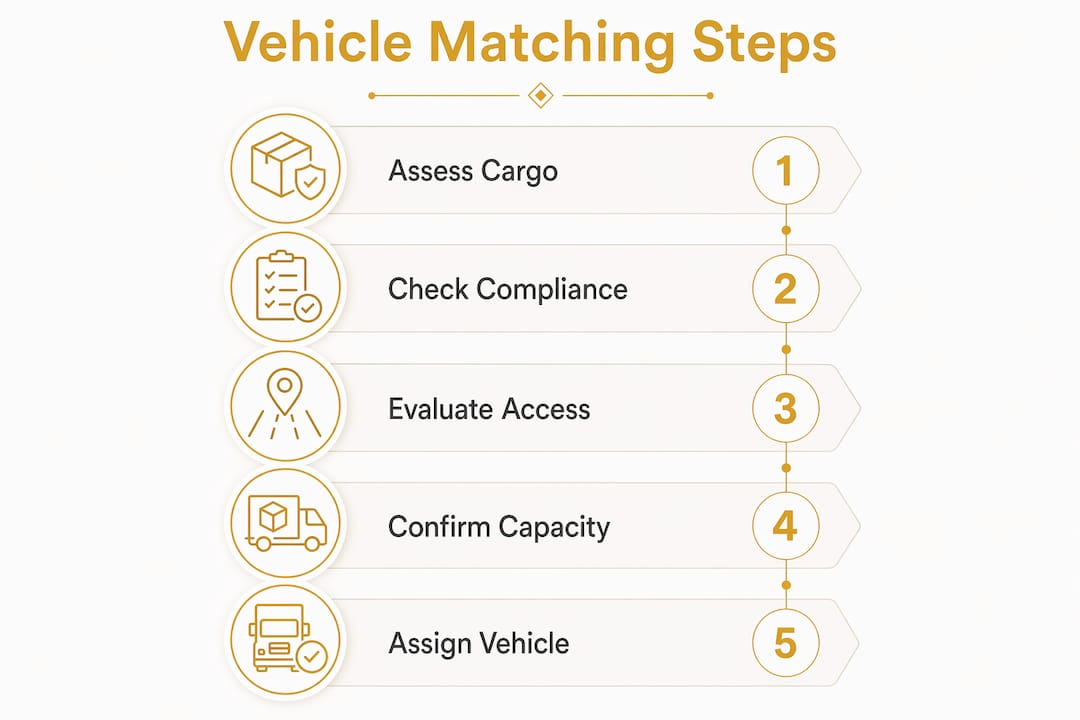
The table below summarises the primary matching criteria and the vehicle classes they typically point towards:
| Matching criterion | Vehicle class typically required |
|---|---|
| Loads over 280 cubic feet or 3,500 lbs | Box truck or 7.5-tonne vehicle |
| Interior height over 60 inches required | High-roof van or Luton van |
| Sub-ambient temperature requirements | Refrigerated van or temperature-controlled unit |
| Restricted access sites or narrow roads | Motorcycle, car, or small van |
| Loads above 10,001 lbs GVWR | Commercial motor vehicle under 49 CFR Part 390 |
Regulatory compliance is a factor that many businesses underestimate. Vehicles above 10,001 pounds GVWR require compliance with commercial motor vehicle regulations under 49 CFR Part 390, which directly impacts which vehicles can legally carry certain cargo types. Assigning the wrong vehicle class to a regulated load creates legal exposure, not just operational inconvenience.
Route and access constraints add another layer of complexity. A hospital loading bay may only accommodate vehicles below a certain height. A city-centre law firm may require a motorcycle or car courier to avoid parking restrictions. When you organise emergency medical courier collections or urgent legal document runs, these physical constraints must be factored into the matching decision before dispatch, not discovered on arrival.
Pro Tip: Before booking any urgent courier, confirm the exact interior dimensions and weight capacity of the assigned vehicle against your cargo specifications. A mismatch discovered at collection costs more time than the original booking process.
How do automated dispatch systems execute emergency courier vehicle matching?
Digital dispatch systems automate courier and vehicle matching using AI that considers real-time proximity, vehicle capacity, zone certification, route load, and delivery window priorities, with manual override available for exceptions. This is a significant departure from older dispatch models that assigned the nearest available driver regardless of vehicle suitability. The shift matters because proximity alone is one of the most common causes of SLA failure in urgent courier operations.
Modern courier management systems manage order intake, real-time dispatching, route optimisation, and proof of delivery capture, integrating with GPS and ERP systems. They distinguish themselves from basic GPS trackers by actively managing routes, monitoring SLAs, and structuring delivery confirmations. This is the operational backbone behind how emergency courier work actually functions at scale.
The core inputs a dispatch engine processes for each matching decision include:
- Real-time vehicle proximity to the collection point
- Vehicle capacity and configuration against cargo specifications
- Zone certification confirming the driver is authorised for the delivery area
- Current route load to avoid overloading a driver already on multiple stops
- Delivery window priority to rank urgent orders above standard consignments
- Traffic and route constraints affecting estimated arrival times
Dynamic insertion and reassignment algorithms increase delivery efficiency and minimise delays by adjusting mid-route for new orders. This means a driver already on a route can receive a new urgent assignment if the system calculates they can fulfil it within the required window without compromising existing deliveries. Understanding how courier routing works in practice helps businesses set realistic expectations for dispatch timelines.
Human override remains a critical safeguard. Automated systems handle the majority of standard matching decisions well, but complex cases involving unusual cargo, restricted sites, or bespoke emergency courier service agreement terms require a dispatcher to intervene and apply contextual judgement the algorithm cannot replicate.
Pro Tip: When requesting an urgent courier, always provide full emergency delivery vehicle details upfront, including cargo dimensions, weight, temperature requirements, and any site access restrictions. Incomplete information forces manual intervention and adds time to the dispatch process.
What compliance and chain-of-custody considerations impact vehicle matching?
Compliance transforms vehicle matching from an operational preference into a legal obligation for sensitive shipments. The following sequence illustrates how a compliant chain-of-custody workflow connects vehicle assignment to delivery verification:
- Vehicle assignment confirmed with cargo-specific configuration validated against load requirements before dispatch.
- GPS and telematics activated at collection, creating a continuous location record linked to the assigned vehicle and driver identity.
- Temperature logging initiated for cold chain consignments, with real-time alerts if thresholds are breached during transit.
- Licence plate recognition (LPR) recorded at key handoff points such as hospital loading bays, pharmaceutical warehouses, or secure document facilities.
- Proof of delivery captured with timestamp, recipient signature, and location data, completing the auditable record.
Unified chain-of-custody records hold all sensor data and video linked to vehicle and timestamp for efficient verification and dispute resolution. This means that when a pharmaceutical company or legal firm needs to verify a delivery, every data point from collection to handoff is available in a single auditable record.
"Without integrated chain-of-custody workflows, disputes become time-consuming and costly." — Southeastern Security Professionals
Security configuration is another compliance dimension that directly affects vehicle selection. High-value or sensitive consignments may require unmarked vehicles to reduce theft risk. Medical samples, legal documents, and financial instruments are all categories where the vehicle's external appearance is part of the security protocol. This is a detail that standard courier booking processes rarely capture, but that specialist emergency courier service agreement terms should address explicitly.
How does emergency courier vehicle matching benefit businesses in practice?
The practical advantages of precise vehicle matching extend well beyond avoiding delivery failures. Businesses that apply rigorous matching criteria consistently report measurable improvements across speed, cost, and client satisfaction.
Adaptive optimisation models increased demand fulfilment from 71.3% to 96.5% and reduced average delays from 45.2 minutes to 11.8 minutes. That improvement represents the difference between a logistics operation that occasionally fails under pressure and one that maintains service quality even during peak demand or disruption.
The sector-specific benefits are equally compelling:
- Medical and healthcare: Correct vehicle matching for what is emergency medical courier work preserves sample integrity, maintains cold chain compliance, and meets hospital procurement standards.
- Legal and professional services: What is emergency document courier work demands chain-of-custody documentation and, in some cases, secure unmarked vehicles. The right vehicle assignment protects both the cargo and the client relationship.
- Retail and manufacturing: Avoiding vehicle under-utilisation reduces cost per delivery. Avoiding over-utilisation prevents damage to goods that are loaded into vehicles too large for the consignment to travel securely.
- Construction and engineering: Time-critical parts deliveries to active sites require vehicles that can access restricted areas and carry loads within site weight limits.
| Sector | Primary vehicle matching requirement | Key risk of mismatch |
|---|---|---|
| Medical and healthcare | Refrigerated or temperature-controlled unit | Cold chain breach, regulatory failure |
| Legal and document | Secure, unmarked vehicle with chain-of-custody | Custody dispute, client liability |
| Retail and e-commerce | Right-sized van for consignment volume | Cargo damage, wasted capacity cost |
| Construction | Access-compliant vehicle within site weight limits | Delivery refusal, project delay |
Dedicated courier services provide the vehicle specificity that standard courier networks cannot match for urgent or sensitive consignments. A nationwide courier operation with a broad fleet can match vehicles to cargo across the full spectrum of urgent logistics needs, from motorcycle document runs to multi-tonne freight movements.
Key takeaways
Emergency courier vehicle matching succeeds when cargo specifications, compliance requirements, and real-time operational data are all fed into the dispatch decision before a vehicle is assigned.
| Point | Details |
|---|---|
| Vehicle matching is multi-variable | Proximity alone causes SLA failures; capacity, compliance, and access must all be assessed. |
| Compliance is a legal obligation | Vehicles above 10,001 lbs GVWR and cold chain loads carry specific regulatory requirements that dictate vehicle selection. |
| Automation improves outcomes | AI dispatch systems increased demand fulfilment from 71.3% to 96.5% when uncertainty-aware optimisation was applied. |
| Chain-of-custody links to vehicle choice | Auditable delivery records depend on the assigned vehicle having the right telematics and configuration from the outset. |
| Sector requirements differ significantly | Medical, legal, retail, and construction consignments each carry distinct matching criteria that standard couriers often overlook. |
Why vehicle matching is the detail most businesses get wrong
From working closely with urgent logistics operations, the most consistent failure point is not the technology or the fleet. It is the information gap at the point of booking. Businesses request an urgent courier, provide a postcode and a rough description of the load, and assume the dispatcher will figure out the rest. That assumption is where costly mismatches originate.
The businesses that handle emergency logistics well treat vehicle matching as a pre-booking checklist, not an afterthought. They know their cargo dimensions, weight, temperature requirements, and site access constraints before they pick up the phone or submit an online request. That preparation takes two minutes and saves the kind of delays that no amount of fast driving can recover.
I am also sceptical of the idea that automation alone solves this problem. The research on uncertainty-aware optimisation is genuinely impressive, and the fulfilment rate improvements are real. But the algorithm is only as good as the data it receives. A dispatch engine that receives incomplete cargo details will make a confident wrong decision faster than a human dispatcher would. The human override function in platforms like RationalGo exists for exactly this reason, and experienced dispatchers use it more than the marketing materials suggest.
The future improvement I find most credible is tighter integration between vehicle matching and proof of delivery systems. When the chain-of-custody record feeds back into the matching algorithm, the system learns which vehicle configurations actually succeed for specific cargo types and routes. That feedback loop is where the real gains in emergency logistics reliability will come from over the next few years.
— Ayomide
How Sddbyaba supports your urgent vehicle matching needs
Sddbyaba operates as SDD by ABA, a UK-based same day courier and logistics company with a fleet ranging from motorcycles and small vans to 26-tonne trucks and artic lorries. When you need to organise an emergency medical courier, a secure document run, or a time-critical freight movement, the right vehicle is already in the fleet. Sddbyaba matches vehicle to cargo based on the same multi-variable criteria this article covers: dimensions, weight, temperature requirements, access constraints, and compliance needs. Explore the full range of same day courier services or request a quote for a dedicated courier vehicle tailored to your specific urgent logistics requirement.
FAQ
What is emergency courier vehicle matching?
Emergency courier vehicle matching is the process of assigning the most suitable vehicle to an urgent delivery task based on cargo dimensions, weight, environmental requirements, route constraints, and compliance obligations. It is the core dispatch decision that determines whether a time-critical consignment arrives intact and on time.
How does an automated dispatch system match vehicles to urgent orders?
Automated dispatch systems use multi-constraint optimisation, evaluating real-time proximity, vehicle capacity, zone certification, route load, and delivery window priorities simultaneously. Simple proximity-based assignment is a known cause of SLA failures in urgent courier operations.
What vehicles are used for emergency medical courier work?
Emergency medical courier work typically requires refrigerated or temperature-controlled vans for biological samples and pharmaceuticals, with validated cold chain logging and chain-of-custody documentation. Standard cargo vans are unsuitable for sub-ambient temperature requirements.
What should an emergency courier service agreement include?
An emergency courier service agreement should specify vehicle configuration requirements, delivery window guarantees, chain-of-custody documentation standards, temperature monitoring obligations for sensitive cargo, and escalation procedures for failed or delayed deliveries.
Why does vehicle mismatch cause delivery failures?
Vehicle mismatch causes delivery failures because an unsuitable vehicle may be refused access at the delivery site, breach temperature requirements for sensitive cargo, or violate regulatory weight and configuration rules. Correcting a mismatch after dispatch almost always results in delays that exceed the original delivery window.