
Types of engineering emergency deliveries are specialised logistics methods designed to move critical engineering components and services with maximum speed and precision during urgent operational situations. The term covers four distinct categories: like-for-like electrical parts replacement, heavy and oversized equipment transport, bespoke rapid manufacturing and delivery, and rapid-response general engineering crews with heavy machinery. Each category addresses a different combination of speed, part compatibility, site access, and equipment constraints. Understanding which type fits your situation is the difference between a two-hour fix and a two-day shutdown.
1. Types of engineering emergency deliveries for electrical equipment
Electrical failures are among the most time-critical engineering emergencies because every hour of downtime carries direct financial and safety consequences. The most effective response is same-day or next-day delivery of like-for-like replacement components, including circuit breakers, switchgear, motor control centre components, bus systems, and transformers. Providers such as RS Breakers specialise in this exact service, offering emergency circuit breaker delivery faster than the time it takes to source and install a temporary generator.
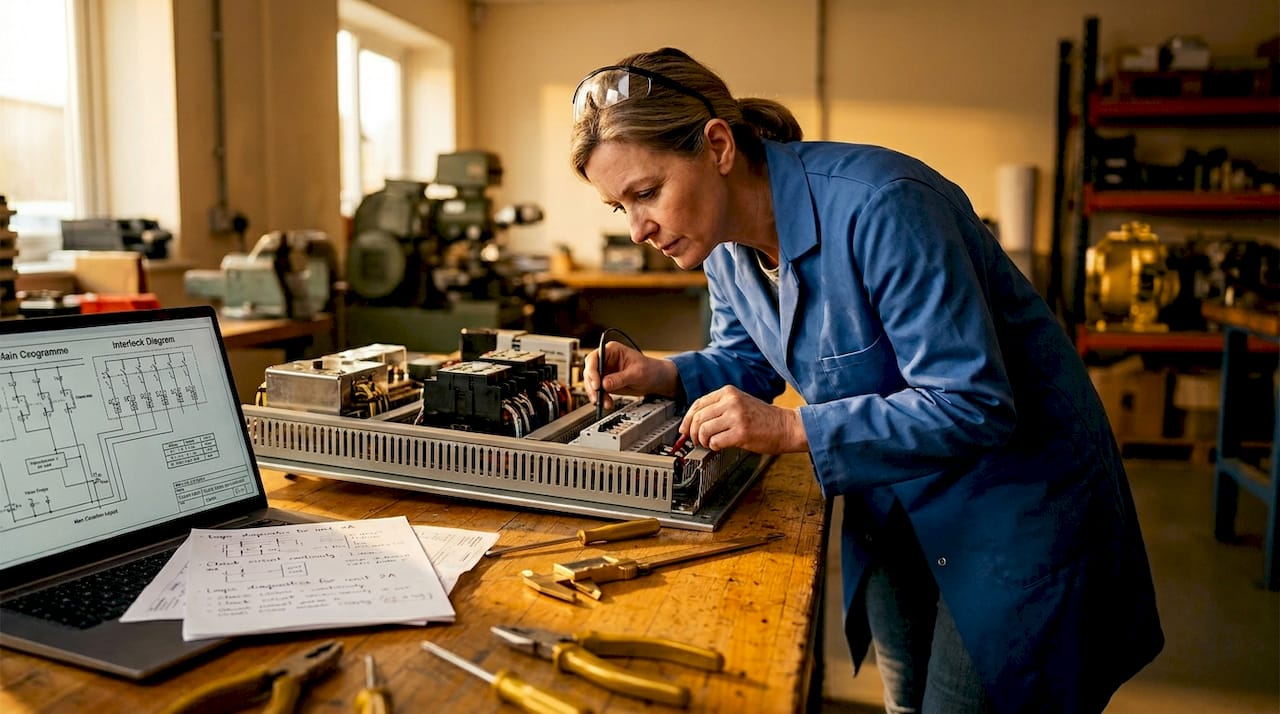
The logic behind like-for-like replacement is straightforward. Identical component substitution avoids the need for system redesign, re-certification, or panel modification, which can add days to a recovery timeline. When a 400A Merlin Gerin MCCB fails on a live distribution board, sourcing the exact frame size, breaking capacity, and trip curve eliminates every downstream engineering decision. The part arrives, it fits, and power is restored.
Key electrical component types covered by emergency delivery services include:
- Circuit breakers: Moulded case (MCCB), air circuit breakers (ACB), and miniature circuit breakers (MCB) in matched ratings
- Switchgear assemblies: Low and medium voltage switchgear panels dispatched as complete units where possible
- Transformers: Distribution and isolation transformers for power restoration in substations and industrial sites
- MCC components: Contactors, overloads, and bus bar sections for motor control centre repair
Pro Tip: When raising an emergency parts request, always provide the full manufacturer reference, rated current, breaking capacity, and pole configuration. Dispatch teams prioritise engineering specifications over part names alone, and a precise specification eliminates substitution risk before the vehicle leaves the depot.
2. How heavy and oversized engineering deliveries handle emergencies
Heavy and oversized emergency deliveries represent the most logistically complex category of urgent engineering shipments. The challenge is not simply moving a large object quickly. It is moving it safely through infrastructure that was never designed to accommodate it, often under time pressure that prevents standard route surveys and permit timelines.
The key insight here is that heavy transport logistics must incorporate engineering adaptations to infrastructure rather than treating transport as a standalone challenge. A real-world example illustrates this precisely. Collett's delivery of an 89.9 tonne transformer to a wind farm site required a bridge-over-bridge system and engineered crane pads to overcome a 3-tonne bridge weight limit on the access route. Without those temporary civil engineering works, the delivery would have been physically impossible regardless of vehicle capability.
The typical workflow for an emergency heavy haulage delivery follows this sequence:
- Route survey and constraint identification: Identify bridge weight limits, overhead obstructions, road widths, and turning radii along the proposed route.
- Temporary infrastructure design: Engineer crane pads, trackways, or bridging systems to distribute load and protect existing infrastructure.
- Permit and escort coordination: Obtain abnormal load permits and arrange police or traffic management escorts where required.
- Civil works execution: Install temporary infrastructure ahead of the transport movement, often requiring a separate crew on site.
- Transport and placement: Move the load using specialist low-loader, multi-axle, or self-propelled modular transporter (SPMT) vehicles.
- Infrastructure removal and site reinstatement: Remove temporary works and restore access routes after delivery.
| Delivery constraint | Engineering solution | Typical lead time |
|---|---|---|
| Bridge weight limit below load | Bridge-over-bridge or trackway system | 12 to 48 hours |
| Soft ground or unstable access | Engineered crane pads and ground protection | 6 to 24 hours |
| Overhead obstruction | Route deviation or temporary lowering of cables | 4 to 12 hours |
| Tight turning radius | SPMT or steerable trailer configuration | Subject to vehicle availability |
Transport providers who coordinate civil engineering works alongside haulage reduce total delivery time significantly because they eliminate the handover delay between separate contractors.
3. Bespoke rapid manufacturing and engineering in emergency deliveries
Bespoke rapid manufacturing is the least understood but arguably most impressive category of engineering crisis response. It applies when no off-the-shelf component exists, when a part is obsolete, or when the physical constraints of the installation require a custom-designed solution. The standard industry term for this workflow is concept-to-delivery rapid engineering, and it compresses design, manufacture, testing, and certification into a single continuous process.
Bramley Engineering's response to a seized penstock at a live sewage treatment plant demonstrates what this looks like in practice. The team designed, manufactured, and tested a bespoke penstock recovery device within 24 hours, including LOLER-standard load testing before the device left the workshop. The device was engineered around the physical constraints of the existing installation, which had been modelled upfront to prevent any rework on site.
The critical factors that make bespoke rapid manufacturing viable in an emergency are:
- Upfront physical modelling: Accurate dimensions, load requirements, and material specifications gathered before design begins prevent costly iterations.
- Parallel workflows: Design, material procurement, and workshop preparation run simultaneously rather than sequentially.
- In-house testing capability: LOLER certification, pressure testing, or functional testing conducted on site at the manufacturer avoids third-party scheduling delays.
- Single point of accountability: One engineering team owns the full process from concept to despatch, eliminating inter-contractor communication delays.
Pro Tip: When commissioning a bespoke emergency part, send photographs, dimensional sketches, and the original equipment manufacturer's data sheet in the first communication. A well-modelled concept-to-delivery workflow depends on complete information at the start, not corrections mid-manufacture.
4. Rapid-response general engineering crews and equipment deployment
General engineering emergency response covers a broad category of urgent site interventions that require both skilled crews and heavy plant, deployed together as a single mobilised unit. This type of urgent engineering shipment is common in infrastructure, highways, utilities, and civil engineering contexts where site damage must be contained or repaired before other works can proceed.
Noble Cortes General Engineering operates a 24/7 emergency response model that illustrates this category well. The company owns and maintains heavy equipment specifically for emergency deployments, including excavators, loaders, dump trucks, and snow ploughs. Ownership rather than hire is the operational differentiator. Hired plant requires availability checks, transport scheduling, and operator assignment. Owned and maintained plant is ready to move within the hour.
Typical services delivered under this category include road repair, culvert repair, tree and debris removal, and snow ploughing. Each of these requires a matched combination of crew competency and plant capability. A culvert repair in a flooded carriageway, for example, demands an excavator operator, a drainage engineer, and the correct pipe stock on the same vehicle convoy. Rapid crew deployment without the matching plant is as ineffective as plant without a qualified operator.
For project managers coordinating this type of response, regional coverage and vehicle routing capability matter as much as equipment specification. A contractor based 200 miles from the incident with a full equipment inventory is less useful than a regional provider with a dedicated courier network and local plant availability.
5. How to choose the right type of emergency delivery for your project
Selecting the correct emergency delivery type is a decision driven by five factors: speed requirement, part specificity, load size and weight, site access constraints, and budget. Getting this decision wrong wastes time. Deploying a bespoke manufacturing workflow when a like-for-like part is available adds 20 hours unnecessarily. Sending a standard van to collect a 6-tonne transformer is not a logistics error. It is a project management failure.
| Delivery type | Best for | Typical lead time | Key constraint |
|---|---|---|---|
| Like-for-like electrical parts | Circuit breakers, switchgear, transformers | Same day to next day | Part must be in supplier stock |
| Heavy and oversized haulage | Transformers, cranes, large plant | 12 to 72 hours | Route access and permits |
| Bespoke rapid manufacturing | Obsolete or custom-fit components | 8 to 48 hours | Requires full specification upfront |
| General engineering crew deployment | Site repair, infrastructure clearance | 1 to 4 hours | Regional coverage and plant availability |
The decision framework is straightforward. If the failed component has a manufacturer reference and a supplier holds stock, pursue like-for-like delivery first. If the component is obsolete or non-standard, escalate immediately to a bespoke manufacturer. If the emergency is site-based rather than component-based, deploy a general engineering crew. If the load exceeds standard vehicle capacity, engage a specialist heavy haulage provider and begin route assessment in parallel.
Pro Tip: Maintain a pre-qualified supplier list for each delivery type before an emergency occurs. Pre-established logistics partnerships reduce mobilisation time from hours to minutes, because account setup, credit terms, and technical contacts are already in place.
Key takeaways
Effective engineering crisis response depends on matching the delivery type to the specific operational constraint, not defaulting to the fastest or cheapest option available.
| Point | Details |
|---|---|
| Like-for-like parts save time | Identical component replacement avoids redesign and restores power faster than any workaround. |
| Heavy haulage requires civil engineering | Temporary infrastructure such as crane pads and trackways is integral to access-constrained emergency deliveries. |
| Bespoke manufacturing needs full specs upfront | A complete specification at first contact compresses concept-to-delivery time from days to hours. |
| Owned plant outperforms hired plant in emergencies | Equipment ownership enables immediate deployment without hire availability delays. |
| Pre-qualified suppliers cut mobilisation time | Established logistics partnerships eliminate account setup delays when every minute counts. |
What I have learned about engineering emergency deliveries
By Ayomide
After working across engineering logistics for a number of years, the pattern I see most often is not a failure of capability. It is a failure of preparation. Teams call for emergency delivery services with incomplete information, no pre-qualified supplier contacts, and no clarity on which delivery type their situation actually requires. The result is a frantic hour of phone calls that could have been a five-minute escalation.
The insight that changed how I think about this came from watching a heavy haulage job stall for six hours because nobody had surveyed the access route before the vehicle departed. The transformer was on the trailer. The driver was at the gate. And a 3-tonne bridge stood between them and the substation. That delay was entirely preventable. Route assessment is not a bureaucratic step. It is the delivery.
I also think the engineering sector underestimates bespoke rapid manufacturing as a quick engineering solution. The assumption is that custom means slow. Bramley Engineering's 24-hour penstock device proves otherwise, but only because they modelled the physical constraints before picking up a tool. The lesson is that speed in bespoke manufacturing comes from information quality, not from cutting corners in the process.
My practical advice: build your emergency response contacts list now, not during an incident. Know your like-for-like supplier for electrical components, your regional heavy haulage contact, your bespoke fabricator, and your general engineering crew provider. When the call comes at 02:00, you will not have time to search.
— Ayomide
How Sddbyaba supports urgent engineering deliveries
Sddbyaba provides same-day emergency delivery services across the UK, with a fleet ranging from motorcycles and small vans through to 12-tonne and 18-tonne vehicles suited to heavier engineering consignments. For project managers and logistics coordinators who need rapid, reliable dispatch of engineering components, Sddbyaba offers dedicated vehicle transport with nationwide coverage and direct communication throughout every movement. Whether you need a precision electrical part collected and delivered within hours or a freight haulage solution for larger engineering loads, Sddbyaba's team is ready to mobilise. Contact Sddbyaba to discuss your urgent delivery requirement and get a vehicle assigned without delay.
FAQ
What are the main types of engineering emergency deliveries?
The four main types are like-for-like electrical parts delivery, heavy and oversized equipment haulage, bespoke rapid manufacturing and delivery, and rapid-response general engineering crew deployment. Each type addresses a different combination of speed, load size, part specificity, and site access requirements.
How quickly can like-for-like electrical parts be delivered in an emergency?
Providers such as RS Breakers offer same-day and next-day delivery of circuit breakers, switchgear, and transformers. Delivery speed depends on stock availability and the accuracy of the part specification provided at the time of order.
When is bespoke rapid manufacturing the right emergency delivery option?
Bespoke rapid manufacturing applies when the required component is obsolete, non-standard, or must be engineered around specific site constraints. With a complete specification provided upfront, concept-to-delivery timelines of 8 to 24 hours are achievable, as demonstrated by Bramley Engineering's penstock recovery case.
Why does heavy haulage emergency delivery take longer than other types?
Heavy and oversized deliveries require route surveys, abnormal load permits, and often temporary civil engineering works such as crane pads or bridging systems. These steps are not administrative delays. They are physical prerequisites that determine whether the load can reach its destination safely.
How do I manage engineering emergencies more effectively?
Maintain a pre-qualified supplier list covering each delivery type before an incident occurs. Provide complete technical specifications at first contact, confirm site access constraints in advance, and use a nationwide courier with dedicated vehicle options to avoid shared-load scheduling delays.