
Emergency logistics is defined as the rapid deployment of transport and supply chain resources during disruptions, where the ability to adapt in real time determines whether operations survive or stall. The industry term for this capability is "dynamic resilience," and it sits at the heart of why emergency logistics requires flexibility. Organisations without integrated emergency response plans face average delays of two weeks after a disruption, while flexible systems respond in hours. For logistics professionals and supply chain managers, that gap is the difference between a recoverable incident and a catastrophic operational failure.
What does flexibility mean in emergency logistics operations?
Flexibility in emergency logistics is the capacity to change routes, carriers, vehicle types, and documentation at short notice without losing operational momentum. It is not a vague aspiration. It is a set of specific, pre-built capabilities that activate the moment a disruption occurs.
The four core dimensions of operational flexibility are:
- Capacity flexibility: Access to a range of vehicle types, from motorcycle couriers to artic lorries, so the right asset matches the load without delay.
- Routing flexibility: Pre-mapped alternate lanes and border crossing options that bypass congestion or closures.
- Carrier flexibility: Pre-vetted partner networks ready to absorb demand spikes. Top emergency freight networks maintain relationships with over 115,000 vetted shippers and carriers to guarantee this capacity.
- Document readiness: Pre-cleared customs paperwork, hazardous goods declarations, and permits stored accessibly before a crisis begins.
Traditional logistics models rely on predicting demand and then optimising around that forecast. That approach collapses under emergency conditions. Flexible frameworks using "budgeted uncertainty" allow real-time adjustments based on live data rather than fixed plans. This means a logistics manager can reroute a consignment mid-transit, swap carriers at a depot, or scale vehicle capacity up or down within hours.
Pro Tip: Pre-approve at least two carrier tiers before any emergency occurs. When your primary carrier is unavailable, a pre-vetted second tier activates immediately rather than requiring fresh negotiations under pressure.
How does flexibility improve response times and reduce disruption impact?
Flexible systems respond in hours. Rigid ones take weeks. That single fact justifies every investment in adaptive capacity management, pre-planned routing, and partner network development.

The mechanism is straightforward. Rigid logistics systems hit bottlenecks at three points: transport capacity, permit and documentation processing, and carrier communication. Flexible systems remove each bottleneck in advance. Throughput capacity is the dominant bottleneck in emergency logistics, not warehouse space. This means flexible transport asset availability is the primary lever managers must pull.
| Response factor | Rigid system | Flexible system |
|---|---|---|
| Carrier sourcing | Days to weeks | Hours (pre-vetted network) |
| Route adjustment | Manual, slow | Pre-mapped alternates |
| Vehicle scaling | Limited by contract | Multi-asset fleet access |
| Document processing | Reactive, delayed | Pre-cleared and stored |
| Escalation authority | Unclear | Defined owner, immediate action |
Dynamic routing and inventory staging are the two most effective flexible tactics. Dynamic routing means the transport management system can redirect a vehicle based on live traffic, road closures, or port delays. Inventory staging means critical stock sits pre-positioned near likely demand points, cutting last-mile response time significantly.
Flexible logistics frameworks incorporating real-time data adjustments consistently outperform rigid, forecast-dependent models during emergencies. The advantage is not marginal. It is structural, because adaptive systems are built to absorb uncertainty rather than resist it.
The financial case is equally clear. Premium costs for emergency freight are regularly outweighed by the cost of downtime. Flexibility functions as strategic insurance, not an operational luxury.
What organisational practices and technologies enable flexibility?
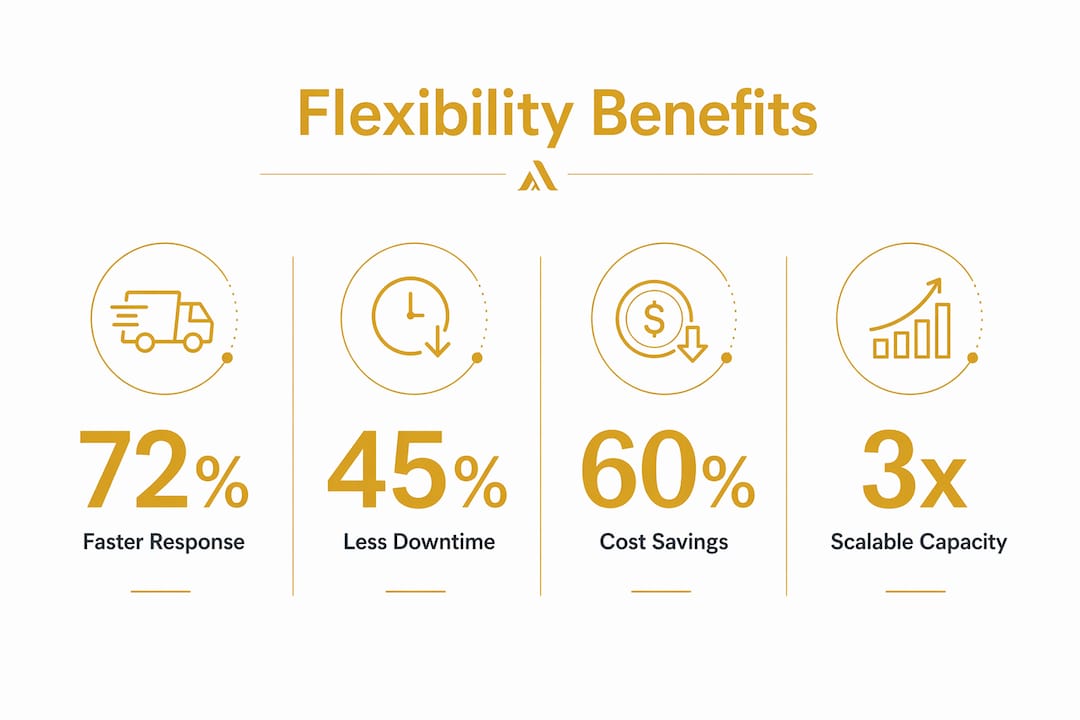
Flexibility does not emerge spontaneously under pressure. It is built through disciplined preparation during normal operations. The organisations that respond fastest to emergencies are those that have already done the hard work of mapping, vetting, and documenting their options.
The five practices that operationalise flexibility are:
- Pre-vet carriers and partners. Successful emergency logistics depends on pre-vetted carriers, defined escalation owners, and validated lane constraints stored accessibly before crises occur. Vetting after a disruption starts is too late.
- Map alternate routes. Every primary lane should have at least one documented alternative. Include border crossing options, port alternatives, and road diversion points.
- Assign escalation owners. Every decision point in an emergency needs a named individual with authority to act. Ambiguity costs hours.
- Embed resilience plans into daily workflows. Resilience plans integrated into shipment workflows are used automatically under pressure. Plans stored in a separate folder are ignored. The plan must live inside the transport management system, not beside it.
- Deploy real-time tracking and automated alerts. Live visibility into vehicle location, load status, and estimated arrival time allows managers to intervene before a delay becomes a failure.
Technology accelerates each of these practices. Integrated execution platforms connect carrier data, routing engines, and document repositories into a single interface. Automated alerts flag deviations from planned routes or delivery windows the moment they occur. This removes the lag between a problem appearing and a manager knowing about it.
Pro Tip: Run a quarterly stress test with your top three carriers. Simulate a primary route closure and measure how quickly your team activates the alternate. The gaps you find in a drill cost nothing. The same gaps in a real emergency cost significantly more.
You can also review common emergency delivery mistakes that businesses make when flexibility has not been built into their standard operating procedures.
What challenges limit flexibility and how can logistics professionals overcome them?
The most common obstacle to flexibility is not a lack of resources. It is a lack of preparation. Disaster logistics failures consistently start with poor coordination and visibility, not with an absence of vehicles or carriers.
The three structural challenges that limit flexibility are:
- Siloed data: When carrier information, route maps, and escalation contacts sit in separate systems or individual inboxes, no one can act quickly. Centralising this data into a shared, accessible platform is the first fix.
- Reactive planning: Organisations that only think about emergency logistics after a disruption begins are always behind. The importance of flexibility in logistics lies precisely in building the capability before it is needed, not during the crisis.
- Capacity scarcity: During widespread disruptions, every logistics operator competes for the same vehicles and drivers. Organisations with pre-approved partner tiers and standing agreements access capacity that reactive buyers cannot.
Overcoming these challenges requires three parallel actions. First, integrate resilience into procurement contracts by requiring carriers to confirm emergency availability and response time commitments. Second, update route maps and partner lists at least twice per year, because road infrastructure, carrier capacity, and regulatory requirements change. Third, stress-test communication protocols with partners before emergencies occur, not during them. Relying on heroic improvisation is a documented failure mode. Pre-established operational discipline is the proven alternative.
How does flexibility in emergency logistics support retail and other critical sectors?
Flexibility in emergency response directly prevents revenue loss across retail, healthcare, manufacturing, and disaster relief supply chains. Each sector faces different disruption triggers, but the mechanism is identical: without the ability to adapt transport capacity and routing in real time, operations stall.
The sector-specific benefits are clear:
- Retail and e-commerce: A stock disruption at a distribution centre can empty shelves within 48 hours. Flexible logistics allows retailers to reroute stock from alternative warehouses or suppliers, maintaining availability and customer satisfaction. How emergency logistics supports retail is increasingly a board-level concern as supply chain fragility grows.
- Healthcare and medical: Time-critical consignments such as pharmaceuticals, surgical equipment, and blood products cannot wait for standard freight schedules. Flexible dedicated transport with pre-cleared documentation is the only viable option.
- Manufacturing: A single missing component can halt an entire production line. Flexible emergency freight restores the supply of that component before the shutdown becomes a financial event.
- Disaster relief: Humanitarian supply chains face the most extreme version of this challenge. Pre-positioned stock, pre-vetted carriers, and adaptive routing are the difference between aid arriving in time and arriving too late.
Emergency logistics is evolving from a fallback tactic to a strategic capability. Organisations that treat it as a core function, rather than an exception, build supply chains that absorb disruption rather than collapse under it.
Key takeaways
Emergency logistics requires flexibility because adaptive systems respond in hours while rigid ones take weeks, and that gap determines operational survival.
| Point | Details |
|---|---|
| Flexibility is pre-built, not improvised | Pre-vet carriers, map alternate routes, and assign escalation owners before any disruption occurs. |
| Throughput capacity is the key bottleneck | Prioritise flexible transport asset availability over warehouse space in emergency planning. |
| Embed plans into daily workflows | Resilience plans stored inside transport management systems are used; those stored separately are ignored. |
| Siloed data is the primary failure mode | Centralise carrier data, route maps, and escalation contacts into one accessible platform. |
| Flexibility protects revenue across sectors | Retail, healthcare, and manufacturing all depend on adaptive logistics to prevent costly downtime. |
Flexibility is a strategic capability, not a contingency plan
I have worked with logistics operations that pride themselves on their emergency response, and the ones that actually perform under pressure share one characteristic: they treated flexibility as a daily discipline, not a backup plan. The organisations that struggle are those that assume their standard carrier relationships and fixed routes will hold during a crisis. They rarely do.
The uncomfortable truth is that most emergency logistics failures are not caused by the disruption itself. They are caused by the absence of preparation that should have happened months earlier. Defining escalation authority, pre-approving carrier tiers, and mapping alternate routes are not exciting tasks. They do not generate immediate commercial returns. But they are the exact work that determines whether your operation recovers in hours or weeks.
What I find most instructive is the pattern of learning. The organisations that build genuine flexibility are the ones that debrief every emergency, document what broke, and update their systems before the next disruption arrives. They treat each incident as a data point, not an anomaly. That mindset is what separates a resilient supply chain from one that is perpetually reactive.
The benefits of agile logistics are not theoretical. They show up in production uptime, customer retention, and regulatory compliance. Flexibility is the mechanism that delivers all three.
— Ayomide
How Sddbyaba supports flexible emergency logistics nationwide
Sddbyaba operates across the UK with a fleet ranging from motorcycle couriers to artic lorries, giving logistics managers the vehicle options they need to match load requirements at short notice. Whether the consignment is a single urgent parcel or a full freight movement, Sddbyaba dispatches on the same day with dedicated vehicles and real-time communication throughout.
For supply chain managers who need a reliable partner for time-critical deliveries, Sddbyaba's same day courier services cover the full range of emergency logistics requirements, from pallet distribution to dedicated freight haulage. The combination of nationwide coverage, multi-asset fleet access, and professional communication makes Sddbyaba a dependable option when standard logistics channels cannot respond fast enough.
FAQ
What is emergency logistics?
Emergency logistics is the rapid deployment of transport and supply chain resources to maintain operations during a disruption. It prioritises speed, adaptability, and pre-planned capacity over standard scheduling.
Why does emergency logistics require flexibility?
Rigid systems face delays averaging two weeks after a disruption, while flexible systems respond in hours. Flexibility removes the bottlenecks of carrier sourcing, routing, and documentation that slow rigid operations.
Why does emergency logistics need advance planning?
Pre-vetting carriers, mapping alternate routes, and assigning escalation owners before a crisis occurs is the only way to activate quickly when one does. Reactive planning consistently produces slower, more costly outcomes.
How does flexibility in emergency logistics support retail?
Flexible logistics allows retailers to reroute stock from alternative warehouses or suppliers during a disruption, preventing empty shelves and protecting customer satisfaction within the critical 48-hour window.
What is the biggest challenge limiting flexibility in emergency logistics?
Poor coordination and visibility are the leading causes of emergency logistics failure. Centralising carrier data, route maps, and escalation contacts into a single accessible platform is the most direct fix.