
Emergency container movement is defined as the expedited, time-critical transport of containers using dedicated vehicle assets, priority routing, and continuous shipment tracking to meet non-negotiable delivery deadlines. In industry terms, this practice is more formally known as expedited container transport or rapid container handling. Understanding what is emergency container movement is critical for logistics professionals and business owners who cannot afford supply chain disruptions. These operations differ fundamentally from standard freight in their speed, resource allocation, and the consequences of failure. When a production line stops or a disaster recovery site needs immediate storage, emergency freight shipping becomes the only viable path forward.
What is emergency container movement and how does it differ from standard transport?
Emergency container movement is the rapid relocation of containers under strict time constraints, where standard freight timelines are operationally unacceptable. The distinction between the two is not simply a matter of speed. It involves a fundamentally different set of resources, priorities, and service levels.

Standard on-demand container delivery typically takes 5–10 business days. Rush options reduce this to 2–5 days, depending on availability and site access. That gap matters enormously when a construction site needs secure storage today, or when a retailer faces stock loss due to a warehouse failure.
The table below summarises the core differences:
| Feature | Standard container transport | Emergency container transport |
|---|---|---|
| Delivery timeline | 5–10 business days | 2–5 business days or same day |
| Vehicle allocation | Shared or scheduled fleet | Dedicated vehicle, no shared loads |
| Routing | Standard carrier lanes | Priority routing, direct dispatch |
| Tracking | Periodic updates | Real-time, continuous tracking |
| Site access assessment | Basic | Detailed pre-delivery site check |
| Cost | Lower | Premium, reflecting urgency |
The operational differences are significant. Emergency container transport uses dedicated vehicles that carry no other freight. Priority routing bypasses standard carrier networks entirely. Real-time tracking gives the receiving party full visibility throughout transit.
Key factors that distinguish emergency container movement from standard options include:
- Dedicated vehicle assets assigned exclusively to the consignment
- Priority routing that avoids shared carrier hubs and consolidation points
- Pre-delivery site assessment to confirm access, ground conditions, and clearance
- Direct communication between driver, dispatcher, and client throughout the journey
Pro Tip: Communicate site constraints before booking. Soft ground, restricted access, or overhead clearance issues must be flagged at the point of order, not on arrival. Failing to do so is one of the most common emergency delivery mistakes businesses make.
What phases and demand patterns define emergency container deployment?
Emergency container demand does not arrive uniformly. Demand occurs in three distinct phases: initial emergency deployment covering days 1–30, recovery purchasing spanning 30–180 days, and long-term resilience investment running from 6–36 months. Each phase carries different procurement urgency, buyer profiles, and container specifications.
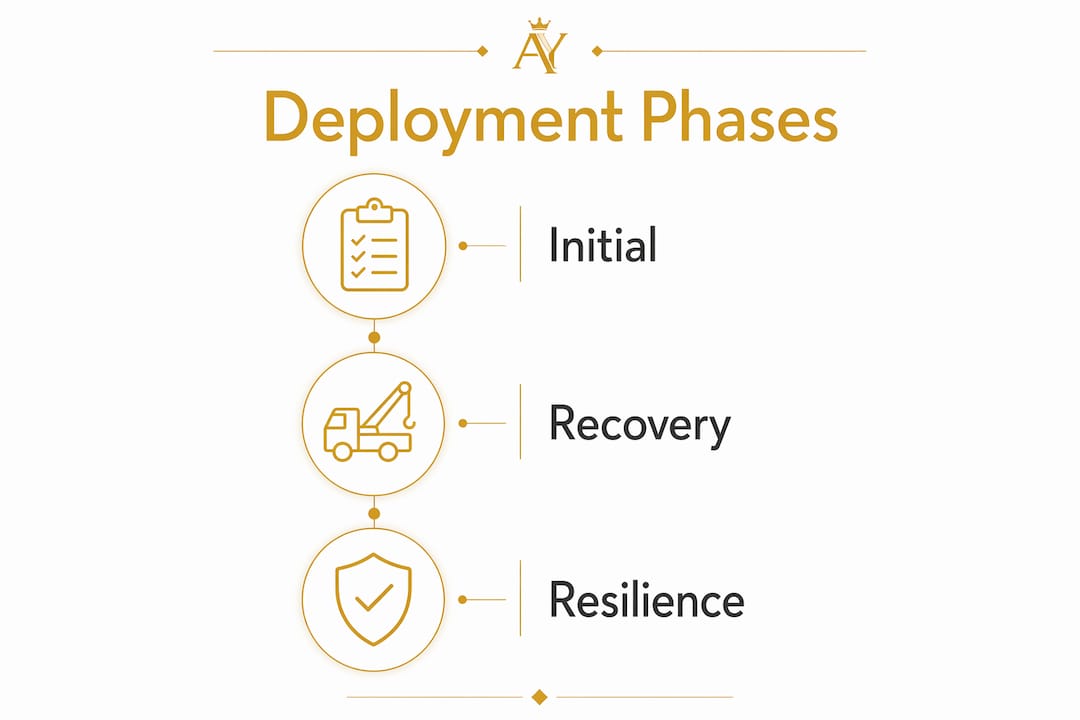
Understanding these phases helps logistics managers plan procurement rather than react to shortages.
| Phase | Timeframe | Buyer profile | Urgency | Typical use |
|---|---|---|---|---|
| Initial deployment | Days 1–30 | Emergency responders, contractors | Critical | Temporary storage, command units |
| Recovery purchasing | Days 30–180 | Project managers, insurers | High | Replacement facilities, site offices |
| Long-term resilience | Months 6–36 | Procurement teams, facility managers | Moderate | Permanent contingency stock |
The initial deployment phase is where emergency container transport is most acute. Buyers in this phase have no flexibility on timing. They need containers on site within hours or days, not weeks. After major disasters, local container inventory depletes rapidly, leading to extended lead times. Delayed ordering creates critical supply bottlenecks that compound the original disruption.
The recovery phase introduces a different challenge. Demand is still elevated but buyers have slightly more time to assess specifications. Container quality, size, and condition become relevant considerations alongside speed.
The resilience investment phase is strategic rather than reactive. Organisations that have experienced a disruption use this period to build contingency stock and pre-position containers for future events. This is where procurement teams replace reactive purchasing with structured container movement procedures.
What are the logistical and technical considerations for emergency container movement?
Successful emergency container transport depends on resolving site-specific constraints before the vehicle departs. The most common failure point is not the transport itself. It is the mismatch between the delivery method and the conditions on the ground.
Delivery method selection
Two primary delivery methods apply to container movement procedures: tilt-bed and crane delivery.
Standard tilt-bed delivery is unsuitable for sites with soft ground, debris, or restricted clearance. The vehicle requires a firm, level surface and sufficient run-out space to slide the container off the bed. On a post-flood site or a congested construction yard, these conditions rarely exist.
Crane delivery overcomes these constraints. It allows precise placement in confined or compromised locations. The trade-off is cost and scheduling. Crane operations require advance booking, a qualified operator, and a clear lift zone. On a time-critical job, that coordination must happen in parallel with the transport booking, not after it.
Container design and certification
The standardised ISO container design enables multi-modal transport across sea, rail, and road. This standardisation is the foundation of rapid deployment in emergency response scenarios. A container loaded at a port can transfer to rail and then road without reloading, which saves hours in a time-critical operation.
Not all containers are equal in emergency contexts. Standard ISO containers are not approved for air transport. Only air-certified, reinforced aerotransportable containers meet the requirements for airlift, airdrop, or helicopter sling operations. These units carry specific certifications for reinforced tie-down points and dimensions matched to airframe specifications. For remote-site or military emergency logistics, specifying the wrong container type causes critical delays.
Key technical considerations for rapid container handling include:
- Ground bearing capacity at the delivery site, particularly after flooding or ground disturbance
- Overhead clearance for crane operations and tilt-bed run-out
- ISO certification confirming the container is fit for the intended transport mode
- Air-transport certification if the container must be moved by helicopter or aircraft
- Container condition including structural integrity, door seals, and locking mechanisms
Pro Tip: Book your delivery method and site survey simultaneously. Waiting for a site survey result before scheduling a crane adds 24–48 hours to your timeline. Run both in parallel to avoid time-critical delivery pitfalls that compound under pressure.
How can businesses integrate emergency container movement into their supply chain strategy?
The businesses that handle emergency container transport most effectively are those that treat it as a planned capability rather than a crisis response. Reactive procurement under pressure produces the worst outcomes: higher costs, longer waits, and compromised site conditions.
Logistics experts advise shifting immediately from standard carrier lanes to dedicated, time-critical providers with real-time tracking and priority routing when an emergency arises. Standard lanes lack the service levels and speed that critical scenarios demand. Engaging a specialist provider before an emergency occurs is the single most effective preparation a logistics manager can make.
The following best practices cover the full lifecycle of an emergency container movement:
- Identify your trigger conditions. Define in advance what circumstances require emergency container transport. A warehouse fire, flood, or production failure each has a different threshold. Knowing your trigger removes decision delay when time matters most.
- Pre-qualify a specialist provider. Vet a dedicated courier or freight haulage provider before you need them. Confirm their fleet includes container transport vehicles, their coverage is nationwide, and their dispatch is available outside standard hours.
- Order early against deployment confirmation. Effective emergency container logistics depend on early, proactive ordering aligned with deployment confirmation rather than final project scoping. Do not wait until the site is fully defined.
- Communicate site conditions at the point of order. Ground type, access restrictions, overhead clearance, and proximity to utilities must be shared immediately. This determines the delivery method and prevents failed attempts.
- Request real-time tracking from dispatch. Continuous visibility allows you to coordinate receiving teams, manage site access windows, and respond to delays without losing time.
- Confirm delivery completion formally. Document the container placement, condition on arrival, and any site access issues encountered. This record supports insurance claims, project reporting, and future procurement planning.
Pro Tip: Partner with a provider that offers emergency courier vehicle matching. Matching the right vehicle to the container size and site conditions prevents costly re-dispatches and keeps your timeline intact.
Key takeaways
Emergency container movement succeeds when businesses combine early procurement, dedicated vehicle assets, and precise site communication before the transport departs.
| Point | Details |
|---|---|
| Definition is operational | Emergency container movement uses dedicated vehicles and priority routing to meet strict, non-negotiable deadlines. |
| Timelines differ significantly | Standard delivery takes 5–10 days; emergency options reduce this to 2–5 days or same day. |
| Three demand phases exist | Initial deployment, recovery purchasing, and resilience investment each require different procurement strategies. |
| Site conditions determine method | Tilt-bed delivery fails on soft or restricted sites; crane delivery costs more but prevents failed attempts. |
| Early ordering is critical | Local inventory depletes fast after major events; ordering on deployment confirmation prevents supply bottlenecks. |
What I have learned from managing emergency container deployments
The most persistent mistake I see in emergency container logistics is the assumption that urgency alone solves the problem. Businesses call a provider, request same-day delivery, and assume the job is done. What they have not done is tell anyone about the flooded access road, the low bridge on the approach, or the fact that the site has no firm standing for a tilt-bed vehicle.
Speed and site readiness are equally important. I have seen same-day dispatches fail at the point of delivery because no one assessed the ground conditions in advance. That failure does not just cost money. It costs the hours you were trying to save.
The second lesson is about provider selection. Not every courier company that claims to handle freight can manage container transport under emergency conditions. You need a provider with the right fleet, the right dispatch capability, and the experience to problem-solve on the road. Checking those capabilities before an emergency occurs is the difference between a resolved crisis and an extended one.
The trend I am watching in 2026 is the integration of real-time site data into dispatch decisions. Providers that can access ground condition reports, traffic data, and site access windows at the point of booking will reduce failed deliveries significantly. Businesses that understand how emergency deliveries prevent downtime are already asking their providers about this capability. The rest will learn the hard way.
— Ayomide
How Sddbyaba supports your emergency container transport needs
When your supply chain cannot wait, Sddbyaba delivers. As a UK-based same-day courier and freight specialist, Sddbyaba operates a full fleet of container transport vehicles, 26-tonne trucks, and dedicated courier assets built for time-critical consignments.

Every emergency container movement booking with Sddbyaba includes priority routing, direct dispatch, and real-time communication from collection to delivery. Whether you need a dedicated courier vehicle for a single container or freight haulage support for a larger operation, Sddbyaba provides nationwide UK coverage with the speed and reliability your business demands. Contact Sddbyaba today via sddbyaba.com to discuss your emergency logistics requirements.
FAQ
What is emergency container movement in logistics?
Emergency container movement is the expedited transport of containers using dedicated vehicles and priority routing to meet strict, time-critical delivery deadlines. It prevents business interruption when standard freight timelines are operationally unacceptable.
How quickly can an emergency container be delivered?
Rush container delivery reduces standard 5–10 business day timelines to 2–5 days, with same-day options available depending on location and site access conditions.
What delivery methods are used for emergency container transport?
Tilt-bed vehicles are the standard method but require firm, level ground. Crane delivery is used for sites with soft ground, debris, or restricted access, though it requires advance scheduling and costs more.
Are all containers suitable for emergency air transport?
Standard ISO containers are not approved for air transport. Only air-certified aerotransportable containers with reinforced tie-down points meet the requirements for airlift or helicopter sling operations.
How should businesses prepare for emergency container movement?
Businesses should pre-qualify a specialist provider, define their trigger conditions in advance, and order containers on deployment confirmation rather than waiting for final site scoping to avoid inventory shortages.