
Emergency freight documentation comprises the critical paperwork and records needed to legally and efficiently manage urgent shipments under pressure. Without it, carriers face regulatory penalties, delayed deliveries, and significant financial exposure. The North American trucking industry alone incurs over £800 million annually in freight claims. That figure reflects what happens when documentation fails at scale. For logistics professionals managing time-critical consignments, understanding why emergency freight documentation matters is not optional. It is the difference between controlled execution and costly chaos.
Why emergency freight documentation matters for compliance
Emergency freight documentation is defined as the complete set of records, permits, and declarations required to move urgent goods legally and safely. The industry term for this body of paperwork is "freight compliance documentation," though logistics professionals commonly refer to it as emergency freight paperwork when shipments are unplanned or crisis-driven.
The legal stakes are immediate. The Department of Transportation (DOT) and the Federal Motor Carrier Safety Administration (FMCSA) both require carriers to maintain accessible, accurate records throughout every shipment. For hazardous materials, DOT requires notification within 12 hours of an incident, with a written follow-up within 30 days. Missing that window triggers regulatory action regardless of the urgency of the original shipment.

Documentation also protects the financial position of every party in the chain. Carriers must respond to freight claims within 30 days and pay or disallow within 120 days under 49 CFR 1005.7. Incomplete paperwork at the time of a claim gives insurers grounds to reject or reduce payouts. Proper documentation is not a formality. It is a financial safeguard.
What documents are required for emergency freight?
The core documents for any emergency freight shipment fall into five categories. Each serves a distinct legal or operational purpose.
| Document | Purpose |
|---|---|
| Bill of lading | Legal contract between shipper and carrier; confirms goods, quantities, and delivery terms |
| Hazardous material shipping papers | Required by DOT for any regulated substance; must include proper shipping name and UN number |
| Safety Data Sheet (SDS) | Provides emergency responders with chemical hazard and handling information |
| Commercial invoice | Confirms goods value and ownership; required for customs clearance on international shipments |
| Emergency permits | Authorises non-standard routes, oversized loads, or out-of-hours movement |
Documentation errors are the most common cause of hazmat shipping violations and delays. Drivers must keep all relevant documents accessible at all times for regulators and emergency responders. A missing SDS during a roadside inspection does not just cause a delay. It can result in the vehicle being placed out of service immediately.
For international emergency shipments, the standard rises further. Documents must tell a consistent story, matching shipper details, consignee information, goods descriptions, quantities, and weights across every form. A single mismatch between a commercial invoice and a packing list can halt a shipment at customs for hours or days.
Pro Tip: Prepare a master document template for your most common emergency freight types. Pre-populate fixed fields such as shipper address, emergency contact numbers, and standard commodity descriptions. This cuts preparation time significantly when speed matters most.
How does documentation support compliance and liability management?
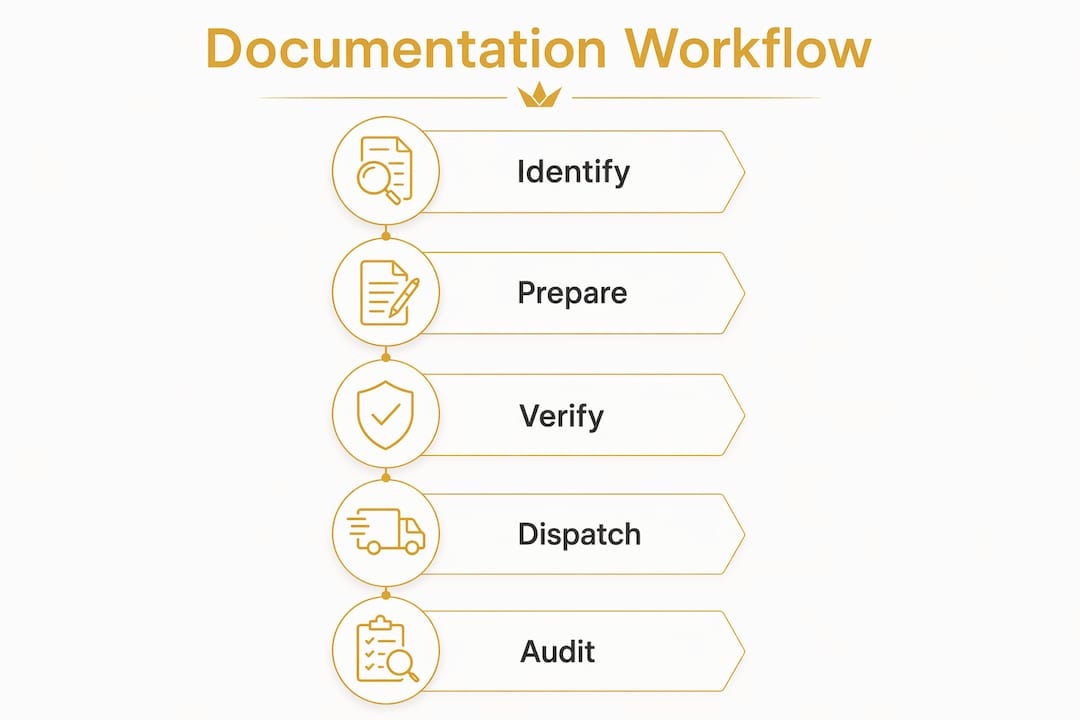
Proper documentation reduces legal and financial risk in three concrete ways: it creates an auditable trail, it provides proof of condition, and it establishes clear accountability between parties.
Photographic documentation with timestamps is one of the most effective tools available. Capturing each pallet from multiple angles before loading, and photographing the sealed trailer after loading, creates irrefutable evidence that expedites claims resolution. This practice protects shippers from false damage claims and gives carriers a defensible record in disputes.
For emergency regulation compliance, a document crosswalk is a practical framework worth adopting. This tool maps temporary regulatory requirements to exact paperwork such as trip manifests, driver training proofs, and emergency permits, so nothing is overlooked during a crisis. Version control and time-stamped records also support fast regulator reviews when temporary driver hours or route exemptions are in play.
The key compliance practices for emergency freight liability management include:
- Maintaining timestamped photo records at loading and delivery
- Keeping all hazmat documents accessible in the cab at all times
- Using version-controlled document sets with clear revision dates
- Recording all communication with emergency contacts and regulators
- Retaining signed delivery confirmations as proof of receipt
Pro Tip: Use a cloud-based document management system so drivers, dispatchers, and compliance officers can access the same version of every document in real time. This removes the risk of a driver carrying an outdated permit or an old SDS.
What mistakes to avoid in emergency freight paperwork?
Rushed documentation produces predictable errors. Knowing the most common mistakes allows logistics professionals to prevent them before they cause disruption.
-
Mismatched data across documents. The shipper name on the bill of lading must match the commercial invoice and the customs declaration exactly. Any discrepancy gives regulators and insurers grounds to query or reject the shipment.
-
Missing or outdated emergency contact numbers. Emergency freight shipments with hazardous materials must include a 24/7 emergency response number. An outdated number, or one that rings unanswered, constitutes a regulatory violation in its own right.
-
Expired or incorrect Safety Data Sheets. SDS documents must reflect the current formulation of a substance. Using an SDS from a previous product version is a compliance failure, even if the chemical composition has not changed significantly.
-
Absent commodity specifics and ready times. Standardised emergency shipment checklists reduce errors and preserve customer relationships during urgent shipments. Without precise commodity descriptions and confirmed ready times, quoting and dispatch slow down at exactly the wrong moment.
-
Treating documentation as a final step. Booking space and freight costs are often prioritised, but rigorous early document validation reduces errors and delays. Starting documentation at the point of problem identification, not at the point of loading, removes the time pressure that causes most errors.
Digital systems address several of these risks directly. Automated error checking flags mismatched fields before a document is submitted. Real-time access means every party works from the same current version. For businesses managing emergency parcel handling at scale, digital documentation management removes the administrative burden that compounds under crisis conditions.
How to manage emergency freight documentation workflows during a crisis
A clear workflow prevents documentation from becoming a bottleneck when time is short. The following framework reflects best practice for logistics professionals handling unplanned urgent shipments.
| Stage | Action | Documentation required |
|---|---|---|
| Problem identification | Confirm shipment need and commodity details | Initial freight brief, commodity description |
| Capacity securing | Contact carrier and confirm vehicle type | Booking confirmation, rate agreement |
| Document preparation | Complete all required paperwork before loading | Bill of lading, SDS, permits, commercial invoice |
| Pre-loading verification | Cross-check all documents against physical goods | Signed checklist, timestamped photos |
| In-transit communication | Maintain contact with driver and consignee | Communication log, incident report template |
| Delivery confirmation | Obtain signed proof of delivery | Signed POD, final photo record |
Even a 15-minute delay in communication can affect available capacity and cause disruptions during an emergency freight movement. That is why documentation preparation must run in parallel with capacity sourcing, not after it.
Contingency documentation is equally important. Every emergency freight plan should include pre-prepared incident report templates, alternative route permits where applicable, and a clear escalation path for regulatory queries. Emergency freight requires real-time communication protocols and contingency documentation plans to manage unexpected delays or changes. Businesses that build these into their standard operating procedures respond faster and with less internal confusion when a crisis hits.
For logistics professionals managing urgent delivery tracking across multiple consignments, version control is non-negotiable. Every document set should carry a revision date and a named owner. When regulators or insurers request records, the ability to produce a complete, timestamped audit trail resolves queries in hours rather than days.
Key takeaways
Emergency freight documentation is the primary operational control that separates compliant, efficient crisis shipments from costly, delayed ones.
| Point | Details |
|---|---|
| Start documentation early | Begin paperwork at problem identification, not at the point of loading, to prevent errors under pressure. |
| Maintain document consistency | All shipper, consignee, and commodity details must match exactly across every form to avoid regulatory rejection. |
| Use photo records with timestamps | Capture pallets before loading and sealed trailers after loading to create a defensible record for claims. |
| Build contingency document plans | Pre-prepare incident report templates and alternative permits so crises do not create documentation gaps. |
| Adopt digital document management | Real-time access and automated error checking reduce the administrative risk that compounds during urgent shipments. |
Documentation as a competitive tool, not just a compliance box
I have seen emergency freight documentation treated as a back-office task for most of my career in logistics. The paperwork gets done because it has to, not because anyone believes it adds value. That mindset is expensive.
The businesses that handle crises best are the ones that treat documentation as an operational priority from day one. They have checklists ready. They have SDS files current. They have emergency contact numbers verified. When a production line stops or a medical consignment needs to move within hours, their documentation is 80% complete before the phone call ends.
The shift I advocate is simple. Stop thinking of freight compliance documentation as something you complete before dispatch. Think of it as something you maintain continuously, so that when an emergency arises, the paperwork is already done. Digital tools make this genuinely achievable now. Cloud-based document management, automated field validation, and pre-populated templates remove the manual effort that used to make early preparation impractical.
Training matters as much as technology. Dispatchers and drivers who understand why each document exists make fewer errors than those who treat forms as bureaucratic obstacles. A driver who knows that an accessible SDS protects them personally in a hazmat incident will keep that document current without being told.
Documentation done well is a competitive advantage. It means faster dispatch, fewer claims, and stronger relationships with carriers and customers who trust you to get it right under pressure.
— Ayomide
How Sddbyaba supports compliant emergency freight movements
Sddbyaba operates nationwide across the UK, providing same day dispatch for time-critical consignments across industries including manufacturing, medical and healthcare, construction, and commercial logistics.
When an emergency freight requirement arises, Sddbyaba's dispatch team works with businesses to confirm commodity details, vehicle requirements, and documentation needs from the first call. The fleet covers everything from small vans to freight haulage vehicles capable of handling large or specialist consignments. For businesses that need a dedicated vehicle with full documentation support, the dedicated courier service provides a single point of accountability from collection to delivery. Contact Sddbyaba to discuss your emergency freight requirements and get a consignment moving with the right paperwork in place from the start.
FAQ
What is emergency freight documentation?
Emergency freight documentation is the complete set of legal records, permits, and declarations required to move urgent goods safely and compliantly. It includes the bill of lading, Safety Data Sheets, hazardous material shipping papers, and proof of delivery.
What happens if emergency freight paperwork is incomplete?
Incomplete documentation causes shipment delays, regulatory fines, and rejected insurance claims. Under 49 CFR 1005.7, carriers must pay or disallow freight claims within 120 days, and missing records give insurers grounds to reduce or reject payouts.
Which regulatory bodies govern emergency freight documentation in the UK and US?
The DOT and FMCSA govern emergency freight documentation requirements in the United States. In the UK, the Driver and Vehicle Standards Agency (DVSA) and the Health and Safety Executive (HSE) set equivalent standards for hazardous and commercial freight movements.
How do I prevent documentation errors during an emergency shipment?
Use standardised checklists, begin document preparation at the point of problem identification, and adopt digital document management with automated error checking. Pre-populated templates for common shipment types reduce preparation time and the risk of mismatched data.
Why does photo documentation matter for freight claims?
Timestamped photographs of pallets before loading and sealed trailers after loading create a defensible record that expedites claims resolution and protects shippers from false damage claims.