
Emergency load securing is defined as the practice of immobilising cargo against the dynamic forces generated during sudden braking, sharp turns, or evasive driving manoeuvres. The industry standard term is cargo securement, governed in the United States by FMCSA 49 CFR Part 393 and in the UK by the Highway Code and the Road Vehicles (Construction and Use) Regulations 1986. For transport managers and logistics professionals, understanding what is emergency load securing means recognising that the securement system must be designed before the vehicle moves, not improvised when an emergency occurs. Unsecured or poorly secured loads kill drivers, damage freight, and expose operators to serious legal liability.
What is emergency load securing and why does it matter?
Emergency load securing is the method of firmly immobilising cargo so it cannot shift or fall during any foreseeable road event, including hard emergency braking. Under FMCSA 49 CFR Part 393, cargo must be contained, immobilised, or secured to prevent movement during transport, including during emergency braking. That is not a best practice recommendation. It is a legal minimum.
The securement system must withstand specific dynamic forces: 0.8 g forward, 0.5 g lateral and rearward during simulated emergency events. To put that in practical terms, a 10,000 kg load must be restrained against an 8,000 kg forward force during a hard stop. Most transport incidents involving cargo movement occur precisely because operators underestimate these forces at the point of loading.

A critical misconception is that emergency driving somehow changes the legal standard. It does not. Emergency driving does not alter the fundamental legal requirement for load securement. The system must already be capable of withstanding those forces before the vehicle departs. This is the core principle that separates compliant operators from those facing prohibition notices and prosecution.
What regulations govern load securing requirements?
The regulatory framework for cargo securement is detailed and non-negotiable. FMCSA 49 CFR Part 393 sets the performance criteria that any securement system must meet, and UK operators must comply with equivalent domestic legislation. The key requirements transport managers need to understand are as follows.
- The aggregate working load limit of all tiedowns used must equal or exceed 50% of the cargo weight. A 6,000 kg load therefore requires tiedowns with a combined WLL of at least 3,000 kg.
- Tiedowns alone are insufficient. Blocking, bracing, and dunnage must work alongside tiedowns to address multi-directional movement.
- The vehicle's own structure, including headerboards and sideboards, forms part of the securement system and can be counted towards immobilisation.
- Drivers carry personal responsibility for inspecting and maintaining securement throughout the journey.
- Legal compliance depends on the complete system, not on any single device or tiedown in isolation.
Transport managers sometimes focus exclusively on tiedown count and overlook the aggregate WLL calculation. That is a compliance gap. Regulators assess the whole system, and a vehicle can be placed out of service if the combined WLL falls short, regardless of how many straps are present.
Pro Tip: Calculate aggregate WLL at the planning stage for each load type your fleet regularly carries. Build a reference card for drivers so they can verify compliance before departure without needing to recalculate from scratch on the day.
Which securement techniques are essential for emergency load safety?
Effective load securing for transport requires a layered approach. No single technique addresses all the forces a load will experience during an emergency event. The following components work together to create a compliant and genuinely safe securement system.
- Tiedowns. Ratchet straps, chains, and wire rope each have rated WLLs that must be matched to the load. Chains suit heavy or abrasive loads; polyester webbing straps are appropriate for palletised goods and lighter freight. Never mix tiedown types without verifying combined WLL.
- Blocking and bracing. Chocks, wedges, and timber dunnage prevent rolling and lateral sliding. Cargo likely to roll must be restrained by chocks, wedges, cradles, or equivalent means. These devices must be secured so they cannot themselves become loose during transit.
- Edge protection. Tiedowns running over sharp cargo edges are vulnerable to abrasion and failure. Corner protectors and edge guards preserve tiedown integrity under load and vibration.
- Vehicle structure. Headerboards resist forward cargo movement during braking. Sideboards and stanchions resist lateral movement. Using vehicle structure correctly reduces the number of tiedowns required and improves overall system performance.
- Dunnage and friction mats. Rubber friction mats placed between cargo and the deck increase the coefficient of friction, reducing the restraining force that tiedowns must provide. This is particularly effective for palletised loads.
The table below compares the primary tiedown types by application and key characteristic.
| Tiedown type | Best application | Key consideration |
|---|---|---|
| Polyester webbing strap | Pallets, packaged goods | Check WLL rating; avoid sharp edges without protection |
| Chain with binder | Heavy plant, steel, machinery | High WLL; resistant to abrasion and heat |
| Wire rope | Structural steel, large equipment | Durable but requires correct termination fittings |
| Synthetic rope | Light loads, general freight | Lower WLL; inspect for UV degradation regularly |
Pro Tip: Design your securement system to address forces in all three axes: forward, rearward, and lateral. A load secured only vertically by tiedowns will still shift sideways during an emergency turn.
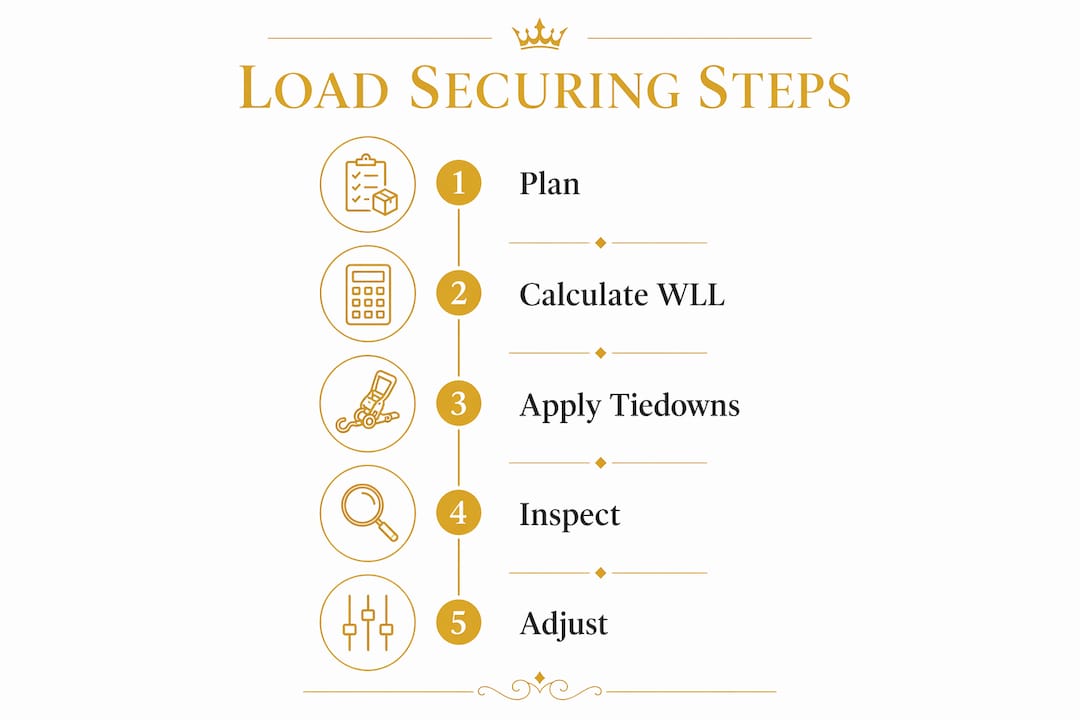
How and when should load securement be inspected during transport?
Inspection is not a one-time activity at the point of loading. Load settling, road vibration, and temperature changes all affect tiedown tension during a journey. A securement system that is fully compliant at departure can become dangerously inadequate within the first hour of transit.
The required inspection schedule under FMCSA regulations is clear. Drivers must inspect cargo securement within the first 50 miles of the trip and then every 3 hours or 150 miles thereafter, whichever comes first. That first check at 50 miles is the most critical. It catches the initial settling that occurs as the load beds down onto the vehicle deck.
Excessive load settling and vibration can loosen tiedowns significantly within the first stretch of motorway driving. Scheduled settling checks catch this degradation before it creates an unsafe condition. Drivers should check the following at each inspection point.
- Tiedown tension: re-tension any strap or chain that has lost tension.
- Tiedown condition: look for cuts, fraying, or abrasion damage that reduces WLL.
- Blocking and bracing position: confirm chocks and wedges have not shifted.
- Cargo position: verify the load has not moved relative to its original position.
- Edge protection: check corner guards are still in place and undamaged.
Any harsh event during the journey, such as hard braking, a pothole, or an uneven level crossing, should trigger an unscheduled inspection at the next safe stopping point. Failure to maintain inspection records is itself a compliance offence and can result in a vehicle being placed out of service during a roadside check.
What special considerations apply during declared emergencies?
Emergency relief transport introduces a layer of complexity that standard commercial haulage does not face. During declared national or regional emergencies, the US DOT and equivalent UK authorities may issue regulatory relief waivers that temporarily modify certain requirements under regulations including 49 CFR Part 393. However, the scope of those waivers varies significantly by event and jurisdiction.
Transport managers must understand a critical distinction. A waiver may relax administrative requirements such as documentation timelines or hours of service rules. It does not eliminate the physical obligation to secure cargo safely. Logistics teams managing emergency relief shipments should continue adhering to securement practices even when regulatory waivers apply, because the physical risks of unsecured cargo do not disappear because a waiver exists.
"During emergency or disaster response transport, operational risks extend beyond physical securement to include recordkeeping, rule verification, and responsibility management under waivers." This means transport managers must actively track which specific rules are waived, document their compliance decisions, and maintain clear lines of responsibility within their teams.
Operationally, emergency deliveries often involve unfamiliar loads, unfamiliar routes, and time pressure. These are precisely the conditions under which securement errors occur. The types of engineering emergency deliveries that arise during disaster response frequently involve oversized or non-standard cargo that requires bespoke securement planning rather than a standard strap count.
Pro Tip: Prepare a pre-approved securement plan for the load categories your fleet most commonly carries during emergency operations. When time pressure is highest, having a documented plan removes the risk of improvised and non-compliant securing.
How can transport managers implement best practices for load securing?
Translating regulatory knowledge into operational practice requires deliberate system design. The following framework gives transport managers a structured approach to embedding emergency load safety across their operations.
- Calculate aggregate WLL for every load type. Build a load securement matrix that maps common cargo categories to minimum tiedown requirements, blocking needs, and vehicle structure contributions. Update it when new cargo types are introduced.
- Train drivers on inspection procedures, not just loading. Drivers who understand why inspections matter at 50 miles are more likely to conduct them properly than those who see it as a paperwork exercise.
- Document every inspection. Record the time, location, findings, and any adjustments made. This documentation is your primary defence during a roadside check or incident investigation.
- Integrate blocking and bracing into standard operating procedures. Tiedowns alone do not constitute a compliant system. Chocks, friction mats, and dunnage should be listed as required equipment for specific load types, not optional extras.
- Plan for emergency scenarios at the load planning stage. Consider what happens to this load during hard braking or a sharp evasive manoeuvre. If the answer is uncertain, the securement plan needs revision before departure.
- Conduct internal audits. Regular spot checks of loaded vehicles before departure catch systemic training gaps and equipment deficiencies before they become incidents or prohibition notices.
For freight haulage operations carrying heavy or specialist loads, the aggregate WLL calculation and multi-directional restraint design are the two areas where compliance failures most commonly occur. Addressing both through documented procedures and driver training produces measurable improvement in roadside check outcomes.
Key takeaways
Emergency load securing requires a complete, pre-designed securement system capable of withstanding emergency forces before the vehicle departs, not a reactive measure applied after an incident.
| Point | Details |
|---|---|
| Regulatory minimum WLL | Combined tiedown WLL must equal at least 50% of cargo weight under FMCSA 49 CFR 393. |
| Multi-directional restraint | Tiedowns address vertical forces; blocking, bracing, and dunnage address lateral and rolling movement. |
| Inspection schedule | Inspect within 50 miles of departure, then every 3 hours or 150 miles throughout the journey. |
| Emergency waivers do not remove risk | Regulatory relief waivers may relax administrative rules but do not eliminate the physical need for secure cargo. |
| System-level compliance | FMCSA judges the aggregate securement system, not individual devices in isolation. |
Why most operators get emergency load securing wrong
I have seen transport operations where drivers treat the first inspection at 50 miles as optional, particularly on familiar routes. That is the single most common securement failure I encounter, and it is entirely preventable. Load settling is not theoretical. On a motorway run, a pallet load can lose meaningful tiedown tension within the first 20 minutes simply through vibration and the natural compression of packaging materials.
The deeper problem is that many operators design their securement systems around the average journey, not the worst-case scenario. Emergency load securing demands that you design for the worst case: a hard stop at motorway speed, a sharp evasive manoeuvre, an unexpected road surface. If your securement system would hold in that scenario, it will certainly hold in normal conditions. The reverse is not true.
What I find genuinely underappreciated is the role of vehicle structure. Headerboards and sideboards are not just bodywork. They are rated structural components that contribute to your aggregate securement system. Operators who understand this can often reduce tiedown count while improving overall compliance, because they are using the vehicle correctly. That is the kind of practical knowledge that separates professional freight operations from those that rely on habit and hope.
The two-stage mindset matters most: design with adequate WLL at loading, then verify repeatedly during transit. Neither stage is optional, and neither compensates for failure in the other.
— Ayomide
Secure freight transport with Sddbyaba
Cargo securement compliance is not a back-office concern. It is a live operational responsibility on every journey your fleet makes.
Sddbyaba operates a nationwide fleet ranging from small vans to 26-tonne freight vehicles, and every movement is planned with load safety and regulatory compliance at its centre. Whether you need same day freight haulage for time-critical consignments or dedicated 18-tonne haulage for heavy loads requiring bespoke securement planning, Sddbyaba provides the expertise and vehicle capacity to move your goods securely. Contact Sddbyaba through sddbyaba.com to discuss your freight requirements with a logistics team that treats load safety as standard, not optional.
FAQ
What is load securing in freight transport?
Load securing is the practice of immobilising cargo using tiedowns, blocking, bracing, and vehicle structure to prevent movement during transit. Under FMCSA 49 CFR Part 393, the combined working load limit of all tiedowns must equal at least 50% of the cargo weight.
How often must drivers inspect cargo securement?
Drivers must conduct an initial inspection within the first 50 miles of departure and repeat checks every 3 hours or 150 miles thereafter. Any harsh road event should trigger an additional unscheduled inspection at the next safe stopping point.
Does an emergency waiver remove load securing obligations?
No. US DOT and equivalent emergency regulatory relief waivers may relax administrative requirements but do not remove the physical obligation to secure cargo safely. Securement practices must be maintained throughout emergency relief operations.
What is the minimum working load limit for tiedowns?
The aggregate WLL of all tiedowns securing an article must equal or exceed 50% of the cargo weight. A 4,000 kg load therefore requires tiedowns with a combined WLL of at least 2,000 kg, calculated across all devices in the system.
What is the difference between tiedowns and blocking in load securing?
Tiedowns restrain cargo vertically and prevent it from lifting or moving forward and rearward. Blocking and bracing, including chocks, wedges, and dunnage, prevent lateral movement and rolling. Both are required for a fully compliant securement system.