
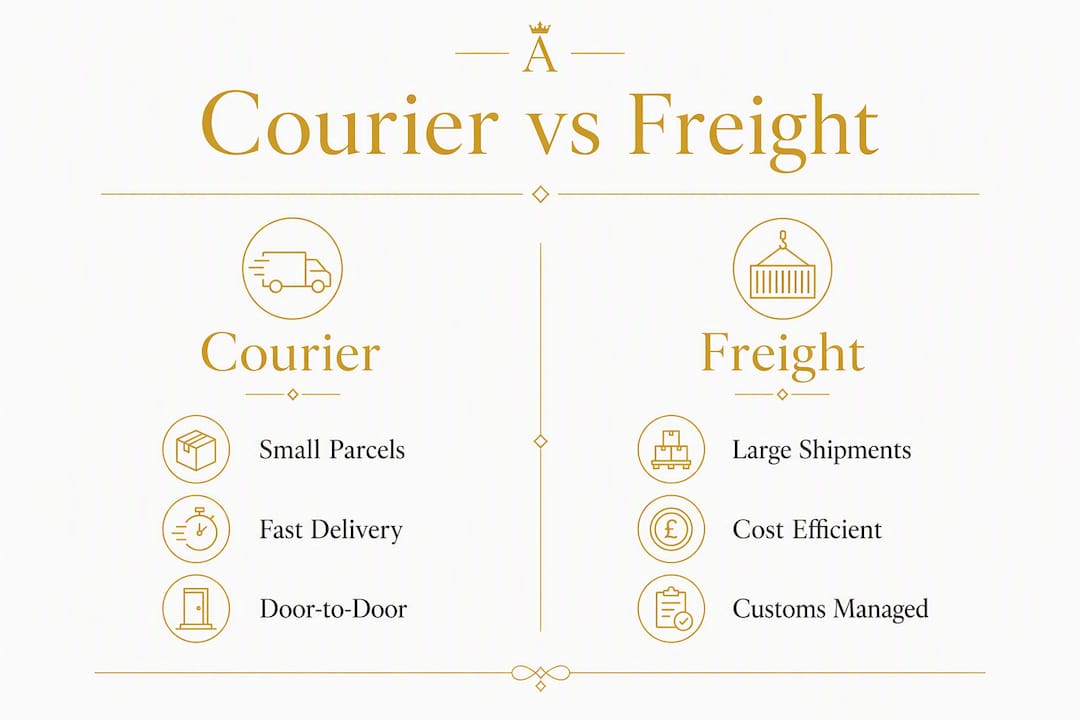
Use a courier for urgent, small parcels delivered door-to-door; use a freight forwarder for bulk, palletised, or complex international shipments; and deal directly with a carrier when you are booking full-truck or container capacity at scale. The deciding factors include shipment weight and volume, urgency, customs complexity, and total landed cost.
- Size and weight: smaller parcels suit courier services; anything heavier or palletised typically belongs with freight.
- Urgency: same-day and next-day requirements point to courier; scheduled supply-chain replenishment suits freight.
- Customs complexity: standard electronic clearance works for most courier parcels; non-standard documentation needs a freight forwarder's proactive management.
This guide covers UK-focused definitions, a side-by-side comparison, worked pricing examples, and a practical decision checklist.
Table of Contents
- What does a courier service actually do?
- What a freight forwarder does and when you need one
- What carriers are and how they differ from couriers and forwarders
- How courier, forwarder, and carrier compare side by side
- How pricing and lead times actually differ, with UK examples
- How to choose: a practical checklist before you book
- Key takeaways
- Why the courier-versus-freight decision is more nuanced than most guides admit
- Sddbyaba: same-day courier, pallet transport, and haulage across the UK
- Useful sources for further reading
What does a courier service actually do?
A courier collects a parcel from your door and delivers it to the recipient's door, with real-time tracking at every stage. Courier services are designed for speed, convenience, and smaller parcels, making them the default choice for urgent, customer-facing deliveries: legal documents, medical samples, replacement parts, or e-commerce orders.
Typical shipment profile for couriers:
- Weight and size: most courier networks impose per-parcel weight limits with dimensional restrictions.
- Use cases: documents, product samples, small components, retail orders, and time-critical consignments where the recipient expects a named delivery window.
- Tracking: electronic, real-time, with proof of delivery.
Pricing follows a dimensional weight formula using divisors around 5,000–6,000, which means a light but bulky box can be charged at a higher weight than its actual mass. For dense, heavy items this is manageable; for lightweight, voluminous goods it can make courier pricing uncompetitive quickly. International courier shipments typically clear customs electronically for standard goods, though non-standard paperwork can cause delays. Good courier documentation practices reduce that risk considerably.
What a freight forwarder does and when you need one
A freight forwarder does not own the trucks or ships. Instead, forwarders coordinate carriers, manage customs documentation, and consolidate shipments to reduce cost per unit on larger consignments. Think of them as a logistics project manager for complex or high-volume moves.
Key services freight forwarders provide:
- Carrier booking and route optimisation across road, sea, air, and rail.
- Customs brokerage and compliance management, including commodity codes, import/export declarations, and HMRC requirements.
- Consolidation (LTL) for businesses that cannot fill a full trailer or container, grouping their cargo with others to share costs.
- Full truckload (FTL) and container coordination for larger volumes.
- Specialist handling for temperature-sensitive, oversized, or hazardous goods.
- Warehousing and multimodal coordination where cargo changes mode mid-journey.
Forwarders proactively manage customs throughout the entire journey, whereas couriers typically clear standard parcels electronically and can struggle when documentation is non-standard. For UK businesses importing or exporting palletised stock, raw materials, or bulk goods, a forwarder's consultative approach often prevents costly delays at the border.

What carriers are and how they differ from couriers and forwarders
Carriers are the transport operators: the haulage companies, shipping lines, and airlines that physically move cargo. They provide capacity and schedules. A freight forwarder books space on a carrier's network; a courier operates its own integrated point-to-point parcel service, often using a mix of owned vehicles and carrier partnerships.
- When you deal directly with a carrier: usually for full-truck or full-container bookings, long-term haulage contracts, or when your volumes are large enough to negotiate rates directly.
- When you use a forwarder: for complex, multi-leg, or international moves where you need documentation support and route optimisation.
- When you use a courier: for door-to-door parcel delivery with integrated tracking and no need for separate carrier management.
Most businesses never need to book a carrier directly. The practical choice is almost always between a courier and a freight forwarder, with the carrier operating invisibly in the background.
How courier, forwarder, and carrier compare side by side
| Dimension | Courier | Freight Forwarder | Carrier (direct) |
|---|---|---|---|
| Best for | Urgent parcels, customer-facing deliveries | Palletised, bulk, or complex international shipments | Full-truck/container at scale |
| Pricing model | Per parcel, dimensional weight (divisor ~5,000–6,000) | Per pallet, CBM, or container; economies of scale | Negotiated rate per load or lane |
| Speed / lead times | Same day to next day (UK domestic); 1–5 days international | Road: 1–5 days EU; sea: weeks; air: 1–3 days | Depends on mode and contract |
| Customs support | Electronic clearance for standard goods | Full brokerage, proactive compliance management | None (you or a forwarder manages it) |
| Tracking / liability | Real-time tracking; per-parcel liability limits | Shipment-level tracking; insurance arranged separately | Varies by contract |
| UK coverage | Nationwide door-to-door | Nationwide and international via carrier network | Depends on operator |
A few nuances worth noting:
- A courier can be faster than air freight for domestic UK deliveries, even for medium-weight items, because there is no consolidation wait.
- Freight offers modal choices — sea, air, road, and rail — with cost-versus-speed trade-offs that couriers cannot match for large volumes.
- Couriers suit time-critical, customer-facing deliveries; forwarders suit supply-chain replenishment and complex international moves.
How pricing and lead times actually differ, with UK examples
Courier pricing applies a dimensional weight divisor of roughly 5,000–6,000. To calculate chargeable weight: multiply the parcel's length × width × height in centimetres, then divide by the divisor. If the result exceeds actual weight, you pay the dimensional figure.
Freight pricing works differently. Freight is priced by pallet, container, or CBM, and the cost per kilogram falls as volume increases. A single pallet moving on a shared trailer (LTL) costs a fraction of what multiple individual courier parcels would cost for the same total weight.
Break-even rule of thumb: once a shipment exceeds a moderate size or volume, freight shipping typically becomes significantly more economical than express courier.
Worked UK example:
- Smaller parcel: dimensional weight calculation applies, and an express courier quote for this within the UK might be competitive, with same-day delivery achievable. For an international move, courier pricing can be higher than consolidated pallet freight once handling charges are included.
- Larger pallet shipment: freight services typically undercut courier pricing significantly and can still achieve next-day UK delivery.
Businesses commonly prioritise speed for bulk stock without checking shipment size, paying express courier rates for non-urgent replenishment that freight consolidation would handle at lower cost.
Pro Tip: Always get both a courier and a freight quote for any shipment above 80 kg. Calculate the chargeable weight (L × W × H ÷ 5,000) before calling, and have your pallet dimensions and weight ready. The difference in total landed cost can be significant, especially for regular lanes. For documentation requirements on urgent freight, the emergency freight documentation checklist is a practical starting point.
How to choose: a practical checklist before you book
Work through these steps in order before committing to any service.
- Confirm weight, dimensions, and pallet requirement. Weigh and measure the consignment. If it exceeds 100–150 kg or 0.5 CBM, request a freight quote alongside any courier quote.
- Assess urgency and customer impact. Same-day or next-day delivery for a customer or production line? Use a courier. Scheduled stock replenishment with a 2–5 day window? Freight is likely more cost-effective.
- Check customs complexity. Standard goods with straightforward commodity codes can clear electronically via courier. Restricted goods, high-value items, or anything requiring a full import/export declaration need a freight forwarder's documentation support. Consult HMRC's import and export guidance for current UK requirements.
- Request quotes and compare total landed cost. Include all surcharges: fuel, residential delivery, remote area, handling, and any customs fees. The headline rate rarely tells the full story.
- Verify insurance and tracking. Confirm per-parcel or per-shipment liability limits. For high-value goods, arrange additional cover explicitly. Check whether real-time tracking is available end-to-end.
Questions to ask any supplier before booking:
- What is the guaranteed transit time, and what happens if it is missed?
- Do you handle customs clearance in-house, or is it outsourced?
- How do you manage fragile, temperature-sensitive, or hazardous cargo?
- What are your pickup and delivery windows, and are there accessorial charges for timed slots?
- When does Sddbyaba fit? For same-day urgent parcels, dedicated vehicle transport, or palletised and heavy haulage across the UK, Sddbyaba covers the full range from motorcycle courier to artic lorry, with no need to manage multiple suppliers.
Key takeaways
Matching the service to the shipment profile — not defaulting to the fastest or most familiar option — is what keeps UK logistics costs under control and deliveries on time.
| Point | Details |
|---|---|
| Courier for urgent small parcels | Use a courier for door-to-door, time-critical deliveries under roughly 100–150 kg or 0.5 CBM with real-time tracking. |
| Freight for palletised or bulk volume | Freight pricing by pallet or CBM becomes more economical above 100–150 kg or 0.5 CBM. |
| Forwarders manage customs complexity | For non-standard documentation or international compliance, a freight forwarder's proactive management prevents costly delays. |
| Carriers operate in the background | Most businesses book via a courier or forwarder; direct carrier contracts suit only high-volume, full-load operations. |
| Sddbyaba covers both ends | Sddbyaba handles same-day courier, pallet distribution, and heavy haulage up to artic lorry across the UK from a single provider. |
Why the courier-versus-freight decision is more nuanced than most guides admit
The standard advice — "use a courier for small parcels, freight for big ones" — is correct but incomplete. The more useful question is: what is the operational consequence of getting it wrong?
Choosing express courier for a 200 kg pallet of non-urgent stock does not just cost more. It signals a misalignment between procurement decisions and operational reality that compounds over time. Conversely, routing a time-critical medical component through a freight consolidation service to save £30 can halt a production line or delay a patient procedure. The cost of the wrong choice is rarely just the price difference on that single shipment.
What most businesses underestimate is how often the decision sits in a grey zone: 80–150 kg, moderate urgency, domestic UK, no customs complexity. This is precisely where getting both quotes and understanding chargeable weight pays off. A dedicated vehicle courier at that weight can match or beat a pallet freight quote on total cost while delivering faster, particularly for same-day requirements where freight consolidation introduces a wait.
The other overlooked factor is supplier consolidation. Managing a courier account, a freight forwarder relationship, and a direct carrier contract separately creates administrative friction and accountability gaps. A provider that spans same-day parcel delivery, dedicated vehicle transport, and palletised haulage under one roof removes that friction entirely, and that operational simplicity has real value beyond the per-shipment rate.
Sddbyaba: same-day courier, pallet transport, and haulage across the UK
When speed and reliability cannot be separated, Sddbyaba delivers both. As a UK-based same-day courier and logistics provider, Sddbyaba covers the full spectrum of shipment types that this guide addresses: urgent parcels dispatched the same day, dedicated vehicle transport for time-sensitive consignments, pallet distribution and freight haulage for larger loads, and heavy haulage using 7.5 tonne, 18 tonne, 26 tonne, and artic vehicles nationwide.
To get a quote, have the following ready: total weight, dimensions (L × W × H), pickup and delivery postcodes, any special handling requirements, and your required delivery window. Sddbyaba operates across construction, retail, manufacturing, medical, and commercial sectors, with a fleet that scales from motorcycle courier to artic lorry.
Request a quote or book a same-day dispatch directly through the Sddbyaba website.
Useful sources for further reading
- HMRC import and export guidance: the primary UK government source for customs declarations, commodity codes, and import/export compliance requirements.
- Freight Forwarder vs Courier vs Carrier — IFS Group: a clear industry breakdown of each service type and when to use them.
- Freight Forwarder vs Courier for UK Exporters — Exporter Services: UK-specific guidance on the practical differences for exporters and importers.
- Sddbyaba emergency freight documentation checklist: a practical checklist covering the documentation steps for urgent and freight shipments.
- Why courier documentation matters for businesses: explains when courier paperwork suffices and when freight-level documentation is required.