
A breakdown delivery service is defined as a specialised roadside assistance contract that dispatches a qualified mechanic or recovery team to repair or retrieve a vehicle immobilised by mechanical failure during transit. This service is entirely separate from motor insurance and operates as a dedicated support layer for delivery operations. For businesses running time-sensitive consignments, understanding the breakdown service definition is not optional. A single immobilised van can halt an entire delivery schedule, damage customer relationships, and trigger financial penalties that far exceed the cost of the breakdown itself.
What does breakdown delivery service mean in practice?
A breakdown delivery service covers the gap between a vehicle stopping and that vehicle returning to service. The industry term for this provision is "breakdown cover," and it operates through a tiered structure of response levels. Each tier determines how much assistance a driver receives at the roadside and what happens if the vehicle cannot be repaired on the spot.
The three core service tiers are:
- Roadside assistance: A mechanic attends the vehicle at its location and attempts a repair. This covers battery jump-starts, tyre changes, fuel delivery to stranded drivers, and lockout assistance.
- Recovery: If the roadside repair fails, the vehicle and driver are transported to a garage or depot. Distance limits apply and vary by contract.
- Onward travel: The driver receives alternative transport, accommodation, or a hire vehicle to complete the delivery or return home.
Coverage details matter significantly. Most standard contracts exclude certain vehicle weights, specialist equipment, or pre-existing faults. Businesses running mixed fleets, from motorcycles to 26-tonne artics, need contracts that explicitly cover every vehicle class in operation.
Pro Tip: Read the exclusions section of any breakdown contract before signing. A policy that excludes vehicles over 3.5 tonnes is useless for a fleet running Luton vans or 7.5-tonne trucks.

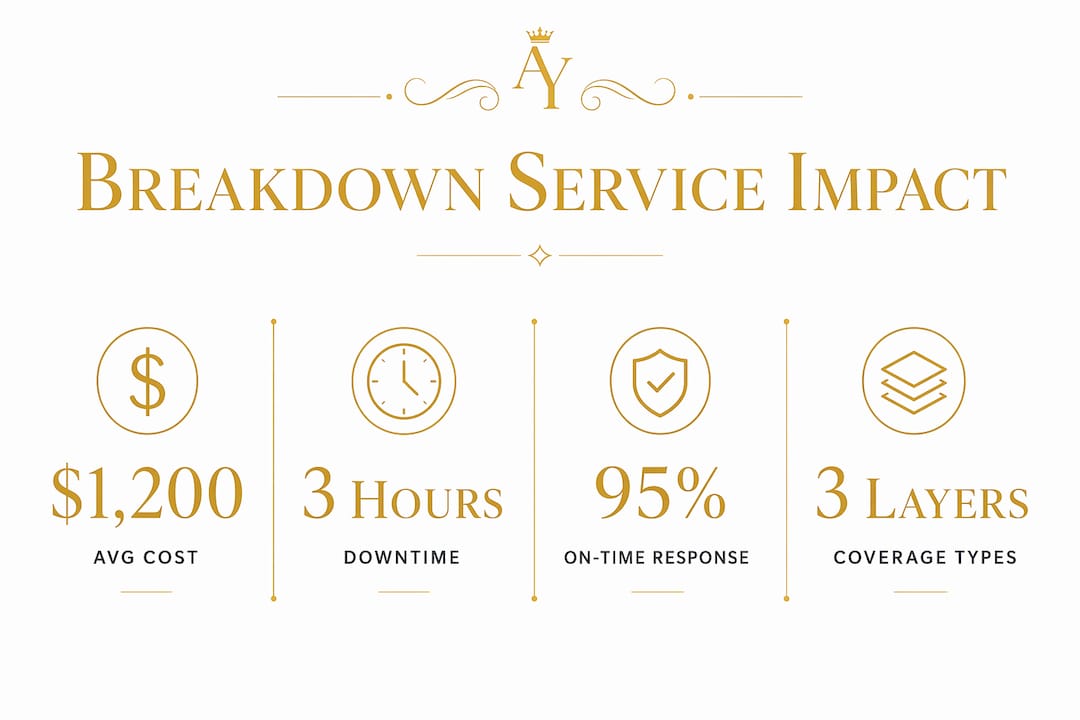
The meaning of breakdown delivery cover also extends to response time guarantees. A contract promising attendance within 60 minutes carries very different operational value from one with a four-hour window. For time-critical deliveries, that difference is the gap between meeting and missing a service level agreement.
How does breakdown delivery differ from motor insurance?
Breakdown cover is fundamentally different from motor insurance, and conflating the two is one of the most common and costly mistakes fleet operators make. Motor insurance satisfies the requirements of the Road Traffic Act 1988 and covers liability, damage, and injury resulting from accidents. Breakdown cover addresses mechanical failures that make a vehicle immobile. Neither replaces the other.
The practical distinctions are clear:
- Motor insurance responds to collisions, third-party claims, and vehicle damage caused by accidents.
- Breakdown cover responds to mechanical faults, electrical failures, flat tyres, and fuel errors.
- Motor insurance does not dispatch a mechanic to a stranded vehicle.
- Breakdown cover does not pay for accident repairs or third-party liability.
Many businesses assume that a comprehensive motor insurance policy includes full recovery. It does not. Many customers wrongly conflate motor insurance with breakdown cover, leaving fleets exposed to unprotected mechanical failures. A delivery van stranded on the M6 with a failed alternator is not an insurance event. It is a breakdown event, and without a separate breakdown contract, the operator pays for recovery out of pocket.
Equipment breakdown insurance adds a third layer. This type of policy protects fleets financially from mechanical or electrical failures and is often required for operating authority and compliance in commercial haulage. General liability policies typically include per-occurrence limits of £1 million for fleet equipment breakdowns, but these do not cover roadside attendance or recovery logistics.
The correct approach is to hold all three: motor insurance for legal compliance, breakdown cover for roadside response, and equipment breakdown insurance for financial protection against major mechanical failures.
What is the cost impact of breakdowns in delivery fleets?
Vehicle breakdowns carry a financial weight that most operators underestimate until they calculate the full picture. Unplanned breakdowns cost approximately $1,200 per event when repair premiums, driver overtime, and lost delivery time are combined. That figure represents a single incident on a single vehicle.
The downstream costs are where the real damage accumulates. For a 40-vehicle fleet, annual breakdown costs can reach £18,000 to £30,000 when SLA breach penalties, expedited shipping fees, and customer churn are factored in. Operators who focus only on the repair bill miss the larger financial exposure entirely.
A vehicle breakdown is a systemic disruption. It does not just stop one van. It affects dispatch schedules, driver rotas, customer trust, and supply chain reliability simultaneously. The businesses that recover fastest are those with a pre-planned response, not those scrambling to find a recovery truck after the fact.
The operational impact compounds quickly. A driver waiting three hours for recovery cannot complete their remaining drops. Those deliveries either fail or require a second vehicle to be diverted, adding fuel costs and driver hours. Customers receiving late or missed deliveries raise complaints, and repeat failures trigger contract reviews.
Pro Tip: Track every breakdown event with a cost log that includes repair cost, driver overtime, missed delivery revenue, and any SLA penalties. Most operators discover their true breakdown cost is three to four times the repair bill alone.
Mobile repair units change this equation. Fleet managers use fully-equipped mobile repair units to perform complex diagnostics and repairs onsite, including hydraulic and pneumatic work, reducing the need for towing. A vehicle repaired at the roadside in 45 minutes returns to service the same day. A vehicle towed to a garage may be off the road for 48 hours or more.
How does a breakdown differ from a delivery exception?
A vehicle breakdown and a delivery exception are two distinct events that require completely different responses. Confusing them leads to the wrong team being contacted, the wrong solution being applied, and the wrong message being sent to customers.
A delivery exception is a carrier-side notification that flags a specific shipment disruption. It appears in parcel tracking systems and indicates that a consignment has been delayed, misdirected, or cannot be delivered as planned. Common causes include:
- Incorrect or incomplete delivery address
- Recipient unavailable at time of delivery
- Customs delays for international shipments
- Severe weather preventing access
- Damaged packaging flagged at a depot
A vehicle breakdown, by contrast, is a physical mechanical failure. The vehicle stops moving. The driver needs roadside assistance or recovery. The disruption affects every consignment on that vehicle, not just one parcel.
Distinguishing these two events enables more accurate logistics incident response. A delivery exception triggers a customer communication and a rerouting decision. A vehicle breakdown triggers a breakdown service call, a driver welfare check, and an emergency reallocation of remaining deliveries. Treating a breakdown as a delivery exception delays the mechanical response and leaves the driver stranded longer than necessary.
Businesses that resolve urgent delivery failures quickly maintain clear internal protocols that separate these two incident types from the first call.
What modern solutions help businesses reduce breakdown downtime?
Proactive fleet management reduces breakdown frequency and limits the damage when breakdowns do occur. The most effective approach combines telematics data with mobile repair capability and emergency courier backup.
Most fleet operators have telematics data to predict failures but fail to act on it before faults cause immobilisation. The gap between reading a sensor alert and scheduling a maintenance check is where preventable breakdowns happen. Profitable fleets close that gap with automated maintenance triggers linked directly to telematics outputs.
Key solutions that reduce breakdown downtime include:
- Telematics-driven maintenance: Sensors monitor engine temperature, battery health, tyre pressure, and brake wear in real time. Alerts trigger maintenance appointments before faults develop into failures.
- Mobile repair units: Fully-equipped vans attend breakdowns onsite and perform sophisticated repairs including diagnostics, hydraulic work, and electrical fixes. This eliminates towing delays for the majority of breakdown types.
- Emergency courier backup: When a vehicle cannot be repaired quickly, a same-day courier service collects the stranded consignments and completes the deliveries. This protects customer SLAs even when the original vehicle is off the road.
- Out-of-hours protocols: Breakdowns do not respect business hours. Managing emergency out-of-hours delivery requires pre-agreed escalation contacts and a courier partner available around the clock.
Operational excellence in fleet logistics is defined by maintaining continuity despite breakdowns, not by avoiding them entirely. The businesses that sustain customer trust through disruptions are those with layered contingency plans, not just breakdown cover policies.
Key takeaways
A breakdown delivery service is a separate, specialist contract that dispatches mechanical support to immobilised vehicles, and its absence exposes delivery businesses to repair costs, SLA penalties, and customer loss that far exceed the cost of cover itself.
| Point | Details |
|---|---|
| Breakdown cover is not insurance | Motor insurance covers accidents; breakdown cover addresses mechanical failures. Both are required separately. |
| Cost per breakdown event is significant | A single unplanned breakdown costs approximately $1,200 in repairs, overtime, and lost delivery time. |
| Fleet-wide annual exposure is high | A 40-vehicle fleet can face £18,000–£30,000 in annual breakdown-related costs including SLA penalties. |
| Breakdowns and delivery exceptions differ | A breakdown needs a mechanic; a delivery exception needs a rerouting decision and customer communication. |
| Telematics and mobile units reduce downtime | Acting on sensor data before failure, combined with onsite repair capability, keeps vehicles on the road. |
Why breakdown preparedness is the real competitive edge
I have watched businesses invest heavily in fleet vehicles and then treat breakdown cover as an afterthought. The logic seems reasonable at first: if you maintain your vehicles well, you will not break down often. The problem is that mechanical failure does not follow a maintenance schedule.
What separates operationally strong fleets from fragile ones is not the absence of breakdowns. It is the speed of recovery when a breakdown happens. A business that can redirect stranded consignments within 30 minutes, keep the customer informed, and have the vehicle back on the road the same day loses almost nothing. A business that spends three hours finding a recovery truck and another day waiting for a garage loses the delivery, the customer's confidence, and often the contract.
The shift I would encourage every fleet operator to make is treating breakdown response as a logistics function, not a vehicle maintenance function. That means having a same-day courier partner on speed dial, not just a breakdown recovery number. It means knowing exactly which consignments are on which vehicle at any given moment. Real-time tracking is not a luxury in this context. It is the tool that makes rapid reallocation possible when a vehicle goes down.
The future of fleet breakdown management points toward predictive prevention through telematics, combined with instant courier substitution when prevention fails. Businesses that build both capabilities now will carry a genuine operational advantage over those still treating breakdowns as rare emergencies rather than manageable events.
— Ayomide
How Sddbyaba supports businesses when vehicles go down
When a vehicle breaks down mid-route, the priority is protecting the delivery, not just the vehicle. Sddbyaba provides same-day emergency courier services across the UK, designed specifically to step in when a breakdown disrupts a live delivery schedule.
Sddbyaba operates a fleet ranging from motorcycle couriers and cars through to 26-tonne trucks and artic lorries, giving businesses the flexibility to match the right vehicle to the stranded consignment. Whether the load is a single urgent parcel or a full pallet consignment, Sddbyaba dispatches a dedicated vehicle fast. For businesses that need nationwide same-day dispatch with professional communication and reliable logistics support, Sddbyaba is built for exactly that. Contact the team to discuss how emergency courier cover can protect your delivery commitments when breakdowns occur.
FAQ
What does breakdown delivery service mean?
A breakdown delivery service is a specialist roadside assistance contract that sends a qualified mechanic or recovery team to repair or retrieve a vehicle immobilised by mechanical failure. It operates separately from motor insurance and is designed to restore vehicle operation or redirect stranded consignments quickly.
Is breakdown cover the same as motor insurance?
No. Motor insurance satisfies Road Traffic Act 1988 requirements and covers accidents and liability. Breakdown cover addresses mechanical failures that immobilise a vehicle. Both are required separately for full fleet protection.
How much does a vehicle breakdown cost a delivery business?
A single unplanned breakdown costs approximately $1,200 in repair premiums, driver overtime, and lost delivery time. For a 40-vehicle fleet, annual costs including SLA penalties and customer churn can reach £18,000 to £30,000.
What is the difference between a breakdown and a delivery exception?
A vehicle breakdown is a physical mechanical failure requiring roadside assistance. A delivery exception is a carrier-side tracking alert indicating a parcel has been delayed or cannot be delivered as planned. Each requires a different operational response.
How can businesses reduce downtime from vehicle breakdowns?
The most effective approach combines telematics-driven preventive maintenance, mobile repair units for onsite fixes, and a same-day courier partner to collect and complete deliveries when a vehicle cannot be repaired quickly.