The RHA Conditions of Carriage limit a carrier's liability when validly incorporated into a contract, and they are available only to Road Haulage Association members. For hauliers, the practical effect is a capped exposure, often around £1,300 per tonne, alongside tighter customer duties on loading and claims evidence. The immediate action: confirm your RHA membership status and get the terms referenced in every quote and job confirmation.
TL;DR:
- The liability cap of approximately £1,300 per tonne applies only to physical damage, excluding consequential losses like lost contracts or reputational harm.
- The updated 2024 and 2026 editions significantly increase customer responsibilities for loading, site access, and providing safety equipment, shifting operational risk.
- Proper incorporation of the Conditions requires explicit written acknowledgment before or during contract formation, with referencing in quotes and documented customer acceptance.
- The strict seven-day claim notification window demands supporting evidence, such as photos, weighbridge tickets, and witness contact details, to avoid claim rejection.
- Using the Conditions without current, active membership and proper legal referencing leaves hauliers vulnerable to disputes and reduces the enforceability of liability limits.
Table of Contents
- What are RHA conditions of carriage, and who can use them?
- Liability limits and how they operate in practice
- Customer duties on loading, unloading and site access
- Claims: notification deadlines and evidence you need
- How to build the Conditions into your contracts properly
- Insurance and risk management alongside the conditions
- Key definitions that decide how a dispute plays out
- How the RHA conditions sit alongside CMR and other freight terms
- Handling exceptions, loss and damage under RHA terms
- Legal enforceability and where disputes actually arise
- Updates and changes: what moved between 2020, 2024 and 2026
- Applying the conditions on the road, not just on paper
- Compliant haulage capacity that backs up your RHA terms
- Sources
What are RHA conditions of carriage, and who can use them?
The RHA Conditions of Carriage are standard contractual terms drafted by the Road Haulage Association for use by its members when moving goods by road in the UK. They are not statutory rules imposed on every haulage job. They only take effect when a carrier actively brings them into the contract with a customer, whether through a quote, a signed agreement, or a consistent course of dealing.
Membership matters here in a way that surprises some smaller operators. The Conditions are copyright material available to RHA members, and using them without membership risks infringement and potential legal action, as legal analysis of the 2024 update makes clear. Before relying on the Conditions, a haulier needs to check three things:
- Current, paid RHA membership status
- Written incorporation into every contract, not just verbal reference
- The specific edition being used, since 2024 and 2026 wording differs materially from 2020
Liability limits and how they operate in practice
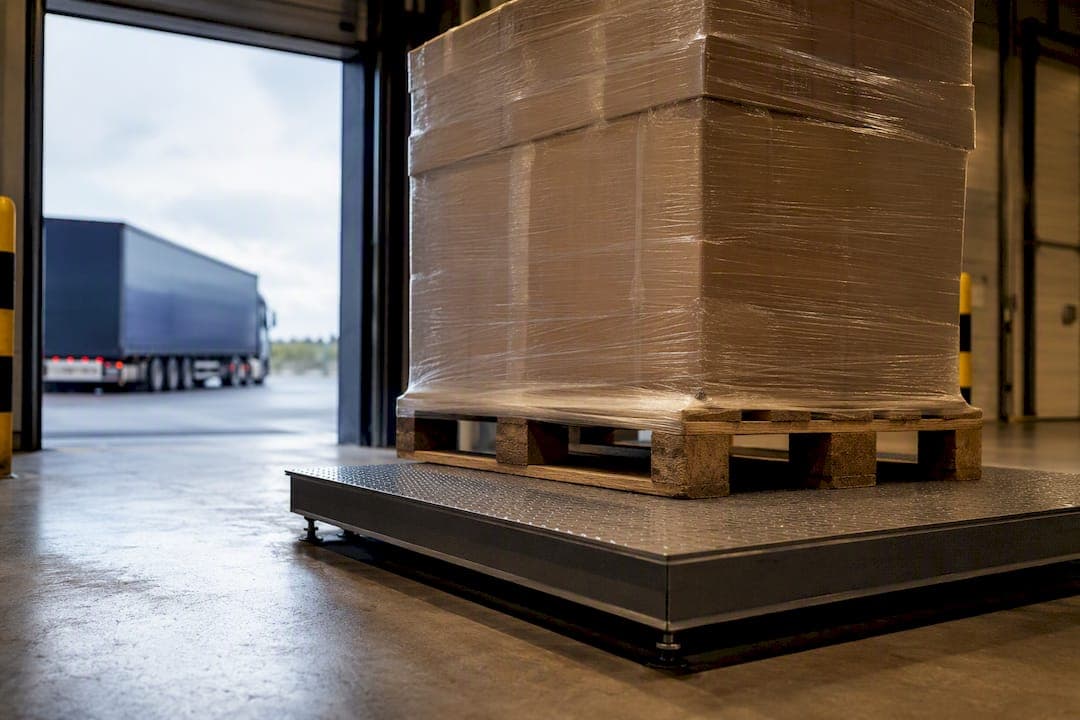
The headline figure most hauliers know is the £1,300 per tonne cap on gross weight, calculated against the weight of the goods rather than their declared value. If a pallet weighing 0.8 tonnes is damaged in transit, the carrier's exposure under the Conditions is capped at roughly £1,040, regardless of what the goods were actually worth to the customer.
That cap covers direct physical loss or damage to the goods. It does not extend to consequential losses, things like lost production time, missed contracts, or reputational damage the customer suffers because a delivery went wrong. Those losses sit outside the Conditions entirely unless a separate agreement says otherwise.
Two scenarios show the gap clearly:
- A pallet of electronics worth £8,000 damaged in transit: liability capped near the per‑tonne limit, not the retail value.
- A late delivery causing a customer to lose a retail contract: consequential loss, generally excluded from the carrier's liability under the Conditions.
Pro Tip: Always state the gross weight of goods on the job sheet before departure. If a claim arises, the weight figure is what determines your maximum exposure, and disputing it after the fact rarely goes well for either side.
Customer duties on loading, unloading and site access
The 2024 and 2026 editions push considerably more responsibility onto the customer than earlier versions did. Condition 4 now spells out obligations that used to sit in a grey area, and the effect is a meaningful shift in operational risk.
- Loading and unloading: customers are responsible for providing safe, suitable equipment and competent operators unless the carrier has expressly agreed to take this on.
- Site access: carriers gain clearer grounds to refuse entry to sites that present obvious safety hazards, and can reasonably request a risk assessment before committing a vehicle.
- Indemnity wording: if a customer's own equipment or staff cause loss or injury during loading, the indemnity clauses in the 2024/2026 wording generally shift that cost back to the customer rather than leaving the carrier to absorb it.
This matters most at the quote stage. A haulier who accepts a job without querying site conditions has effectively waived the protection these updated clauses were designed to give.
Claims: notification deadlines and evidence you need
The Conditions set a strict seven‑day window for customers to notify a claim in writing, and the 2024/2026 editions go further by requiring supporting evidence alongside that notice, not just a bare assertion of loss. Miss the deadline, or fail to produce evidence, and the claim is generally barred outright.
For carriers, that deadline cuts both ways. It protects you from stale claims arriving months later, but it also means you need your own evidence ready the moment something goes wrong, because a customer who moves quickly and produces a solid case puts you on the back foot fast.
- Retain the proof of delivery, signed and timestamped, for every job
- Photograph the load at collection and again at delivery
- Keep weighbridge tickets where gross weight is relevant to a liability calculation
- Note down witness details immediately if there's a dispute over how damage occurred
Pro Tip: Never apologise in writing to a customer after a damage report without first checking the load photos. A well‑meant "sorry for the trouble" email has been read back as an admission of liability in disputes before.
How to build the Conditions into your contracts properly
Incorporation is where most disputes actually start, not the liability cap itself. Legal briefings on the 2024 changes are consistent on this point: membership alone does not make the Conditions apply. They have to be brought to the customer's attention and accepted, ideally in writing, before or at the point the contract is formed.
- Add an express clause to every written quote stating that work is carried out subject to the RHA Conditions of Carriage, current edition.
- Get customer signoff, even a simple email acknowledgement, confirming they've seen and accepted the terms.
- Publish the Conditions on your website and reference the page in booking confirmations, so there's a documented trail.
- Where a customer proposes their own bespoke terms, treat that as a red flag. Any variation from the RHA Conditions needs to be in writing and signed by both sides, never assumed.
Build this into job intake as a fixed step, not an afterthought. A dispatcher who forgets to reference the Conditions on a rushed booking has quietly given away the protection the terms were meant to provide.
Insurance and risk management alongside the conditions
The Conditions limit what a carrier can be made to pay. They do nothing to compensate the customer for the difference between that capped figure and the real value of their goods. That gap is why industry briefings consistently advise customers to hold their own goods‑in‑transit insurance, rather than relying on the haulier's liability cover to make them whole.
Carriers should treat any move to updated wording as a reason to speak to their broker, since changes in the 2024 Conditions can affect how existing cover responds.
Practical steps worth building into your process:
- Ask customers directly at booking whether goods are insured, and note the answer
- Photograph loads and retain PODs as standard, not just when something looks risky
- Check site access details before the vehicle is committed
- Review your own regulatory compliance position whenever you update your terms
A simple line in your booking form, "Please confirm whether the goods being transported are covered by transit insurance," costs nothing to add and removes a common point of dispute later.
Key definitions that decide how a dispute plays out
Several terms in the Conditions do far more legal work than their plain-English meaning suggests, and misreading them is a common source of disputes.
"Carrier" refers specifically to the RHA member operating under the Conditions, not any subcontractor they might use without disclosure. "Customer" covers whoever contracted the carriage, which is not always the same party as the consignee receiving the goods, a distinction that matters when working out who has standing to claim.
"Consequential loss" is the term that excludes the widest range of customer claims. It covers losses that flow indirectly from a delay or damage, lost sales, penalty clauses in the customer's own contracts, reputational harm, rather than the physical cost of the goods themselves. This is deliberately drawn wide to keep a carrier's exposure predictable.
"Gross weight" is the figure the £1,300 per tonne cap is actually calculated against, including packaging and pallet weight, not just the net product weight. Get this wrong on a job sheet and you've misjudged your own maximum exposure before a dispute even starts.
"Force majeure" and related exclusion wording cover events genuinely outside the carrier's control, weather, strikes, unforeseeable road closures, but these clauses are narrower than many operators assume. A vehicle breakdown from poor maintenance, for instance, will not typically qualify.
"Written notice" for claims means exactly that: a letter or email, not a phone call or a verbal complaint at the point of delivery. Carriers who accept verbal complaints as satisfying the notification requirement are giving away a defence they didn't need to give away.
How the RHA conditions sit alongside CMR and other freight terms
Domestic road haulage within the UK sits under the RHA Conditions when incorporated. International road carriage, however, is generally governed by the CMR Convention, a separate international framework with its own liability limits calculated differently, typically by weight in Special Drawing Rights rather than sterling per tonne. A haulier running mixed domestic and international work needs to know which regime applies to which leg of a journey, because the two are not interchangeable.
British Standards, where relevant to specific cargo types like hazardous goods handling or vehicle safety equipment, sit alongside the Conditions rather than replacing them. Meeting a British Standard for load restraint, for example, does not itself determine liability. It's evidence of due diligence that can support a defence, but the RHA Conditions still govern the contractual liability question.
International sea carriage conventions, the Hague, Hamburg, and Rotterdam Rules among them, offer a useful comparative reference point for understanding how liability periods and carrier responsibility are handled elsewhere. They have no direct application to UK domestic road haulage, though. A haulier quoting on a multimodal job involving a sea leg needs to be clear with the customer about where RHA terms end and a different convention takes over, since customers frequently assume one set of terms covers the whole journey when it doesn't.
The practical takeaway: know your leg, know your regime, and never let a customer assume blanket coverage across a multimodal movement.
Handling exceptions, loss and damage under RHA terms
When something goes wrong, the sequence you follow in the first 24 hours often decides how a claim resolves. The moment damage or loss is identified, note it on the delivery paperwork before the customer signs, or record a clean signature with a separate written follow‑up if the damage only becomes apparent after unloading.
Photograph everything: the state of packaging, any visible damage, and the site conditions if those are relevant to how the incident occurred. Where a load has been damaged during customer-side unloading under the expanded Condition 4 duties, that evidence is what determines whether the indemnity shifts back to the customer.

Exceptional events, vehicle breakdown, adverse weather, third‑party accidents, need to be logged with timestamps and, where possible, independent corroboration such as breakdown recovery paperwork or police incident numbers. A carrier that can produce a clean evidential trail within the seven‑day claims window is in a fundamentally stronger position than one relying on memory and goodwill weeks later.
Where a dispute escalates, resist the urge to settle informally out of a desire to keep the customer relationship smooth. An informal payment or discount offered without reference to the liability cap can be read later as an acceptance of a higher liability figure than the Conditions actually require. Route every settlement discussion through the lens of what the Conditions say you owe, not what feels diplomatically easiest in the moment.
Legal enforceability and where disputes actually arise
Courts generally uphold the RHA Conditions as enforceable commercial terms, provided incorporation is properly evidenced. The recurring problem is not the Conditions themselves; it's proving they were actually agreed. Disputes frequently turn on whether the customer was given clear, express notice of the terms, or whether a consistent pattern of prior dealings meant the customer should reasonably have known the terms applied.
A carrier who has quoted "subject to RHA Conditions of Carriage" on every invoice for two years has a strong evidential position even without a signed contract for a specific job. A carrier who has never mentioned the Conditions before, then tries to rely on them the moment something goes wrong, is on far shakier ground.
Another common dispute point involves bespoke rider clauses customers try to attach to a booking, additional guarantees, extended liability, or specific delivery windows, without formally varying the RHA terms in writing. If a driver verbally agrees to something at the point of collection that contradicts the standard Conditions, that verbal variation can undermine the carrier's ability to rely on the cap later. The written, signed variation requirement exists precisely to prevent this kind of informal erosion.
Genuine legal risk also sits with unauthorised use. A non‑member using the Conditions without a licence isn't just exposed to a copyright claim; a court may also question whether they had any legitimate basis to rely on terms they weren't entitled to use in the first place, weakening their liability defence at the worst possible moment.
Updates and changes: what moved between 2020, 2024 and 2026
The 2024 edition marked the most significant rewrite in recent years, expanding customer obligations under Condition 4 around loading, unloading and equipment provision, and tightening Condition 14's claims evidence requirements well beyond the simpler wording of the 2020 version. The seven‑day notification rule existed previously, but the explicit demand for supporting evidence alongside that notice was strengthened in 2024, closing a gap that had allowed weaker claims to proceed on notice alone.
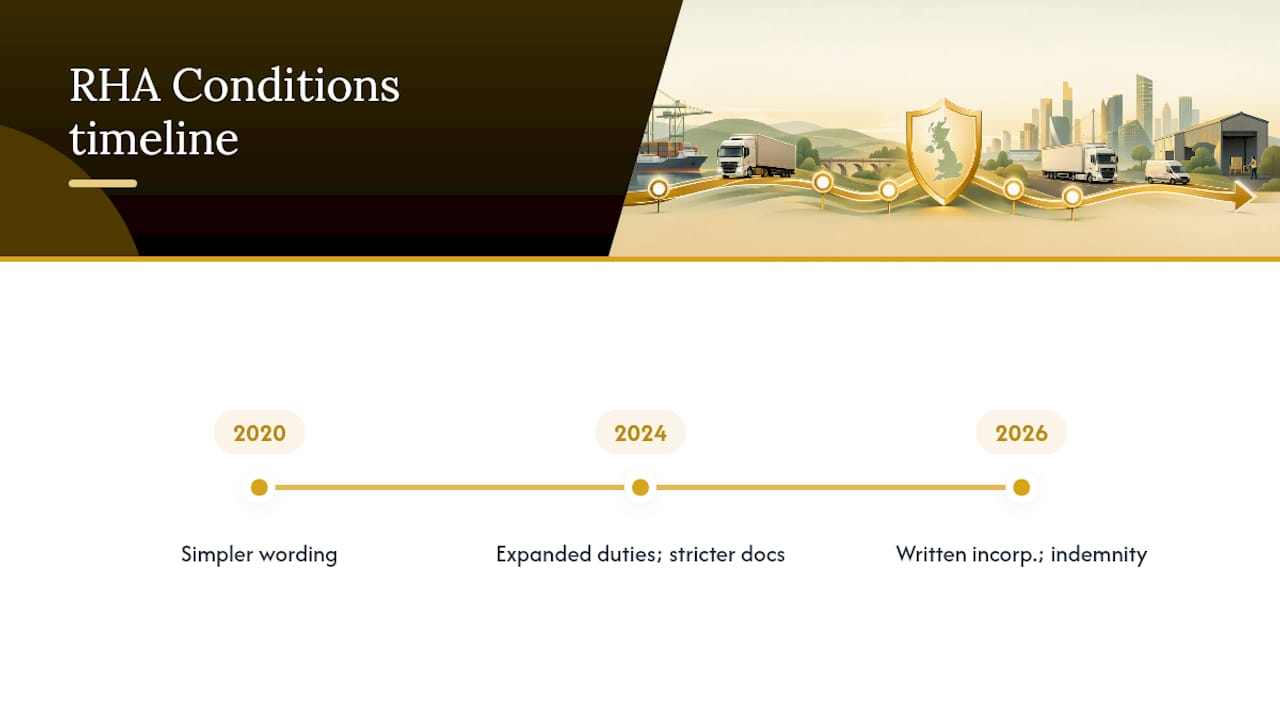
The edition effective from 1 January 2026 builds on that direction rather than reversing it. It reiterates the requirement for written incorporation, sharpens the indemnity wording around loading and unloading safety obligations, and states more plainly that customers may not be entitled to full compensation in every circumstance, closing off an ambiguity some customers had previously tried to exploit in negotiations.
For hauliers still running on 2020 wording, the practical gap is real. Older contracts may not carry the expanded customer duties or the strengthened evidence requirements, meaning a carrier relying on outdated terms could find themselves with less protection than a competitor who updated their paperwork. Reviewing which edition sits behind every active contract, and refreshing that reference at renewal, is not a formality. It is the difference between a cap that actually holds up and one a sharp customer's solicitor picks apart.
Applying the conditions on the road, not just on paper
Reading the Conditions is one thing. Getting every dispatcher, driver, and account handler to actually reference them at the point of booking is another entirely, and that gap is where most of the protection quietly leaks away. The strongest operators build a habit around it: quote with the Conditions named explicitly, brief drivers to photograph every load, and treat proof of delivery as a legal document rather than a formality. None of this is complicated. It just has to happen every time, not most of the time.
— Ayomide
Compliant haulage capacity that backs up your RHA terms
Referencing the RHA Conditions in a quote only works if the job itself is run in a way that produces the evidence those terms rely on: clean PODs, photographed loads, and drivers briefed on site access checks before wheels turn. Sddbyaba runs freight haulage across a fleet from small vans through to 26 tonne trucks, with operational practices built around exactly this kind of documentation.

For consignments that fall within the weight bands most affected by the per‑tonne liability cap, our 12 tonne transport service gives operators a fleet option matched to typical pallet and part-load freight, with drivers who capture the collection and delivery evidence that supports a claims defence under the Conditions. Whether you need a one-off movement or a recurring haulage arrangement, get a quote from Sddbyaba and specify your incorporation and evidence requirements at the booking stage.
Sources
The RHA's own Conditions of Carriage notice is the starting point for any operator confirming membership status and current wording. For a detailed breakdown of the 2024 changes, Hill Dickinson's legal update and HFW's briefing on current risks and practices both cover the customer duty and insurance implications in practical detail. Operators wanting to compare wording across editions can also review the 2026 Conditions document published by AGI Global Logistics.
None of this replaces proper legal advice. Where a specific contract, dispute, or bespoke clause is at stake, speak to a solicitor with experience in transport and logistics law before relying on any general summary, including this one.
This article is general information, not a substitute for advice from a qualified lawyer. Consult a qualified legal professional about your own circumstances before acting on anything here.
- RHA Conditions of Carriage
- Road Haulage Association’s Conditions of Carriage for 2024: an update
- RHA Conditions of Carriage 2024 – Update reflecting current risks and practices