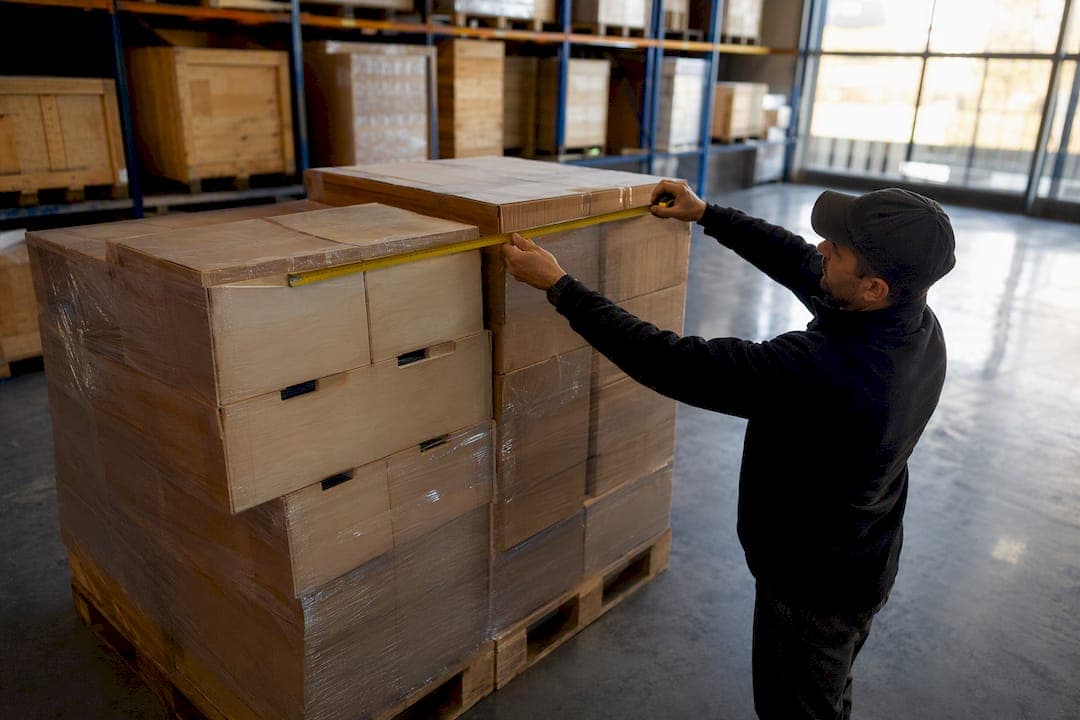
Most UK carriers accept a full pallet loaded up to a typical maximum height used in the industry, with lower standard heights for half and quarter pallets. Those figures cover transport acceptance only. Warehouse stacking safety under HSE guidance and export compliance under ISPM15 apply separate, often stricter, requirements before a pallet ever reaches the road.
TL;DR:
- Carrier acceptance standards are based on height and weight but do not guarantee warehouse stacking safety, which depends on risk assessments.
- Overheight pallets often face surcharges, repack requirements, or need dedicated transport, especially if exceeding typical 2,200 mm trailer limits.
- Safe stacking relies on the pallet’s narrowest base dimension and manufacturer’s compression rating, not just carrier limits, to prevent collapse or instability.
- International shipments require ISPM15-treated wood pallets with the proper stamp; non-compliant packaging may be rejected or destroyed at borders.
- Proper pre-collection checks, including measuring height and confirming dimensions with the carrier, help avoid delays and costs associated with oversize freight.
Table of Contents
- Standard UK pallet footprints and the height bands carriers accept
- Transport limits and safe warehouse stacking are not the same thing
- What happens when a pallet exceeds carrier limits
- ISPM15 and wood packaging rules for cross-border pallets
- A practical checklist before your pallet is collected
- Industry-specific height expectations across sectors
- The real risks of stacking pallets too high
- Adjusting pallet height for different cargo and packaging
- How we handle over-height pallets
- Book specialist pallet transport with SDD by ABA
- Sources
Standard UK pallet footprints and the height bands carriers accept
The standard UK pallet footprint measures 1,200 × 1,000 mm, sized to fit most trailer floors and warehouse racking without wasted space. That base dimension underpins the three height categories carriers use to price and accept freight, as confirmed by industry guidance on UK pallet sizes.
The typical bands work like this:
- Full pallet: loaded height up to a commonly accepted maximum used by carriers, with gross weight limits varying by carrier and network.
- Half pallet: loaded height up to a medium height suited to lighter or lower-volume consignments.
- Quarter pallet: loaded height up to a smaller height often used for small parts, samples or retail top-ups.
- Light/mini variants: some networks offer reduced-weight versions of each band at lower rates, useful when volume rather than weight is the constraint.
These bands are commercial conventions repeated across UK pallet sizing guides, not statutory limits. A carrier will quote against them, but meeting them says nothing about whether that same pallet is safe to stack three-high in your own warehouse.
Transport limits and safe warehouse stacking are not the same thing
Carrier acceptance tells you what fits on a trailer. It tells you nothing about what is safe to stack on your own racking or warehouse floor, and treating the two as interchangeable is where most stacking incidents start.
HSE guidance under PUWER sets out the actual legal position, and it is deliberately not a single number. ISPM15 requires a site-specific risk assessment that accounts for the pallet manufacturer's compression rating, the load's centre of gravity, floor condition and racking design, according to HSE's stacking guidance. There is no statutory maximum height for pallets in the UK. Safe stacking depends on what the pallet and the load underneath it can actually bear.
There is no single statutory maximum height for pallets in the UK. Safe limits are a function of risk assessment, pallet integrity and packaging compression behaviour, and practitioners often use the shortest base dimension to judge how high a stack can safely go.
A common practitioner heuristic ties safe stack height to the pallet's narrowest base dimension rather than to whatever the carrier will accept in transit. A 2,200 mm load that travelled perfectly well on a trailer can still be unstable stacked two-high in a warehouse aisle with forklift traffic.
Pro Tip: Never assume a carrier's 2,200 mm acceptance doubles as a warehouse stacking approval. Run your own risk assessment before stacking, and check the pallet manufacturer's compression rating first.
What happens when a pallet exceeds carrier limits
Trailers commonly cap loaded height near 2,200 mm because of internal clearances, tail-lift reach and the practical limits of loading equipment at both ends of the journey, a point echoed in Amazon Freight's UK and EU shipping guidance. Go over that and your options narrow quickly.
- Surcharge or refusal: many networks apply an oversize surcharge, and some simply refuse the consignment at the depot.
- Repack requirement: you may be asked to lower the stack, remove dunnage or split the load before collection is rebooked.
- Slower turnaround: specialist bookings take longer to arrange than standard next-day pallet slots.
- Bespoke vehicle hire: taller or heavier consignments often need a dedicated vehicle rather than a shared pallet network run.
The practical fix is usually one of three moves: repack to bring the load under the standard band, split the consignment across two pallets, or book specialist haulage that is built for oversize freight from the outset.
ISPM15 and wood packaging rules for cross-border pallets
Any solid wood pallet moving internationally, including GB to EU freight, must be ISPM15-treated and carry the official stamp. Gov is unambiguous on this: non-compliant wood packaging can be rejected, retreated or destroyed at the border, and the cost lands with the exporter, not the carrier.
What this means in practice:
- Check the stamp on every wooden pallet before it leaves your site, not after a border rejection.
- Plastic pallets and pallets built entirely from processed wood (plywood, OSB) are exempt from ISPM15 marking.
- Repaired pallets need re-treatment if the repair introduces new untreated timber.
The UK pallet repair sector has expanded heat-treatment capacity since the transition period, with industry arrangements designed to keep compliant stock moving through the network, as outlined in Defra's wood packaging guidance. That capacity growth has made compliant pooled pallets easier to source than in the immediate aftermath of GB–EU border changes.
A practical checklist before your pallet is collected
Getting this wrong costs money and time, usually in that order. A short pre-collection check avoids both.
- Measure total loaded height, including any pallet collars, dunnage or protective caps. Carriers measure from floor to the highest point of the load, not the highest point of the goods alone.
- Record the narrowest base dimension if you are stacking multiple layers. That figure, not the overall footprint, usually sets the safe stacking limit.
- Wrap for vertical integrity. Shrink or stretch wrap combined with corner protection and proper strapping keeps a tall load from shifting under braking, cornering or acceleration during transit. Dynamic stresses during transport affect tall stacks more than static warehouse loads, so wrap accordingly.
- Check the manufacturer's compression rating on the pallet itself before assuming it can bear another layer.
- Update your paperwork. Declare the actual measured dimensions on the consignment note, not the dimensions you intended to load.
- Confirm with the carrier before collection day, particularly if the load is close to a band boundary.
- Book specialist transport if oversize. Supply exact height, weight, footprint and ISPM15 status at the point of booking, not on arrival.
A packaging workflow guide for UK operations is worth reviewing if your protective materials or wrapping process need tightening up before this becomes a recurring issue.
Pro Tip: Photograph the loaded pallet against a tape measure before it leaves your yard. If a carrier disputes the declared height later, you have proof of what actually left your premises.
Our own guide to UK pallet sizes and load limits breaks these bands down further if you need to check a specific carrier's tolerances before booking.
Industry-specific height expectations across sectors
Retail distribution tends to favour lower, wider stacks because pallets move through automated conveyor and mixed-case picking systems that have fixed clearance heights, often well under the 2,200 mm carrier maximum. A retail distribution centre that accepts taller pallets at goods-in still has to break them down before they reach conveyor height limits, so many retailers specify a lower delivery height in their supplier terms regardless of what the carrier would otherwise accept.
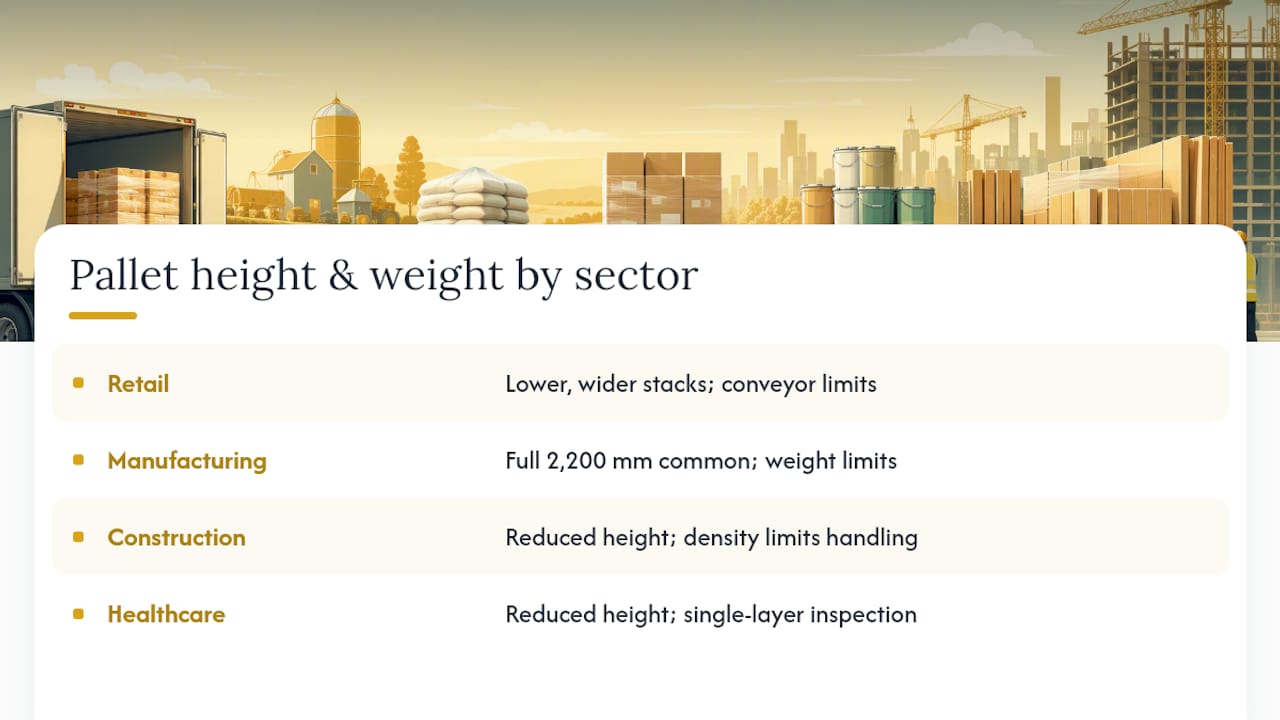
Manufacturing and industrial supply chains behave differently. Raw materials and finished components are often heavier and denser than retail stock, so the limiting factor is usually weight rather than height, and full-height 2,200 mm pallets are common where the goods themselves are compact and heavy, such as metal fixings or packaged chemicals.
Construction materials sit somewhere between the two. Palletised bricks, blocks and bagged aggregates are frequently shipped at reduced heights because their density makes a full 2,200 mm stack too heavy for standard handling equipment on site, even where the volume would technically fit.
Healthcare and medical logistics typically specify their own reduced height and stacking rules, driven less by carrier limits and more by the fragility of the goods and strict traceability requirements that favour single-layer, easily inspected pallets. Sector-specific supplier agreements often override the generic carrier bands entirely, so it pays to check your customer's own goods-in specification before assuming standard limits apply.
The real risks of stacking pallets too high
Exceeding a safe stacking height is not primarily a compliance problem. It is a physical one, and the consequences show up on the warehouse floor long before anyone checks the paperwork.
Overloaded or over-stacked pallets are prone to collapse under lateral forces, particularly from forklift contact, racking vibration or an uneven floor. A collapse at height turns a manageable load-shift into a falling-object hazard for anyone working nearby. HSE's guidance on stacking stability exists precisely because pallet collapse and falling loads remain a recurring cause of warehouse injury, and the fix is rarely a single fixed height limit but a proper assessment of the specific load, racking and floor combination in play.
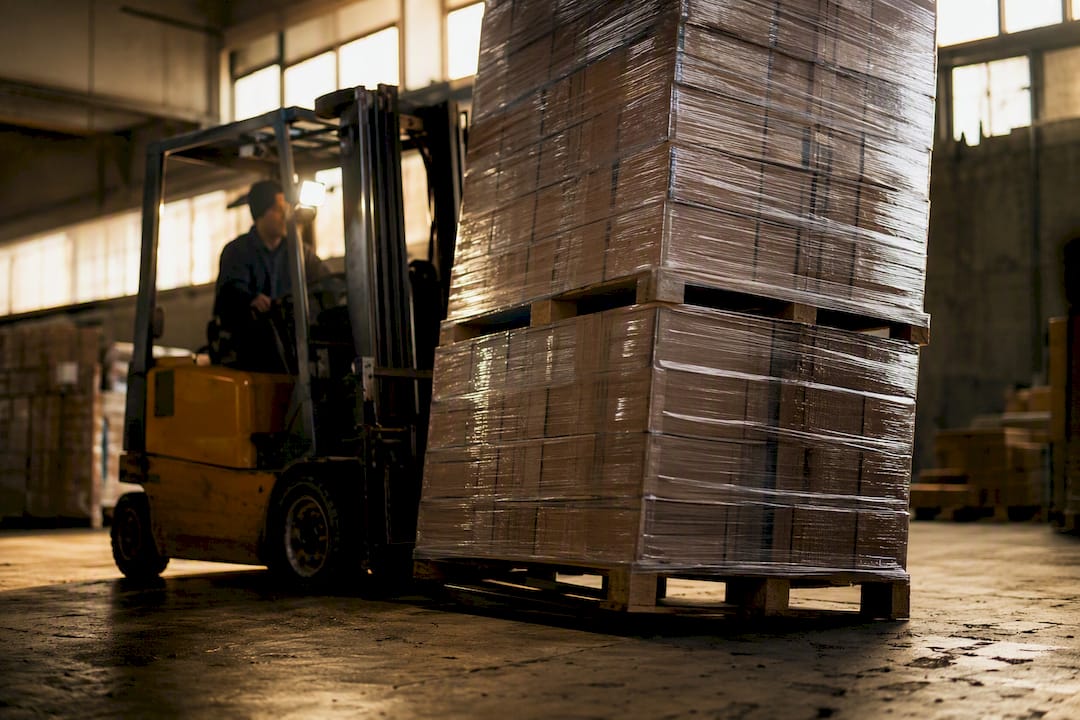
Risk mitigation starts with the basics: never exceed the pallet manufacturer's stated compression rating, always assess the narrowest base dimension before adding another layer, and keep stacked loads away from high-traffic forklift routes where lateral impact is most likely. Secure wrapping and strapping reduce the chance of shift during handling, but they do not substitute for a genuine risk assessment when the load, the racking or the flooring changes. Rotating stock so the heaviest, most stable pallets sit at the base of any stack also reduces the chance of a top-heavy collapse.
Training matters as much as equipment here. Forklift operators who understand why a particular stack has a lower limit than the trailer that delivered it are far less likely to override that limit under time pressure.
Adjusting pallet height for different cargo and packaging
A single height rule rarely survives contact with real cargo variety. Dense, rigid goods like bagged cement or boxed metal parts can often be stacked close to the standard 2,200 mm carrier maximum because the load barely compresses under its own weight. Lightweight, bulky or irregularly shaped cargo behaves very differently, and pushing it to the same height usually creates instability long before it reaches any weight limit.
Fragile or crushable packaging needs the opposite adjustment. Cartons of glassware, electronics or anything in blister packaging should be stacked lower than the carrier maximum, with weight distributed so the heaviest cartons sit at the base rather than the top. Pallet collars and rigid dunnage can help maintain a taller stack safely, but only when the manufacturer's compression rating for the pallet itself supports the additional layers.
Shrink-wrapped mixed pallets, common in retail replenishment, present their own adjustment: uneven case sizes create voids that let a stack lean during transit even if the total height sits within limits. Filling those gaps with void-fill or restocking to create a flatter top layer reduces shift risk considerably. The rule of thumb worth keeping in mind across all of this: match the height to the cargo's own stability characteristics, not to whatever the carrier's height band technically allows.
How we handle over-height pallets
SDD by ABA runs a fleet from small vans through to 26 tonne and artic trucks, which means an over-height or oversize pallet rarely needs to become a problem you solve alone. When a consignment sits close to a standard band boundary, we look at the actual measured dimensions, the destination and the ISPM15 status of any wooden packaging before deciding whether repacking or a dedicated vehicle makes more sense. Compliance comes first in that decision, not convenience. Our approach stays practical: get the right vehicle booked early, confirm dimensions before collection, and avoid the delays that come from discovering a problem at the depot.
— Ayomide
Book specialist pallet transport with SDD by ABA
When a pallet sits outside the standard 2,200 mm band, or you simply need a same-day slot without the wait, SDD by ABA gets it moving without the delay of a standard network booking. We run dedicated pallet delivery using vehicles from 7.5 tonne through to full artic and 26 tonne freight, so an oversize or heavy consignment gets matched to the right vehicle rather than bounced between depots.
To get an accurate quote, tell us the loaded height, weight, footprint and ISPM15 status of the pallet, along with the collection and delivery postcodes. That lets us confirm the right vehicle, whether that is a 7.5 tonne van-alternative or an 18 tonne haulage run, before you commit to a collection slot. Request an urgent quote through Sddbyaba and we will confirm availability the same day.
Sources
- Gov
- PM15: Stacking of goods on pallets and stability - HSE
- UK pallet sizes – what are they, and do they affect your packaging?