
Under The Road Vehicles (Authorised Weight) Regulations 1998, the maximum permitted weight for a single driving axle is set by regulation and is higher than for a single non-driving axle. A driving tandem axle group reaches a specified maximum where certain conditions are met, and a tri-axle group also has a defined authorised maximum weight. These are the statutory ceilings, but they are not the only limits that count.
The fundamental compliance rule: a vehicle is overloaded if it exceeds either its plated weight or the statutory maximum under the AWR or Construction and Use Regulations — whichever is lower. Both sets of limits apply simultaneously, and neither overrides the other.
Every fleet manager responsible for axle weight compliance in the UK must act on three things before the first commercial trip:
- Check the plate. Confirm the manufacturer plate and ministry plate figures for each axle and the gross vehicle weight.
- Verify axle spacing and suspension type. These two factors directly determine which statutory weight band applies.
- Weigh the loaded vehicle. A certified weighbridge or calibrated on-board system is the only reliable way to confirm compliance before departure.
The primary legislation governing HGV axle weights in the UK is the Road Vehicles (Authorised Weight) Regulations 1998 (AWR) and the Road Vehicles (Construction and Use) Regulations 1986 (C&U). Both remain operative, and operators must satisfy whichever set of limits applies to their specific vehicle configuration.
Key takeaways
UK axle weight limits require operators to satisfy both plated weights and statutory maxima simultaneously, with a single driving axle capped at 11,500 kg and a non-driving axle at 10,000 kg under the AWR.
| Point | Details |
|---|---|
| Statutory axle maxima | Single driving axle: 11,500 kg; single non-driving axle: 10,000 kg under the AWR. |
| Both limits apply | A vehicle must comply with plated weights and AWR/C&U statutory limits; the lower figure governs. |
| Spacing changes the limit | A tandem driving axle group at ≥ 1.3 m spacing reaches 19,000 kg; below 1.3 m, the limit drops to 18,000 kg. |
| Weigh before departure | Use a certified weighbridge or calibrated on-board system and retain the printout for every journey. |
| Sddbyaba fleet compliance | Sddbyaba vehicles from 7.5 tonne to artic are maintained within plated and statutory weight limits for compliant urgent movements. |
Table of Contents
- What are the standard HGV axle and gross weight limits?
- Which regulation applies: C&U or AWR, and when does each govern?
- How do wheel arrangement, tyre type and axle spacing affect permitted weights?
- What do manufacturer and ministry plates tell you, and what must you check?
- What conditions allow you to operate at higher gross or axle weights?
- When can you operate above statutory limits, and how do you get authorisation?
- How to calculate and check axle loads before every departure
- What are the penalties for axle overloading, and who is liable?
- Common operator errors that lead to axle overloads
- The compliance gap most operators underestimate
- Compliant haulage vehicles, ready when you need them
- Sources
What are the standard HGV axle and gross weight limits?
The table below covers the most common rigid, articulated and drawbar configurations. Figures are drawn from Gov and the simplified guide to lorry types and weights.
Notes on conditions for higher weights:
- The AWR figures in the table above apply where the vehicle meets road-friendly suspension requirements, correct axle spacing thresholds, and twin-tyre fitment where specified.
- A 2-axle rigid reaching 18,000 kg under AWR requires road-friendly suspension on the driving axle.
- Five and six-axle articulated vehicles operating at 44,000 kg require road-friendly suspension and, for the highest bands, a Euro II or better engine.
- Drawbar combinations at 44,000 kg require both road-friendly suspension and correct axle spacing.
For non-standard configurations, consult the statutory schedules directly rather than relying on summary tables. Download or print this table for depot reference, but treat it as a starting point, not a substitute for checking the actual regulations for your specific vehicle.
Which regulation applies: C&U or AWR, and when does each govern?
The short answer: for most modern HGVs operating in Great Britain, the Road Vehicles (Authorised Weight) Regulations 1998 is the operative instrument for determining gross and axle weight limits. The Construction and Use Regulations 1986 predates the AWR and was largely superseded by it when the UK aligned with EU directives on vehicle weights. However, C&U remains relevant for certain vehicles and configurations not covered by the AWR.
Both sets of regulations run in parallel. A vehicle must comply with whichever limits are applicable to its configuration under each instrument, and it must also stay within its plated weights. The practical effect is that the lowest of the three figures — AWR limit, C&U limit, and plated weight — is the binding ceiling for any given journey.
Practical rule: if your vehicle is covered by the AWR (most HGVs are), use the AWR table as your primary reference for gross and axle limits. Then cross-check against Regulation 78 of the C&U Regulations for wheel and axle-specific maxima, and always verify against the plate.
A worked flow for a fleet manager checking a 4-axle rigid:
- Step 1: Identify the vehicle type and axle count.
- Step 2: Check the ministry plate for the gross vehicle weight and individual axle weights.
- Step 3: Look up the AWR Schedule 3 table for the applicable gross and axle maxima.
- Step 4: Check axle spacing — does it qualify for the higher AWR band?
- Step 5: Confirm road-friendly suspension is fitted and documented.
- Step 6: The permitted maximum for that journey is the lowest figure from steps 2, 3 and 4.
Regulation 78 of the C&U Regulations contains the detailed wheel and axle weight table that maps specific tyre arrangements and spacing to permitted weights. This is the reference for axle-level limits where tyre configuration is a variable.
How do wheel arrangement, tyre type and axle spacing affect permitted weights?
Axle weight limits are not fixed numbers applied uniformly across all configurations. The statutory tables in Schedule 3 of the AWR and Regulation 78 of the C&U Regulations produce different legal maxima depending on three variables: whether the axle is driving or non-driving, the tyre arrangement, and the spacing between axles in a group.
Wheel and tyre criteria
Regulation 78 of the C&U Regulations sets specific maximum permitted weights for wheel and axle configurations, including lower limits for single tyres compared to twin tyres on driving axles, with higher weights permitted for twin-tyred axles under the Authorised Weight Regulations.
Spacing and worked examples
Axle spacing is the physical distance between the centrelines of adjacent axles in a group, measured in metres. The AWR uses spacing thresholds to determine which weight band applies.
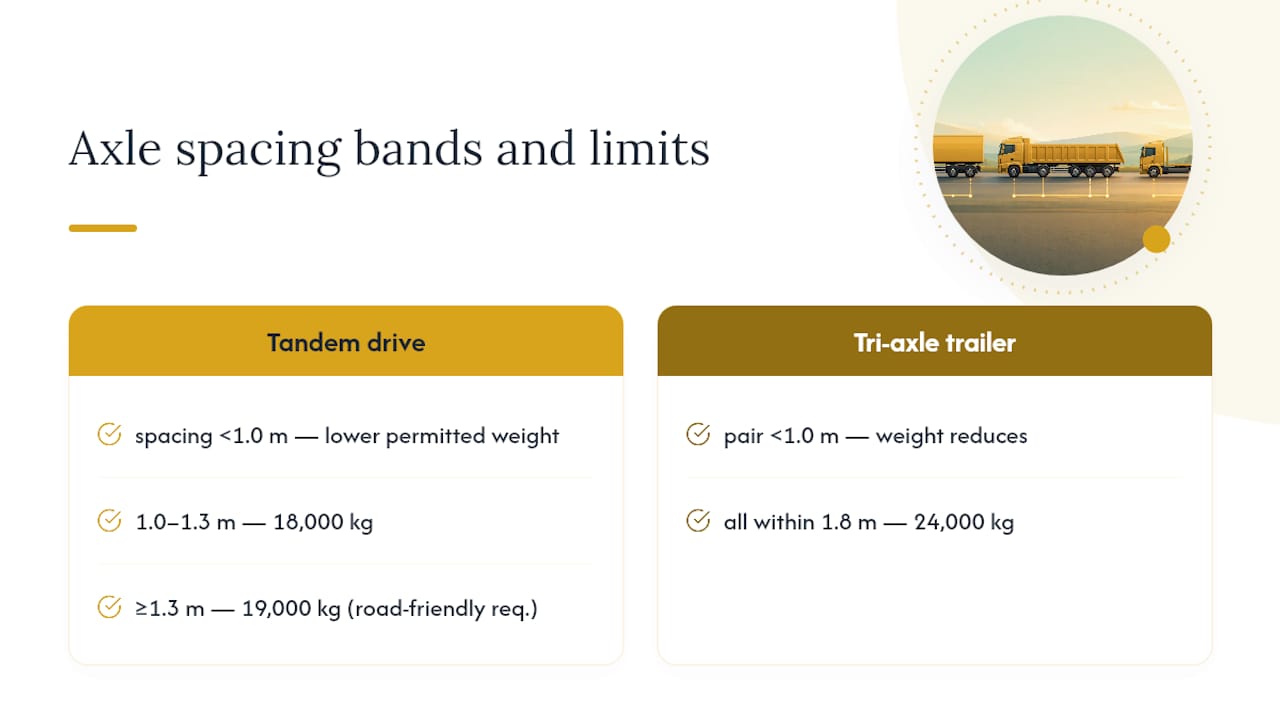
Example 1: A tandem drive axle group with spacing of 1.25 m falls in the 1.0–1.3 m band. The authorised maximum for that group is 18,000 kg, not 19,000 kg.
Example 2: The same tandem group with spacing increased to 1.35 m now qualifies for the ≥ 1.3 m band. The authorised maximum rises to 19,000 kg, provided road-friendly suspension is also fitted.
Example 3: A tri-axle trailer group with all three axles within 1.8 m of each other qualifies for the 24,000 kg tri-axle maximum. If the spacing between any two axles in the group falls below 1.0 m, the permitted weight reduces.
Pro Tip: Measure axle spacing with a steel tape from centreline to centreline of each axle, not from tyre edge to tyre edge. Record the measurement in the vehicle's fleet documentation alongside the suspension type and tyre specification. DVSA inspectors may ask for this data at the roadside, and having it pre-recorded removes ambiguity.
What do manufacturer and ministry plates tell you, and what must you check?
Every HGV operating in the UK carries two types of plate: the manufacturer plate and the ministry plate (also called the plating certificate or Department for Transport plate). Both are legally significant, and neither alone is sufficient for compliance.
The manufacturer plate is fixed by the vehicle builder and states the technical maximum weights the vehicle's structure and components can bear. It is typically found in the cab on the driver's side door pillar or on the chassis frame. The ministry plate is issued following a statutory goods vehicle test and reflects the weights at which the vehicle is authorised to operate. It is usually displayed in the cab and must be kept legible at all times.
The critical point: plated weights are technical maxima, not a standalone legal authorisation. A vehicle operating within its plated weights can still be overloaded if those plated figures exceed the statutory limits applicable to its configuration under the AWR or C&U Regulations. Both must be satisfied.
Practical checks every operator must carry out:
- Locate both plates on each vehicle in the fleet and confirm they are legible and undamaged.
- Record the axle-by-axle plated weights and the gross vehicle weight from the ministry plate.
- Compare plated axle weights against AWR/C&U statutory maxima for the vehicle's configuration — use the lower figure as the operational ceiling.
- Keep the plating certificate (form VTG6 or VTG7) in the vehicle at all times; DVSA officers may request it.
- Update records when a vehicle is re-plated following modification or a change in axle configuration.
A vehicle that has been modified — a body swap, a trailer re-axle, or a suspension change — may require re-plating before it can legally operate at its previous weights. Never assume the old plate still applies after a structural change.
What conditions allow you to operate at higher gross or axle weights?
Accessing the higher weight bands in the AWR is not automatic. Specific technical conditions must be met and, critically, must be documented. Fleet managers who cannot demonstrate compliance with these conditions at the roadside cannot claim the higher limit.
Road-friendly suspension
Road-friendly suspension is the most common gateway to higher gross weights. To qualify, the suspension system must meet the technical definition set out in the AWR: typically, an air suspension system or one recognised as equivalent. The suspension must be fitted to the relevant driving axle or axle group, and its presence must be verifiable from the vehicle's specification sheet or maintenance records.
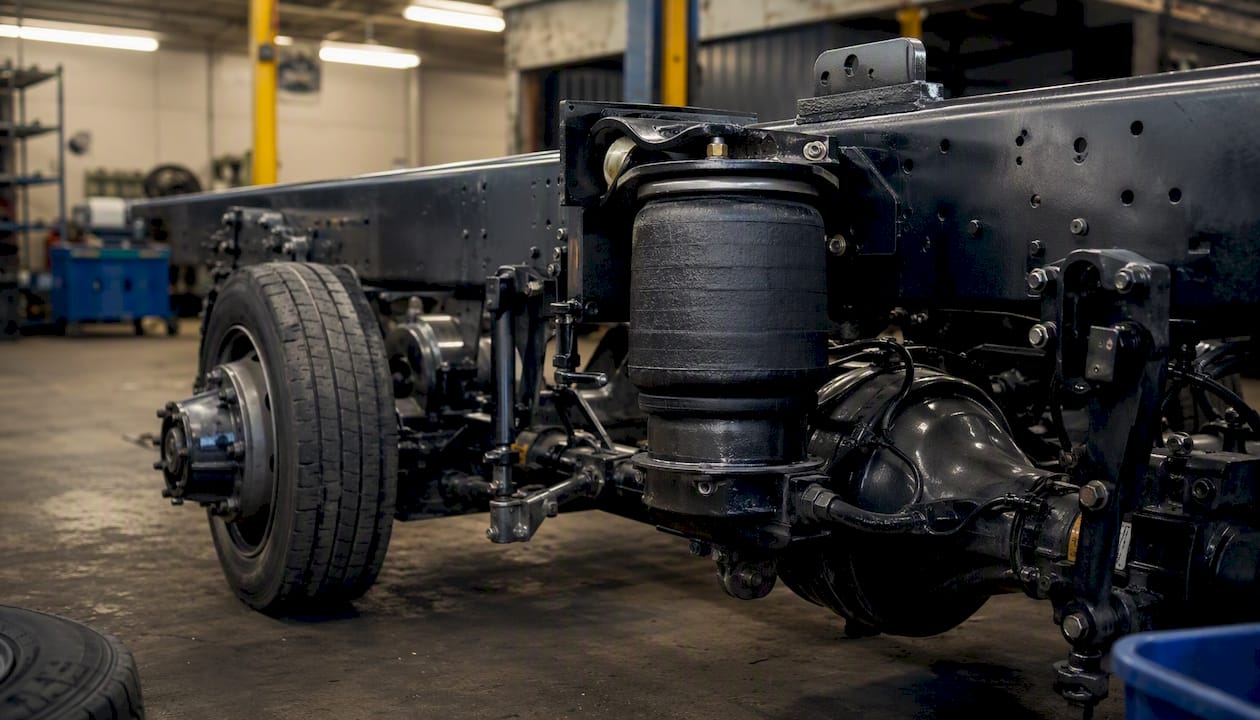
Maintenance records and fleet specification sheets should document the suspension type for every vehicle. This is not a one-time check; if a suspension component is replaced, confirm the replacement meets the road-friendly standard before operating at the higher weight band.
Twin tyres and per-axle conditions
Fitting twin tyres to a driving axle raises the permitted axle weight from 10,500 kg to 11,500 kg. This is a straightforward technical condition, but tyre ratings must also support the load. A tyre's load index must be sufficient for the weight it is carrying; fitting twin tyres that are under-rated for the axle load does not satisfy the condition.
Engine emission class for the highest weight bands
For articulated vehicles seeking to operate at 44,000 kg under the AWR, the engine must meet at least Euro II emission standards. This condition applies specifically to the highest gross weight bands and is checked against the vehicle's type approval documentation.
Technical checklist for higher-weight certification
- Confirm road-friendly suspension is fitted to the relevant axle(s) and record the suspension type in fleet documentation.
- Verify twin tyres are fitted where required and that tyre load indices are sufficient for the planned axle weights.
- Check axle spacing meets the threshold for the target weight band (≥ 1.3 m for a 19,000 kg tandem driving axle).
- Confirm engine emission class from type approval documents where operating at the highest gross weight bands.
- For zero-emission or alternatively fuelled vehicles, check whether increased weight limits for qualifying vehicles apply to your configuration.
- Retain all supporting documentation on the vehicle and at the operating centre.
When can you operate above statutory limits, and how do you get authorisation?
Statutory axle and gross weight limits apply to the vast majority of commercial vehicle movements. Exceeding them is an offence unless the vehicle is carrying an abnormal indivisible load (AIL) under a specific authorisation.
An abnormal indivisible load is a load that cannot, without undue expense or risk of damage, be divided into two or more loads, and which by reason of its dimensions or weight cannot be carried within the standard statutory limits. Common triggers for an AIL permit include a gross train weight above 44,000 kg, a single axle weight exceeding the statutory maximum for that axle type, or overall dimensions that exceed standard limits.
How to apply for an AIL authorisation
- Classify the move. Determine whether the load falls under a standard abnormal load notification or requires a Special Types General Order (STGO) category.
- Conduct a route survey. Assess bridge weight restrictions, road widths, overhead obstructions and any local authority restrictions on the planned route.
- Prepare vehicle specification evidence. Gather axle weight calculations, vehicle dimensions, and suspension and tyre documentation.
- Notify the relevant authorities. For most STGO moves, notify the police, highway authorities and any infrastructure owners (such as Network Rail where a level crossing is involved) at least two days in advance; for heavier or wider loads, longer notice periods apply.
- Apply for a movement order where the load exceeds STGO category limits. The Driver and Vehicle Licensing Agency (DVLA) and the relevant traffic commissioner's office are the starting points for formal applications.
- Appoint an escort where required by the authorisation conditions.
Key points to confirm before any AIL movement:
- The route has been physically surveyed, not just checked on a map.
- All required notifications have been sent and acknowledgements received.
- The vehicle and trailer specification matches the authorisation conditions exactly.
How to calculate and check axle loads before every departure
Checking axle loads is a procedural discipline, not a one-off exercise. The following steps form the basis of a reliable depot-level process.
- Check plated weights. Before loading, confirm the ministry plate figures for each axle and the gross vehicle weight. These are the upper bounds for loading.
- Measure axle spacing. For tandem and tri-axle groups, record the spacing and confirm which AWR weight band applies.
- Load the vehicle. Distribute the load according to the planned load plan, placing heavier items over or between axles to balance the distribution.
- Weigh on a certified weighbridge. Drive the loaded vehicle onto a certified weighbridge and obtain an axle-by-axle printout. Compare each axle reading against the plated weight and the statutory maximum for that axle type.
- Check the gross vehicle weight. Confirm the total does not exceed the plated gross weight or the AWR gross maximum for the vehicle's configuration.
- Adjust if necessary. If any axle is over its limit, redistribute the load before departure. Do not depart overloaded and plan to adjust en route.
- Retain the weighbridge ticket. Keep the printout with the vehicle documentation for that journey. It is evidence of compliance at the point of departure.
Tools available to fleet managers:
- Certified weighbridges: use the GOV.UK weighbridge finder to locate public weighbridges near your depot or route.
- On-board weighing systems: electronic load cells fitted to the vehicle provide real-time axle weight data and are particularly useful for repeat routes with variable loads.
- Portable axle pads: useful for spot checks at loading bays where a fixed weighbridge is not available; confirm the pads are calibrated and certified.
Pro Tip: For repeat routes with consistent cargo types, create a load plan template that specifies pallet positions and maximum weights per position. Laminate it and fix it to the loading bay wall. Drivers and loaders can then follow it without recalculating from scratch each time, and any deviation from the template triggers a mandatory weighbridge check.
Frequency of checks: weigh every load on a new route or with a new cargo type. For established routes with consistent loads, a weekly weighbridge check combined with daily on-board scale readings is a practical minimum.
What are the penalties for axle overloading, and who is liable?
Overloading an axle is a criminal offence in the UK. The offences are distinct: a vehicle can be prosecuted for exceeding an individual axle weight, the gross vehicle weight, the train weight (for articulated combinations), or the plated weight. Each is a separate charge, and a single overloaded journey can attract multiple offences simultaneously.
Penalties and enforcement outcomes include:
- Fixed penalty notices issued at the roadside by DVSA enforcement officers or the police.
- Graduated fixed penalties based on the degree of overloading, with higher fines for more serious exceedances.
- Vehicle prohibition notices requiring the vehicle to be off-loaded before it can continue its journey.
- Prosecution and unlimited fines in the magistrates' court for serious or repeat offences.
- Operator licence review by the traffic commissioner, which can result in curtailment, suspension or revocation of the operator's licence.
Both the driver and the operator can be liable. The driver is responsible for the vehicle's condition at the point of departure; the operator is responsible for the systems, training and supervision that should prevent overloading. An operator who cannot demonstrate that adequate procedures were in place faces greater regulatory risk, regardless of whether the driver acted independently.
Enforcement reality: DVSA officers use portable weighing equipment at roadside checks and can weigh individual axles without requiring the vehicle to attend a weighbridge. A vehicle found overloaded at the roadside may be prohibited from continuing until the load is redistributed or removed, causing significant delay and cost. Proper pre-departure weighing is far less expensive than a prohibition notice and a traffic commissioner inquiry.
Proper documentation — weighbridge tickets, load plans, driver training records — is the primary defence against operator liability. It demonstrates that the operator took reasonable steps to prevent the offence, which is a material factor in any traffic commissioner hearing.
Common operator errors that lead to axle overloads
Most axle overloads in practice are not the result of deliberate non-compliance. They stem from a small number of recurring procedural failures.
Frequent mistakes:
- Assuming plated weight is the legal ceiling. The plate shows the technical maximum, not the statutory authorisation. A vehicle can be within its plated weight and still exceed the AWR limit for its configuration.
- Overlooking axle spacing. Operators who know their gross weight is compliant sometimes miss that a tandem axle group's spacing puts it in a lower weight band than expected.
- Ignoring tyre load ratings. Fitting tyres without checking that their load index supports the planned axle weight is a compliance gap that is easy to overlook and difficult to defend.
- Poor load distribution. Concentrating heavy cargo at one end of the vehicle can push a single axle over its limit even when the gross weight is within bounds.
- Skipping weighbridge checks on familiar routes. Cargo density varies between consignments even when the product type is the same. A route that was compliant last week may not be this week.
Pre-load, at-load and post-load compliance checklist
Pre-load:
- Confirm ministry plate figures for each axle and gross vehicle weight.
- Verify axle spacing and record in fleet documentation.
- Confirm road-friendly suspension is fitted and documented.
- Check tyre load indices against planned axle weights.
At load:
- Follow the load plan; place heaviest items over or between axles.
- Do not exceed the plated weight for any individual axle during loading.
- Weigh on a certified weighbridge or calibrated on-board system before departure.
Post-load:
- Retain the weighbridge ticket or on-board scale printout with journey documentation.
- If any axle reading exceeds its limit, redistribute before departure.
- Record the final axle weights in the journey record.
Retain all weight check records for a minimum of 15 months. In the event of a traffic commissioner inquiry or prosecution, contemporaneous records are the most effective evidence of a compliant operating system.
The compliance gap most operators underestimate
Fleet managers who have worked in logistics for any length of time know the regulations exist. What they often underestimate is how quickly a technically compliant vehicle becomes non-compliant through small operational decisions made at the loading bay, not on the road.
The most common scenario: a driver accepts an additional pallet at the last minute because the customer needs it urgently. The gross weight stays within the plated limit. Nobody checks the axle distribution. The rear axle, already carrying the heaviest part of the load, tips over its statutory maximum. The vehicle departs, passes a DVSA check, and the operator faces a prohibition notice, a fine, and a traffic commissioner letter.
The regulations themselves are not the problem. The AWR and C&U Regulations are detailed, but they are also consistent and predictable once you understand the structure. The problem is the gap between knowing the rules and embedding them into daily loading practice. Mandatory weighbridge checks on the first run of the day, laminated load plans at every bay, and a standing instruction that no additional cargo is accepted without a weight check — these are not bureaucratic additions. They are the difference between a compliant fleet and an enforcement file.
Axle weight compliance is also a safety issue, not just a regulatory one. Overloaded axles reduce braking performance and steering response, particularly in emergency situations. The legal risk and the safety risk point in the same direction: weigh every load, every time.
Compliant haulage vehicles, ready when you need them
When a load needs to move urgently and compliance cannot be compromised, having access to correctly specified vehicles matters as much as having the right driver. Sddbyaba operates a fleet that spans 7.5 tonne delivery through to 26 tonne freight and artic truck transport, with each vehicle maintained to its plated specification and operated within statutory weight limits.
For fleet managers who need a compliant vehicle at short notice — whether that is an 18 tonne rigid for a time-critical consignment or an artic for a full-load movement — Sddbyaba's operations team can confirm vehicle specification, axle configuration and weight capacity before the booking is confirmed. No guesswork, no last-minute compliance questions at the loading bay.
Contact the Sddbyaba operations team to request a freight haulage quote or discuss vehicle specification for your next movement.
Sources
The following sources are the authoritative references for UK axle weight limits. Consult the statutory text directly for unusual vehicle configurations or non-standard axle arrangements.
- The Road Vehicles (Authorised Weight) Regulations 1998
- HGV maximum weights
- Simplified guide to lorry types and weights
For abnormal indivisible load movements, contact the relevant traffic commissioner's office and the DVSA for guidance on the applicable authorisation route. Where a movement requires a formal movement order, allow sufficient lead time for route survey, authority notification and permit processing before the planned departure date.