
The plan is simple to state and hard to skip: declare the incident, activate a named RACI structure, and protect critical inventory and manifests within the first hour, before anything else. Every logistics manager building an emergency logistics backup strategy should treat a Business Impact Analysis (BIA) and a defined recovery time objective (RTO) as the backbone of that plan, with the PPRR risk model (prevention, preparedness, response, recovery) giving structure to the response cycle. Where in-house capacity cannot flex fast enough, a dedicated haulage or same-day courier partner such as Sddbyaba becomes a practical lever, not a last resort.
Your activation trigger should be written down and agreed in advance, for example: "any service-impacting outage lasting more than two hours, or any safety-critical incident." Once triggered:
- Declare the incident formally and log the time.
- Activate the RACI structure, starting with the incident commander and ops lead.
- Protect critical inventory, manifests and telemetry data immediately.
This one paragraph should sit on the desk of the ops lead, head of transport and on-call dispatch, because they are the people who act on it first.
Key Takeaways
A workable emergency logistics backup strategy depends on a completed BIA, a named RACI, tested backups, and at least one pre-qualified rapid-response transport partner.
| Point | Details |
|---|---|
| Trigger the plan early | Define and agree the activation trigger before an incident, not during one. |
| Complete the BIA first | Prioritise recovery by RTO and RPO across the first 2, 24 and 72 hours. |
| Build supplier redundancy | Qualify at least two backup carriers per critical lane with pre-agreed rate caps. |
| Test quarterly | Run tabletop drills every quarter and a live failover test twice a year. |
| Use a rapid-response partner | Sddbyaba's dedicated courier and haulage services give a pre-qualified fallback for time-critical loads. |
Table of Contents
- What does an emergency logistics backup strategy actually cover?
- How do you run a risk assessment and BIA for logistics?
- What are the core mitigation strategies for logistics disruption?
- Who should communicate what during a logistics incident?
- What technology keeps logistics visible during an outage?
- How often should you test the plan?
- Which contract clauses protect supplier continuity?
- How do you build the plan in 30, 60 and 90 days?
- When should you call a same-day courier or dedicated haulage partner?
- Sddbyaba: your operational lever when the plan activates
- Frequently asked questions
- Sources
What does an emergency logistics backup strategy actually cover?
An emergency logistics backup strategy is the set of pre-agreed actions, resources and contacts that keep goods moving when a primary route, supplier, warehouse or system fails. It sits inside your wider disaster recovery strategy but focuses specifically on physical movement and the data that supports it.
Scope typically includes:
- Critical transport corridors and the SKUs that must keep flowing.
- Command and control: who decides, who communicates, who executes.
- Data and telemetry backups for routing, tracking and manifests.
- Supplier redundancy across haulage, warehousing and last-mile delivery.
This plan must integrate with your corporate business continuity plan (BCP) and security teams rather than operate as a standalone document, particularly where cyber incidents overlap with physical disruption.
How do you run a risk assessment and BIA for logistics?
Start with a risk register: list each risk, score its likelihood and impact on a simple 1 to 5 or low/medium/high scale, note a mitigation and assign an owner. Keep it in a shared spreadsheet, not a static document, so scores can be revisited after every drill or real incident.
The Seko Logistics guidance on disaster recovery recommends building this around a PPRR cycle, paired with a Business Impact Analysis that translates risk scores into recovery priorities. A single BIA row might look like this:
| Function | Critical assets | RTO | RPO | Immediate mitigation | Owner |
|---|---|---|---|---|---|
| Outbound dispatch | TMS, driver comms, live manifests | 2 hours | 1 to 2 hours | Switch to backup dispatch line, activate courier partner | Ops lead |
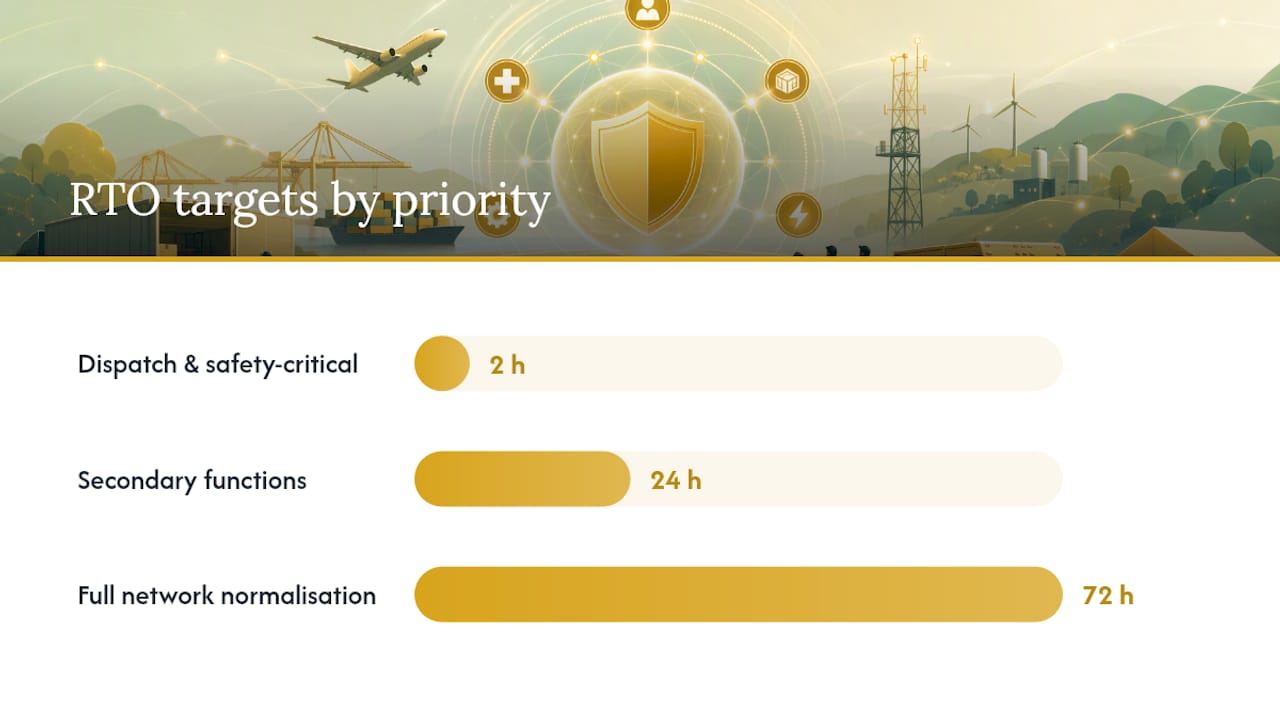
Use the BIA to build a prioritised recovery sequence: restore safety-critical and highest-revenue functions within 2 hours, secondary transport and warehousing within 24 hours, and full network normalisation within 72 hours.
What are the core mitigation strategies for logistics disruption?
Keystone Technology Consultants' guidance on disaster recovery points to redundancy, diversification and explicit RTOs as the backbone of resilience. Five tactics do most of the work:
- Redundant systems. Duplicate dispatch and telemetry platforms so a single outage never blinds the whole fleet. Owner: IT/operations.
- Supplier diversification. Qualify at least two backup carriers or hauliers per critical lane. Owner: procurement.
- Alternative transport modes. Pre-agree fallback routes and vehicle classes, from motorcycle couriers to 18-tonne trucks, for when the usual mode fails. Owner: transport planning.
- Backup warehousing. Hold a small buffer of critical SKUs at a secondary site or with a third-party store. Owner: inventory management.
- People and process resilience. Cross-train dispatch staff and document manual fallback procedures for when systems are down. Owner: operations manager.
Cost drivers vary sharply. Buffer stock carries ongoing holding costs; premium same-day haulage carries a per-job premium but no fixed overhead. Diversified suppliers cost little to set up but need periodic requalification to stay ready.
Pro Tip: Spend first on the mitigation that shortens your longest recovery gap, not the cheapest one. A £500 monthly retainer with a same-day courier often buys more availability per pound than a warehouse lease you use twice a year.
- Redundant systems reduce single points of failure.
- Diversified suppliers and alternative transport buy flexibility.
- Backup warehousing protects your highest-impact SKUs specifically.
Who should communicate what during a logistics incident?
Confusion kills response speed faster than the incident itself. A compact RACI keeps roles unambiguous:
| Role | Responsibility |
|---|---|
| Incident commander | Declares the incident, owns the overall decision |
| Ops lead | Executes the recovery sequence from the BIA |
| Dispatch | Reroutes vehicles, activates backup carriers |
| Customer liaison | Sends status updates to affected clients |
| IT/security | Restores systems, isolates any cyber threat |
Build a notification tree with primary and failover channels: phone first, SMS or encrypted chat as backup, public status page for wider updates.
- Internal message template: "Incident declared at [time]. [Function] affected. Backup activated. Next update in 30 minutes."
- Customer message template: "We're managing a service disruption affecting [route/service]. Deliveries are being rerouted. We'll update you by [time]."
A well-run dispatch centre makes this notification tree far easier to execute under pressure.
What technology keeps logistics visible during an outage?
Your minimum viable stack needs four elements: a backup dispatch or TMS instance, redundant GPS telemetry, encrypted cloud storage for manifests, and a verified daily backup routine. CyberFortress's guidance on logistics data protection notes that automated, verified backups for dispatch and warehouse systems cut downtime and protect the routing data you need to keep moving.
Cyber resilience does not need to be complicated. It needs to be owned:
- Multi-factor authentication on every dispatch and TMS login.
- Role-based access so a single compromised account cannot touch everything.
- Offline recovery documentation stored outside the primary network.
- Daily backups verified through an actual test restore, not just a completed job log.
Pro Tip: Test your backup by restoring it, not by checking that the job finished. A backup that has never been restored is a hope, not a plan. Where GPS or 4G fails entirely, fall back on SMS/GSM-based reporting so drivers stay trackable through basic mobile signal.
How often should you test the plan?
A plan that has never been drilled is a guess dressed up as a strategy. Run tabletop exercises quarterly, a live failover test twice a year, and a full-scale drill involving external suppliers annually.
After every exercise, complete a short after-action review:
- Scenario tested and objectives set beforehand.
- Outcome versus objective, stated plainly.
- What failed, and why.
- Actions assigned, with named owners and deadlines.
Track a small set of KPIs across drills: time to restore the critical route, percentage of manifests recovered intact, and number of successful vendor failovers. The Nature Communications research on emergency last-mile algorithms found that distributed routing and vehicle-to-vehicle coordination improved recovery timeliness in disaster simulations, reinforcing why decentralised decision-making, tested repeatedly, tends to outperform a single control point under pressure.
Which contract clauses protect supplier continuity?
Your approved-supplier list only works if the contracts behind it hold up under stress. Request these clauses when qualifying backup carriers or hauliers:
- Priority allocation during declared emergencies.
- Guaranteed capacity windows, stated in hours or vehicle count.
- Defined notification periods for activation and stand-down.
- Pre-agreed rate caps so emergency pricing does not spiral.
Vet backup suppliers on insurance, licensing and vehicle mix before you need them, not during the incident. Commercial levers like a short-term retainer, call-off agreement or volume guarantee buy you reserved capacity for peak periods without locking you into full-time overhead.
How do you build the plan in 30, 60 and 90 days?
| Milestone | Key tasks | Cost driver |
|---|---|---|
| Days 1 to 30 | Complete risk register and BIA, name RACI owners, secure first backup carrier | Staff time, low direct spend |
| Day 30 to 60 | Sign supplier contracts, set up backup dispatch/telemetry, run first tabletop drill | Contract retainers, tech setup |
| Day 61 to 90 | Run live failover drill, complete AAR, brief leadership on residual risk | Drill logistics, training time |
Quick wins in the first 30 days: finishing the risk register and naming a single incident commander cost almost nothing but remove the two biggest sources of delay in a real event. Dependencies matter here. You cannot meaningfully drill a supplier failover until the contract clauses from the previous section are signed.
When should you call a same-day courier or dedicated haulage partner?
Call a same-day courier or dedicated haulage partner when your time-to-customer threshold is measured in hours, the load is safety-critical or high-value, or your own fleet is already committed elsewhere. Check load size and any regulatory requirements before onboarding, then confirm the partner can receive a manifest securely and report ETA and proof of delivery digitally.
- Confirm time-to-customer threshold and item criticality first.
- Transmit manifests through an encrypted channel, never plain email.
- Confirm ETA and proof of delivery before closing the job.
Pro Tip: Pre-negotiate an emergency call-out slot or retainer with your dedicated courier partner before you need one. Sddbyaba's dedicated courier services are built for exactly this kind of on-demand activation.
Why does this plan actually matter on the ground?
I've watched teams avoid an SLA breach purely because a backup carrier was already contracted when the primary route failed during an IT outage. The paperwork is dull. The saved client relationship is not. Fewer missed deliveries and faster recovery are what actually earn the board's continued investment, not the plan document itself.

Sddbyaba: your operational lever when the plan activates
Most of this plan is about preparation, but the moment it activates, you need a transport partner who can move without a lengthy onboarding process. Sddbyaba gives logistics managers exactly that: a same-day courier and dedicated haulage service already set up to receive an emergency call-out and deploy the right vehicle, from a motorcycle courier to an 18-tonne truck, without you needing to qualify a new supplier mid-incident.

That matters because the alternative, sourcing an unfamiliar haulier under pressure, adds hours you don't have when your RTO is measured in minutes. Sddbyaba covers construction, retail, manufacturing, medical and commercial freight nationwide, with a fleet mix flexible enough to match load size and urgency on the same call. If your backup strategy currently has a gap where "call a supplier" should sit, get a quote from Sddbyaba's dedicated courier service now and slot it into your approved-supplier list before you need it.
Frequently asked questions
What is the difference between a disaster recovery strategy and a business continuity plan? A disaster recovery strategy focuses on restoring specific systems and operations, such as transport and data, after an incident. A business continuity plan (BCP) is broader, covering the whole organisation's ability to keep functioning, and the logistics plan should sit inside it.
How often should a risk register be updated? Review it after every drill and every real incident, and formally revisit it at least quarterly, since supplier lists, routes and system dependencies change faster than most teams expect.
What is a realistic RTO for critical logistics functions? It depends on the function, but many teams set outbound dispatch and safety-critical transport at 2 hours, secondary functions at 24 hours, and full network normalisation at 72 hours, based on BIA prioritisation.
Do small logistics operations need a formal BIA? Yes, though it can be a single spreadsheet rather than a lengthy document. Even a five-row BIA covering your most critical functions gives you a prioritised recovery sequence, which is the part most small teams skip.
Sources
- Emergency logistics last-mile algorithms and facility planning (Nature Communications, 2025)
- Creating a disaster recovery plan for logistics and supply chain operations (Seko Logistics)
- Logistics data protection & uptime (CyberFortress)
- Disaster recovery planning for logistics: are you prepared? (Keystone Technology Consultants)