If a critical delivery is at risk, the correct move is simple: trigger a 60-minute collection with a dedicated same-day courier and notify every stakeholder in parallel, not in sequence. Waiting to see if the problem resolves itself is the single biggest reason event logistics failures become visible event failures. Late equipment, missing AV kit and wrong deliveries are among the most common causes of a show falling apart in front of a client, and the operational backbone of any event is the logistics layer nobody sees when it works.
Here is what to do in the first five minutes:
- Assign an owner. One named person runs the recovery, not a committee.
- Lock transport immediately. Call a same-day courier and request a 60-minute collection before you finish confirming details.
- Confirm venue access. Check the dock booking, loading window and on-site contact before the vehicle arrives.
Before you make that call, collect the minimum facts a dispatcher needs: the exact item and quantity, size and weight, pickup address, delivery bay or entrance, and a mobile number for someone physically present at both ends. Every minute spent gathering this after the courier is already assigned is a minute added to your ETA.
Pro Tip: Ask for real-time tracking and a named driver contact from the first phone call. A dispatcher who can't confirm live visibility on a time-critical job is not the right one for this consignment.
Key Takeaways
Managing an urgent event delivery successfully depends on assigning a single owner immediately, matching the vehicle to the consignment, and booking a courier with a 60-minute collection SLA and real-time tracking.
| Point | Details |
|---|---|
| Act in the first five minutes | Assign an owner, lock transport, and confirm venue access before gathering every detail. |
| Match vehicle to consignment | Use motorcycle couriers for small items and artic trucks for full stand builds or pallets. |
| Set escalation triggers early | Agree fixed thresholds (t+15, t+30, t+60, t+90) before the event, not during a crisis. |
| Document everything | Photograph items before dispatch and record signed handover sheets for insurance purposes. |
| Choose a trusted same-day provider | Sddbyaba offers a 60-minute collection SLA, a fleet from motorcycles to 26 tonne artics, and real-time tracking for urgent event runs. |
Table of Contents
- How to manage urgent event logistics delivery in the first 60 to 120 minutes
- Who to coordinate and what each role must do
- Which transport option fits an urgent delivery
- How do you pack AV and exhibition kit for urgent transit?
- Managing delivery, set-up and derig on site
- What contingencies prevent one delay from derailing the event?
- What are realistic timelines and cost drivers for urgent runs?
- What to tell a same-day courier when booking under pressure
- How Sddbyaba handles urgent event logistics in practice
- When should you outsource versus solve it in-house?
- Book same-day delivery before the deadline closes in
- Frequently asked questions
- Sources
How to manage urgent event logistics delivery in the first 60 to 120 minutes
The first two hours decide whether this becomes a footnote or a headline. Work through this sequence in order, not simultaneously, because each step depends on the last one being confirmed.
- Assign an owner and a deputy. One person makes decisions; a second covers if the first goes into a meeting or loses signal.
- Confirm the exact kit list. Cross-check against the original packing manifest so nothing gets left behind on a rushed second trip.
- Photograph every item before it moves. This protects you later if there's a damage dispute or an insurance claim.
- Check packing standards. Fragile items need padding and secure closure even under time pressure, not despite it.
- Confirm venue dock rules. Loading bay hours, height restrictions and required paperwork vary by site and can stall a driver on arrival.
- Call the same-day courier and lock the booking. Get a confirmation number before you move to the next task.
Pro Tip: Label mission-critical kit differently from everything else. A single red tag on the item that absolutely must arrive first tells a driver and a marshal exactly what to prioritise if the van has to split loads.
Communication during this window needs to be short and specific, not conversational. Use templates like:
- "URGENT: [item] collecting from [address] at [time]. Confirm receipt."
- "Courier confirmed, ETA [time]. Dock contact is [name/number]. Please meet on arrival."
- "Delay flagged: revised ETA [time]. Escalating now, will update in 15 minutes."
Who to coordinate and what each role must do
Confusion over who signs for what is one of the fastest ways to lose ten minutes you don't have. Setting this out before the crisis, not during it, is what separates event teams that recover quickly from those that don't.
The core stakeholders in an urgent delivery are:
- Event manager — owns the overall decision and authorises spend on emergency transport.
- Production or AV lead — confirms the exact kit specification and technical requirements on arrival.
- Venue operations — controls dock access, loading windows and any site-specific restrictions.
- Courier or driver — executes the physical move and provides live location updates.
- On-site marshal — meets the vehicle, directs unloading and manages the handover.
- Client contact — needs visibility but should not be the one chasing logistics detail.
Responsibilities break down roughly like this:
- The event manager is accountable for the final call to outsource or manage in-house, and signs off on cost.
- The production lead is responsible for verifying the kit list matches what's needed on stage or stand.
- Venue operations must confirm dock access before the vehicle departs, not after it arrives.
- The marshal is responsible for the physical sign-off and photographic proof of handover.
- Escalation sits with the event manager, who should have a backup mobile number for every named contact on the list, plus an agreed on-site meeting point if phones fail.
Appointing a single point of contact for each function and keeping one live source of truth for the run-of-show avoids the classic problem of three people independently trying to solve the same delay.
Which transport option fits an urgent delivery
Matching the vehicle to the consignment saves time and money. Getting it wrong, either by under-booking a large stand build or over-booking a single flight case, wastes both.
- Motorcycle courier — best for small, urgent parcels: a spare cable, a replacement badge printer, a single hard drive.
- Small or medium van — right for a single kit run, one or two flight cases, or a technician's equipment bag.
- 7.5 tonne truck — suits palletised exhibition stands or multiple crates that won't fit in a van.
- Artic or 26 tonne vehicle — needed for full stand builds, large freight, or when several pallets are moving together.
When a technician needs to travel with the equipment, whether to babysit fragile AV kit or complete an on-site build, request an onboard or dedicated courier rather than a standard same-day van. This gets you a driver briefed specifically for your job, secure seating for the escort, and often white-glove handling for anything genuinely irreplaceable.
Whatever option you choose, ask for the same service level markers every time: a 60-minute collection SLA, a clear door-to-door ETA window, real-time tracking, and photographic proof of delivery. Real-time shipment visibility is what lets you spot a delay early enough to still fix it.
Pro Tip: If the item is worth more than the transport itself, whether financially or reputationally, the onboard courier option almost always pays for itself in reduced risk.
How do you pack AV and exhibition kit for urgent transit?
Rushed packing is where most transit damage happens, not on the road. A few extra minutes here prevents a much longer delay if something arrives broken.
Work through this before the van leaves:
- Label every case and group cables by function, not by size.
- Assign or confirm case IDs so nothing gets separated en route.
- Pad fragile items with whatever's available. Foam is ideal, but blankets and bubble wrap work under pressure.
- Secure loose parts inside cases so they can't shift during a fast, less-controlled load.
- Attach a handling note to anything that needs to travel upright or flat.
For weight distribution, keep heavier racks and flight cases low and central in the vehicle, and use restraint straps on anything that could shift under braking. Monitors and fragile props should never be stacked directly under heavier items, even for a short journey.
Before the vehicle departs, record two things: serial numbers of high-value items, and photographs showing a damage-free baseline. This single step resolves most disputes before they start.
- Photograph each case from two angles before loading.
- Note any existing scuffs or marks so they aren't blamed on this trip.
- Log serial numbers against your kit manifest.
Pro Tip: No proper crate available? Wrap the item in removal blankets and secure with ratchet straps against the van's internal rails. It's not elegant, but it holds far better than loose padding alone.
Given that technology failures are one of the most visible logistics problems at live events, packing spares for critical items, an extra HDMI lead, a backup mic, a spare laptop charger, is worth the extra case space.
Managing delivery, set-up and derig on site
Getting the vehicle to the venue is only half the job. What happens in the ten minutes after arrival determines whether the delivery counts as a success or opens a dispute later.
Run through this handover sequence:
- Confirm arrival time against the agreed dock booking.
- Direct the driver to the correct dock point, not the nearest entrance.
- Have the on-site contact meet the vehicle in person.
- Follow the venue's sign-off process before unloading begins.
- Photograph the handover, including the signed paperwork.
- Place equipment in its final position and run a basic power check before the driver leaves.
Some venues require staff assistance for ramps, goods lifts, or floor protection on delicate surfaces. Check this before the vehicle arrives, not after it's blocking a loading bay with nowhere to unload.
- Photograph the truck at the dock with a visible timestamp.
- Photograph the item in its final on-site position.
- Photograph the signed handover sheet itself.
Pro Tip: Time-stamped photos aren't just for insurance. They're the fastest way to settle a "where's my kit" question from a client three hours later.
Working backwards from the event's doors-open time, and sequencing high-risk installs earlier in the load-in window, avoids the pile-up of vehicles and crews that turns a simple handover into a queue.
What contingencies prevent one delay from derailing the event?
A single missed delivery shouldn't be able to sink an entire event, but it will if there's no backup plan already agreed before you need it.
Keep these options ready:
- An alternate vehicle or backup driver on standby for the same route.
- A local rental partner who can supply replacement kit at short notice.
- Loan monitors, mics or cables from a nearby vendor if the original kit is delayed beyond recovery.
- A small on-site spares cache for the items most likely to fail or go missing.
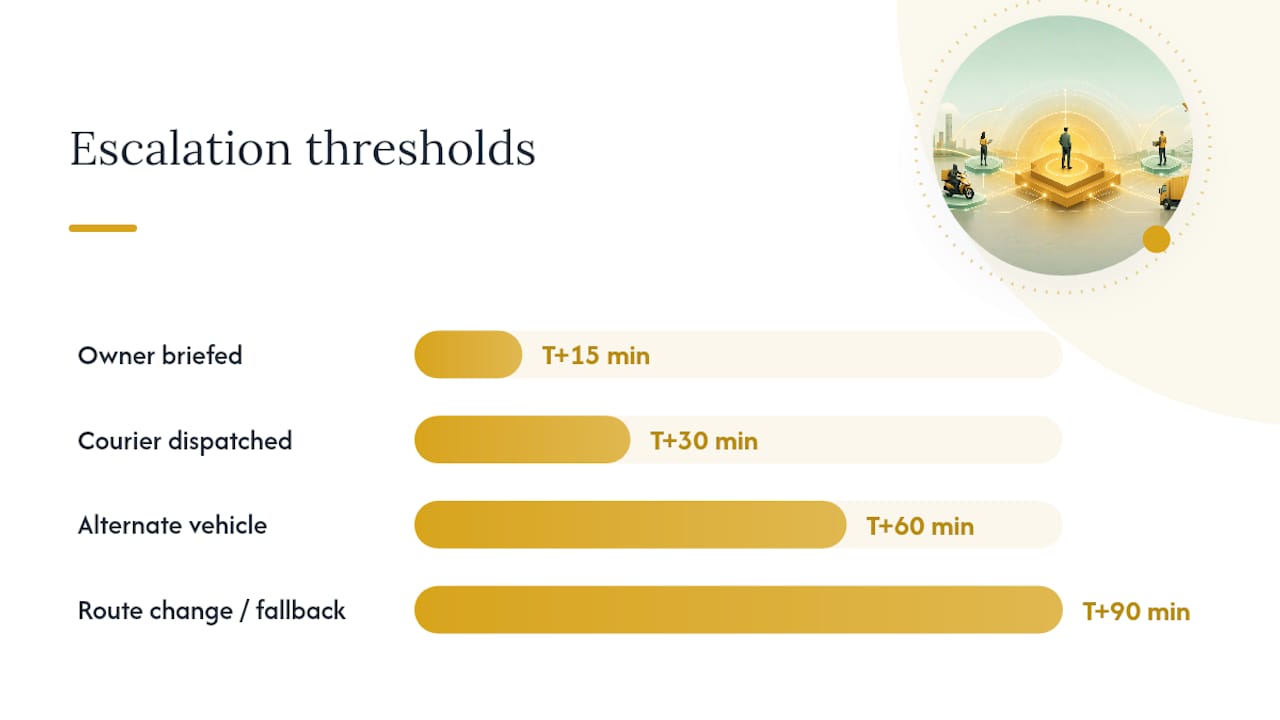
Use a fixed escalation timeline rather than reacting case by case:
- T+15 minutes — owner is dialled and briefed on the delay.
- T+30 minutes — courier dispatched or re-confirmed with updated ETA.
- T+60 minutes — alternate vehicle requested if the original hasn't moved.
- T+90 minutes — route change or full technical fallback triggered.
Stakeholders should be updated at each threshold, not left to ask. Standardising channel names and using a single group thread, rather than three parallel WhatsApp chats, reduces confusion when last-minute changes occur.
If damage does occur, log it immediately: photograph the item, note the time and person present, and notify the courier and your insurer the same day. Delayed reporting weakens any claim.
Pro Tip: Agree your trigger thresholds before the event, not during it. A team arguing over whether "it's bad enough yet" to activate contingency plans has already lost ten useful minutes.
For more on avoiding repeat failures, see this breakdown of common time-critical delivery pitfalls.
What are realistic timelines and cost drivers for urgent runs?
Setting expectations correctly here avoids two problems: overpaying for urgency you didn't need, and underestimating what a genuinely last-minute job costs.
Typical service benchmarks look like this:
- 60-minute collection from booking confirmation for most urban and intra-region jobs.
- Same-day delivery within the same region, often within a few hours of collection.
- Next-day for longer-haul or cross-country moves, particularly with larger vehicles.
The main factors that push up price on an urgent job are vehicle type, distance, waiting time at either end, whether a technician escort is required, whether pallet handling is involved, and out-of-hours surcharges for evening or weekend collections.
To get an accurate quote quickly, have this ready before you call: total weight and volume, exact pickup and delivery addresses, any loading complexity (stairs, no lift, restricted access), and whether on-site support is needed at the destination.
Planning ahead reduces how often you're in this position at all. For events with 200 or more attendees, logistics planning should begin 10 to 12 weeks in advance, with multi-venue or larger shows needing six months or more. The tighter your planning window, the more you'll rely on urgent same-day solutions to cover gaps.
What to tell a same-day courier when booking under pressure
A dispatcher can only move as fast as the information you give them. A vague call costs you minutes you don't have; a precise one gets a vehicle moving within the hour.
Have this brief ready before you dial:
- Collection address and named contact on-site
- Item dimensions and weight (even an estimate is better than nothing)
- Packaging status, boxed, palletised or loose
- Delivery bay details and any access restrictions
- Target ETA and any hard deadline
Once you're through, verify these points with the provider directly:
- What's the collection SLA, and can they commit to it in writing or by text?
- What tracking method will you get, a link, a call, or driver contact direct?
- Do they have experience moving AV or exhibition equipment specifically?
- Is the load insured, and to what level?
- Can they provide a technician escort or onboard courier if needed?
Record the booking properly: confirmation number, driver name, vehicle registration, live tracking link and an escalation contact if something goes wrong mid-transit.
Pro Tip: Save a template message for exactly this scenario. Something like: "Urgent same-day collection needed from [address] to [address], [item] approx [weight/size], ETA required by [time]. Please confirm collection SLA and tracking method." Paste it in, adjust the details, send.
Centralised dependency tracking across venue operators, technical teams and contractors matters most precisely at this stage, when several parties need the same information at the same time.
How Sddbyaba handles urgent event logistics in practice
When an event planner calls with a genuine time-critical job, the process has to move without losing accuracy. Sddbyaba's approach follows a consistent sequence: initial call and assessment, vehicle dispatch decision, on-board courier option where required, on-site handover, and post-delivery reconciliation.
That assessment stage matters because not every urgent job needs the same fix. A single flight case needs a different answer than a full stand rebuild, and getting that right on the first call avoids sending the wrong vehicle and starting the clock over.
Sddbyaba's fleet range covers this decision from end to end, from motorcycle couriers and small vans through to 7.5 tonne trucks and full artic transport, so the vehicle matches the consignment rather than forcing the consignment to fit whatever's available. A 60-minute collection SLA applies across the urgent service tier, with white-glove handling for fragile or high-value kit and an onboard courier option when a technician needs to travel with the equipment.
Throughout the job, real-time tracking and 24/7 communication mean the event manager isn't left guessing between updates. That visibility is what lets a planner make an informed call on contingency triggers rather than reacting blind.
- Fleet options from motorcycles to 26 tonne and artic vehicles
- 60-minute collection SLA for genuinely urgent runs
- Onboard/dedicated courier for technician escort and fragile kit
- Real-time tracking with continuous, 24/7 communication
- Secure handling and insurance appropriate to the consignment
Pro Tip: Save Sddbyaba's contact details in your event-day emergency folder before you need them, not while you're already mid-crisis.
Requesting an urgent quote takes minutes: call the dedicated desk directly or submit a request through the Sddbyaba website with the details covered in the booking brief above.
When should you outsource versus solve it in-house?
Most planners default to trying to fix it themselves first, and that instinct costs more time than it saves in a genuine crisis. The decision should come down to four factors: time remaining until the item is needed, complexity of installation once it arrives, whether you actually have spare labour and a vehicle on hand right now, and how much reputational or insurance risk sits on getting it wrong.
A rough but useful threshold: if the required ETA is under four hours, outsource immediately rather than attempting an internal fix. If you're dealing with fewer than three small items and someone with a suitable vehicle is already free, managing it in-house can work. Anything larger, more technical, or further out geographically almost always favours a professional same-day courier over an improvised staff run.
My honest view, having looked at how these situations actually unfold, is that planners waste far too much time trying to negotiate a "better" solution when a competent vendor is already available. Under genuine time pressure, the cost of three extra phone calls comparing options is almost always higher than the cost difference between those options. Quick vendor selection beats prolonged negotiation every time the clock is the real constraint, not the budget. The planners who recover fastest from a logistics scare are rarely the ones with the cleverest workaround. They're the ones who picked up the phone to a courier they already trusted and let them do the job.
Book same-day delivery before the deadline closes in
Sddbyaba exists for exactly the moment covered in this article: the point where an event depends on a delivery that absolutely cannot be late. Where a general courier might quote you a same-day window and leave you guessing, Sddbyaba backs it with a 60-minute collection SLA, a fleet that scales from motorcycle to full artic, and real-time tracking so you're never chasing a driver for an update.
Whether it's a single flight case or a full stand build needing an artic and an onboard courier, the fleet range and commercial logistics service are built around getting time-critical kit to site without the guesswork of a generalist courier. For larger consignments, the freight and haulage service covers palletised loads that a van simply can't take.
If you've got a delivery on the clock right now, phone the dedicated desk or request an urgent quote through Sddbyaba with your collection address, item details and target ETA ready to go.
Frequently asked questions
What's the fastest way to manage urgent event logistics delivery when time is almost gone? Assign one decision-maker, call a same-day courier and request a 60-minute collection, and confirm venue dock access simultaneously rather than one after another.
How do I know whether to outsource an urgent delivery or handle it in-house? If the required ETA is under four hours, outsource. If it's a handful of small items and you already have a vehicle and driver free, managing it internally can work.
What information does a same-day courier need to book an urgent job quickly? Collection address, contact name, item dimensions and weight, packaging status, delivery bay details, access restrictions, and your target ETA.
What should I photograph before and after an urgent delivery? Photograph items before dispatch for a damage-free baseline, then photograph the vehicle at the dock, the item in its final position, and the signed handover sheet on arrival.
Do urgent same-day deliveries cost more than standard bookings? Yes, typically, driven by vehicle type, distance, waiting time, technician escort requirements, and out-of-hours surcharges, though the exact cost depends on your specific job details.
Sources
Planning around a crisis is easier when you've already read how experienced teams structure the work before urgency hits.
- Event Logistics Management
- The Complete Guide On Event Logistics for Planners in 2026
- Master Event Logistics Planning: The Complete 2026 Guide
- Event Logistics: The Complete Event Planning & Management Guide
- Event logistics : how to ensure seamless coordination?