
Responding to urgent customer delivery requests is defined as the structured process of acknowledging, communicating, and resolving time-critical shipment issues before they escalate into complaints or lost business. Speed alone does not determine success here. The combination of proactive communication, the right courier partner, and a clear internal escalation process is what separates businesses that retain customers from those that lose them. Tools like ShippyPro Track & Trace, DialMyCalls, and services such as Sddbyaba exist precisely to close the gap between a delivery problem and a satisfied customer.
How to respond to urgent customer delivery requests effectively
The most effective urgent delivery response begins before the customer contacts you. Monitoring shipment status in real time and sending proactive updates the moment a delay is confirmed is the single most impactful step any business can take. Waiting for the carrier to declare a parcel lost before acting is the most common and costly mistake in urgent order management.
Courier providers set the baseline for what fast actually means. Anika Logistics advertises a 50-minute pickup guarantee for emergency collections, while Same Day Team promises collection within 60 minutes, with 24/7 availability and insurance included. These benchmarks matter because they define the service level your customers are comparing you against, whether you realise it or not.

The table below compares key features across urgent courier service tiers to help you select the right partner for your operation.
| Service type | Typical pickup time | Coverage | Key feature |
|---|---|---|---|
| Motorcycle courier | Under 30 minutes | Urban areas | Fastest for small parcels |
| Dedicated van courier | 30 to 60 minutes | Nationwide | Direct route, no stops |
| Same day freight | 60 to 90 minutes | Nationwide | Suitable for pallets and bulk |
| Hot shot / emergency | Under 60 minutes | Nationwide | Guaranteed pickup SLA |
Pro Tip: When selecting a courier for urgent shipments, always confirm the pickup SLA in writing before committing. A verbal promise of 60-minute collection is not the same as a contractual guarantee.
Automated alert systems from platforms like ShippyPro Track & Trace reduce inbound support calls by notifying customers of status changes before they pick up the phone. This is not a convenience feature. It is a customer retention tool.
What does good communication look like during urgent delivery updates?
The best communication for urgent delivery situations starts with emotional acknowledgement, not logistics data. Calm scripts for customer support confirm that labelling the customer's feeling first, then offering controlled choices such as a trace, replacement, or refund, reduces emotional intensity faster than any amount of factual explanation.
A well-constructed delivery update message contains six components:
- Acknowledgement of the delay, stated plainly without corporate language
- Brief reason for the issue, one sentence only
- Revised ETA or best estimate, with a specific time or date
- Tracking link so the customer can self-serve
- Next steps, including what you will do and by when
- Direct contact point, a named person or team, not a generic inbox
Delivery update templates from DialMyCalls demonstrate that messages containing all six elements reduce inbound support calls significantly compared to vague delay notices. The implication is direct: every missing component becomes a reason for the customer to call you.
Inconsistent messaging across channels is a separate and underappreciated risk. If your email says the parcel arrives Thursday and your order status page still shows Wednesday, the customer loses confidence in both. Aligning messaging across channels around a single source of truth, covering email, SMS, and order tracking simultaneously, is the standard that protects customer trust when operations are under pressure.
Pro Tip: Send the first update within 30 minutes of confirming a delay, not after you have a full resolution plan. Customers respond far better to early, honest communication than to a polished message that arrives three hours late.
Step-by-step process for handling urgent delivery issues
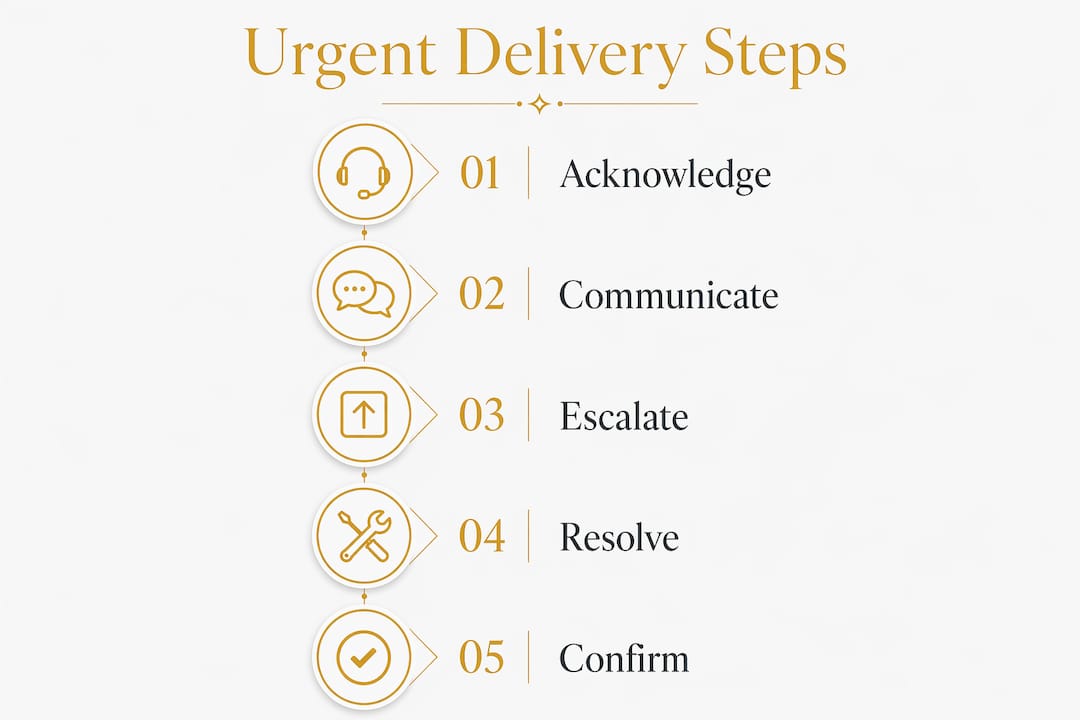
A reliable process for responding to delivery requests removes guesswork under pressure. The following sequence covers the full lifecycle from identification to resolution.
- Monitor shipment status using real-time tracking alerts. Set triggers for stalls, missed scans, or carrier exceptions so your team is notified before the customer is.
- Open a carrier trace request immediately using the shipment tracking number and dispatch reference. Do not wait for the carrier to flag the issue independently.
- Send the first proactive customer update within 30 minutes of confirming the delay. Include acknowledgement, a brief reason, a revised ETA, and a direct contact point.
- Set an internal decision point at 24 to 48 hours. If the carrier has not resolved the issue within this window, escalate to replacement or refund proactively. Waiting longer increases churn risk substantially.
- Maintain a communication log recording every customer contact, carrier case number, and internal decision made. This protects you legally and operationally.
- Confirm resolution with the customer directly. A short follow-up message confirming delivery, or confirming a replacement has been dispatched, closes the loop and signals professionalism.
- Apply a goodwill gesture where appropriate. A discount code or priority upgrade on the next order costs little and recovers significant goodwill after a difficult experience.
The 24 to 48 hour internal escalation rule is the most frequently ignored step in this process. Fast internal escalation consistently outperforms waiting for carrier confirmation when it comes to retaining customers after a delivery failure. Businesses that act within this window retain far more customers than those that wait for the carrier to declare a parcel officially lost.
Pro Tip: Keep a dedicated carrier contact sheet with direct escalation numbers for each courier you use. Generic customer service lines add hours to resolution time when minutes matter.
How to choose the right urgent delivery option for your customers
Selecting the correct delivery tier is as important as responding quickly. Matching the service to the customer's actual need prevents over-promising and under-delivering, which is the root cause of most urgent delivery complaints.
The criteria for evaluating a courier for urgent shipments are:
- Confirmed pickup SLA: Is the collection time guaranteed or estimated?
- Direct routing: Does the vehicle go straight to the destination or make multiple stops?
- Insurance cover: Is the consignment insured for its full declared value?
- Live tracking: Can you and the customer monitor progress in real time?
- Vehicle suitability: Is the vehicle matched to the size and weight of the goods?
- Service area: Does the courier cover the collection and delivery postcodes reliably?
Retailers like Walmart have launched 30-minute delivery services across 33 US markets, setting a new benchmark for consumer expectations globally. UK businesses are not immune to this shift. Customers who experience 30-minute delivery from a retailer will apply that expectation to your business, regardless of your sector.
Communicating delivery windows clearly before the order is placed reduces complaints significantly. If same-day dispatch is available only within a certain postcode radius or above a minimum order value, state this at the point of purchase. Surprises at checkout or after payment are the fastest route to a frustrated customer.
For businesses managing mission-critical deliveries in sectors like healthcare, engineering, or manufacturing, dedicated vehicle transport is the only appropriate option. Shared or consolidated services introduce delay risk that is unacceptable when the consignment is time-critical.
Common mistakes when responding to urgent delivery requests
The most damaging mistakes in urgent delivery response are not operational failures. They are communication failures that compound an already difficult situation.
- Vague updates: Telling a customer their parcel is "on its way" without a revised ETA is not an update. It is a placeholder that generates a follow-up call.
- Delayed first contact: Waiting until you have a full resolution before contacting the customer leaves them anxious and more likely to escalate publicly.
- Inconsistent timelines: Quoting different ETAs across email, SMS, and order tracking destroys credibility even when the operational fix is progressing well.
- Skipping emotional validation: Launching straight into logistics facts without acknowledging the customer's frustration increases escalation rates. Validating emotions first is the fastest route to a productive conversation.
- No internal escalation trigger: Without a defined decision point, teams wait indefinitely for carrier updates instead of acting in the customer's interest.
The remedy for most of these mistakes is a standardised communication framework, trained into the team and applied consistently. Embedding validated communication frameworks across channels and training staff on their use produces faster resolutions and fewer escalations than any technology investment alone.
Compliance is also a factor. The FTC's 30-day rule requires sellers to notify customers of delays with revised shipping dates and cancellation options. Vague delay emails are non-compliant. While this is a US regulation, the principle of legally adequate delay communication applies to UK consumer law obligations equally.
Pro Tip: Document every carrier interaction with a case number and timestamp. If a dispute escalates, this record is your evidence. Without it, you are relying on the carrier's version of events.
Key takeaways
Effective urgent delivery response requires proactive communication, a defined escalation process, and a courier partner with guaranteed pickup SLAs, not reactive fixes applied after the customer complains.
| Point | Details |
|---|---|
| Communicate before they call | Send the first update within 30 minutes of confirming a delay, with a revised ETA and contact point. |
| Set a 24 to 48 hour escalation rule | Offer replacement or refund proactively if the carrier has not resolved the issue within this window. |
| Validate emotions first | Acknowledge the customer's frustration before presenting logistics facts to reduce escalation rates. |
| Align all channels | Use a single source of truth across email, SMS, and order tracking to prevent conflicting information. |
| Match the service to the need | Dedicated vehicle transport is the only appropriate option for time-critical or mission-critical consignments. |
What I have learned about urgent delivery expectations in 2026
The gap between what customers expect and what most businesses deliver has never been wider. Walmart's 30-minute delivery rollout is not a curiosity from another market. It is a signal that the baseline for acceptable delivery speed is shifting faster than most logistics operations are adapting.
What I find consistently underestimated is the role of human empathy in what is fundamentally a technical process. Businesses invest heavily in tracking technology and carrier integrations, then lose the customer in the first 60 seconds of a support call because the agent skips straight to case numbers. The technology is only as good as the communication wrapped around it.
The businesses I have seen handle urgent delivery failures best share one trait: they have a written escalation process that every team member knows and follows. It is not about having the fastest courier on speed dial. It is about removing the decision-making burden from individuals under pressure. When the process is clear, the response is fast and consistent, and the customer feels it.
My recommendation is to treat your urgent delivery failure process as a product in its own right. Design it, test it, and train it. The businesses that do this retain customers through problems that would otherwise end the relationship permanently.
— Ayomide
How Sddbyaba supports your urgent delivery needs
When a delivery cannot wait, Sddbyaba provides same-day dispatch, dedicated courier transport, and nationwide coverage across the UK for businesses and individuals who need fast, reliable logistics support.

Sddbyaba operates a full fleet from motorcycle couriers to artic lorries, with guaranteed pickup times and 24/7 availability for time-critical consignments. Whether you need a dedicated courier service for a single urgent shipment or a nationwide dispatch solution for ongoing urgent order management, the team is ready to respond. Contact Sddbyaba directly to discuss a bespoke solution for your urgent delivery requirements.
FAQ
What is the first step when responding to an urgent delivery issue?
Send a proactive customer update within 30 minutes of confirming the delay. Include an acknowledgement, a brief reason, a revised ETA, and a direct contact point.
How long should you wait before escalating an urgent delivery to a replacement or refund?
Set an internal decision point at 24 to 48 hours. If the carrier has not resolved the issue within this window, offer a replacement or refund proactively rather than waiting for a lost parcel declaration.
What should a delivery delay update message include?
A compliant and effective delay message includes acknowledgement of the delay, a brief reason, a revised ETA, a tracking link, clear next steps, and a direct contact point for the customer.
How do you de-escalate a frustrated customer during a delivery complaint?
Validate the customer's emotion first before presenting any logistics information. Calm scripts that label feelings and offer controlled choices such as a trace, replacement, or refund reduce emotional intensity faster than factual explanations alone.
What delivery tier is appropriate for mission-critical urgent shipments?
Dedicated vehicle transport is the correct choice for time-critical consignments in sectors like healthcare, engineering, or manufacturing. Shared or consolidated services introduce delay risk that is unacceptable for urgent or mission-critical goods.