
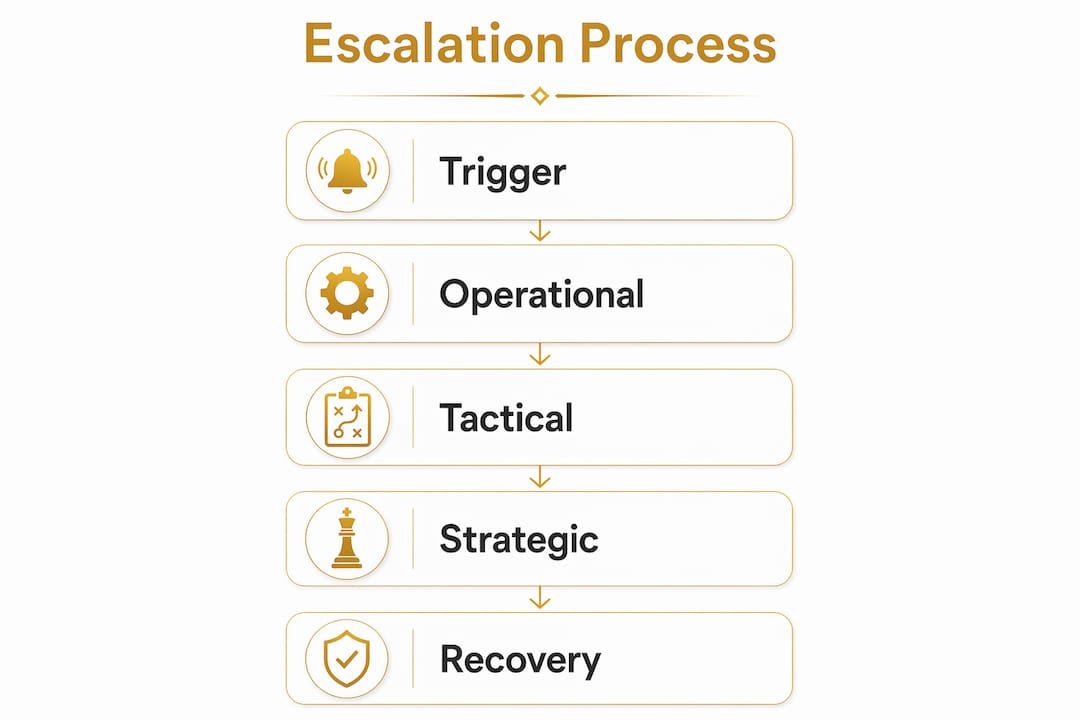
The emergency delivery escalation process is a defined set of protocols that moves critical shipment failures to progressively higher decision-making levels until resolution is achieved. Standard courier tracking and customer service tiers cannot resolve time-sensitive crises on their own. When a delivery fails at the operational level, a structured escalation framework determines who acts, when they act, and what authority they carry. Organisations such as Tacto.ai, Flex Fulfillment, and Medallion Logistics each document versions of this framework, confirming it as recognised practice in professional logistics management. The process protects revenue, customer relationships, and supply chain continuity when standard procedures break down.
What is the emergency delivery escalation process and when does it activate?
The emergency delivery escalation process is the structured sequence of actions, authorities, and communications triggered when a shipment issue exceeds the resolution capacity of the current operational tier. The industry also refers to this as a delivery crisis management framework or an emergency delivery protocol. Both terms describe the same core mechanism: a pre-agreed set of rules that determines when a problem moves upward and who owns it at each level.
Escalation trigger thresholds include specific criteria such as a 10% cost deviation, a 48-hour delay, or a 72-hour stagnation in shipment progress. These numbers matter because they remove ambiguity. Without defined thresholds, teams waste time debating whether a situation qualifies as a crisis rather than resolving it.
The process applies across industries where delivery failure carries direct financial or operational consequences. In manufacturing, a missing component halts a production line. In healthcare, a delayed medical supply creates patient risk. In retail, a missed fulfilment window damages customer trust and triggers penalty clauses. Understanding types of emergency deliveries across these sectors clarifies why a single, consistent escalation model is worth building and maintaining.
What are the typical stages and triggers in an escalation?
Most documented escalation frameworks follow a three-stage model: operational, tactical, and strategic. Each stage carries distinct trigger criteria, decision authority, and expected response timelines.

| Stage | Trigger criteria | Decision authority | Response timeline |
|---|---|---|---|
| Operational | Delay under 48 hours, minor route deviation | Dispatcher or logistics coordinator | Immediate to 4 hours |
| Tactical | 48-hour delay, 10% cost overrun, carrier failure | Logistics manager or operations director | 4 to 24 hours |
| Strategic | 72-hour stagnation, supply shortage, multi-shipment failure | Senior management or executive team | 24 to 72 hours |
At the operational stage, the dispatcher or logistics coordinator holds full authority to reroute, reassign a vehicle, or contact the carrier directly. No upward approval is needed. The tactical stage activates when the issue exceeds the coordinator's authority or resource access. A logistics manager steps in to authorise expedited options, negotiate with carriers, or adjust customer commitments. The strategic stage involves senior leadership when the disruption affects multiple shipments, triggers contractual penalties, or requires budget decisions beyond normal operational spend.
Documented escalation workflows that assign roles and responsibilities at each stage prevent duplicated effort and inconsistent customer communication. Without this documentation, two team members may contact the same carrier simultaneously, or a customer may receive conflicting updates from different departments. The table above is not theoretical. It reflects the structure that logistics teams in manufacturing, retail, and freight management use to maintain control under pressure.
How should communication be handled during a delivery crisis?
Communication during an escalation is not a secondary concern. It is a core operational function that directly affects customer retention and internal decision quality. The first principle is proactive disclosure: notify affected customers before they contact you.
Delivery promise adjustments follow a clear pattern depending on disruption type. Regional issues typically require adding three to seven days to the stated delivery window. Supply shortages or port disruptions may require adjustments of eight to twenty-one days. Publishing these revised windows immediately reduces inbound enquiries and sets accurate expectations.
Communication best practices during an active escalation include:
- Send proactive disruption notifications within two hours of confirming a delay, not after a resolution is found
- Adjust published delivery promises publicly and in direct customer correspondence as soon as revised timelines are known
- Prioritise high-value accounts in your customer service triage, contacting them directly rather than relying on automated notifications
- Schedule status updates every 48 to 72 hours even when the situation has not changed, as regular scheduled updates reduce customer enquiry overload significantly
- Assign a single point of contact per affected account to prevent conflicting messages from reaching the same customer
Pro Tip: Never wait for complete information before communicating. A brief, honest update stating that the issue is under active investigation carries more credibility than silence followed by a detailed explanation three days later.
Internal communication carries equal weight. Escalation steps must be logged in a shared system so that every team member, including deputies covering for absent staff, can see the current status and the actions already taken.
What recovery strategies exist to resolve emergency delivery issues?
Recovery is the operational phase that follows escalation. Once the right authority level owns the problem, the team must select and execute the fastest viable resolution. Expedited recovery options evaluated by logistics teams include air freight, next-flight-out services, dedicated ground transport, and charter aircraft. Each option carries a different cost profile and lead time.
Recovery options and their practical applications:
- Next-flight-out air freight: the fastest option for high-value, low-volume shipments. Suitable for medical supplies, precision components, and critical retail stock. Cost is significantly higher than standard freight but justified when production downtime or contractual penalties exceed the premium.
- Dedicated ground transport: a dedicated vehicle dispatched exclusively for one consignment, with no shared stops or consolidation delays. Sddbyaba operates this model across the UK using vehicles ranging from motorcycles to 26-tonne trucks, matching the vehicle to the load rather than the other way around.
- Charter aircraft: reserved for large-volume, time-critical freight where commercial air capacity is unavailable or insufficient. Documentation requirements are more complex, and lead times for chartering typically run two to six hours minimum.
- Carrier rerouting: redirecting a shipment already in transit through an alternative hub or terminal. This requires direct contact with the carrier's operations team, not the standard customer service line.
- Cross-docking and relay transport: using intermediate transfer points to hand freight between vehicles and reduce total transit time without requiring a single vehicle to cover the full distance.
The choice between these options depends on three variables: the value of the goods, the cost of the delay to the business, and the documentation requirements for the shipment. A pharmaceutical consignment and a pallet of retail stock require different recovery paths even if the delay duration is identical. Emergency courier vehicle matching is a critical step in this phase, as deploying the wrong vehicle type adds time rather than saving it.
What pitfalls and advanced practices improve escalation effectiveness?
The most common failure in delivery crisis management is not a lack of options. It is a failure of process execution under pressure. The following pitfalls account for the majority of escalation breakdowns in practice.
- Waiting for complete information before communicating. Teams delay customer notifications while gathering full details. This erodes trust and increases inbound call volume simultaneously.
- Relying solely on automated tracking systems. Automated tracking misinterprets delays and cannot identify root causes. A system showing "in transit" may mask a shipment sitting at a closed terminal for 36 hours.
- Centralising all decision authority in one person. When the key decision-maker is absent, the escalation stalls. Decentralised decision authority and formal deputy arrangements maintain continuity regardless of staff availability.
- Contacting carriers through standard customer service channels. Standard channels are designed for routine queries. Crisis resolution requires direct contact with dispatch supervisors or regional operations managers.
- Treating all affected shipments equally. Not every delayed shipment carries the same business consequence. Triage by impact, not by delay duration.
Advanced practices that separate effective escalation teams from reactive ones centre on relationships and documentation. Human intervention and direct industry contacts enable shipment reroutes and special authorisations that automated systems cannot achieve. A logistics coordinator with a direct line to a terminal supervisor can resolve in two hours what a standard support ticket takes two days to process.
Pro Tip: Build and maintain a contact directory of carrier operations managers, regional dispatchers, and freight terminal supervisors. This list is worth more in a crisis than any tracking platform.
Documented workflows also prevent the institutional knowledge problem. When an experienced coordinator leaves or is unavailable, an undocumented process leaves the team without a clear path forward. Written procedures with named role assignments at each escalation stage remove this dependency entirely.
Key takeaways
A structured emergency delivery escalation process with defined triggers, clear role authority, and proactive communication is the single most effective defence against costly delivery failures.
| Point | Details |
|---|---|
| Define trigger thresholds | Set specific criteria such as 48-hour delays or 10% cost deviations to activate escalation without debate. |
| Use a three-stage model | Assign operational, tactical, and strategic tiers with distinct authorities and response timelines. |
| Communicate before resolution | Send proactive updates every 48 to 72 hours even without new information to maintain customer trust. |
| Prioritise human contacts | Direct relationships with carrier dispatchers resolve crises faster than automated tracking or standard support channels. |
| Decentralise decision authority | Appoint deputies for key roles to prevent escalation paralysis when primary contacts are unavailable. |
Why the human element still defines crisis outcomes
There is a tendency in logistics management to treat escalation as a technology problem. Better tracking software, more detailed dashboards, automated alerts. These tools have genuine value, but they do not resolve crises. They report them.
What I have observed repeatedly is that the businesses which recover fastest from delivery failures are not the ones with the most sophisticated systems. They are the ones with the best relationships and the clearest internal accountability. A logistics coordinator who can call a carrier's regional operations manager directly, explain the situation in thirty seconds, and receive an authorised reroute within the hour is worth more than any platform that sends automated delay notifications.
The documentation piece is equally underrated. Most teams know what to do in a crisis. The problem is that this knowledge lives in the heads of two or three experienced people. When those people are on leave, in a meeting, or have moved on, the team defaults to improvisation. Written escalation workflows with named role assignments at each stage are not bureaucracy. They are the mechanism that makes a team's collective knowledge transferable and repeatable.
The other insight worth stating plainly: speed and accountability are not in tension. The fastest escalation outcomes come from teams where every person knows exactly what they own and exactly when to hand it upward. Ambiguity is what slows things down, not caution.
— Ayomide
How Sddbyaba supports emergency delivery escalation
When a delivery crisis activates your escalation protocol, the recovery phase depends entirely on having a courier partner that can respond at the speed the situation demands.

Sddbyaba provides same day dedicated courier and freight haulage services across the UK, with a fleet ranging from motorcycle couriers to articulated lorries. Every vehicle is dispatched exclusively for your consignment, with no consolidation delays. For logistics coordinators managing an active escalation, this means a confirmed vehicle, a direct driver contact, and a tracked delivery from collection to proof of delivery. When your escalation process reaches the recovery stage, Sddbyaba is built to execute it.
FAQ
What is the emergency delivery escalation process?
The emergency delivery escalation process is a structured protocol that moves unresolved delivery failures to progressively higher decision-making levels until the issue is resolved. It defines trigger thresholds, role authorities, and response timelines at each escalation stage.
What triggers an emergency delivery escalation?
Common triggers include a 48-hour shipment delay, a 10% cost deviation from the agreed rate, or a 72-hour stagnation with no movement update. These thresholds activate the next escalation tier automatically.
How often should customers be updated during a delivery crisis?
Customers should receive status updates every 48 to 72 hours throughout an active escalation, even when no new information is available. Regular communication reduces inbound enquiries and maintains trust.
Why is human intervention critical in delivery escalations?
Automated tracking systems cannot identify root causes or authorise special actions such as reroutes or priority handling. Direct carrier contacts at the dispatch and terminal level enable resolutions that standard customer service channels cannot achieve.
How do you prevent escalation paralysis when key staff are absent?
Decentralise decision authority by appointing formal deputies for each escalation role and documenting the full workflow. This ensures the process continues regardless of individual availability, as confirmed by procurement escalation best practice.