
A failed delivery emergency is defined as any shipment that has missed its delivery attempt and sits at risk of return-to-origin unless action is taken within a narrow recovery window. The industry term for this process is NDR management, short for Non-Delivery Report management. Shipments typically remain in the courier network for 24 to 48 hours before return-to-origin begins, making speed the single most important variable in any recovery attempt. To recover a failed delivery emergency successfully, you must act within four hours of the NDR being raised. Tools like the WhatsApp Business API, SMS fallback systems, and logistics aggregators such as Shiprocket and iThink Logistics are the infrastructure that makes that speed possible at scale.
What systems do you need to recover failed delivery emergencies?
Rapid emergency delivery recovery depends on three prerequisites: real-time NDR alerts, automated customer outreach, and a human escalation path for high-value orders. Without all three working together, even a well-intentioned team will lose shipments to return-to-origin simply through delay.

Real-time NDR alerts come from two sources. Courier platforms like Delhivery and iThink Logistics push webhook notifications the moment a delivery attempt fails. Logistics aggregators such as Shiprocket consolidate alerts across multiple carriers into a single dashboard, which is critical for businesses managing more than one courier relationship. The moment an alert fires, your recovery clock starts.
Automated outreach channels are the next layer. The WhatsApp Business API delivers read rates significantly higher than email and allows customers to respond directly with a reschedule preference or address correction. SMS acts as a reliable fallback when WhatsApp is unavailable. Email remains useful for documentation and for customers who prefer it, but it should never be the first contact channel in a time-sensitive recovery.
- Real-time NDR alerts via courier webhooks or aggregator dashboards (Shiprocket, iThink Logistics, Delhivery)
- Automated first-touch messaging via WhatsApp Business API with SMS fallback
- Human escalation protocols for orders above a defined value threshold or SLA breach
- Accurate contact data validated at order entry, including a verified mobile number and a confirmed delivery address
Pro Tip: Validate customer contact details at the point of order, not at the point of failure. An incorrect phone number discovered during an NDR event cannot be corrected in time to save the shipment.
The human escalation layer matters most for high-value consignments. First contact within 2 to 4 hours of NDR issuance is the SLA target that separates businesses with strong recovery rates from those that routinely absorb return costs. Assign a team member or automated trigger to flag any order above your defined value threshold for a direct phone call if automated messages go unanswered within 30 minutes.
How do you execute recovery steps for each failure scenario?
Failed delivery exceptions most commonly arise from four causes: recipient not home, incorrect or incomplete address, customer refusal, and an unreachable customer. Each cause requires a different recovery protocol. Treating all four the same way wastes time and reduces your chances of success.
The following steps map directly to each failure type:
-
Recipient not home. Send an automated WhatsApp message within 15 minutes of the NDR alert. Offer two or three specific reschedule slots rather than an open-ended question. Customers respond faster to a choice than to a blank field. Confirm the chosen slot immediately and pass the instruction to your courier before the warehouse holding window closes.
-
Incorrect or incomplete address. Send an SMS containing a link to an address correction form that includes a map pin-drop function. This removes ambiguity and gives the courier a precise GPS coordinate rather than a retyped address that may contain the same error. Verify the corrected address against a postcode database before resubmitting the delivery instruction.
-
Customer refusal. Acknowledge the refusal without pressure. Addressing customer refusal through acknowledgement and a modest discount offer recovers 25 to 35% of such orders. A message that says "We noticed you declined the delivery. We'd like to offer you 10% off your next order if you'd like us to reattempt" converts a significant share of refusals into completed deliveries.
-
Unreachable customer. Run a multi-channel sequence: WhatsApp first, SMS second, email third, phone call fourth. Space each attempt no more than 20 minutes apart. If the customer remains unreachable after all four channels, escalate to a human agent for a direct call. Document every attempt with a timestamp for carrier dispute purposes.
USPS uses specific UAA reason codes such as "No Such Number", "No Such Street", and "Attempted — Not Known" to classify delivery failures. Branching your recovery workflow by reason code increases efficiency and avoids sending an address correction form to a customer who simply was not home.
Pro Tip: Build your WhatsApp message templates around the specific NDR reason code, not a generic "we missed you" message. A customer who refused delivery needs a different message from one who was simply out. Specificity increases response rates.
What do you do when initial recovery attempts fail?
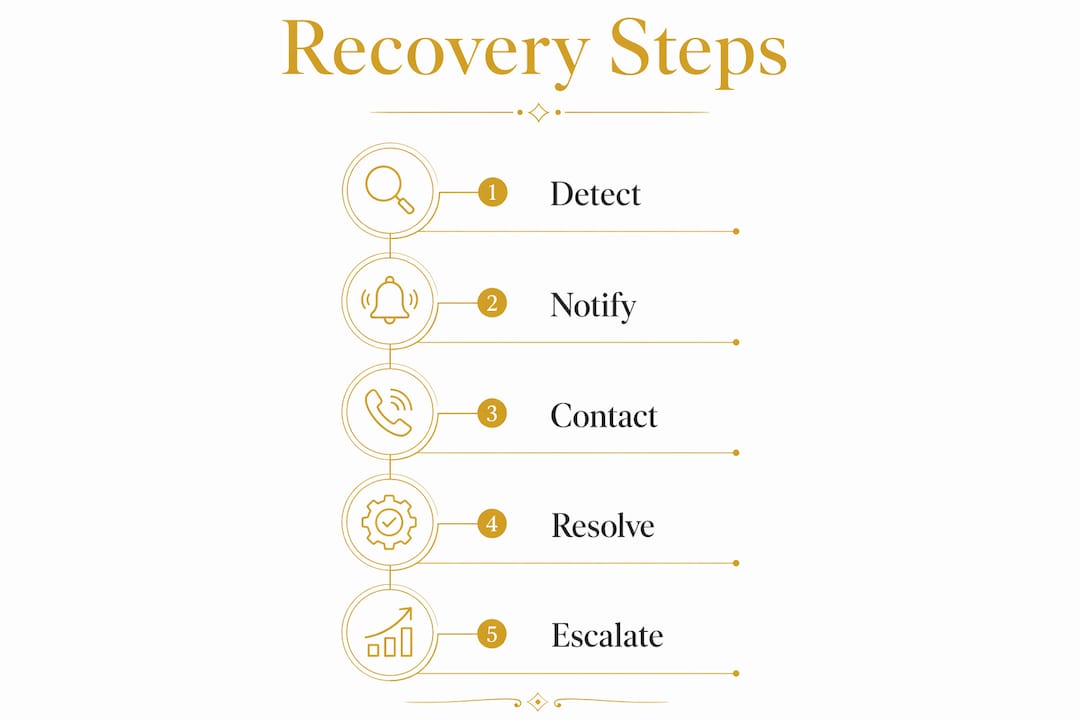
Recovery rates drop sharply after four to twelve hours and fall below 30% after 24 hours. When your first-touch outreach goes unanswered and the standard holding window is approaching, you need a structured escalation path rather than repeated identical messages.
The following escalation options apply depending on the failure type and elapsed time:
- Package intercept. If the shipment is still in transit, contact the carrier to redirect it to a different address or hold it at a depot for customer collection. This option closes once the shipment reaches the return-to-origin scan.
- Post office hold and collection. USPS holds missed deliveries at the local post office for approximately 15 days with free redelivery options available. Customers need photo ID and the delivery notice slip to collect. UK carriers operate similar depot hold periods, typically five to seven working days.
- GPS scan verification. For "delivered but not received" cases, wait at least 24 hours after a "Delivered" status before filing a claim. Request GPS scan data from the carrier to confirm the precise delivery location. This differentiates a misdelivery from an actual loss and enables the route carrier to attempt retrieval.
- Carrier escalation. Most delivery exceptions resolve within one to three business days through reattempt or address correction. If an exception remains unresolved beyond seven days, contact the carrier directly and open a formal investigation case.
| Scenario | Elapsed time | Recommended action |
|---|---|---|
| Recipient not home, no response | Under 4 hours | Automated reschedule via WhatsApp or SMS |
| Incorrect address, unconfirmed | 4 to 12 hours | Address correction form plus human follow-up call |
| Refusal, no reattempt agreed | 12 to 24 hours | Incentive message plus escalation to account manager |
| Delivered but not received | 24 to 48 hours | GPS scan request plus carrier investigation |
| Unresolved exception | Beyond 7 days | Formal carrier escalation and claim initiation |
Understanding specific reason codes and elapsed time is the deciding factor in whether you reship, refund, or continue recovery efforts. Jumping to a refund before exhausting recovery options costs more than the recovery attempt itself.
Manual versus automated delivery failure response: which works better?
The choice between manual, semi-automated, and fully automated failed delivery solutions is not a matter of preference. It is a matter of volume and response speed.
Manual NDR management does not scale beyond 20 failed orders daily without automation. A team member manually reviewing NDR reports, composing individual messages, and logging responses cannot maintain the sub-four-hour contact window that drives recovery rates above 75%. At 50 or more daily failures, manual management becomes a direct financial liability.
| Approach | Best suited for | Key limitation |
|---|---|---|
| Manual outreach | Fewer than 20 NDRs daily | Cannot maintain 4-hour SLA at scale |
| Semi-automated (SMS/email triggers) | 20 to 100 NDRs daily | Limited personalisation by reason code |
| Fully automated (API/webhook + WhatsApp) | 100 or more NDRs daily | Higher setup cost and integration effort |
| Human calls only for high-value orders | Any volume | Requires clear value threshold definition |
Logistics aggregators with API and webhook integration deliver minute-level responsiveness that no manual process can match. The WhatsApp Business API, when connected to your order management system via a platform like Shiprocket, fires a personalised message within seconds of an NDR event. SMS workflows serve as the fallback layer for customers without WhatsApp. For how courier routing works in practice, understanding the carrier network helps you identify exactly where in the chain a failure occurred and which recovery option remains open.
Pro Tip: Reserve human phone calls for orders above a defined value threshold, such as £150 or more. Automated messaging handles the volume; human calls protect your highest-margin shipments.
The ROI calculation is straightforward. Automation reduces return-to-origin rates, cuts reverse logistics costs, and preserves customer relationships. The setup investment in API integration pays back within weeks for any business handling more than 30 failed deliveries per month.
Key takeaways
Recovering a failed delivery emergency requires acting within four hours of the NDR, using reason-code-specific outreach, and escalating through structured channels before the 24-hour return-to-origin window closes.
| Point | Details |
|---|---|
| Act within four hours | Recovery rates reach 75 to 85% when first contact happens within 4 hours of the NDR. |
| Match response to reason code | Address correction, refusal incentives, and reschedule messages each serve a different failure type. |
| Automate first-touch outreach | WhatsApp Business API and SMS workflows eliminate the human delay that kills recovery rates. |
| Escalate unresolved cases at 7 days | Contact the carrier directly if an exception remains open beyond one week. |
| Reserve human calls for high-value orders | Automated channels handle volume; direct calls protect your highest-margin shipments. |
Why response latency is the real enemy in delivery crisis management
From working closely with logistics operations across retail, manufacturing, and medical supply chains, the pattern is consistent: businesses do not lose shipments because of bad couriers. They lose them because of slow internal responses to NDR alerts.
The four-hour window is not a guideline. It is a hard boundary. Every 30 minutes of delay after an NDR is issued reduces your probability of recovery in a measurable way. The businesses that maintain recovery rates above 80% are not necessarily using better couriers. They are using automated first-touch systems that fire within minutes, not hours.
The second mistake I see repeatedly is treating all NDRs identically. A customer who was not home needs a reschedule. A customer who refused delivery needs acknowledgement and a reason to reconsider. Sending the same "we missed you" message to both is not just inefficient. It actively reduces your chance of recovering the refusal case because it signals that you have not understood the situation.
Segmenting your escalation by order value is the third lever most businesses underuse. Not every failed delivery warrants a phone call, but every high-value shipment does. Define that threshold clearly, build it into your workflow, and your team will spend their time where it generates the most return.
NDR management is not a back-office function. It is a direct input to customer satisfaction and repeat purchase behaviour. A customer whose failed delivery is resolved quickly and professionally is more likely to order again than one who receives a refund after a week of silence.
For businesses handling urgent delivery failures at volume, the investment in automation is not optional. It is the difference between a recoverable situation and a write-off.
— Ayomide
How Sddbyaba supports emergency delivery recovery
When a delivery fails and time is running out, having a same-day courier on standby is the fastest way to redirect a shipment and protect the customer relationship. Sddbyaba provides dedicated vehicle transport and nationwide same-day dispatch specifically designed for time-critical situations where standard courier reattempts are not fast enough.
Whether you need a motorcycle courier for an urgent parcel in London or a Luton van for a redirected pallet consignment, Sddbyaba's fleet covers the full range of delivery requirements. The service operates across the UK with professional communication at every stage, so you always know where your shipment is and when it will arrive. For businesses managing emergency delivery recovery at scale, Sddbyaba offers dedicated courier solutions and nationwide dispatch through Abundance by AY, built for exactly these situations.
FAQ
What is the recovery window for a failed delivery?
Shipments remain in the courier network for 24 to 48 hours after a failed attempt before return-to-origin begins. Acting within four hours of the NDR gives you the highest recovery rate of 75 to 85%.
How do I fix a failed delivery with the wrong address?
Send the customer an SMS or WhatsApp message with a link to an address correction form that includes a map pin-drop option. Verify the corrected address against a postcode database before resubmitting the delivery instruction to the carrier.
When should I contact the carrier directly about a delivery exception?
Most exceptions resolve within one to three business days through reattempt or address correction. If the exception remains unresolved after seven days, contact the carrier directly and open a formal investigation.
What do I do if a package shows as delivered but has not arrived?
Wait at least 24 hours after the "Delivered" status before filing a claim, then request GPS scan verification from the carrier to confirm the exact delivery location and rule out misdelivery.
Can customer refusals be recovered?
Yes. Acknowledging the refusal and offering a modest discount recovers 25 to 35% of refused orders. A brief, specific message that addresses the customer's likely concern converts a significant share of refusals into completed deliveries.