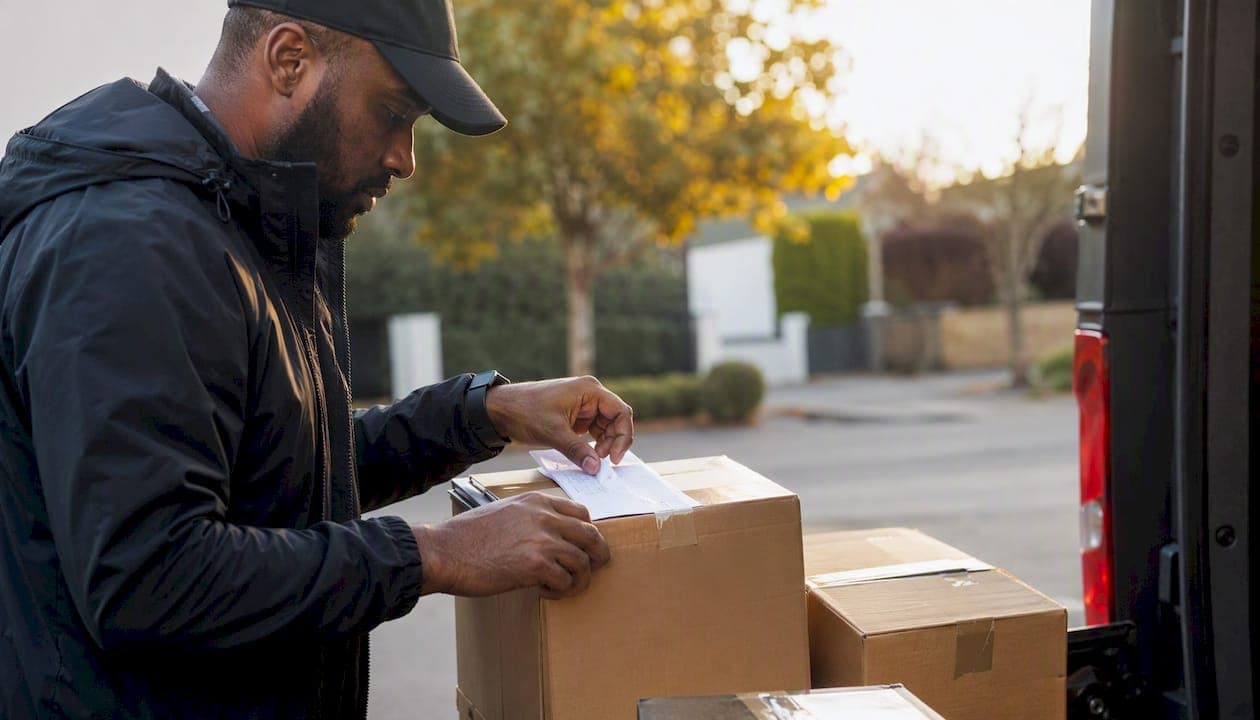
The most common examples of urgent courier consignments include blood samples and transplant organs, signed legal documents and court bundles, aircraft-on-ground spare parts, last-minute retail stock, exhibition materials, temperature-sensitive food and pharmaceuticals, and high-value prototypes. If your shipment falls into any of these categories, the first step is to call a dedicated same-day desk rather than booking through a standard parcel portal.
Immediate actions when you have an urgent consignment:
- Phone a same-day or emergency courier operator directly and request a dedicated, direct-run vehicle
- Confirm whether the consignment requires temperature control, security seals, or regulated documentation before collection
- Establish chain-of-custody requirements and agree on proof-of-delivery format upfront
The UK sectors that most frequently use urgent courier services are healthcare, legal and financial services, manufacturing and engineering, and retail and events. Each has its own compliance expectations, and getting those right at the booking stage is what separates a smooth delivery from a costly delay.
Key takeaways
Urgent courier consignments are defined by a delivery window measured in hours, a direct consequence of delay, and goods that are perishable, regulated, or irreplaceable — and matching the right vehicle and documentation to the consignment at the booking stage is what determines whether the job succeeds.
| Point | Details |
|---|---|
| Recognise urgency correctly | A consignment is urgent when delay carries a direct financial, clinical, or legal consequence — not simply when it feels time-sensitive. |
| Match vehicle to consignment | Use a motorcycle for documents, a van for boxes, a 7.5-tonne or larger vehicle for palletised parts; never under-size the vehicle. |
| Prepare paperwork before collection | Consignment note, declared value, recipient mobile, and any regulatory documentation must be attached to the package, not sent separately. |
| Declare regulated goods at booking | Clinical specimens, controlled drugs, and ADR-classified goods require specific handling; undeclared status forces a collection refusal. |
| Use Sddbyaba for dedicated UK runs | Sddbyaba operates motorcycles to 26-tonne trucks with nationwide coverage, direct runs, and professional chain-of-custody procedures. |
Table of Contents
- What makes a consignment count as 'urgent' in the UK?
- Examples of urgent courier consignments by sector
- How does an urgent courier job run from booking to delivery?
- Which vehicle should you choose for an urgent consignment?
- How to package and document urgent consignments
- What are the typical timelines and cost drivers for urgent jobs?
- UK legal and compliance requirements for regulated urgent consignments
- Common mistakes that delay urgent consignments
- When should you not use an urgent courier?
- How Sddbyaba handles urgent consignments across the UK
- An operator's honest view on urgent deliveries
- Book an urgent collection with Sddbyaba today
What makes a consignment count as 'urgent' in the UK?
Urgency is defined by three operational criteria: the delivery window is measured in hours rather than days, a delay carries a direct financial or safety consequence, and the goods are either perishable, regulated, or irreplaceable.
A consignment is operationally urgent when any one of these conditions applies. A blood sample with a four-hour viability window is urgent. A signed contract that must reach a solicitor before exchange completes is urgent. A production-line spare part that is keeping a factory idle is urgent. The common thread is that the cost of delay, whether financial, clinical, or reputational, exceeds the cost of a dedicated courier.
Typical SLA expectations from same-day operators in the UK split broadly into two tiers. Urban rapid-response jobs, covering collections and deliveries within a major city or conurbation, are often activated within the hour. Nationwide direct runs, where a dedicated vehicle travels point-to-point across the country, can still achieve same-day delivery if the booking is placed early enough in the day, though very long distances may require an overnight or air leg.
Examples of urgent courier consignments by sector
Understanding which category your goods fall into helps you choose the right service and prepare the correct paperwork before the driver arrives.
Healthcare and medical
- Blood samples, pathology specimens, and biopsies with short viability windows
- Transplant organs requiring immediate hand-carry and close co-ordination with hospitals and airports; on-board courier teams are routinely activated for these missions
- Urgent medicines and pharmaceuticals, including cases where a dedicated courier has personally transported life-saving treatment to a patient within 24 hours
- Clinical trial samples and temperature-sensitive reagents requiring cold-chain documentation
Legal and financial
- Original signed deeds, contracts, and completion documents that cannot be scanned
- Court bundles with a filing deadline measured in hours
- Regulatory submissions and original certificates for financial transactions
Manufacturing and engineering
- Aircraft-on-ground (AOG) spare parts, where a grounded aircraft costs thousands of pounds per hour; hand-carried AOG deliveries have restored aircraft to service within hours by couriers with airport access permits
- Production-line components that have caused a factory stoppage
- Tooling, dies, and calibrated instruments that cannot be substituted
Retail and e-commerce
- Last-minute stock replenishment for high-demand SKUs ahead of a promotional window or peak trading day
- Replacement goods for a failed delivery that has triggered a customer escalation
- Display units or point-of-sale materials needed for a store opening
Events and exhibitions
- Exhibition stands, display screens, and branded materials with a fixed build deadline
- Demo equipment and presentation technology for a client pitch or trade show
- Replacement components for AV or staging equipment that has failed on-site
Perishables and food
- Fresh produce, chilled ready meals, and temperature-sensitive samples for quality testing
- Pharmaceutical cold-chain consignments requiring insulated shippers and temperature logs
- Floral arrangements and live plants with a narrow viability window
High-value and irreplaceable goods
- Prototype electronics and pre-production samples before a product launch
- Original artwork, signed documents, or one-of-a-kind items that cannot be replaced if lost
- High-value jewellery or components requiring security seals and chain-of-custody documentation
Pro Tip: If the financial or operational cost of a delay exceeds the cost of a dedicated vehicle within the first two hours, classify the job as emergency rather than priority. Emergency activation means a driver is dispatched immediately; priority may still enter a queue.
How does an urgent courier job run from booking to delivery?
The typical flow for a same-day or emergency consignment runs in four stages: immediate quote and activation, dedicated vehicle dispatch, direct transport with minimal handovers, and confirmed proof of delivery.
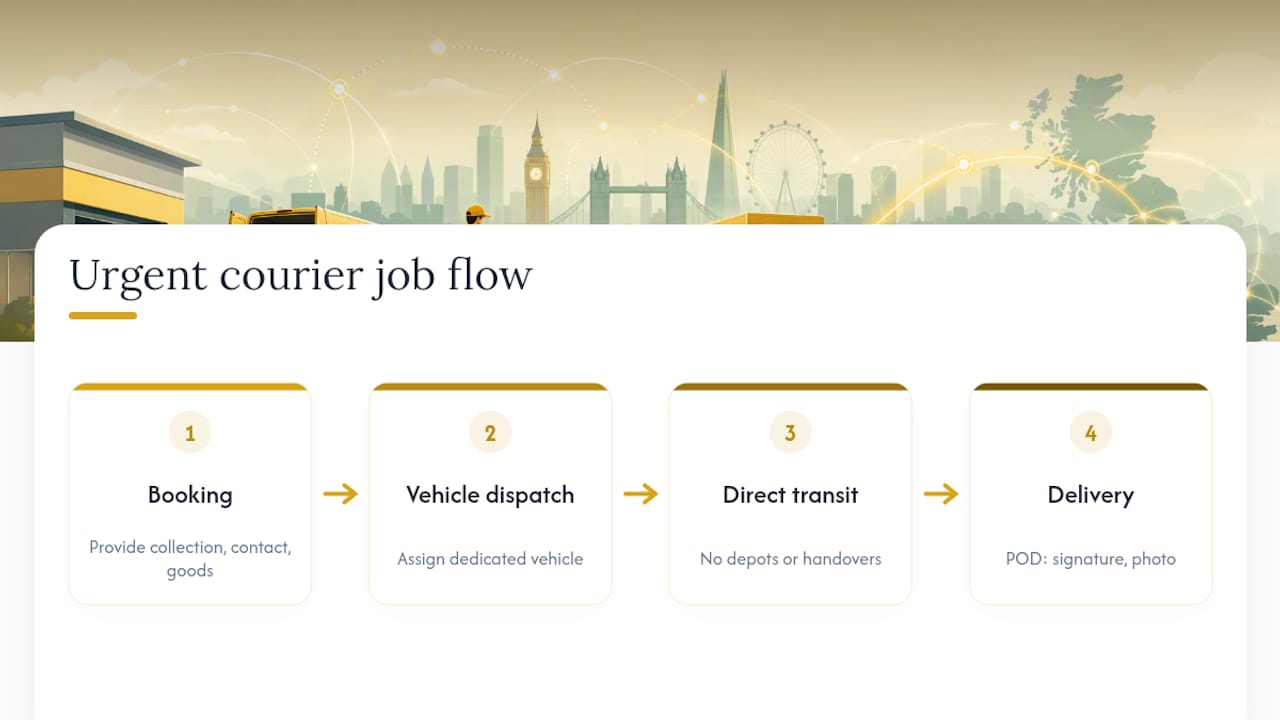
At booking, the operator needs the collection postcode and recipient address, a description of the goods, dimensions and weight, declared value, any regulatory status (clinical, hazardous, controlled), recipient contact name and mobile number, and any access restrictions at either end. Providing incomplete information at this stage is the single most common cause of wasted collection attempts.
At collection, the driver will check the consignment against the booking details, obtain a signature or scan, and note any temperature log readings if cold-chain is required. For high-value or regulated goods, tamper-evident seals are applied and recorded.
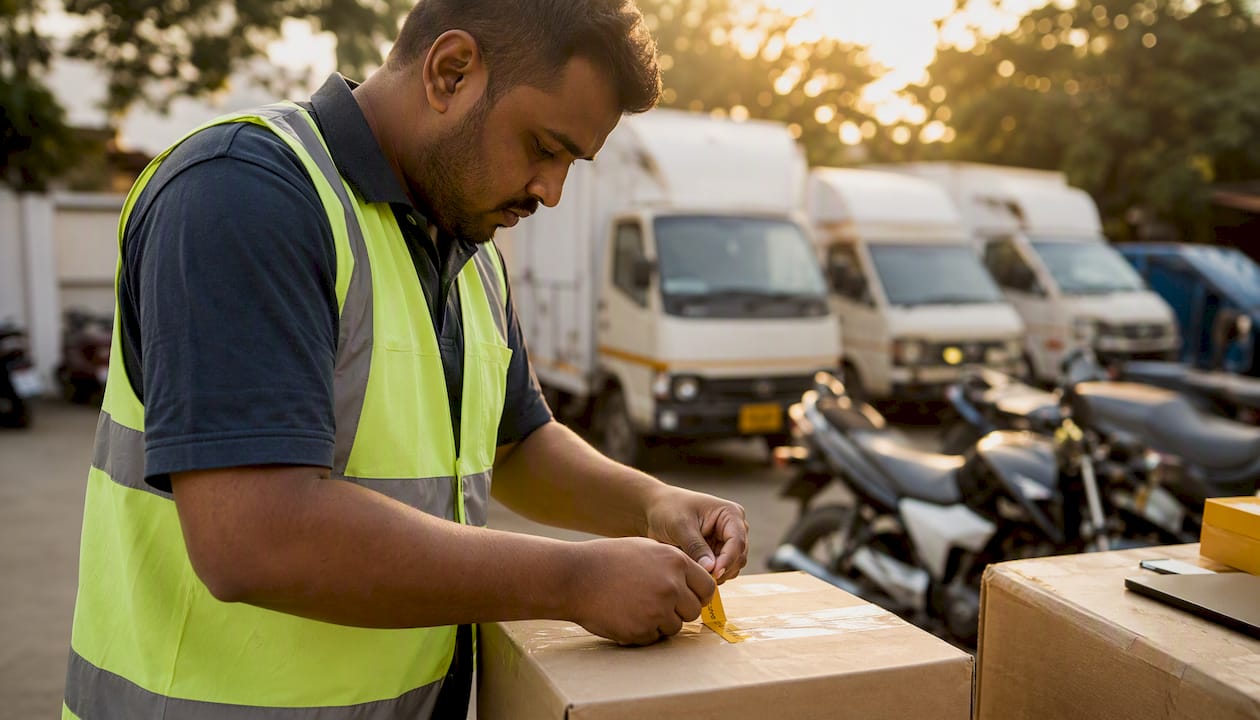
During transit, a dedicated direct run means the vehicle goes from collection point to delivery point without intermediate depots or handovers. Tracking is maintained throughout, and the operator's control desk can provide live status updates. For very long distances or airport-access requirements, an on-board courier travels with the consignment to maintain continuous supervision and chain of custody.
At delivery, proof of delivery (POD) is captured by signature, photograph, or both. Temperature records are handed over with clinical consignments. For chain-of-custody-sensitive goods, a named recipient signature is mandatory. The POD is typically available to the booker within minutes of completion.
Operational exceptions worth noting: multi-stop jobs require pre-agreed sequencing at booking; customs clearance for international legs needs commodity codes and commercial invoices prepared in advance; and out-of-hours collections carry surcharges that are best confirmed before the job is placed.
Which vehicle should you choose for an urgent consignment?
Matching the vehicle to the consignment prevents both under-resourcing (a motorbike sent for a pallet) and unnecessary cost (a 7.5-tonne truck sent for a single envelope).
| Vehicle / service type | Typical consignment | Standout capability |
|---|---|---|
| Motorcycle courier | Single urgent documents, keys, small parcels | Fastest urban response; bypasses congestion |
| Car courier | Small parcels, legal documents, medical samples | Discreet, temperature-stable interior |
| Small or medium van | Multiple boxes, fragile items, exhibition materials | Flexible load space; suitable for most B2B urgent jobs |
| Luton or long-wheelbase van | Palletised parts, large event equipment | Tail-lift option; handles awkward or heavy loads |
| 7.5-tonne truck | Multiple pallets, manufacturing components | Suited to same-day freight for manufacturers |
| 26-tonne or artic | Large freight, construction materials, bulk urgent stock | Full-load capacity; nationwide direct runs |
| On-board courier | Organs, AOG parts, high-security items | Personal supervision; airport access; zero handovers |
| Temperature-controlled vehicle | Pharmaceuticals, clinical samples, fresh food | Validated cold-chain with temperature logging |
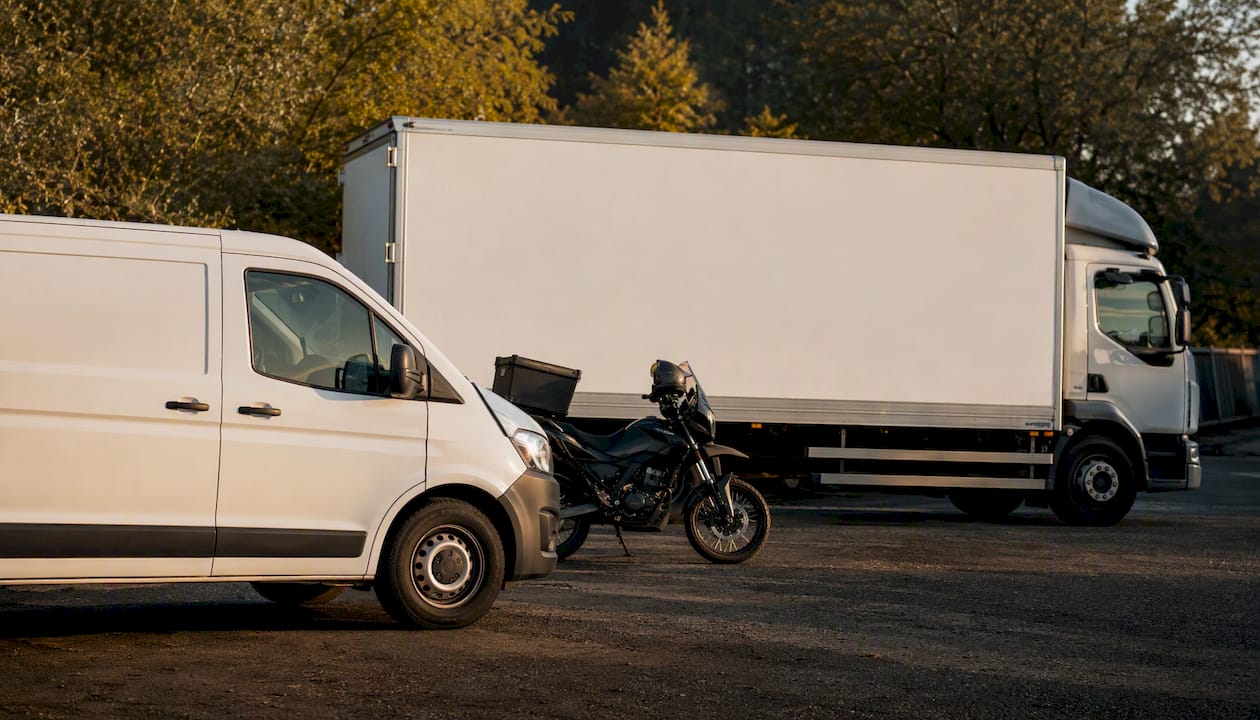
A dedicated direct run is the right choice whenever the consignment is highly time-critical, requires airport or restricted-site access, or carries a security or chain-of-custody requirement that cannot tolerate depot handling.
Urban congestion, night-time deliveries, and out-of-hours access restrictions all affect vehicle choice. A motorcycle is fastest in central London at midday; a van may be more practical for a 3 AM hospital delivery where loading bay access matters more than lane filtering.
Pro Tip: When you are unsure of the weight or whether the load needs palletising, describe the goods in full to the operator and let them size the vehicle. Undersizing costs more in the long run if a second vehicle is needed.
How to package and document urgent consignments
Poor packaging and missing paperwork are the two fastest ways to turn an urgent job into a delayed one. Follow this checklist before the driver arrives.
Packaging checklist:
- Secure the item in a rigid inner container appropriate to its fragility
- Apply protective cushioning (bubble wrap, foam inserts, or moulded packaging for fragile parts)
- Use tamper-evident seals for high-value, legal, or regulated goods
- For temperature-sensitive consignments, use validated insulated shippers with gel packs or dry ice as appropriate, and attach a temperature log form
- Use rigid crates or flight cases for precision instruments, prototype electronics, or artwork
- Seal and label outer packaging clearly so the contents are not ambiguous to the driver
Documentation checklist:
- Consignment note with collection and delivery addresses, declared value, and goods description
- Recipient's full name, direct mobile number, and an alternative contact
- Hazard labels and a dangerous goods declaration if the consignment is classified under ADR regulations
- Temperature log forms and cold-chain certificates for clinical or pharmaceutical goods
- Any regulatory paperwork required for controlled drugs (Home Office licence reference) or clinical specimens (UN3373 biological substance Category B labelling)
- Customs documentation for any international leg
For regulated consignments, the safe handling of live and regulated goods requires that all paperwork travels with the consignment, not separately by email. A driver who arrives without the correct documentation attached to the package may be legally unable to collect.
Pro Tip: Always note access restrictions, gate codes, and loading bay hours on the booking. A driver who cannot access the collection point loses time that cannot be recovered on a same-day job.
Specialist couriers emphasise that clear documentation, rapid decision-making, and a dedicated point of contact are the three operational factors that most consistently prevent delays during emergency missions.
What are the typical timelines and cost drivers for urgent jobs?
Urban same-day jobs, where collection and delivery are within the same city or region, typically complete within two to four hours of booking. Nationwide direct runs can achieve same-day delivery if booked before midday, though very long routes (London to Edinburgh, for example) may require an early start or an overnight leg. For the most time-critical consignments, some emergency logistics providers can provide a customised quote within 30 minutes and arrange collection in the shortest possible time after the order is placed.
Main cost drivers:
- Response time: immediate activation costs more than a scheduled same-day booking placed hours in advance
- Distance and route complexity: a direct nationwide run commands a higher rate than a local urban job
- Vehicle type and payload: a motorcycle is the lowest-cost option; an artic or temperature-controlled vehicle carries a premium
- Temperature control and security: validated cold-chain equipment and security seals add to the base rate
- Out-of-hours and weekend surcharges: evening, overnight, and weekend collections carry additional charges; confirm these at booking
- Airport or restricted-site access: on-board courier missions involving airport passes or customs clearance carry specialist fees
The practical way to reduce cost on a predictable urgent need is to book earlier in the day and, where the deadline allows, opt for a scheduled same-day run rather than an immediate emergency activation. For repeat urgent needs, a service contract with a dedicated operator typically secures better rates and guaranteed response times than ad hoc bookings. Guidance on managing out-of-hours emergency deliveries is worth reviewing if your operation regularly requires overnight or weekend collections.
UK legal and compliance requirements for regulated urgent consignments
Certain goods require specialist handling, specific licences, or accredited carriers regardless of how urgent the delivery is. Urgency does not override compliance.
Key compliance points to check before booking:
- Clinical specimens: must be packaged and labelled to UN3373 (Category B biological substance) or P650 standards; the outer packaging must carry the correct UN mark and the consignment note must identify the specimen type
- Human organs and tissue: require co-ordination with NHS Blood and Transplant or the relevant hospital procurement team; the courier must follow strict chain-of-custody and temperature protocols
- Controlled drugs: carriage requires a Home Office licence; the carrier must be authorised, and the consignment must be accompanied by the correct Schedule documentation
- Dangerous goods (ADR): any consignment classified as hazardous under the ADR regulations (flammable liquids, corrosives, compressed gases) requires appropriate packaging, hazard labels, a transport emergency card (TREMCARD), and a driver with ADR certification
- Medicines and pharmaceuticals: the MHRA sets Good Distribution Practice (GDP) requirements for temperature control and documentation; carriers handling medicines should be GDP-compliant
- Radioactive materials: require specific packaging classifications (Type A, Type B) and prior notification to the carrier and, in some cases, the relevant authority
Pro Tip: Always declare the regulated status of a consignment at the point of booking, not at collection. A carrier who discovers undeclared hazardous or controlled goods at the door is legally required to refuse the job, and you will have lost the time it took to arrange the collection.
Common mistakes that delay urgent consignments
Most delays on urgent jobs are caused at the booking or preparation stage, not during transit.
Frequent errors and how to correct them:
- Vague recipient details: a missing mobile number or an incorrect postcode means the driver cannot confirm delivery. Always provide the recipient's direct mobile and a named alternative contact.
- Incorrect or inadequate packaging: goods that shift, leak, or are damaged in transit cause delays and potential liability. Package to the standard the goods require, not the minimum that fits the box.
- Undeclared regulated goods: presenting hazardous, controlled, or clinical goods without the correct documentation at collection forces the driver to refuse the job. Declare everything at booking.
- Missing access instructions: a driver who cannot enter a building, find a loading bay, or pass a security gate loses unrecoverable time. Note gate codes, contact names, and access hours on the booking form.
- Under-sized vehicle choice: choosing a motorcycle or car for a consignment that needs a van means a second vehicle and a second collection window. Describe the goods accurately and let the operator confirm the vehicle.
- Assuming a standard parcel service will suffice: next-day or standard courier networks use depot sorting and multiple handovers. For a genuinely time-critical consignment, a dedicated direct run is the only reliable option.
The most common time-critical delivery pitfalls share a pattern: they are all preventable with thirty seconds of additional information at the booking stage.
Pro Tip: Before you confirm any urgent booking, call the recipient directly to confirm they are available, that the delivery address is accessible, and that they know to expect the driver. A failed delivery attempt on a same-day job is almost always caused by a recipient who was not expecting the courier.
When should you not use an urgent courier?
An urgent courier is the right tool for a specific problem. When the problem does not match, a lower-cost option is almost always the better choice.
Do not use an urgent courier when:
- The delivery window is flexible and the item is non-perishable and not business-critical
- A next-day guaranteed or timed delivery slot will meet the deadline at a fraction of the cost
- The consignment can be consolidated with other outbound goods on a scheduled pallet run
- The urgency is perceived rather than real, driven by poor planning rather than a genuine operational constraint
Sensible alternatives to consider:
- Next-day guaranteed delivery for non-time-critical B2B consignments
- Timed delivery slots (AM, pre-noon, or specific-hour) for predictable needs
- Consolidated pallet services for regular outbound freight that does not require a dedicated vehicle
- Regional same-day hub networks for lower-cost urban coverage when a dedicated run is not required
- Scheduled service contracts for businesses with predictable urgent needs, which secure better rates and guaranteed response times than repeated ad hoc bookings
For businesses with recurring urgent requirements, reviewing alternatives to standard same-day services can identify where a planned approach reduces cost without compromising reliability.
How Sddbyaba handles urgent consignments across the UK
Sddbyaba operates a multi-vehicle UK fleet covering motorcycles through to 26-tonne trucks and artic lorries, providing same-day, dedicated, and palletised urgent delivery options for the sectors described throughout this article.
Operational capabilities:
- Nationwide UK coverage with dedicated direct runs, not depot-sorted networks
- Fleet range from motorcycle couriers for urgent documents to 26-tonne freight for large manufacturing or construction consignments
- Temperature-controlled transport options for pharmaceutical, clinical, and food consignments
- Dedicated direct runs with professional chain-of-custody procedures and POD confirmation
- Same-day pallet distribution and commercial logistics for palletised urgent loads
- Support for healthcare, legal, manufacturing, retail, construction, and engineering sectors
Sddbyaba's emergency parcel handling guidance covers packaging standards, temperature control protocols, and vehicle matching for time-critical consignments.
Pro Tip: When booking an urgent job with Sddbyaba, have the following ready: collection and delivery postcodes, goods description and dimensions, declared value, recipient's direct mobile, any regulatory status, and access instructions for both ends. Providing this upfront means the vehicle can be dispatched without a follow-up call.
An operator's honest view on urgent deliveries
There is a gap between how businesses think about urgency and how operators actually triage it. Most clients declare a job urgent because it feels urgent internally. Operators triage by a different measure: what is the actual consequence if this consignment arrives two hours late?
That question matters because it determines the response. A genuine emergency, where a production line is stopped, a patient is waiting, or a legal deadline is immovable, warrants immediate activation and, in some cases, escalation to an on-board courier or air charter. A job that is urgent because someone forgot to book it yesterday warrants a same-day dedicated run, but not the same level of resource.
The other thing operators see repeatedly is the assumption that airport access is automatic. It is not. On-board couriers who hold special airline or airport status can bypass standard handling and save critical minutes, but that access is established in advance through relationships and permits, not arranged at the gate. If your consignment needs to travel airside, say so at booking and confirm the operator has the access in place.
Managing internal stakeholders is its own challenge. When a job is declared urgent, the temptation is to promise a specific delivery time before the operator has confirmed the route. Resist it. Give the operator the destination and the deadline, let them confirm feasibility, and then communicate that confirmed time internally. A realistic committed time is always better than an optimistic one that cannot be met.
Book an urgent collection with Sddbyaba today
When time is the constraint, the difference between a good outcome and a costly delay comes down to who you call and how quickly you call them. Sddbyaba provides dedicated same-day courier and urgent freight services across the UK, with a fleet matched to the consignment, professional chain-of-custody procedures, and direct communication from booking to proof of delivery.
To request an urgent quote or arrange immediate collection, contact Sddbyaba directly via Sddbyaba. Have your collection and delivery postcodes, goods description, declared value, and recipient contact details ready. The faster that information reaches the desk, the faster a vehicle can be dispatched.