
Every consignment handover requires a completed, signed consignment note containing the Article 6 mandatory fields — and any reservations about condition or count must be recorded on that note before the vehicle leaves. Under the CMR Convention, that signature is prima facie evidence of the carriage contract and the goods' condition at pickup. Without it, liability disputes become guesswork.
At every pickup, your team must:
- Complete all consignment note fields before the driver arrives
- Have both sender and carrier sign all copies at the point of collection
- Photograph the consignment, packaging, and any visible damage before loading
- Apply tamper-evident seals where the cargo warrants it, and record seal IDs on the note
- Confirm package counts match the manifest before the vehicle departs
Pro Tip: Require the driver to initial the package count field and write any reservations in their own hand on the consignment note before departure. A carrier who accepts goods without noting reservations faces a legal presumption that goods were in good condition at pickup — that presumption is the single most important piece of evidence you will ever need.
Key takeaways
Correct courier handover documentation, anchored by a fully completed and signed consignment note, is the single most effective way to protect liability, speed claims, and reduce operational disputes.
| Point | Details |
|---|---|
| Complete Article 6 fields | Every consignment note must carry all CMR Article 6 mandatory fields before the driver signs. |
| Sign and photograph at pickup | All three original copies must be signed by sender and carrier; photograph the consignment before loading. |
| Record reservations immediately | Any damage, shortage, or doubt must be written on the note before the vehicle departs — not after. |
| Retain records for six years | Keep consignment notes, manifests, and PODs for at least six years to cover UK tax and limitation periods. |
| Sddbyaba | Sddbyaba provides documented same-day courier, pallet, and freight services with POD capture and handover checklists as standard. |
Table of Contents
- What documents should you prepare for a courier handover?
- What fields must a consignment note contain under Article 6?
- How does the handover workflow run from sender to consignee?
- Copy-ready reservation wording for consignment notes and PODs
- What to do immediately when a shipment goes wrong
- How does e-CMR change your handover routine?
- How long should you keep handover records?
- Printable handover checklist for dispatch, drivers, and warehouse teams
- Why documentation discipline pays for itself
- Sddbyaba supports compliant handovers across every consignment type
- Sources
What documents should you prepare for a courier handover?
A complete courier handover documentation pack covers more than a single form. Each document serves a distinct legal or operational purpose, and a missing item can delay customs clearance, void an insurance claim, or shift liability in the wrong direction.
- Consignment note / waybill: The primary transport document. It proves the carrier accepted specified goods and, under the CMR Convention, acts as prima facie evidence of the carriage contract and goods condition. Read why courier documentation matters for businesses of every size.
- Manifest: A consolidated list of all shipments on a vehicle or within a consignment. Links individual parcels or pallets to the consignment note and supports reconciliation at depot and delivery.
- Proof of delivery (POD): Signed at the point of receipt by the consignee. Confirms delivery, records condition, and marks the moment the consignor's liability typically ends.
- Packing list: Itemises contents, quantities, and packaging. Supports customs declarations and helps resolve shortage claims.
- Commercial invoice (international shipments): Required for customs clearance. States value, origin, and commodity codes.
- Hazardous goods paperwork (ADR): Mandatory for dangerous goods under the European Agreement concerning the International Carriage of Dangerous Goods by Road. Carrier and driver must carry it throughout transit.
- Certificates and permits: Includes phytosanitary certificates, temperature logs for pharmaceutical cargo, and any sector-specific permits.
- Chain-of-custody records: Continuous logs of every custody transfer, condition check, and authorised recipient verification. Chain-of-custody standards require tamper-evident measures and authorised recipient checks to keep evidence admissible.
What fields must a consignment note contain under Article 6?
The CMR Convention's Article 6 sets out the mandatory fields that make a consignment note legally effective. Omitting any of them weakens the document's evidential value and can complicate claims.
- Date and place of issue — establishes when and where the contract was formed
- Sender's name and address — full legal name and registered address
- Carrier's name and address — the party accepting legal responsibility for carriage
- Consignee's name and address — who is authorised to take delivery
- Place and date of taking over the goods — the pickup location and agreed collection date
- Place designated for delivery — the full delivery address
- Description of the goods — nature, commodity type, and any special handling requirements
- Method of packing — how goods are packaged (palletised, crated, shrink-wrapped)
- Number of packages and their special marks and numbers — count and any identifying marks or barcodes
- Gross weight or quantity expressed otherwise — in kilograms or agreed unit
- Charges relating to carriage — freight cost, customs duties, and any other charges
- Instructions for customs and other formalities — commodity codes, import licences, or special declarations
- CMR declaration — the statement that the carriage is subject to the CMR Convention
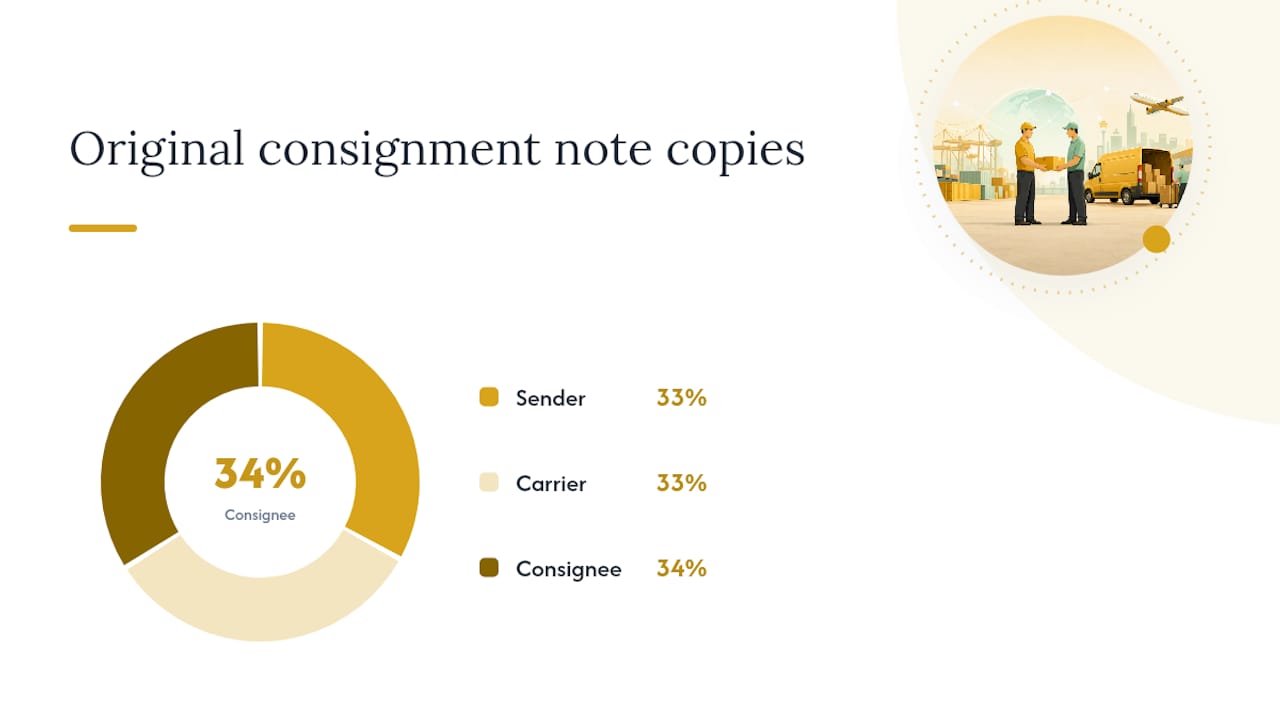
Three original copies must be produced: one for the sender, one travels with the goods for the carrier, and one accompanies the consignment to the consignee. All three must be signed by both sender and carrier at pickup.
How does the handover workflow run from sender to consignee?
A disciplined shipping handover process treats every custody transfer as a formal event with its own evidence trail.
- Pre-pickup (sender): Confirm packaging meets the carrier's requirements. Print and attach labels showing shipment ID, destination, and handling instructions. Assemble the full documentation pack. Cross-check the manifest against physical counts.
- Driver arrival: The driver inspects the consignment against the consignment note. Any discrepancy in count or visible damage must be noted as a reservation on all copies before signing. Both parties sign; the sender retains their copy immediately.
- Vehicle loading: The driver confirms goods are secured and sealed. Seal IDs are recorded on the consignment note. Photographs of the loaded vehicle are taken where cargo value or fragility warrants it.
- Depot transfer (multi-leg shipments): Each internal transfer is a custody event. Scan, sign, and timestamp every movement. A gap in the custody log can invalidate a claim. Treat every depot scan as a formal handover — not an administrative formality.
- Final delivery: The driver presents the consignment and documentation to the consignee. The consignee inspects before signing the POD. Any reservation about damage or shortage is written on the POD at this point. The consignment note travels with the freight and the signed POD marks the moment the consignor's liability ends.
- Post-delivery: The carrier retains the signed travelling copy. The consignee retains their signed copy and the POD. Photographs of any damage are taken immediately and sent to the carrier in writing.
Pro Tip: For multi-leg or depot-routed shipments, set up automated dispatch notifications at each custody event. A timestamped digital notification at every scan creates an independent evidence trail that supplements the paper record.
Copy-ready reservation wording for consignment notes and PODs
Practical templates and copy-ready reservation phrases materially increase the probability a claim will succeed by removing ambiguity at the point of handover. Use these verbatim or adapt them to your consignment.
Reservation phrases for the consignment note (at pickup):
- "Received subject to count — packages not individually verified at time of collection."
- "Outer carton of package [ID] visibly damaged at collection — contents not inspected."
- "Shrink wrap on pallet [number] torn prior to loading — condition of contents unconfirmed."
- "Goods accepted under reservation pending customs inspection."
Reservation phrases for the POD (at delivery):
- "Delivered with visible damage to outer packaging of [item/pallet ID] — contents not yet inspected."
- "Shortage noted: [X] units received against [Y] units on consignment note."
- "Hidden damage reported within 7 days of delivery as permitted under the CMR framework."
Minimal POD template fields to capture:
- Shipment ID and consignment note reference
- Date and time of delivery (timestamp)
- Receiver's full name and signature
- Condition at delivery (tick: intact / damaged / shortage)
- Free-text reservation field
- Seal number (if applicable) and whether seal was intact on arrival
Store completed PODs and consignment notes in a shared, access-controlled folder linked to the shipment record and invoice. Staff should be able to retrieve any document within two minutes of a query. For practical implementation guidance, the Sddbyaba documentation blog covers how accurate paperwork reduces disputes in practice.
What to do immediately when a shipment goes wrong
Speed is the critical factor when a consignment deviates from plan. Evidence degrades, memories fade, and claim windows close.
Immediate steps for damage or shortage:
- Do not sign the POD without recording a written reservation — an unqualified signature can waive your right to claim
- Photograph damaged packaging and contents before moving goods
- Retain the signed travelling copy of the consignment note
- Notify the carrier in writing within 24 hours; for hidden damage, written notice is required within seven days of delivery under the CMR framework
- For delay claims, written notice must be submitted within 21 days of delivery
For missing paperwork or customs holds:
- Contact the carrier's operations team immediately and request a copy of the consignment note
- For customs holds, provide the commercial invoice and commodity codes without delay
- Document every communication with timestamps
Escalation flow:
- Internal logistics or dispatch manager
- Carrier's operations or claims team (written communication only)
- Your insurer or freight insurance broker
- Legal or commercial team if the carrier disputes liability
For detailed exception-handling procedures, the emergency parcel handling guide covers deviation scenarios and resolution steps.
How does e-CMR change your handover routine?
The electronic consignment note (e-CMR) replaces paper copies with a tamper-evident digital record. Industry experts advise prioritising e-CMR because it speeds document processing, reduces administrative cost, and gives real-time transparency across the transport chain.
What to require from any e-CMR vendor or platform:
- Electronic signatures that are legally equivalent to wet signatures in the operating jurisdictions
- Tamper-evident timestamps at every custody event
- Interoperability with other carriers and platforms (TransFollow is one widely referenced interoperability standard in European road freight)
- Full audit trail exportable for claims or customs
- Offline capture mode for drivers in low-connectivity areas
- Data ownership clarity — confirm you can export and retain records independently of the vendor
Operational changes to plan for:
- Paper copies reduce, but the discipline of recording reservations does not change
- Reconciliation at depot becomes faster when scan data feeds directly into the e-CMR record
- Drivers need provisioned devices and training before go-live
Pro Tip: Pilot e-CMR on low-risk, domestic lanes first. Verify that offline capture works reliably before deploying on time-critical or high-value consignments. Check courier dispatch software options that integrate e-CMR and POD capture in a single driver workflow.
How long should you keep handover records?
Retention periods for carriage records should cover the longest of three overlapping windows: the tax authority's requirement, the insurance claim window, and the contractual limitation period. It is generally recommended to keep consignment notes, manifests, and PODs for a period that covers typical tax and commercial limitation periods, though specific contracts or regulated industries may require longer.
- Tax records: HMRC requires most business records to be kept for at least six years from the end of the relevant accounting period
- Insurance claims: Retain records for the full period during which a claim could be brought under your policy
- Contractual disputes: The Limitation Act 1980 sets a six-year limitation period for most contract claims in England and Wales; Scotland and Northern Ireland have their own rules
- e-CMR and digital PODs: Confirm with your platform vendor that records are exportable in a readable format and stored with integrity checksums
For digital archives, store records in a format that can be exported without proprietary software, and test retrieval annually. Link each archived document to the corresponding shipment ID, invoice, and any claims correspondence.
Printable handover checklist for dispatch, drivers, and warehouse teams
Dispatch staff (pre-collection)
- Confirm packaging meets carrier specification and goods are secured
- Attach labels: shipment ID, destination address, handling symbols, and barcode
- Assemble documentation pack: consignment note, manifest, packing list, commercial invoice (if applicable), ADR paperwork (if applicable)
- Cross-check physical package count against the manifest
- Pre-fill all Article 6 fields on the consignment note before the driver arrives
Drivers at pickup
- Inspect each package or pallet against the consignment note — count, condition, and marks
- Record any reservation in writing on all copies before signing
- Sign all three original copies; confirm the sender signs simultaneously
- Record seal IDs on the consignment note and apply seals
- Photograph the consignment and any pre-existing damage
- Retain the travelling copy throughout transit
Receiving staff at delivery
- Inspect the consignment before signing the POD — count packages and check for visible damage
- Record any reservation on the POD in writing before signing
- Sign the POD with full name, timestamp, and position
- Photograph any damage immediately
- File the signed POD and consignment note copy linked to the shipment record
Capture on device or paper manifest:
- Shipment ID and consignment note reference number
- Seal number and seal integrity status
- Signatures and printed names of both parties
- Timestamp (date and time)
- Condition code and free-text reservation
- Photo reference IDs
Store completed checklists in the same folder as the consignment note and invoice. The courier manifest guide explains how to link manifests to consignment records for full traceability.
Why documentation discipline pays for itself
Correct paperwork at every handover is not a compliance exercise — it is the fastest route to resolving disputes without legal cost. When a consignment note carries accurate Article 6 fields, a signed reservation, and a timestamped photograph, a damage claim that might otherwise take months to resolve can be settled in days. The carrier's liability is clear, the evidence is unambiguous, and neither party has grounds to delay.

Sddbyaba's operational teams emphasise documentation discipline as a core part of driver training, not an afterthought. The pattern we see consistently is that businesses with complete, signed paperwork at every custody event spend a fraction of the time on claims that businesses with informal handover habits do. The cost of a missed reservation or an unsigned POD is almost always higher than the cost of the goods themselves, once you factor in management time, legal fees, and the damage to supplier relationships.
Sddbyaba supports compliant handovers across every consignment type

Sddbyaba's dedicated courier service and freight haulage operations are built around the documentation standards this guide covers. Every consignment handled by Sddbyaba — from urgent same-day parcels to 26-tonne freight movements — is supported by signed consignment notes, POD capture, and chain-of-custody records as standard. Dispatch teams receive documentation checklists and reservation phrase guides as part of onboarding. For businesses that need compliant pallet distribution, time-critical courier transport, or full freight haulage with documented handovers, Sddbyaba operates nationwide across the UK with a fleet scaled to every consignment size. Contact Sddbyaba to request a documentation pack, arrange a compliance review, or get a quote for your next consignment.
Sources
Legal and regulatory references:
- Courier chain of custody requirements: documentation and accountability | Courier Authority
- Consignment notes explained: a practical guide - Sprintlaw Australia
Operational and e-CMR guidance:
Sddbyaba resources:
This article is general information, not a substitute for advice from a qualified lawyer. Consult a qualified legal professional about your own circumstances before acting on anything here.