
Courier fleet management is the end-to-end oversight of every vehicle and driver in a delivery operation, covering everything from vehicle acquisition and maintenance to real-time GPS tracking and regulatory compliance. The industry recognises five core pillars: vehicle acquisition and maintenance, route optimisation, driver management, GPS tracking, and regulatory compliance. Each pillar connects directly to three operational goals: controlling costs, maximising vehicle uptime, and hitting delivery windows consistently. Modern operations rely on telematics and AI to monitor vehicle health and reroute drivers in real time, shifting fleet management from reactive troubleshooting to proactive control.
What is courier fleet management and why does it matter?
Courier fleet management is defined as the comprehensive process of managing all vehicles involved in delivery operations, from first-mile collection through to last-mile drop-off. It is not simply tracking where vehicles are. It is the full system that keeps those vehicles moving efficiently, safely, and profitably.
The five pillars work together. Vehicle acquisition sets the foundation by matching the right vehicle type to each delivery task, whether that is a motorcycle for urgent urban parcels or an articulated lorry for bulk freight. Route optimisation reduces wasted mileage. Driver management addresses the human behaviours that directly affect fuel use, vehicle wear, and safety. GPS tracking provides the real-time visibility that makes all other decisions possible. Regulatory compliance protects the business from legal exposure.

Businesses that treat these pillars as separate functions tend to operate reactively. Those that integrate them into a unified system gain granular visibility into delivery cycles that converts problems into data and data into decisions. That shift is the competitive advantage fleet management delivers.
How does technology enhance courier fleet management?
Telematics and AI are the engine behind modern fleet management. They monitor vehicle status, adjust routes based on live traffic, and schedule predictive maintenance before breakdowns occur. The practical result is reduced fuel consumption and far fewer unscheduled stops.
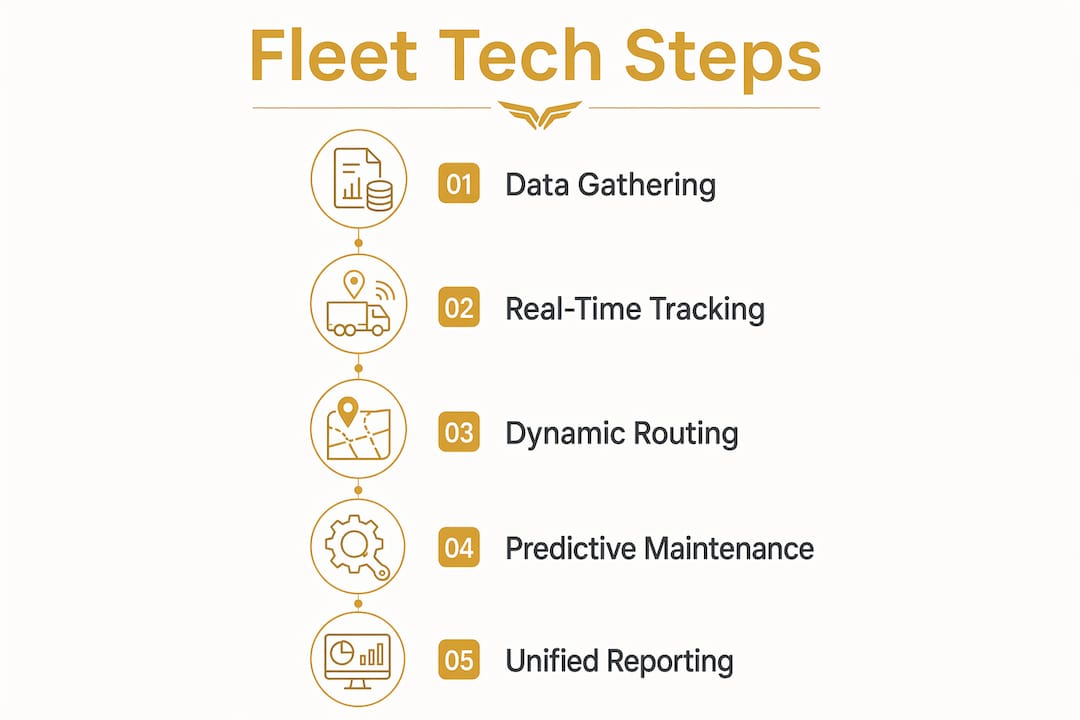
Real-time GPS tracking gives logistics managers a live map of every vehicle in the fleet. When a driver hits unexpected congestion, the system flags the delay and suggests an alternative route automatically. That responsiveness protects delivery windows without requiring a dispatcher to monitor every vehicle manually.
Predictive maintenance uses engine diagnostics and AI to identify components approaching failure. A vehicle flagged for a worn brake pad gets scheduled for service during off-peak hours rather than breaking down mid-route. That single capability alone reduces both repair costs and missed deliveries.
Unified fleet management platforms consolidate telemetry, driver reports, dashcam footage, and proof-of-delivery data into a single dashboard. Managers stop switching between disconnected tools and start making decisions from one source of truth. The reduction in manual administration is significant.
Integration with order management platforms takes this further. When a customer places an order, the fleet system receives it, assigns the nearest available vehicle, and sends the customer a live ETA. If a delay occurs, the system updates the ETA automatically. That level of responsiveness builds customer trust without adding headcount.
Key technology capabilities to look for in fleet management software:
- Real-time GPS tracking with live traffic overlays
- Predictive maintenance alerts based on engine diagnostics
- Unified dashboards combining vehicle, driver, and delivery data
- Order platform integration for automatic dispatch and ETA updates
- Driver behaviour monitoring with coaching reports
- Geofencing for automated delivery verification
Pro Tip: When selecting fleet management software, choose a platform that integrates with your existing order and warehouse systems from day one. Retrofitting integrations later costs significantly more in time and money than building them in at the start.
What are the key practices for managing drivers and vehicle maintenance?
Driver behaviour is one of the largest controllable cost variables in any courier fleet. Harsh braking, excessive idling, and aggressive acceleration all increase fuel consumption and accelerate vehicle wear. Monitoring these behaviours and providing structured coaching improves safety and cuts maintenance costs over time.
The critical distinction is treating telematics data as a coaching tool rather than a surveillance mechanism. Drivers who understand why their behaviour data matters, and who receive constructive feedback, change their habits. Drivers who feel monitored without context become disengaged. The data is the same in both cases. The management approach determines the outcome.
Structured maintenance schedules prevent the most common cause of fleet downtime: deferred servicing. A vehicle that misses an oil change or tyre rotation does not fail immediately. It fails at the worst possible moment, mid-route, with a time-sensitive delivery on board. Scheduling maintenance proactively, based on mileage and engine data, removes that risk.
Geofencing automates delivery verification by logging arrival and departure times at each stop without driver input. When a customer disputes a delivery, the geofence data provides an indisputable record of when the vehicle arrived and departed. That transparency reduces disputes and protects the business.
Routine practices that every courier fleet should implement:
- Schedule vehicle servicing based on mileage and engine diagnostics, not calendar dates alone
- Conduct pre-shift vehicle checks and log results digitally
- Set geofences at all regular delivery and collection points
- Review driver behaviour reports weekly, not monthly
- Balance vehicle utilisation to prevent overworking specific assets
- Use dashcam footage alongside telematics data for accurate incident review
Pro Tip: Pair driver behaviour reports with courier documentation practices to build a complete operational record. When both are in place, resolving disputes and auditing performance becomes straightforward.
How do route optimisation and real-time tracking improve delivery outcomes?
Automated route planning considers live traffic conditions, stop priorities, vehicle capacity, and delivery time windows simultaneously. A human dispatcher cannot process those variables at speed for a fleet of ten or more vehicles. Automated planning does it in seconds and updates continuously as conditions change.
Dynamic rerouting responds to delays in real time. If a road closure appears mid-route, the system recalculates and pushes the updated route to the driver immediately. The driver does not need to call the office. The customer receives an updated ETA without anyone manually intervening. That responsiveness is what separates well-managed fleets from reactive ones.
The fuel savings from optimised routing are direct and measurable. Fewer unnecessary miles mean lower fuel spend per delivery. Over a fleet of vehicles operating daily, the cumulative saving is substantial. For a deeper look at how routing decisions are made, courier routing mechanics explains the process in full.
| Factor | Manual route planning | Automated route planning |
|---|---|---|
| Traffic response | Reactive, requires dispatcher input | Real-time, automatic rerouting |
| Stop sequencing | Based on experience and guesswork | Calculated by priority and distance |
| Fuel efficiency | Variable, often suboptimal | Consistently lower mileage |
| ETA accuracy | Estimated, frequently wrong | Live-updated, high accuracy |
| Scalability | Breaks down beyond 10 vehicles | Handles large fleets without added resource |
Real-time tracking also serves the customer directly. Live ETA updates reduce inbound enquiries to the operations team. Customers who can see where their delivery is do not need to call. That reduction in customer service demand is a genuine operational benefit, not just a convenience feature.
What are the challenges and common pitfalls in courier fleet management?
Fragmented tools are the most common cause of operational failure in growing courier businesses. When GPS tracking, driver management, and order data sit in separate systems, operational gaps widen and costs increase. A vehicle delayed by traffic cannot trigger an automatic customer update if the tracking system does not connect to the order platform.
Siloed data prevents effective rerouting and real-time decision-making. A fleet manager working from three separate dashboards will always be behind the operational reality. By the time the data is reconciled, the delivery window has passed.
Underestimating the human element is equally damaging. Businesses that invest in technology but neglect driver coaching see limited returns. The technology identifies the problem. The coaching changes the behaviour. Both are required.
Common pitfalls and how to address them:
- Data silos: Adopt a unified platform early. Consolidating data sources is far harder after the fleet has grown.
- Neglecting geofencing: Set geofences at every regular stop from the outset. Retrofitting them after a dispute is too late.
- Deferred maintenance: Hidden costs from poorly maintained vehicles accumulate faster than the cost of scheduled servicing.
- Ignoring driver coaching: Telematics data without feedback loops produces no behavioural change.
- Scaling without structure: Adding vehicles to a fragmented system multiplies existing problems rather than resolving them.
How can small and growing courier businesses implement fleet management?
Scalable telematics solutions work for fleets of any size. A business running three vans benefits from GPS tracking and route optimisation just as much as an enterprise fleet. The difference is the starting investment, not the principle. Modern platforms are priced to grow with the operation.
The most practical starting point is integrated GPS tracking combined with basic route optimisation. Those two capabilities address the highest-cost problems immediately: wasted mileage and missed delivery windows. Driver training and structured maintenance schedules should follow as the second phase. Both require process rather than technology spend, making them accessible regardless of fleet size.
Data insights become more valuable as the fleet grows. A business with five vehicles can identify which routes consistently run late and adjust schedules accordingly. At fifteen vehicles, that same data reveals patterns across drivers, vehicle types, and time windows. The insight compounds with scale.
Selecting flexible fleet management software matters from the start. A platform that cannot integrate with new order systems or expand to cover additional vehicles will become a constraint rather than an asset. For businesses exploring courier tracking solutions, understanding the range of available options before committing to a platform avoids costly migrations later.
Pro Tip: Implement fleet management changes in phases rather than all at once. Start with GPS tracking and route optimisation in the first month. Add driver behaviour monitoring in month two. Introduce predictive maintenance scheduling in month three. Phased rollout prevents operational disruption and gives your team time to adapt.
Key takeaways
Effective courier fleet management integrates vehicle oversight, driver coaching, route optimisation, and real-time tracking into a single system to control costs and protect delivery performance.
| Point | Details |
|---|---|
| Five core pillars | Vehicle acquisition, route optimisation, driver management, GPS tracking, and compliance form the foundation. |
| Technology drives efficiency | Telematics and AI reduce fuel consumption, prevent breakdowns, and enable real-time rerouting. |
| Driver coaching is non-negotiable | Treating behaviour data as a coaching tool changes habits and cuts maintenance costs over time. |
| Unified platforms prevent gaps | Fragmented tools create operational blind spots; consolidating data into one platform removes them. |
| Small fleets benefit equally | Scalable telematics solutions deliver measurable returns for businesses of any fleet size. |
What I have learned about fleet management that most guides miss
Most articles on fleet management focus on the software. The real question is whether the people using it actually trust it.
I have seen businesses invest in excellent telematics platforms and then watch their drivers find workarounds within weeks. The technology flagged harsh braking. The managers used it to issue warnings. The drivers switched off. The data kept flowing, but nothing changed operationally. The problem was never the software. It was the management approach.
The businesses that get the most from fleet management treat the data as a shared resource. Drivers see their own reports. Managers discuss patterns in team briefings rather than individual reprimands. That shift from surveillance to coaching changes the dynamic entirely. Fuel costs drop. Vehicle wear reduces. And drivers start flagging issues proactively because they trust the system is working for them, not against them.
The second thing most guides understate is the value of real-time tracking for emergency deliveries. When a time-critical consignment is in transit, live visibility is not a convenience. It is the difference between a successful delivery and a failed one. Businesses that have that visibility can intervene. Those that do not are simply hoping.
AI-driven predictive analytics will define the next phase of courier fleet management. The businesses that build clean, integrated data foundations now will be the ones that can act on those predictions when the technology matures. The ones still running fragmented tools will be catching up.
— Ayomide
Reliable courier logistics backed by strong fleet operations
Efficient delivery operations depend on more than good intentions. They depend on the right vehicles, the right routes, and the right support behind every consignment.
Sddbyaba operates a nationwide fleet covering everything from motorcycle couriers for urgent urban parcels to articulated lorries for bulk freight. Every vehicle is deployed with the same commitment to speed, reliability, and professional communication. Whether you need a dedicated courier service for time-critical consignments or full commercial logistics support across the UK, Sddbyaba provides the operational backbone your business needs. Contact Sddbyaba today to discuss a courier solution built around your delivery requirements.
FAQ
What is courier fleet management?
Courier fleet management is the end-to-end oversight of all vehicles and drivers in a delivery operation, covering vehicle maintenance, route optimisation, GPS tracking, driver management, and regulatory compliance. Its primary goal is to control costs, maximise vehicle uptime, and deliver consignments on time.
What are the main benefits of fleet management for courier businesses?
The core benefits include reduced fuel consumption, fewer unscheduled vehicle breakdowns, improved delivery accuracy, and better customer satisfaction through live ETA updates. Businesses that integrate fleet management with their order systems also reduce manual administration significantly.
How does real-time tracking improve courier fleet performance?
Real-time tracking enables dynamic rerouting when delays occur, provides customers with accurate ETAs, and gives managers live visibility across the entire fleet. That visibility shifts operations from reactive to proactive.
Can small courier businesses benefit from fleet management software?
Yes. Scalable telematics solutions are designed to work for fleets of any size, with pricing and features that grow alongside the business. A three-vehicle operation benefits from GPS tracking and route optimisation just as measurably as a large enterprise fleet.
What is the biggest mistake in courier fleet management?
The most common mistake is running fragmented tools that create data silos. When GPS tracking, driver data, and order management sit in separate systems, operational gaps increase costs and prevent real-time decision-making. Adopting a unified platform early prevents this problem from compounding as the fleet grows.