
Vans entering central London face two separate charges: the Congestion Charge, now a daily rate set by TfL from 2 January 2026, and the ULEZ daily charge if the vehicle fails emissions standards. Outside London, many English cities run their own Clean Air Zones with their own rates. Check your registration on the official checkers and register for Auto Pay if you run electric vans, since most discounts no longer apply automatically.
TL;DR:
- The London Congestion Charge for vans will be £18 daily starting January 2026, rising to £21 if paid within three days, excluding ULEZ and regional CAZs.
- ULEZ applies daily and 24/7 to non-compliant vans based on emissions standards, with discounts only available through Auto Pay enrollment, which stops being automatic for electric vans.
- Outside London, regional Clean Air Zones have different rules and rates, so compliance checks must be done separately for each city to avoid unexpected charges.
- Route timing and consolidation can significantly reduce costs, as avoiding charging hours and optimizing multi-drop routes can lower overall charges.
- Penalties for missed payments are higher than the original charges, emphasizing the importance of timely admin tasks like updating DVLA records and maintaining Auto Pay enrollment.
Table of Contents
- What is the congestion charge for vans in 2026?
- Where and when do these charges apply?
- Discounts, exemptions and what changed for 2026
- How do you check if your van is compliant?
- How do you register and pay the congestion charge for vans?
- What does the congestion charge cost look like in practice?
- What happens if you get a penalty notice?
- How can van operators cut their charge exposure?
- What this means for operators day to day
- Prefer to skip managing these charges entirely?
- Sources
What is the congestion charge for vans in 2026?
Van operators need one number and one date more than any other: a specified daily Congestion Charge rate for any non-exempt vehicle, including vans, entering central London within the charging hours, confirmed by Transport for London as effective from 2 January 2026. Miss the payment window and it jumps to a higher charge if payment is made within the allowed grace period after travel. After that, you're into penalty territory.
That figure sits on its own, though. It doesn't include ULEZ, and it doesn't include any Clean Air Zone charge if your route touches a city outside London. The table below sets out what a van operator is realistically looking at before route planning or exemptions come into play.
| Charge type | Typical daily rate for vans | Notes |
|---|---|---|
| Congestion Charge (London) | £18 | Rises to £21 if paid within the 3-day grace window |
| ULEZ (non-compliant van) | Charge applies per TfL guidance | Based on emissions standard, not vehicle value |
| ULEZ (electric van, Auto Pay) | 50% Congestion Charge discount from 2 January 2026 | Discount only applies if enrolled in Auto Pay |
| Clean Air Zone (regional) | Varies by scheme | Checked via Gov |
The pattern worth noticing: Congestion Charge is a flat traffic management fee that doesn't care what your van emits, while ULEZ is entirely about emissions standards. A brand-new diesel van and a twelve-year-old diesel van pay the same Congestion Charge but very different ULEZ bills. Independent commentary has flagged this as one of the most common points of confusion among operators managing both charges at once.
Regional Clean Air Zones add a third layer. Birmingham, Bristol, and several other cities run their own schemes with rates set locally rather than by TfL, so a van that's exempt in London can still owe money elsewhere. Penalty levels also differ by scheme, and late payment almost always costs more than the original charge, sometimes by a significant margin. Treat the table as a starting estimate, not a final bill. Your actual daily exposure depends on where you're driving, what your van is registered as, and whether you've done the admin to unlock any discount going.
Where and when do these charges apply?
The London Congestion Charge zone covers central London, bounded broadly by the Inner Ring Road, and it's charged from 7:00 AM to 6:00 PM Monday to Friday, and 12:00 PM to 6:00 PM on weekends and bank holidays. Outside those hours, and on Christmas Day, there's no charge at all. That timing matters more than most operators realise. A courier run scheduled for 6:30 AM misses the charge entirely; the same run at 7:15 AM doesn't.
ULEZ is a different animal geographically and operationally. It covers a much larger area, stretching to the boundary of Greater London, and unlike the Congestion Charge zone, it operates every day of the year, 24 hours a day. There's no evening or weekend reprieve. A van that's ULEZ non-compliant pays whether it's making a 3:00 AM delivery run or a Sunday afternoon collection. TfL's own guidance for vans and minibuses sets out exactly which emissions standards a van needs to meet to avoid the charge, and it's worth checking against your specific registration rather than assuming based on the vehicle's age.
Clean Air Zones outside London work on a different model again, and this is where a lot of operators trip up because they assume the London rules travel with them. They don't. Birmingham's Clean Air Zone covers the city centre inside the A4540 Middleway Ring Road and operates continuously, but Bath's zone has different boundaries, different vehicle categories, and its own rate structure. Bristol runs a scheme that specifically targets certain vehicle types entering defined city zones. Each of these is a genuinely separate scheme with its own rules, and none of them recognise a London ULEZ compliance certificate as automatic proof of anything.
For a van operator running multi-drop routes across several cities in a week, that's the real headache. Your van might be fully compliant in London, comfortably inside ULEZ standards, and still liable for a charge the moment it crosses into a regional CAZ boundary that classifies emissions differently or covers a wider range of vehicle types. GOV.UK's clean air zone checker is built precisely for this problem: enter your registration and it tells you, zone by zone, whether you owe anything. It's the single most useful five-minute task a fleet manager can do before planning a week's routes.
The practical takeaway is to treat London and the regional CAZs as entirely separate compliance checks. Don't assume one clears you for the other, and don't assume vehicle age is a reliable proxy for compliance in either system. A Euro 6 diesel van bought within the last few years will usually meet ULEZ standards but should still be checked individually, particularly if there's any uncertainty about its exact emissions classification on the log book.
Discounts, exemptions and what changed for 2026
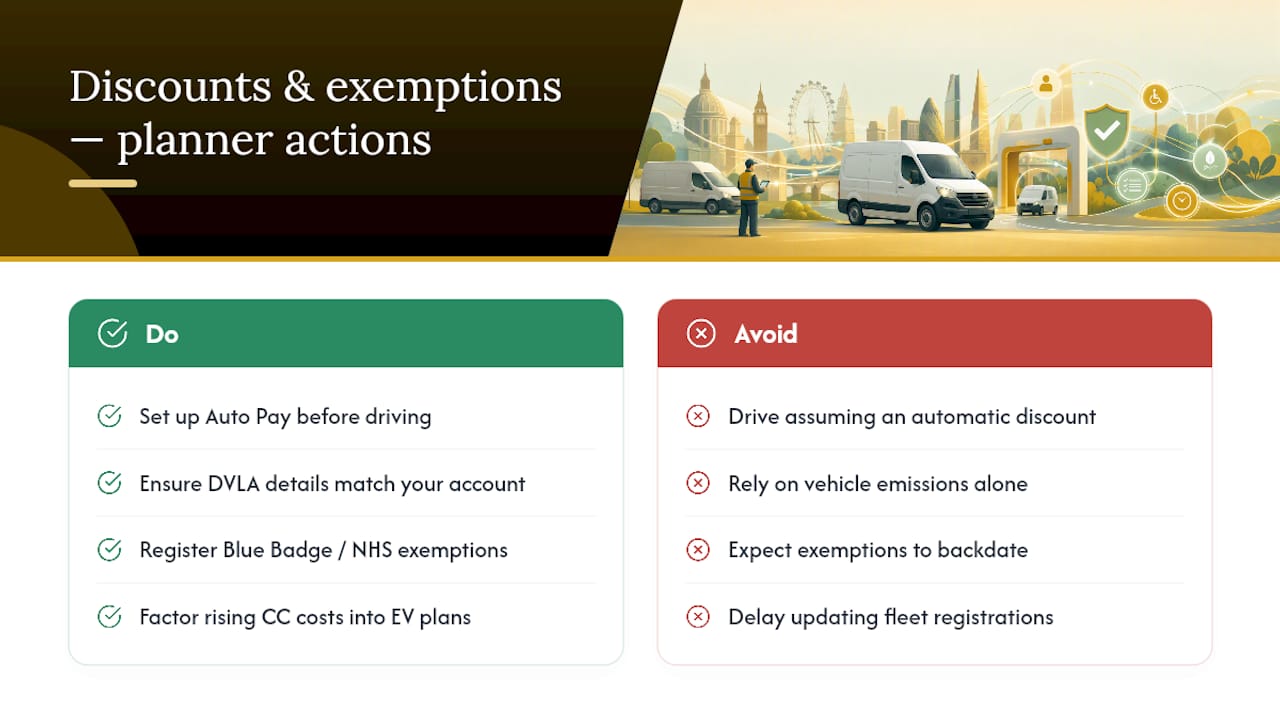
The biggest shift for van operators this year is the Cleaner Vehicle Discount restructure. Electric vans no longer get a free pass through the Congestion Charge zone. Drive in without Auto Pay set up, and there's no discount at all, regardless of how clean the van's emissions actually are.
That's a genuine change in how these systems work. Historically, compliance was something a vehicle simply had, based on its engine and emissions certificate. Increasingly, discounts sit behind an administrative gate: an account, correct DVLA-matched details, and active Auto Pay enrolment. The TfL changes page is explicit that the 50% rate isn't automatic. Miss the paperwork and you pay full price on a zero-emission van.
It also isn't a permanent arrangement. Any fleet business planning EV purchases on a five or six-year replacement cycle should factor rising net Congestion Charge costs into that calculation now, not in 2029 when the change actually lands.
A handful of exemptions remain outside the discount system entirely. Blue Badge holders can register for an exemption. Certain NHS-related journeys carry specific exemption criteria. Some car club and back-to-base fleet arrangements have separate rules depending on how the vehicle is registered and used. None of these apply automatically. Every one requires registration through the correct TfL process, and none of them backdate: get it wrong and you're paying full charges until the paperwork clears.
How do you check if your van is compliant?
Start with the TfL vehicle checker for ULEZ and the GOV.UK clean air zone service for anywhere outside London. Both need the same basic input: your vehicle registration number. That's it for the initial check, and it takes under a minute to get an answer.
Where it gets less straightforward is interpreting results that don't match what you expected. Three situations cause most of the confusion we see among fleet operators:
- A diesel retrofit that's been fitted but not yet updated on the DVLA record, so the checker still shows the pre-retrofit emissions standard.
- Gross vehicle weight thresholds that push a van from the "van" category into a heavier commercial classification with different rules entirely.
- A registered keeper mismatch, where the van is leased or recently purchased and the DVLA record hasn't caught up with the change of ownership.
Any of these can produce a checker result that looks wrong but is technically accurate based on official records. The fix isn't to ignore it. If a retrofit or upgrade genuinely happened, you need documentation from the installer and an updated DVLA record before the checker will reflect reality. If the weight classification looks off, check your V5C logbook against the exact category definitions on the GOV.UK service rather than assuming based on the van's model name.
The pitfall to avoid is assuming a van is compliant because it's newer, or because a similar model elsewhere in your fleet cleared the check. Emissions standards and weight categories vary between trims, engine options, and even production years within the same model line. Check every registration individually. It takes minutes and it's considerably cheaper than a penalty notice discovered weeks later.
How do you register and pay the congestion charge for vans?
Set up a London Road User Charging account through TfL first. This is the account that underpins Congestion Charge payment, ULEZ payment, and Auto Pay enrolment, so it's worth creating even if you're not yet sure you need the discount. Once the account exists, enrolling in Auto Pay links your vehicle registration to automatic billing and is the only route to the Cleaner Vehicle Discount for electric vans.
For operators running several vehicles, Fleet Auto Pay consolidates billing across the whole fleet under one account, which cuts down on the admin of managing individual payments and discount eligibility separately for each van. It's a meaningful time saver if you're running more than two or three vehicles regularly through the zone.
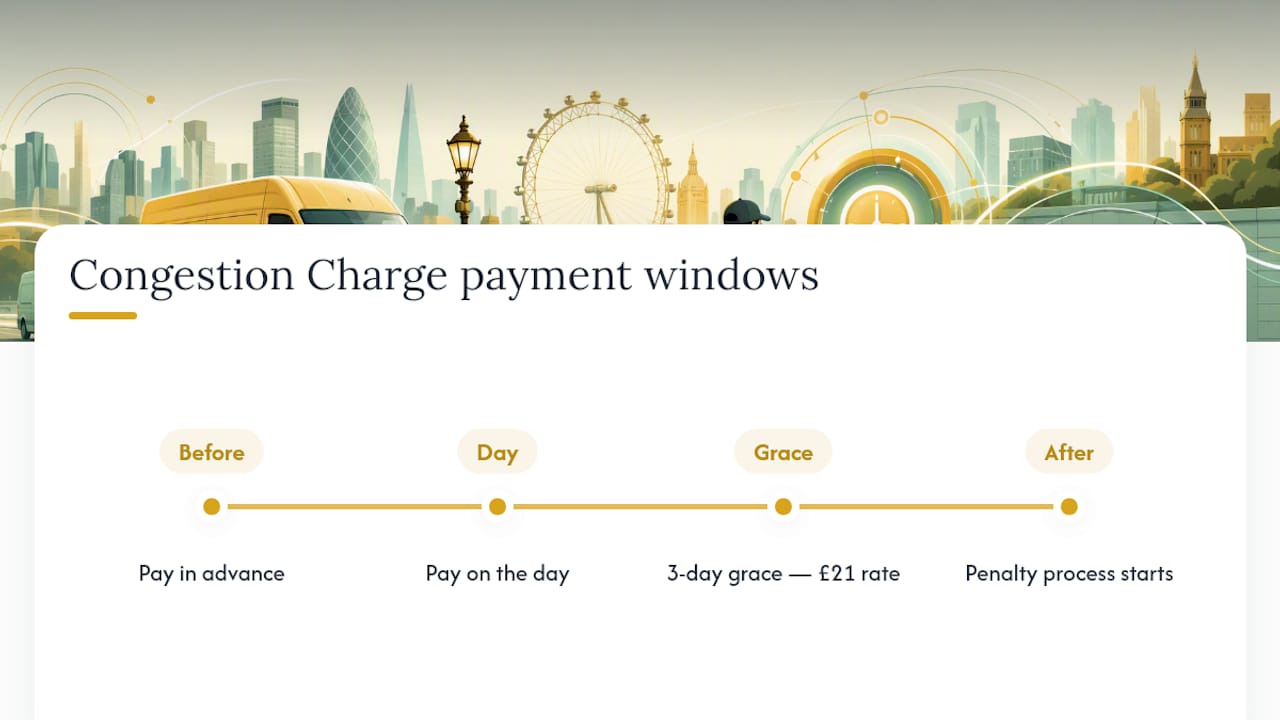
If you're paying without Auto Pay, you have three windows: pay in advance for a known future journey, pay on the day of travel, or pay within the three-day grace period at the higher £21 rate. Beyond that window, you're not paying a charge anymore, you're facing a penalty, which is a different process altogether and considerably more expensive.
Clean Air Zone and regional scheme payments run through separate portals, generally reachable via the GOV.UK clean air zone service, which links out to the specific city's payment page. Tunnel charges, such as those on the Dartford Crossing or the Mersey Gateway, have their own dedicated payment systems entirely separate from both TfL and GOV.UK CAZ services. Bookmark each one relevant to your regular routes rather than searching fresh each time a payment's due.
What does the congestion charge cost look like in practice?
Numbers make this real in a way percentages don't. Take a diesel medium van, non-ULEZ compliant, making a single delivery run into central London during charging hours. That's the standard daily Congestion Charge amount, plus a separate ULEZ daily charge on top because the vehicle fails emissions standards. Miss both payment windows and you're not looking at a modest late fee, you're looking at penalty notices for each charge separately, which stack fast.
Now compare an electric van on the same route. The same electric van without Auto Pay enrolment pays the the full standard Congestion Charge without discounts, no discount, because the 50% rate genuinely depends on active enrolment, not on the vehicle simply being electric. That single admin gap costs £9 a day, which adds up across a working month fast.
A third scenario worth planning for: a route that touches a tolled tunnel and a regional Clean Air Zone on the same day, on top of the London charges. A briefing from Cross River Partnership on charge overlaps makes the point clearly: these schemes were designed independently of one another, so nothing stops them stacking on a single multi-leg journey. A van crossing from an external CAZ, through a tunnel, and into central London in one day can rack up three or four separate charges before the delivery itself is even accounted for. Map the full route before assuming you know the total.
What happens if you get a penalty notice?
Penalty levels for missed Congestion Charge, ULEZ, and CAZ payments are all higher than the original daily rate, and most schemes offer a reduced rate if you pay within a set number of days from the notice date rather than waiting it out. Ignore it entirely and the amount typically increases further.
Enforcement runs almost entirely on Automatic Number Plate Recognition cameras, which capture registration plates at zone boundaries and cross-reference them against DVLA vehicle records and payment accounts. There's no manual check at the roadside; the system either finds a matching payment or it doesn't, which is exactly why keeping your DVLA details current matters as much as the payment itself.
If a notice arrives, don't ignore it and don't assume it's an error without checking first. Verify the date, time, and registration against your own records. If you genuinely paid and the charge shows unpaid, contact TfL or the relevant local authority directly with your payment reference. If the charge is correct but you missed it, pay within the reduced-rate window immediately rather than waiting, since the cost only rises the longer it sits.
How can van operators cut their charge exposure?
Route planning is the cheapest lever available, and most operators underuse it. Consolidating multiple central London drops into a single zone entry, rather than three separate trips across a day, can turn three Congestion Charge liabilities into one. Scheduling non-urgent runs before 7:00 AM or after 6:00 PM avoids the London Congestion Charge window entirely, though remember ULEZ doesn't offer that same escape since it runs all day, every day.
Fleet composition is the second lever, and it's a slower one. Prioritising compliant or electric vans for routes that regularly enter charged zones reduces per-journey cost immediately, and it's worth checking current retrofit schemes and any local scrappage incentives before committing to a full vehicle replacement. A practical vehicle selection guide is a useful starting point when weighing which van category actually suits your delivery mix, rather than defaulting to whatever's already on the yard.
Administrative controls matter just as much as the vehicles themselves:
- Enrol every eligible fleet vehicle in Auto Pay rather than paying individually, which removes the risk of a missed manual payment.
- Keep DVLA records for each vehicle current, especially after any change of keeper, retrofit, or reclassification.
- Run a quarterly compliance check on every registration rather than assuming last year's status still holds.
- Centralise CAZ and tunnel payment tracking so no regional charge slips through unnoticed on a multi-city route.
Pro Tip: Model your 2030 costs now, not later. If you're planning a fleet replacement cycle around today's EV discount rate, you'll be budgeting against a number that won't exist by the time the vans are due for renewal.
Keeping vehicles properly serviced also plays into this indirectly. A well-maintained fleet is easier to verify against emissions standards and less likely to throw up a surprise reclassification. Our own guide to fleet maintenance covers the basics worth building into a regular schedule.
What this means for operators day to day
Running vans into central London has become a genuine planning exercise rather than a rounding error on a job quote. The gap between a compliant electric van on Auto Pay and a non-compliant diesel van without it isn't marginal anymore. It's the difference between roughly £9 a day and £18 plus a full ULEZ charge, and that difference multiplies across a working month fast.
What surprises most operators isn't the rate increase itself, it's how much of the saving now depends on admin rather than the vehicle. A clean, modern electric van gets no financial credit for being clean if the Auto Pay account isn't set up correctly, or if the DVLA record still lists the previous keeper. Accurate records have quietly become as valuable as the vehicle itself.
If you run a fleet, the one-week task worth doing now is straightforward: check every registration against the TfL and GOV.UK checkers, confirm Auto Pay enrolment matches current DVLA details for each vehicle, and map your regular routes against every zone they cross. Most surprise penalty notices trace back to one of those three gaps, and all three are fixable in an afternoon.
— Ayomide
Prefer to skip managing these charges entirely?
Every charge, discount, and compliance check covered above assumes you're running the van yourself. Sddbyaba offers a way round that admin altogether: same day courier and dedicated vehicle transport across the UK, without your business having to register vehicles, track Auto Pay enrolment, or monitor DVLA records for compliance changes.
For businesses that need goods moved into central London or across multiple cities regularly, outsourcing that specific journey to a dedicated courier service means someone else carries the compliance burden, not you. Sddbyaba runs a fleet from small vans through to Luton vans and up to 26 tonne trucks, matched to the size and urgency of the job, with commercial logistics support for businesses that need this handled on a regular schedule rather than as a one-off. If you're weighing up the true cost of running charged journeys yourself against handing them to a specialist, get a quote from Sddbyaba and compare it against your current fleet costs directly.