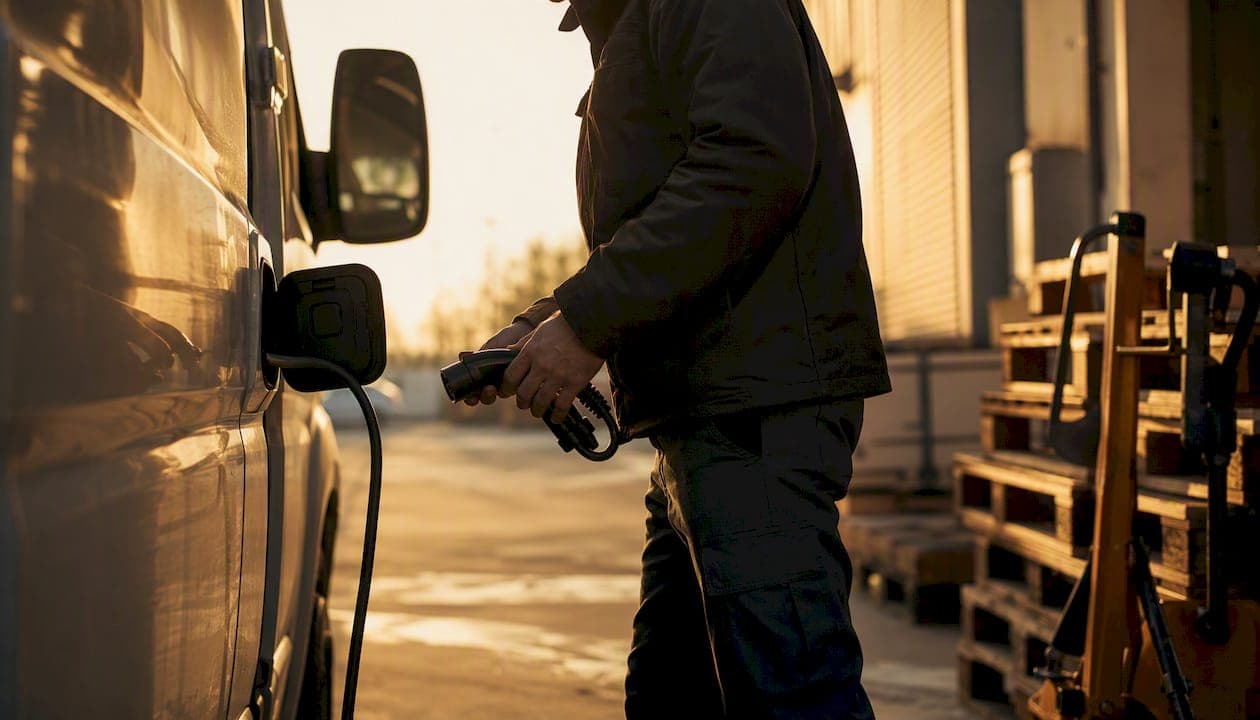
Call your carrier now, quote your booking reference, and have your load's weight, dimensions, pallet count and photos ready to read out. That single call, backed by accurate data, is how you arrange an emergency vehicle upgrade request without losing hours to back-and-forth quoting. Dispatchers cannot price or allocate a larger vehicle without those figures, so the fastest route from van to Luton, 7.5 tonne, 18 tonne or artic starts with a data-ready phone call, not an email that sits in a queue.
Sddbyaba treats these calls as priority dispatch decisions. Give the operator your booking reference, load specifics and photos, and ask directly for a "dedicated vehicle upgrade" rather than a general enquiry. That phrase tells the desk you need an exclusive vehicle allocated now, not a slot on a consolidated run.
- Have your booking reference and quote number to hand before dialling.
- State weight, external dimensions and pallet or piece count in the first thirty seconds.
- Attach or email photos of the load and site access straight after the call.
- Ask for a vehicle reference number and estimated arrival time before hanging up.
If your fleet provider has a suitable vehicle already in the region, same-day upgrades typically confirm within one to three hours of the call. When mobilisation of a specialist vehicle or driver reallocation is needed, expect a window stretching into the next available slot or the following day. If the call goes to voicemail, leave your booking reference and callback number, then immediately send the follow-up email with your data packet attached. Do not wait for a callback before sending it.
Key Takeaways
Securing a same-day vehicle upgrade depends on giving the carrier accurate weights, dimensions and photos upfront, since incomplete data is the most common cause of quoting delay.
| Point | Details |
|---|---|
| Call first, email second | Phone the carrier with your booking reference and load data, then follow up in writing immediately. |
| Prepare the full data packet | Weights, dimensions, pallet count, access constraints and photos all need to be ready before you dial. |
| Match the vehicle to the load | Request the smallest vehicle that legally and physically fits the job to avoid delivery rejections. |
| Pre-approve a spend band | Giving your logistics lead upfront authority to approve cost removes delay during the live call. |
| Sddbyaba offers dedicated upgrade dispatch | Provide your booking reference and load packet to Sddbyaba for a fast quote across vans through to artic vehicles. |
Table of Contents
- How do you arrange an emergency vehicle upgrade request?
- What will the operator check before approving your upgrade?
- Which upgraded vehicle should you request?
- What does an emergency upgrade cost and how long does it take?
- Build a simple if-then playbook for your team
- How Sddbyaba handles emergency vehicle upgrade requests
- An operations note on avoiding upgrade delays
- Sources
How do you arrange an emergency vehicle upgrade request?
The process comes down to three moves: call, confirm, follow up in writing. Each step removes a reason for the operator to delay your quote.
The phone script that gets a fast answer
Open with urgency and your reference number together, not separately. Dispatchers triage by information density, so front-load the details that let them check availability while you're still talking.
- "This is [name] from [company], calling about booking reference [X]. I need to upgrade this to a [Luton van / 7.5 tonne / 18 tonne / artic] today."
- State the reason in one sentence: extra pallets, oversized item, or a tighter delivery window than originally booked.
- Read out weight, external dimensions, pallet count, and whether the load is stackable or floor-loaded.
- Ask: "Can you confirm vehicle availability and a reference number now, or do you need me to email photos first?"
- Before ending the call, confirm the new vehicle type, estimated collection time, and any additional cost.
If the call cannot complete the booking there and then, send an email immediately with the subject line "Urgent vehicle upgrade — Booking Ref [X]". Include the same figures you read out on the phone, attach photos, and state your required collection window in the first line, not buried in a paragraph.
Building this information into a repeatable checklist matches what logistics teams call a quote-ready data packet: a single document with everything a carrier needs to retender or upgrade a job without a second phone call, a structure supported by Shipit's mode-switch playbook guidance.
- Booking reference and original vehicle type booked.
- Number of pallets or pieces, plus precise weights (total and per pallet where relevant).
- External dimensions: length, width, height.
- Stacking information and whether the load is floor-loaded.
- Site access constraints: narrow lanes, low doorways, restricted loading bays.
- Equipment needed: tail lift, ramp, HIAB or crane, pallet truck assistance.
- Proof of delivery instructions and the site contact's mobile number.
Pro Tip: Photograph the pallet layout and the delivery site access before you call. Having images ready to send the moment they're requested removes the single biggest cause of quoting delay: the carrier waiting on visual confirmation of load shape or access width.
What will the operator check before approving your upgrade?
Every upgrade request goes through the same mental checklist on the other end of the phone, whether the person says so or not. Knowing what they're checking lets you answer before they ask.
Availability comes first. The operator checks fleet mix in your region and whether a driver has remaining hours under working-time rules. Ask directly: "What's your nearest available [vehicle type] and driver?" rather than waiting to be told there's nothing free.
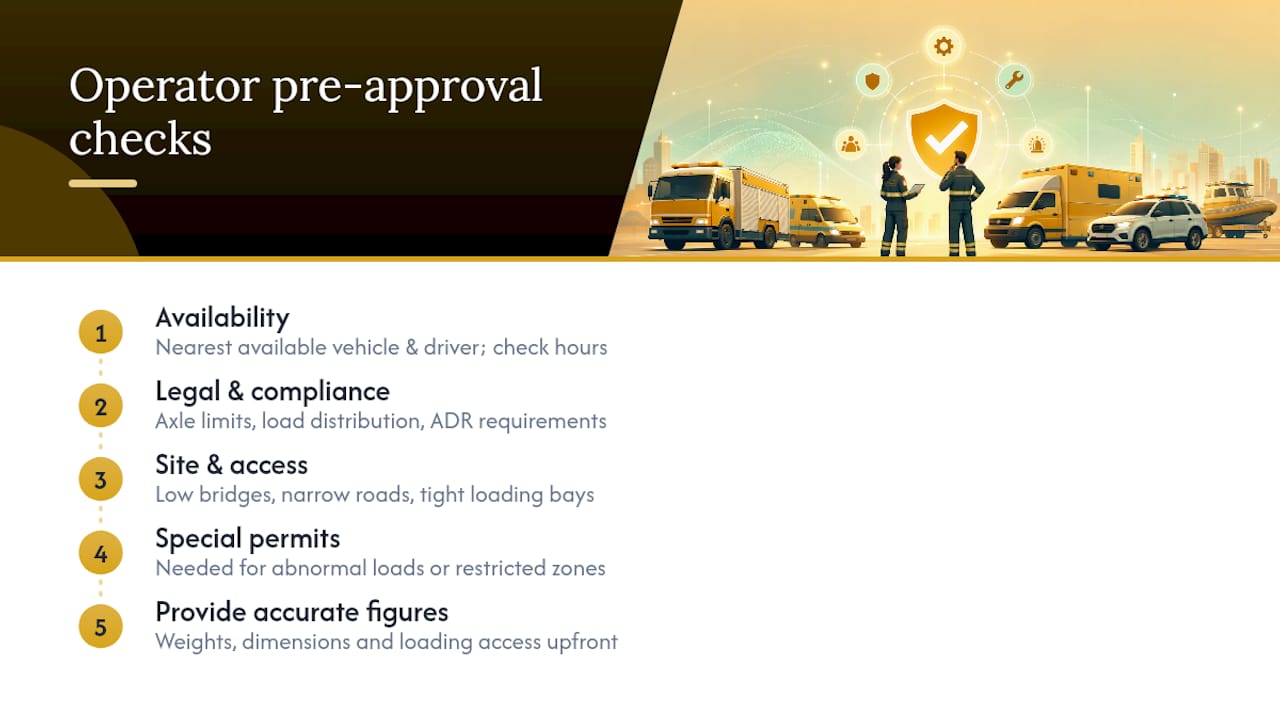
Legal and compliance checks follow close behind. Axle weight limits, load distribution, and ADR requirements for hazardous goods all get reviewed against the figures you provide. A load that exceeds legal axle limits on the vehicle you've requested will trigger a size-up recommendation from the operator, not a straight refusal, so give accurate weights rather than rounded estimates.
Site and access checks matter just as much as the vehicle itself. Low bridges, narrow site roads, tight loading bays and fixed delivery appointment windows all affect which vehicle can physically complete the job. An 18 tonne rigid that can't turn into a site access road is a wasted upgrade.
Missing dimensions, insufficient loading access, and load weights that exceed legal limits for the requested vehicle are the three issues that most commonly stall a same-day upgrade at the approval stage. Providing accurate figures upfront removes each one before it becomes a blocker.
Special permits, such as those needed for abnormal loads or restricted urban zones, are the fourth red flag. If your consignment is oversized or unusually heavy, ask the operator directly whether a permit applies. It's cheaper to find out on the call than after the vehicle is dispatched.
Which upgraded vehicle should you request?
Choosing correctly the first time avoids the embarrassment of a driver turning up to a job that's too big for the van and too awkward for a curtain-sider.
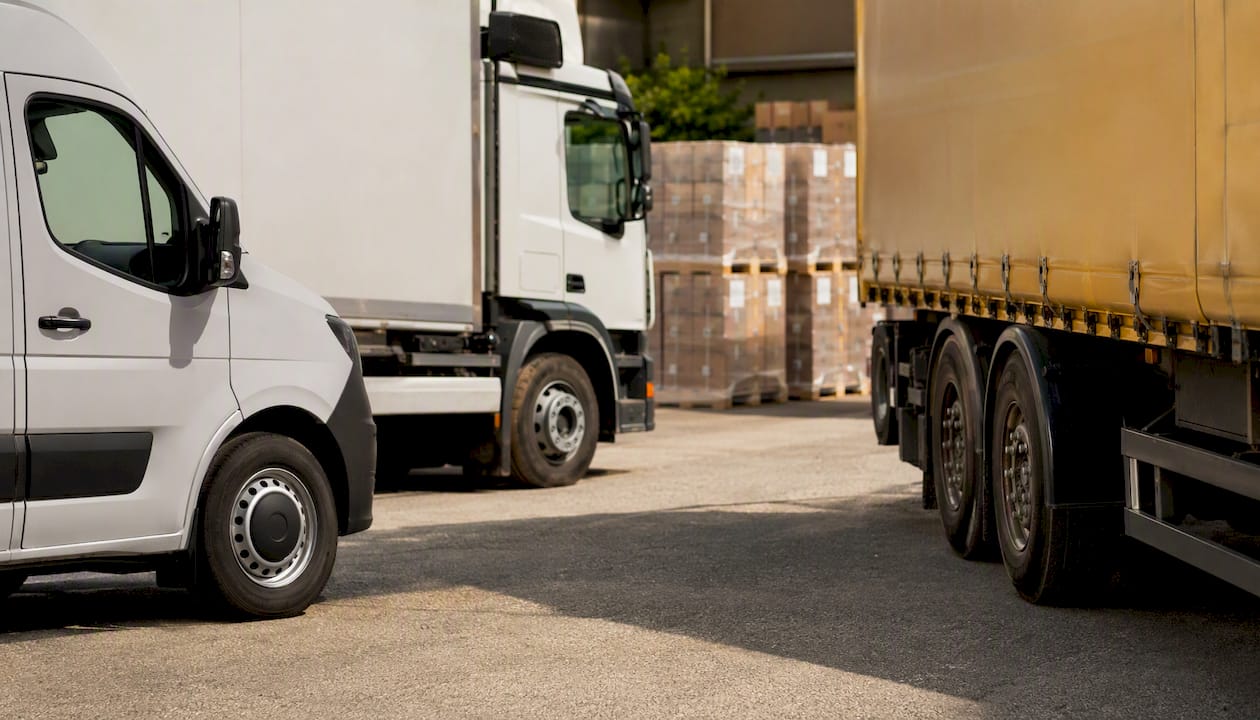
A small van suits parcels and light pallets, typically one to two standard pallets or loose boxed items with no special handling. Once you're beyond two pallets or the items won't fit through a van's side door, ask for the next size up rather than trying to force a fit.
A Luton or box van handles three to six pallets or bulky, non-palletised items like furniture and appliances, thanks to the box body and usually a tail lift. This is the most common upgrade requested when a standard courier van turns out too small on the day.
A 7.5 tonne truck covers roughly six to ten pallets and is the standard step-up for retail restocks, construction materials and general commercial freight that's outgrown van capacity. Most urban and semi-rural delivery routes remain accessible at this size.
An 18 tonne rigid suits ten to twenty-six pallets, heavier machinery, or loads needing a tail lift and pallet truck combination. Confirm site access before requesting this size. It's the point where low bridges and narrow lanes start ruling out delivery routes that a smaller vehicle could manage.
An artic or dedicated vehicle is the right call for full trailer loads, high-value time-critical consignments, or anything needing a HIAB, crane offload, or curtain-sider access from the side. Dedicated vehicle transport assigns one vehicle exclusively to your shipment, giving direct routing and immediate dispatch rather than a slot in consolidated freight, which Cemson Logistics notes cuts the delay risk that comes with shared loads. Construction sites frequently need this tier, and our construction emergency freight guide covers the access and equipment considerations specific to that sector in more detail.
What does an emergency upgrade cost and how long does it take?
Cost and timeline both hinge on the same variables: vehicle size, distance, and how much notice the carrier has.
The main cost drivers are vehicle type, the distance to be covered, an urgent mobilisation premium for same-day requests, potential driver overtime, and any specialist equipment such as a crane or tail lift. A dedicated vehicle costs more than shared or consolidated freight, but for time-critical or high-value consignments, the reduction in delay risk usually justifies that premium.
| Timeline band | Typical scenario | What to expect |
|---|---|---|
| Within 1 to 3 hours | Vehicle already available in region | Fastest confirmation, standard urgent surcharge |
| Same day, later slot | Vehicle needs repositioning | Confirmation within hours, moderate mobilisation cost |
| Next day | Specialist vehicle or equipment required | Longer lead time, higher mobilisation premium |
| — | Bespoke or highly specialised vehicle needed | Rare for standard upgrades, priced individually |
For most urgent upgrades, carriers accept card payment over the phone, BACS transfer for account customers, or existing account credit terms if you're already an established customer. New or one-off customers should expect a quick credit check or upfront card payment before dispatch is confirmed. Having your card details or account number ready when you call shaves minutes off the confirmation process.
Build a simple if-then playbook for your team
A short, written playbook removes the guesswork from urgent decisions and stops the same argument happening every time a job needs upgrading. The principle, as outlined in Shipit's mode-switch playbook framework, is to define decision owners, required evidence, and cost thresholds in advance, so nobody's improvising during a live crisis.
- Set thresholds. If pallet count exceeds six, request a 7.5 tonne. If weight exceeds the legal limit for that vehicle, request an 18 tonne. If the delivery deadline is under four hours away, request a dedicated vehicle regardless of load size.
- Assign roles. The on-call logistics lead approves any upgrade under a pre-agreed spend band. The bookings agent gathers and sends the data packet. The site contact confirms access and receiving hours.
- Confirm in writing. Once the carrier agrees the upgrade, send a short confirmation email restating the vehicle type, reference number, and agreed cost, so there's a paper trail if anything's disputed later.
- Internal escalation template: "Upgrade needed on [booking ref] — approved under [spend band] by [name]. Vehicle: [type]. ETA: [time]."
- External confirmation email: "Confirming upgrade to [vehicle type] on booking [ref], agreed cost [amount], collection [time]. Please confirm driver ETA and vehicle reference."
Pro Tip: Pre-approve a spend band with finance before an emergency happens, not during one. A logistics lead who already has authority to approve up to a set amount can confirm an upgrade in the same call, rather than waiting on a manager's sign-off while the vehicle slot disappears.
Case study evidence backs the idea that fast mobilisation is achievable when a supplier coordinates sourcing and delivery under one plan. Mac's Truck Sales delivered a bespoke crane truck in four weeks using stock chassis and close project management, and Total Vehicle Transformation has shown that combining upfitting and transport coordination can shrink multi-week schedules to days when the job demands it. The same logic applies at the delivery-day scale: centralising decisions with one provider, rather than juggling multiple carriers, is what cuts hours off an upgrade.
How Sddbyaba handles emergency vehicle upgrade requests
Sddbyaba runs emergency upgrade requests as dedicated dispatch decisions, not general enquiries sitting in a queue. Give our team your booking reference, load weights, dimensions and photos, and we'll quote against a fleet range running from small vans through Luton, 7.5 tonne, 18 tonne and up to artic and dedicated vehicles, so you're not passed between providers while the clock runs down.
Response times for emergency requests are built around the same urgency this article has walked through: a data-ready call gets you a fastest-possible quote, while a call with missing figures means we come back to you before we can confirm anything. We accept card payment, BACS and account terms for verified customers, so payment shouldn't be the thing holding up your vehicle.
If your load needs heavier haulage, our freight haulage services cover the 7.5 tonne to artic range directly, and our dedicated courier service is built specifically for the exclusive-vehicle, direct-routing scenario this guide recommends for time-critical jobs. Businesses that hit this situation repeatedly are often better served by an account arrangement through our commercial logistics page, which removes the one-off credit check step entirely. For a straightforward same-day booking or upgrade quote right now, request your quote through Sddbyaba with your booking reference and load data to hand.
An operations note on avoiding upgrade delays
The single biggest delay I see in urgent upgrade calls has nothing to do with vehicle availability. It's the caller not knowing the weight or dimensions of their own load. Operators can usually find a vehicle. What they can't do is quote a job blind, and every minute spent chasing missing figures is a minute the actual vehicle isn't moving toward you.
Teams that keep a standing data packet, updated per job rather than assembled under pressure, get upgrades confirmed noticeably faster than teams reconstructing pallet counts from memory on the phone. The pre-approved spend band matters just as much. I've watched upgrade requests stall for twenty minutes waiting on a manager's sign-off, by which point the vehicle slot had gone to another customer. Decide the threshold before the emergency, not during it.
Whatever you take from this guide, record your booking reference the moment you get it, and confirm payment terms before the vehicle is dispatched, not after. That single habit resolves more disputes than any amount of after-the-fact troubleshooting.
Sources
The playbook structure in this guide draws on Shipit's mode-switch playbook framework, which sets out how if-then decision rules and a quote-ready data packet speed up carrier retendering. The case for requesting a dedicated vehicle for time-critical loads comes from Cemson Logistics' analysis of urgent freight benefits, covering direct routing and reduced delay risk.
Evidence that specialist vehicles can be mobilised faster than expected comes from two rapid-turnaround case studies: Mac's Truck Sales' four-week bespoke build and Total Vehicle Transformation's fleet upfitting case study, both showing that coordinated sourcing and delivery compress standard timelines.
- RAPID 4 Week Truck Turnaround for Wrights of Twycross | Mac's Truck Sales
- Fleet Upfitting & Transport Completed on tight timeline | Total Vehicle Transformation