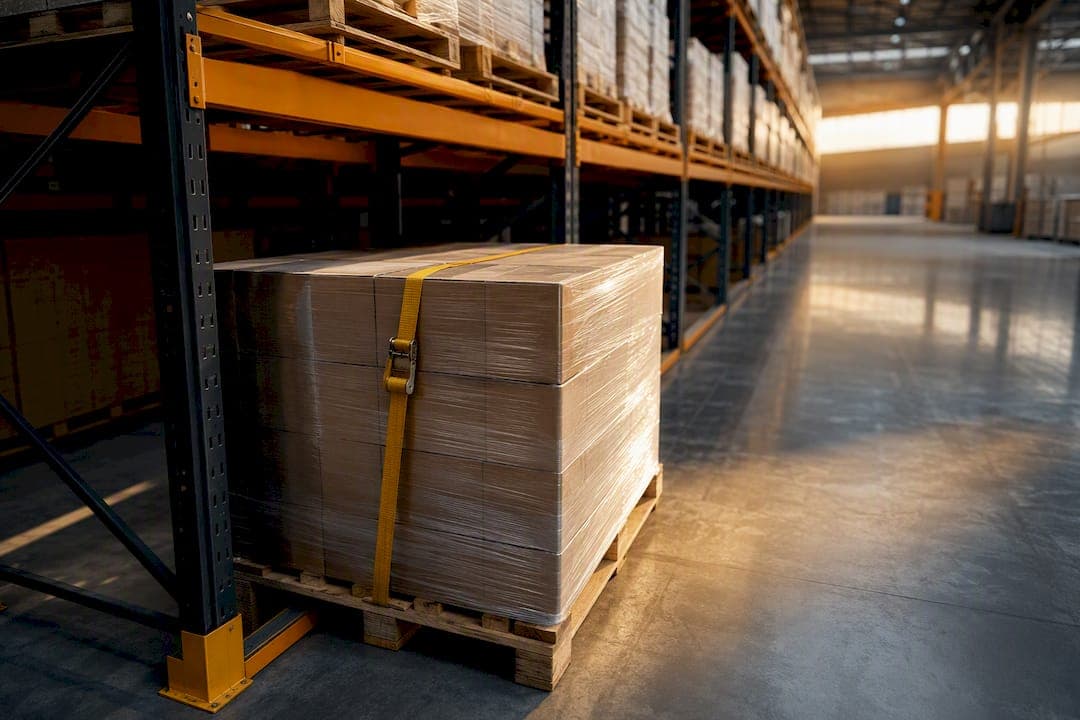
A standard UK full pallet typically carries a load in the range commonly quoted by industry for full, half and quarter pallets. Half and quarter pallets carry proportionally less load. Those figures only hold if you check the manufacturer's stamped rating and confirm whether it's static, dynamic or racking load, since a pallet good for 1,500 kg on the ground may only take 1,000 kg once racked. Damaged boards, moisture, and wooden pallets crossing into the EU under ISPM15 rules can all knock that number down further, highlighting the importance of eco-friendly packaging choices for UK businesses.
TL;DR:
- Pallet load limits depend on whether the pallet is static, dynamic, or in racking, with rated capacities decreasing under movement and support restrictions.
- Concentrated or point loads significantly lower a pallet’s safe capacity, especially if boards are damaged or timber is moisture-affected, requiring regular inspection.
- Vehicle payload and axle weight limits, including pallet tare weight, are critical factors in calculating the maximum cargo that can be transported safely.
- Racking conditions can reduce the load capacity of pallets, especially when stacking high or using drive-in racking, and condition checks are essential for safety.
- Wooden pallets crossing borders must have a legible ISPM15 treatment mark to avoid rejection, destruction, or costly delays at customs.
Table of Contents
- Understanding pallet weight limits UK: the numbers that matter
- How does load type change what a pallet can safely carry?
- What vehicle limits affect how much you can carry per pallet run?
- How high can pallets be stacked, and when does racking change the rules?
- Wooden pallets crossing borders: what does ISPM15 actually require?
- A practical checklist for calculating pallet weight before you ship
- Applying pallet weight guidance in same day and pallet delivery operations
- Why accurate weight checks save more than they cost
- Get heavy pallet consignments moved safely and on time
- Where to check the detail yourself
- Sources
Understanding pallet weight limits UK: the numbers that matter
Businesses moving freight need three numbers, not one. A standard four-way timber pallet carries different weight depending on whether it's sitting still, being moved, or stacked in a warehouse rack.
| Pallet type / rating | Typical maximum load |
|---|---|
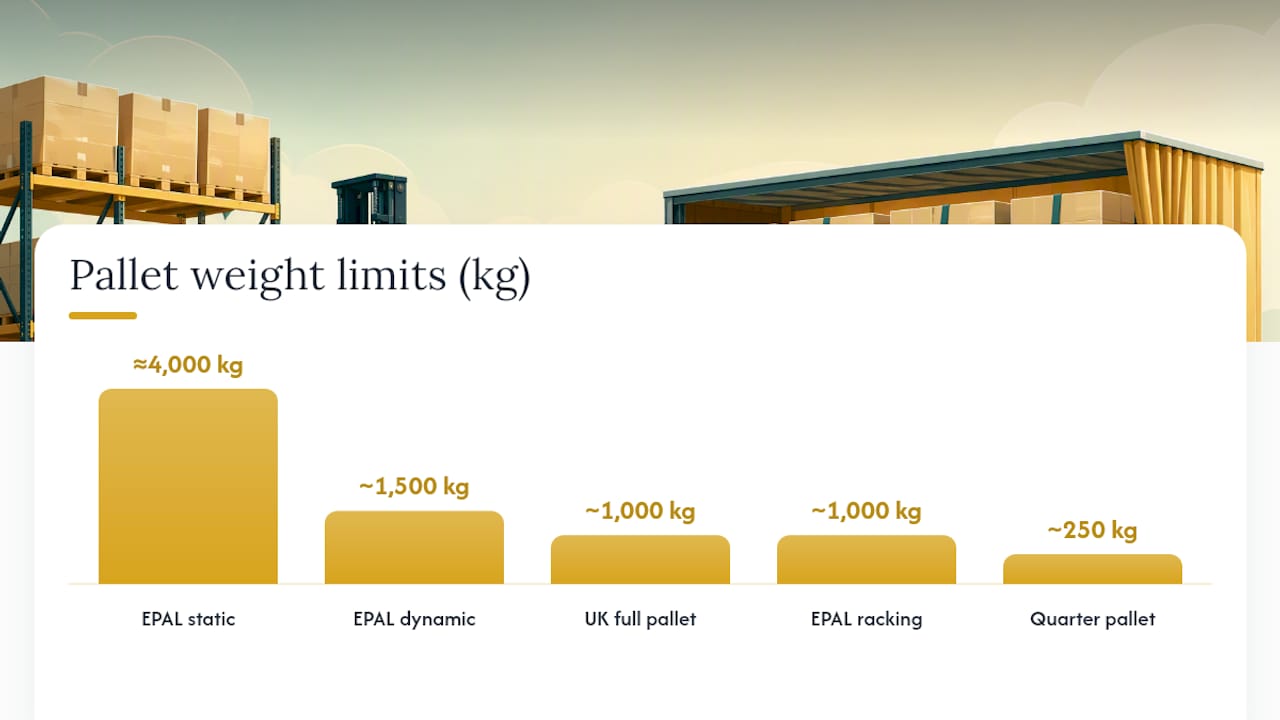
| UK full/standard pallet (working load) | typically around 1,000 kg |
| Half pallet | typically half the full pallet load |
| Quarter pallet | typically around 250 kg |
| Euro/EPAL static load | up to ~4,000 kg |
| Euro/EPAL dynamic load | up to ~1,500 kg |
| Euro/EPAL racking load | up to ~1,000 kg |
Static load is the figure for a pallet standing still and evenly supported, such as on a warehouse floor. Dynamic load covers the pallet while it's being lifted, moved or transported, and it's always lower because forklift movement and vehicle vibration add stress the pallet doesn't feel when static. Racking load is the lowest figure of the three because the pallet is only supported at its edges rather than across its full base, which is exactly the scenario where sagging and creep deflection show up over time.
If a pallet carries a stamped EPAL or manufacturer rating, use that number over any generic industry figure. UK pallet size guidance varies by construction and grade, so a generic table gets you close, but the mark on the pallet itself is the one that actually applies to that unit.
How does load type change what a pallet can safely carry?
The weight a pallet can carry safely depends heavily on how that weight sits on the deck, not just how much of it there is. An evenly distributed load of 1,000 kg spread across the full pallet footprint behaves very differently from the same 1,000 kg concentrated under a single machine base or a stack of steel bar.
- Evenly distributed loads spread stress across all deckboards and stringers, letting the pallet perform close to its rated capacity.
- Point loads or concentrated loads put the full force through a small contact area, which can crack boards well below the pallet's headline rating.
- Damaged or repaired boards reduce capacity regardless of load type. A cracked stringer or a replaced deckboard is a weak point that HSE's PM15 guidance flags as a check-before-use item.
- Moisture damage softens timber and lowers safe working load over the pallet's working life.
- Mixed pallet sizes on the same rack level create instability that has nothing to do with individual pallet rating, according to HSE pallet safety guidance.
Where a load is concentrated rather than spread, a sensible approach is to derate the pallet's working load by a visible margin and inspect more frequently, referencing BS ISO terminology on pallet dimensions and load classification where suppliers provide it.
Pro Tip: Before loading anything with a small footprint (compressors, pumps, stacked drums), add a load-spreading board across the pallet deck. It costs almost nothing and prevents point-load damage that a headline weight rating won't warn you about.
What vehicle limits affect how much you can carry per pallet run?
Pallet weight limits only tell half the story. The vehicle carrying those pallets has its own gross weight, payload and axle limits, and pallet tare weight eats into that payload before a single kilogram of cargo goes on.
- Check the vehicle's gross weight and unladen weight to establish available payload; a 12 tonne vehicle with a 4.5 tonne unladen weight typically has around 7.5 tonnes of usable payload once you allow for fuel and driver.
- Subtract pallet tare weight from that payload. An empty timber pallet typically weighs 20 to 30 kg, so six pallets add up to 180 kg of dead weight before cargo is counted.
- Multiply remaining payload by realistic pallet loads. Six pallets at 1,000 kg each is 6,000 kg of cargo, which fits comfortably within that 7.5 tonne payload alongside restraint equipment.
- Confirm axle weight distribution, since a vehicle can be within gross weight limits yet still overload a single axle if pallets are loaded unevenly along the deck. Fleet operators managing axle weight limits know this is a separate check from gross payload.
- Secure the load properly. HGV operators carry legal responsibility for restraint, and unsecured pallets are a stability risk regardless of how accurately the payload sums were done.
How high can pallets be stacked, and when does racking change the rules?
Racking load is where most weight-limit mistakes happen, because the figure that applies on the warehouse floor doesn't apply once a pallet sits on a beam.
- A pallet rated for 1,500 kg dynamic load might only carry 1,000 kg once placed in racking, since the load is supported only at the edges rather than across the full base.
- Stacking height guidance from HSE's PM15 publication stresses matching stack height to pallet condition and floor stability, not just to warehouse ceiling clearance.
- Drive-in racking carries particular risk: pallets that sag or creep under sustained load over weeks or months can jam or collapse, and this deflection is easy to miss on a quick visual check.
- Consult BS ISO pallet standards or the pallet manufacturer directly when planning stacking heights for anything beyond standard two or three-high floor stacking.
- Build periodic racking inspections into warehouse routines, since pallet condition degrades gradually and won't always announce itself before failure.
Wooden pallets crossing borders: what does ISPM15 actually require?
Every wooden pallet moving between Great Britain and the EU or Northern Ireland has had to comply with ISPM15 rules since 1 January 2021. That means heat treatment of the timber and a legible, correctly formatted mark burned or stamped onto the pallet.
- Wood packaging material that isn't ISPM15 compliant can be rejected at the border, destroyed, or returned at the sender's expense, none of which is a cheap mistake to make on a full lorry load.
- The definition of wood packaging material covers pallets, crates and dunnage, so check every timber component in a mixed consignment, not just the main pallet.
- Before despatch, physically check the ISPM15 mark is legible on every wooden pallet in a cross-border load, not just a sample.
- Confirm the mark shows the correct treatment code and country of origin, since faded or partial marks cause the same rejection risk as no mark at all.
A practical checklist for calculating pallet weight before you ship
Getting the sums right before the vehicle leaves the yard avoids almost every weight-related problem that shows up later.
- Record the pallet's own tare weight and add it to your running total rather than assuming it's negligible.
- Sum the actual cargo mass for everything going on that pallet, including any wrapping, strapping or edge protection.
- Check the pallet's stamped rating where one exists, and default to the standard figures only when no mark is present.
- Derate for concentrated loads or visible damage. A point load or a cracked board means the safe figure is lower than the printed rating.
- Confirm total consignment weight against vehicle payload, factoring in every pallet's tare across the whole load, not just the first one.
- Secure restraint before departure and log that the check has been done.
Pro Tip: Keep a simple weight log per consignment rather than trusting memory. A written tare-plus-cargo figure per pallet catches errors before they become a rejected delivery or an overloaded axle.
Applying pallet weight guidance in same day and pallet delivery operations
Turning these numbers into a safe delivery means matching the vehicle to the load before it's booked. Heavier pallet runs get scheduled onto 7.5 tonne, 12 tonne or larger vehicles rather than squeezed onto whatever's available that day, and fleet selection is planned around actual payload rather than headline vehicle size.
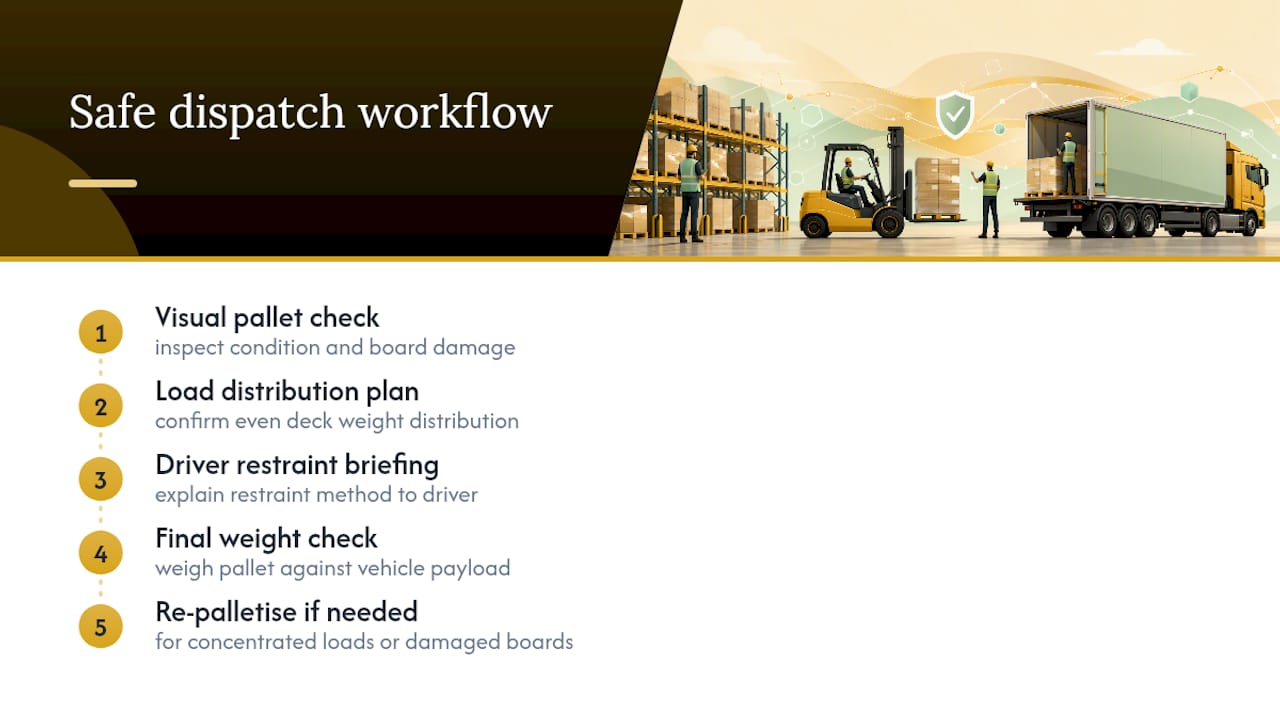
Before despatch, pallets get a visual condition check, a load plan confirming even distribution across the deck, a driver briefing on restraint method, and a final weight check against the vehicle's payload. Where a customer's packaging looks likely to concentrate weight onto a small footprint, or a pallet shows board damage, the sensible call is re-palletising before it ever reaches the vehicle, not hoping the numbers work out on the road.
Why accurate weight checks save more than they cost
Auditing pallet sources and standards properly, rather than trusting a supplier's word, cuts damage claims, reduces border rejections under ISPM15, and stops overloaded axles turning into fines or worse. Formal pallet management, treated as a standing process rather than a one-off check, pays for itself across a busy freight schedule.
— Ayomide
Get heavy pallet consignments moved safely and on time
Getting pallet weight checks right on paper is one thing. Having a fleet that can actually carry the result safely is another, and that's where Sddbyaba fits in against the alternative of juggling multiple hauliers for different vehicle sizes. Whether a consignment needs a single 7.5 tonne run or a full 26 tonne load, Sddbyaba runs the full range from small vans through to artic trucks, so heavy or awkward pallets get matched to the right vehicle rather than forced onto whatever's free.

Our pallet delivery service covers nationwide UK collection and delivery for construction materials, retail stock and commercial freight, backed by freight haulage capacity for larger or multi-pallet consignments. If you're planning a heavy or time-critical pallet run and want operational advice or a straightforward quote, get in touch with our team today.
Where to check the detail yourself
For the primary rules and figures covered here, see HSE's PM15 pallet safety guidance, GOV.UK's wood packaging material rules, and manufacturer or EPAL pages for pallet-specific ratings.
Sources
- Gov
- Pallet safety PM15 - HSE
- UK pallet sizes – what are they, and do they affect your packaging? - GWP
- UK pallet sizes explained | KC Supply