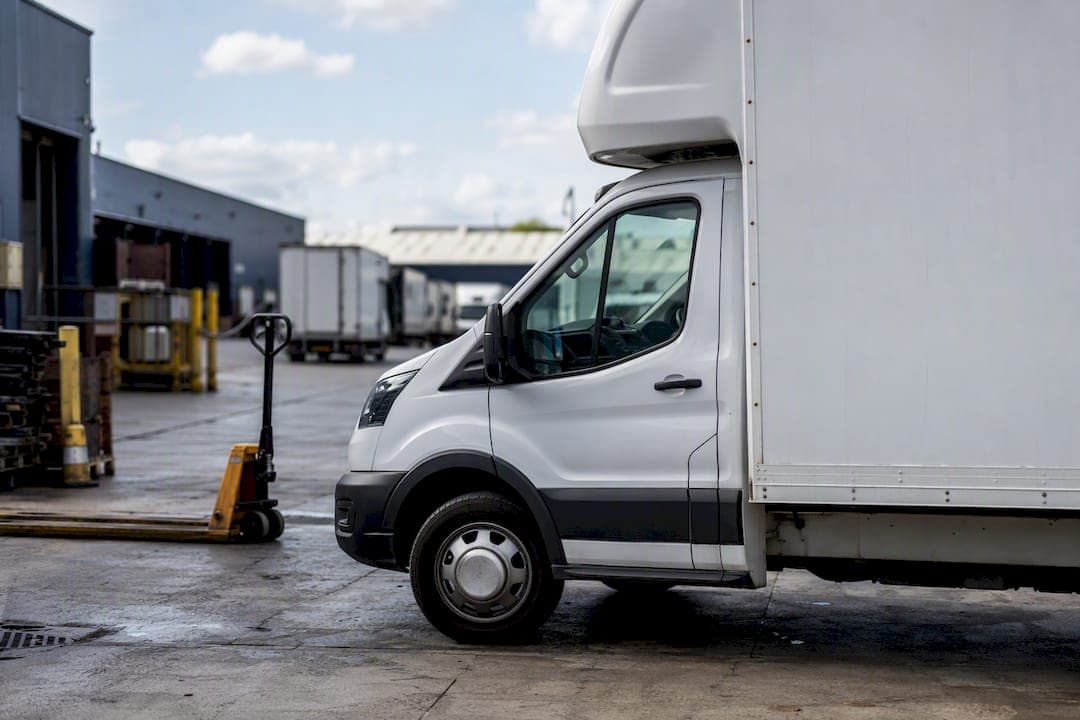
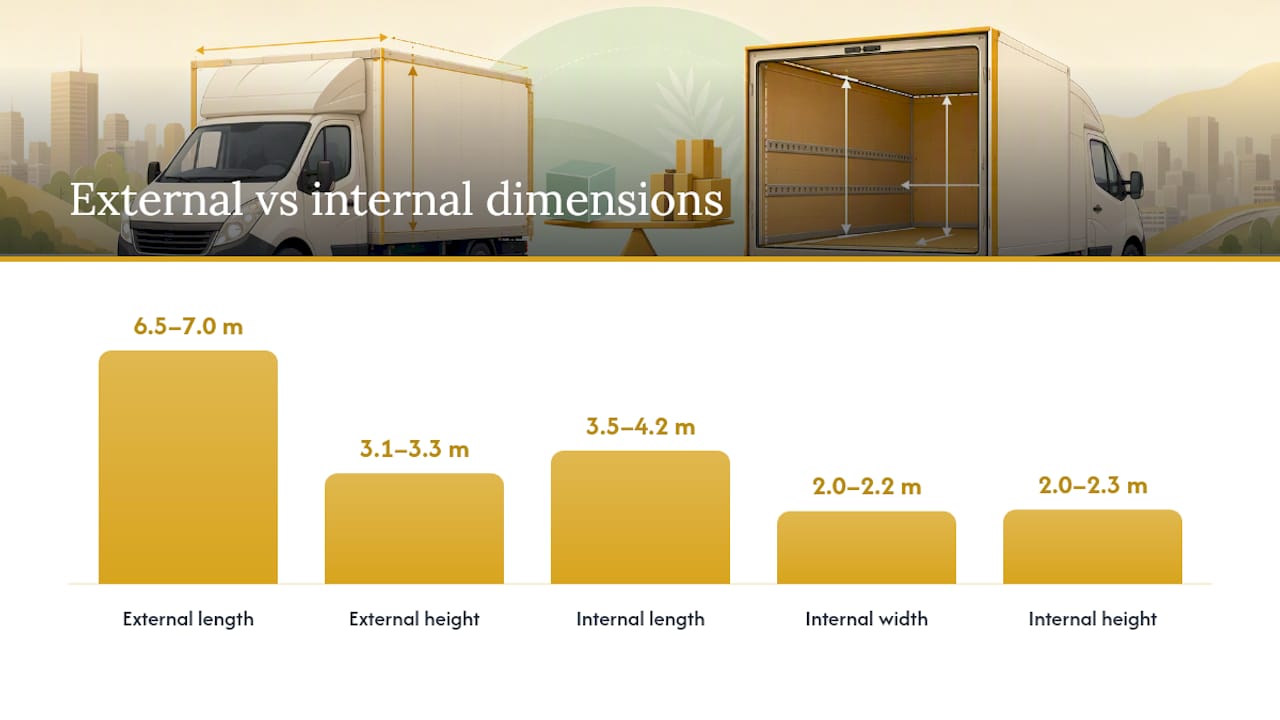
A standard 3.5 tonne Luton van in the UK measures roughly 6.5 to 7.0 metres long, 2.1 to 2.25 metres wide and 3.1 to 3.3 metres high on the outside. Inside the load box, expect around 3.5 to 4.2 metres of length, 2.0 to 2.2 metres of width and 2.0 to 2.3 metres of height, giving a load volume of about 18 to 20 m³. Payload varies by vehicle and fitted equipment, so the number stamped on the VIN plate is the one that actually matters, and a tail lift typically reduces it.
TL;DR:
- External height of most Lutons ranges from 3.1 to 3.3 meters, which can cause issues with low bridges, multi-story car parks, or warehouse canopies.
- Internal load length typically spans 3.5 to 4.2 meters, with width of 2.0 to 2.2 meters, and height around 2.0 to 2.3 meters, affecting maximum cargo volume.
- Payloads usually range from 800kg to 1,200kg, depending on vehicle weight and added equipment like tail lifts, which reduce usable capacity.
- Fitting a tail lift can decrease payload capacity by 150 to 200kg and alter rear clearance, requiring verification of current VIN plate payload figures.
- Accurate load planning requires confirming internal dimensions, payload limits, and the presence of a tail lift before booking to prevent load rejections or delays.
Table of Contents
- Luton van dimensions explained: external versus internal measurements
- What fits inside a Luton van: pallets, furniture and room counts
- Payload, GVW and licence rules for 3.5 tonne Lutons
- Tail lifts and fitments: what changes once you add equipment
- Choosing between a 3.5t Luton, long wheelbase and 7.5t options
- How SDD by ABA checks Luton van specs before quoting
- What planners get wrong about Luton van dimensions
- Book a Luton van with confirmed dimensions and payload
- Where to verify exact specs and legal limits
- Sources
Luton van dimensions explained: external versus internal measurements
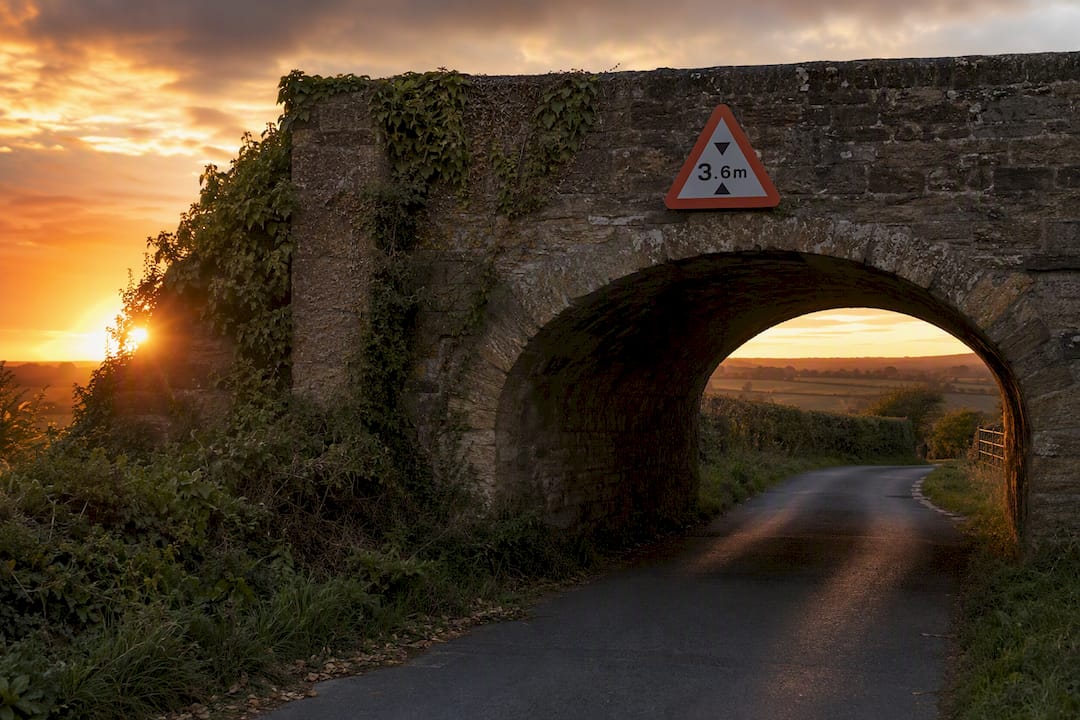
External dimensions decide whether a vehicle gets to the loading bay at all. Height matters most here, because a Luton van's over-cab box pushes total height to 3.1 to 3.3 metres, which is tall enough to catch out drivers unfamiliar with low bridges, multi-storey car parks or warehouse canopy clearances. Width and length affect parking bays, narrow yard access and whether the vehicle can turn into a residential close without a three-point manoeuvre.
Internal, or load, dimensions are what actually decide whether your goods fit. According to GOV.UK's guidance on vehicle weight limits, typical internal load lengths run from 3.5 to 4.2 metres, with internal widths of 2.0 to 2.2 metres and internal heights of 2.0 to 2.3 metres. Mercedes-Benz's Luton box van specifications show external lengths commonly between 6,000mm and 7,000mm, with internal load heights reaching 2.2 to 2.5 metres depending on the body conversion fitted by the coachbuilder.
One distinction trips up a lot of first-time hirers: the peak height inside the over-cab "Luton head" storage area is not the same as the usable internal height through the main box. Bulky but light items, such as duvets or flat-pack furniture, often go up into that peak space. Anything you need to walk around, stack, or strap down goes in the main box height, which is the 2.0 to 2.3 metre figure that governs practical loading.
A quick volume calculation shows why the numbers matter: multiply internal length by width by height, so 4.0m x 2.2m x 2.2m gives roughly 19.4 m³, matching the load volumes hire fleets typically publish for tail-lift Luton models.
- External length: 6.5 to 7.0m — affects parking, turning circles and yard access
- External height: 3.1 to 3.3m — the figure to check against bridges and barriers
- Internal length: 3.5 to 4.2m — the usable floor length for pallets and furniture
- Internal width: 2.0 to 2.2m — often the limiting factor for palletised loads
- Internal height: 2.0 to 2.3m — main box height, distinct from over-cab peak height
- Load volume: approximately 18 to 20 m³ across most 3.5 tonne conversions
If you need to convert your own item measurements into cubic metres before booking, a volume calculator makes quick work of the arithmetic, though it is worth using it purely for the cubic metre sum rather than any local pricing it displays.
What fits inside a Luton van: pallets, furniture and room counts
Internal width is the figure that decides your pallet strategy. A UK standard pallet footprint means two EUR pallets side by side need roughly 1.6 metres of clear width plus handling space, which is tight but workable against a typical 2.0 to 2.2 metre internal width. Get this wrong and you end up running pallets single file, doubling your floor-length requirement and possibly your trip count.
- Pallets: confirm internal width before assuming two pallets will run side by side; some narrower conversions force single-file loading.
- Furniture: a Luton van comfortably takes a three-seater sofa, a double mattress on its side, and two to three wardrobes in a single load, provided you pack tall items against the walls first.
- Packing sequence: load heaviest, flattest items first along the floor, then build upward, using the over-cab peak for soft, light goods rather than boxes.
- House moves: as a rough guide, a one-bedroom flat usually fits in a single Luton trip, a two-bedroom house typically needs one full load plus a top-up run, and a three-bedroom house often requires two trips or an upgrade to a larger vehicle.
- Awkward loads: dense items like books or tools fill payload capacity long before they fill floor space, so weight, not volume, becomes your real constraint.
Payload, GVW and licence rules for 3.5 tonne Lutons
Payload is a subtraction sum, not a fixed number: payload equals the gross vehicle weight (GVW) minus the vehicle's kerb weight. A Luton with a 3,500kg GVW and a 2,500kg kerb weight leaves 1,000kg of usable payload, but that figure shifts the moment you add a tail lift, extra racking, or a heavier conversion body.
Typical payload range: 800kg to 1,200kg for a standard 3.5 tonne Luton van, before accounting for fitted equipment.
- Category B car licences (held before the rule changes) cover most 3.5 tonne Luton models, making them accessible to the majority of UK drivers without extra qualifications.
- Heavier conversions or 7.5 tonne Lutons require a Category C1 or C licence, so always check the specific vehicle's plated weight before assuming you're covered to drive it.
- The GOV.UK guidance on vehicle weight limits sets out exactly how these weight categories and licence entitlements interact.
- Never rely on a generic payload figure quoted online; the VIN plate on the actual vehicle you're booking is the only reliable source.
Tail lifts and fitments: what changes once you add equipment
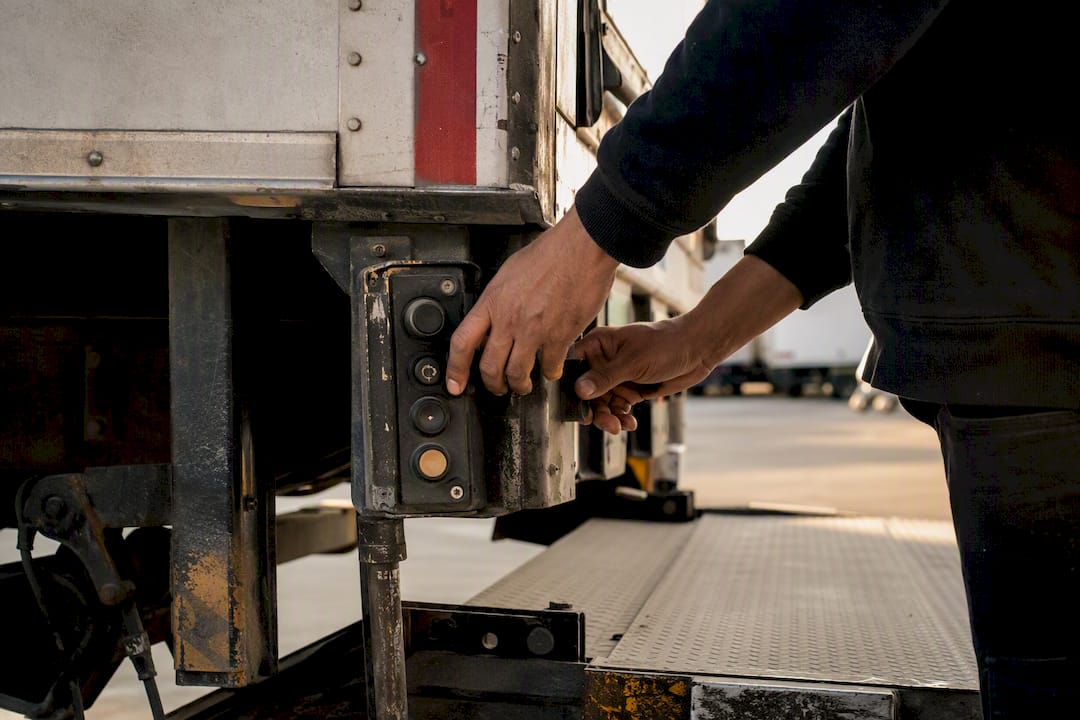
A tail lift solves the problem of loading heavy or awkward items without a ramp, but it comes at a cost to both payload and interior clearance. Common platforms measure around 1.6m by 0.85m, with some fleets offering wider options up to 2.1m for bulkier goods, according to Daily City's Luton van guide.
Fitting one typically reduces available payload by 150 to 200kg, because the lift mechanism adds kerb weight that comes straight off your GVW allowance. Door apertures and threshold height can also change slightly on tail-lift models, which matters if you're loading tall cabinets or appliances that need to clear the opening without tilting.
- Confirm the exact tail lift platform size, not just "tail lift fitted"
- Check the door aperture width and height against your largest item
- Ask for the current VIN plate payload figure, not a brochure estimate
- Note whether the platform folds outward or under, as this affects rear clearance when parked
Pro Tip: Always ask for the payload figure after the tail lift is fitted, not the base vehicle's plated weight. The difference between the two numbers is exactly what a heavy tail lift will cost you in usable capacity.
Choosing between a 3.5t Luton, long wheelbase and 7.5t options
A short-wheelbase 3.5 tonne Luton handles the majority of urban moves and one-to-two room clearances comfortably, and its Category B accessibility keeps hiring straightforward. Once your load edges toward palletised freight, a full house move, or anything pushing past the 1,200kg payload ceiling, it's worth stepping up to a long wheelbase van or a 7.5 tonne vehicle with a higher GVW allowance.
- Estimate total load weight, not just volume, since dense goods hit the payload limit long before the box fills up.
- Count your pallets, if applicable, and check whether they need side-by-side or single-file loading.
- Decide if a tail lift is essential, then factor its payload cost into your total weight budget.
- Confirm permitted GVW against your licence category, particularly if quoted a heavier Luton conversion.
- Check site access, including height barriers, yard width and turning space, before the vehicle arrives.
How SDD by ABA checks Luton van specs before quoting
Every quote starts with the numbers that actually matter: exact internal dimensions, the current payload figure from the vehicle plate, and whether a tail lift is fitted or available. Running a fleet that spans Luton vans through to 26 tonne trucks means we can offer a direct alternative the moment a Luton's payload or volume falls short of the job. For tight, same-day turnarounds, having those dimensions confirmed upfront is what keeps dispatch fast rather than delayed by a rejected load at the collection point.
What planners get wrong about Luton van dimensions
The mistake I see most often is planners quoting the external length when briefing a courier, when it's the internal length that decides whether goods fit. A close second is forgetting that a tail lift quietly removes 150 to 200kg of payload, and a third is never checking the door aperture against an oversized wardrobe or appliance. Fix these three checks before booking and you avoid the most common cause of a rejected or re-planned load.
— Ayomide
Book a Luton van with confirmed dimensions and payload
Quoting a job on assumed dimensions is how loads get rejected on the day. SDD by ABA runs Luton vans as part of a fleet that scales all the way to 26 tonne trucks, including tail-lift capable Lutons for heavier or awkward consignments, and every quote is checked against the actual internal dimensions and payload plate before we confirm a booking.

If your load looks close to a Luton's limits, or you're planning a move with pallets, bulky furniture or a tight turnaround, get the specifics confirmed rather than guessing from a brochure figure. Visit our Luton van courier service page to check availability and request a quote, or head to Sddbyaba for the full range of vehicles if your load needs more than a 3.5 tonne Luton can carry.
Where to verify exact specs and legal limits
For legal weight limits and licence categories, use GOV.UK's vehicle weight guidance. For manufacturer body specs, check Mercedes-Benz's Luton range or the hire firm's own published sheet.