Urgent freight movement is a time-critical transport service that moves a shipment on a dedicated, priority route to meet a fixed delivery window. Unlike standard freight, which consolidates loads to reduce cost, expedited freight prioritises speed, direct routing and dedicated capacity above all else. The main service options available in the UK are:
- Same-day dedicated ground — motorbike couriers, small vans, sprinters, straight trucks
- Hot shot and dedicated truckload — 7.5t through to 26t vehicles and artic trailers for larger or heavier consignments
- Overnight and next-day ground — team-driver services covering national routes within 24 hours
- Next-flight-out (NFO) and air charter — for international or coast-to-coast moves where ground transit cannot meet the deadline
Typical use cases include production-stop parts, emergency equipment repairs, medical supplies, legal documents and trade-show freight where a missed window carries a measurable business cost.
Key takeaways
Matching the right vehicle to the deadline and preparing complete documentation at booking are the two factors that determine whether an urgent freight move succeeds or fails.
| Point | Details |
|---|---|
| Match mode to urgency | Hours available: same-day ground or hot shot. National critical: dedicated truck or NFO air. |
| Prepare documentation first | Missing paperwork — ADR declarations, customs docs, consignment notes — causes more delays than traffic. |
| Declare full value | Insurance cover is capped at the declared value; under-declaring leaves you exposed on high-value loads. |
| Verify provider capability | Confirm live tracking, photo POD, guaranteed pickup window and escalation contact before booking. |
| Sddbyaba for UK urgent freight | Sddbyaba covers motorbike to 26t artic nationwide, with 24/7 dispatch, live tracking and specialist handling. |
Table of Contents
- How urgent freight movement works across different vehicle types
- The step-by-step process from booking to proof of delivery
- What timelines and costs to expect for urgent UK freight
- Documents and UK compliance checks before an urgent move
- How to handle hazardous, medical, live and high-value urgent freight
- Packaging, loading and security best practices for time-critical consignments
- How to choose a reliable urgent freight provider
- A practitioner's perspective on what actually goes wrong
- Sddbyaba's urgent freight services across the UK
- Sources
How urgent freight movement works across different vehicle types
The right mode depends on three variables: the size of the load, the delivery deadline and the distance. Expedited shipments travel point-to-point with dedicated capacity, which eliminates the handling points that cause delays in hub-and-spoke networks.
Hot shot trucking and sprinter vans can often launch within hours when a shipment cannot wait for scheduled network departures, making them the default choice for regional same-day moves up to a few pallets.
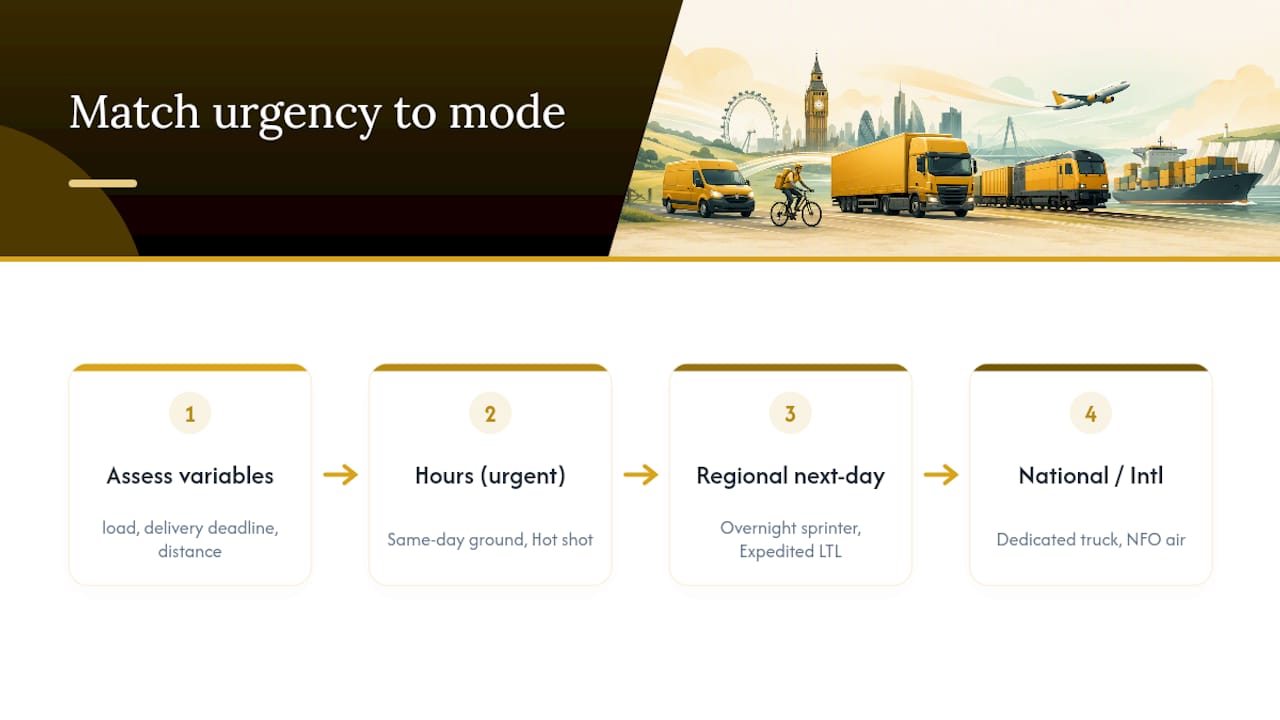
Pro Tip: Match urgency to mode before you call a provider. Hours available → same-day ground or hot shot. Regional next-day → overnight sprinter or expedited LTL. National critical or international → dedicated truck with team drivers or NFO air.
The step-by-step process from booking to proof of delivery
A well-run expedited workflow follows a consistent sequence regardless of vehicle type.
- Request and quote — provide pickup and delivery postcodes, dimensions, weight, deadline and any special handling requirements. A 24/7 dispatch team assesses feasibility and confirms a price.
- Assessment — the provider checks vehicle compatibility, access restrictions, appointment windows and required documentation (ADR, permits, customs).
- Resource assignment — a dedicated vehicle and driver (or team drivers for overnight) are allocated. For air, a seat or charter slot is booked.
- Dispatch and pickup — the driver proceeds directly to the collection point. No consolidation, no depot stops.
- Continuous monitoring — GPS tracking and push notifications keep both shipper and recipient updated. Exceptions (traffic, access issues) are flagged and rerouted in real time.
- Delivery and proof of delivery — signed POD, photo POD or electronic confirmation is captured and shared immediately.
Before pickup, prepare the following:
- Accurate dimensions and gross weight
- Pickup and delivery addresses with access instructions and contact numbers
- All required paperwork (consignment note, dangerous goods declaration if applicable, customs documents for cross-border moves)
- Goods packaged, labelled and ready at the agreed time
- Named contact available to sign at both ends
What timelines and costs to expect for urgent UK freight
Same-day ground moves within a single region typically complete within hours. National overnight services using team drivers cover most UK city pairs within a day. Dedicated capacity and direct routing reduce handling points compared with standard consolidated freight, which is why the transit reliability is higher even when the clock is tight. International air freight, customs permitting, typically arrives within 1–3 business days.
Key cost drivers:
- Distance and fuel
- Urgency of the guaranteed window (same-hour vs next-day)
- Vehicle type and payload
- Specialist handling: tail-lift, temperature control, ADR
- Waiting time and detention at collection or delivery
- Out-of-hours, weekend and bank holiday surcharges
- Accessorials: inside delivery, liftgate, residential surcharge
Expedited freight carries a material premium over standard freight because of dedicated capacity, direct routing and after-hours service. The practical test is straightforward: if the cost of delay (lost production, missed contract, spoiled goods) exceeds the freight premium, the urgent service pays for itself. Businesses use expedited services precisely when downtime costs outweigh the transport premium, and that calculation becomes clearest when a production line is stopped or a medical delivery is time-bound.
Documents and UK compliance checks before an urgent move
Paperwork delays are one of the most avoidable causes of urgent freight failure. Use this checklist before every time-critical consignment:
- Consignment note / CMR — required for all road freight; confirms parties, goods description and terms
- Commercial invoice and packing list — mandatory for any cross-border move out of or into the UK post-Brexit
- Dangerous goods declaration (ADR) — required if the load contains hazardous materials classified under ADR regulations
- Customs documentation — UK import/export declarations via HMRC's Customs Declaration Service for international moves
- Operator licence (O licence) — confirm your provider holds the appropriate O licence for the vehicle weight category
- Oversize / abnormal load permits — required from the relevant highways authority for loads exceeding standard width, height or weight limits
- Animal welfare certificate — required for live animal transport under UK animal welfare legislation
Pro Tip: For cross-border urgent moves, confirm in writing whether the provider handles customs clearance or whether you must supply a customs agent. Assuming the other party will manage it is the single most common cause of border delays.
Refer to the emergency freight documentation checklist for a printable pre-move reference.
How to handle hazardous, medical, live and high-value urgent freight
Specialist cargo requires verified capability, not just a willing driver. Before booking, confirm the provider holds the relevant certifications and procedures:
- ADR certification — drivers and vehicles must be certified for the specific hazard class being transported
- Temperature-controlled transport — cold-chain vehicles with calibrated temperature logging for medical, pharmaceutical or perishable goods
- Live animal handling — species-appropriate vehicles, welfare checks and the correct documentation under UK law
- Secure transport for valuables — GPS-tracked vehicles, sealed consignments, driver vetting and, where warranted, guarded transit
- Specialist lashing and lifting — rated straps, dunnage bags and tail-lifts for oversize or fragile industrial equipment
For time-critical medical shipments, temperature logs must be continuous and chain-of-custody documentation must accompany the goods at every handover point. Double-packaging and tamper-evident seals are standard practice for pharmaceutical and high-value loads.
Pro Tip: Declare the full value of the consignment at booking, not an estimate. Declared value determines the insurance ceiling; an under-declared shipment leaves you exposed if the goods are damaged or lost in transit.
See the emergency parcel handling guide for fragile and high-value consignment specifics.
Packaging, loading and security best practices for time-critical consignments
Speed at pickup depends on preparation before the driver arrives. Poorly packaged or unlabelled freight causes delays that no amount of fast driving can recover.
- Palletise wherever possible; shrink-wrap and strap to the pallet base
- Label every piece clearly: consignee name, full delivery address, contact number and any handling instructions (fragile, this way up, temperature range)
- Pre-stage goods at the loading point before the driver's ETA, not after
- Confirm vehicle compatibility in advance: dock height, tail-lift requirement, internal dimensions for oversized pieces
- Check driver ID against the booking confirmation before handing over goods
- Request photo POD at collection as well as delivery for high-value or disputed consignments
- For high-value loads, request sealed consignment procedures and ask whether the vehicle carries onboard CCTV
Avoid common time-critical delivery pitfalls by running a five-minute pre-pickup check against this list every time.
How to choose a reliable urgent freight provider
The questions you ask before booking reveal more about a provider's capability than any marketing claim.
Ask directly:
- What is your guaranteed pickup window from order confirmation?
- What tracking system do you use, and how frequently does it update?
- What POD formats do you offer — signed, photo, electronic?
- What is your declared value limit, and what insurance applies above it?
- How are drivers vetted, and do you hold ADR or medical transport certifications?
- Who is the escalation contact if something goes wrong at 2 AM?
Trust signals to look for:
- Live GPS tracking with push notifications and ETA updates
- Signed and photo POD as standard
- Declared value cover with clear limits stated upfront
- A diverse fleet covering the full weight range you might need
- Guaranteed response and pickup times, not "as soon as possible"
- Specialist handling certifications relevant to your cargo type
Red flags:
- Vague availability ("we'll try our best")
- No continuous tracking or tracking only at collection and delivery
- Unwillingness to confirm vehicle type or driver details before dispatch
- Insurance terms that are unclear or require you to chase for a certificate
- No named escalation contact or out-of-hours support
A well-briefed provider will confirm vehicle type, driver name, live tracking link and estimated pickup time within minutes of your booking. If those four things are not confirmed before the driver leaves the depot, the move is already at risk.
The emergency courier reliability factors guide covers the full set of trust signals worth checking before you commit to a provider.
A practitioner's perspective on what actually goes wrong
The most common cause of urgent freight failure is not traffic or vehicle breakdown. It is incomplete information at the point of booking. A missing contact number at the delivery address, an unlabelled pallet, or an access restriction that was not communicated can each add hours to a move that was planned in minutes.
A few practical fixes worth building into your process:
- Confirm access windows and any site restrictions before the driver departs, not on arrival
- Pre-agree a contingency driver or secondary vehicle for high-stakes moves
- Use photo POD at collection as well as delivery so any pre-existing damage is documented
- For overnight or multi-leg moves, check in at each handover point rather than waiting for the final delivery notification
Providers who stage resources in advance and maintain reserve capacity for last-minute bookings are materially more reliable than those who source vehicles reactively. When evaluating Sddbyaba or any provider, ask specifically how they handle a same-day booking received at short notice on a Friday afternoon.
Sddbyaba's urgent freight services across the UK
When time is the constraint, the provider's fleet range and dispatch speed determine whether the move is possible at all.
Sddbyaba operates a nationwide fleet from motorcycle couriers through to 26 tonne trucks and artic vehicles, covering same-day dispatch, dedicated vehicle transport, pallet delivery and specialist handling for medical, hazardous and high-value consignments. Live GPS tracking, photo POD, declared value cover and 24/7 dispatch are standard across all bookings. Whether the consignment is a single urgent parcel or a full truckload of construction materials, Sddbyaba's commercial logistics team can confirm vehicle type, driver details and a tracked ETA from the moment of booking. Get a quote or book a same-day move at Sddbyaba.
Sources
The following sources informed this guide's definitions, process steps, mode comparisons and monitoring practices:
- What Is Expedited Freight and How Does It Work for Manufacturers | Load One Transportation
- Expedited Freight Shipping: What It Is & How It Works
- Urgent Freight Services | Fast Shipping When Time Matters
- What Businesses Should Know About Expedited Services